Species · Reptiles
Angel Island Chuckwalla Sauromalus hispidus
The scientific name of the Angel Island Chuckwalla is Sauromalus hispidus. It is a species of reptile in the family Iguanidae (iguanas), order Squamata. The name dates from 1891.
- Scientific name
- Sauromalus hispidus Stejneger, 1891
- Common name
- Angel Island Chuckwalla
- Genus
- Sauromalus
- Family
- Iguanidae (Iguanas)
- Order
- Squamata
- Class
- Reptilia
- Red List category
- EN Endangered
- Recorded in
- 1 country
- Name status
- accepted in the Catalogue of Life

Overview
The Angel Island chuckwalla (Sauromalus hispidus), also known as the spiny chuckwalla, is a species of chuckwalla lizard belonging to the family Iguanidae endemic to Isla Ángel de la Guarda (Guardian Angel Island) in the Gulf of California. The species was transported to other islands by a tribe of the Seri as a potential food source.
Classification of the Angel Island Chuckwalla
| Kingdom | Animalia |
|---|---|
| Phylum | Chordata |
| Subphylum | Vertebrata |
| Infraphylum | Gnathostomata |
| Parvphylum | Osteichthyes |
| Megaclass | Tetrapoda |
| Class | Reptilia (Reptile) |
| Order | Squamata (Snakes) |
| Suborder | Iguania (Iguanas) |
| Family | Iguanidae (Iguanas) |
| Genus | Sauromalus (Chuckwalla) |
| Species | Sauromalus hispidus Stejneger, 1891 |
Where the Angel Island Chuckwalla is found
Checklists and occurrence records place Sauromalus hispidus in 1 country across North America. GBIF holds 398 georeferenced records of it.
Countries
Regions and cities with the most records
Range as the checklists state it
Mexico (Angel de la Guarda, Smith, Pond, Granite, Mejia, San Lorenzo Norte, San Lorenzo Sur [Gulf of California, Baja California], Sonora)
A number beside a place is its count of GBIF occurrence records. A place without a number comes from a checklist alone. Records show where a species has been observed or collected, which can include escapes and vagrants.
Common names
English
- Angel Island Chuckwalla
- Black Chuckwalla
- Spiny Chuckwalla
Names in 4 other languages
- Arabic
- تشاكوالا سوداء
- German
- Stachel-Chuckwalla, Stacheliger Riesenchuckwalla
- Japanese
- トゲチャクワラ
- Spanish
- Chacahuala de la isla Angel de la Guarda, Chuckwalla espinosa, Iguana Espinosa de Pared
Related species
-
 Common ChuckwallaSauromalus ater
- San Esteban ChuckwallaSauromalus varius
-
 Slevin's ChuckwallaSauromalus slevini
-
 Spotted ChuckwallaSauromalus klauberi
-
 Green IguanaIguana iguana
-
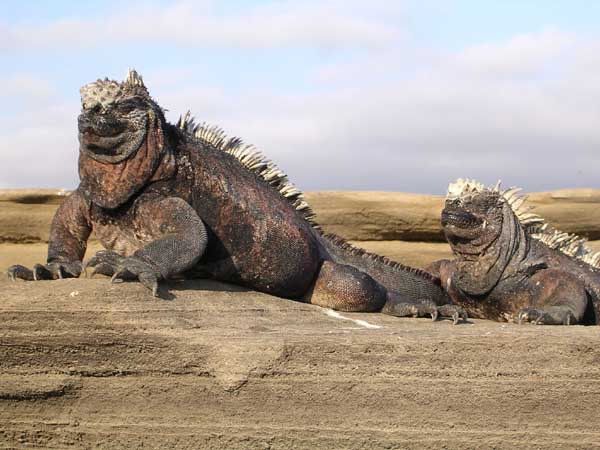 Marine IguanaAmblyrhynchus cristatus
-
 Black Spiny-tailed IguanaCtenosaura similis
-
 Blue IguanaCyclura lewisi
Compare
Questions and answers
What is the scientific name of the Angel Island Chuckwalla?
The scientific name of the Angel Island Chuckwalla is Sauromalus hispidus. Written with its author, the full name is Sauromalus hispidus Stejneger, 1891.
Which family does the Angel Island Chuckwalla belong to?
Sauromalus hispidus belongs to the family Iguanidae, in the order Squamata and the class Reptilia.
Where is the Angel Island Chuckwalla found?
Checklists and occurrence records place Sauromalus hispidus in 1 country: Mexico.
What is the conservation status of the Angel Island Chuckwalla?
The IUCN Red List category recorded for Sauromalus hispidus is Endangered (EN).
What other names does the Angel Island Chuckwalla have?
Sauromalus hispidus is also known in English as Black Chuckwalla and Spiny Chuckwalla.
Sources
Data
- Catalogue of Life, 2026-10-16 XR cc by
- Global Biodiversity Information Facility CC BY 4.0
- Wikidata CC0
- English Wikipedia CC BY-SA 4.0
- GeoNames CC BY 4.0
- Wikimedia Commons per image; credit shown with each image
- Within the Catalogue of Life, this name comes from The Reptile Database cc by
References
- (1891). Proceedings of the United States National Museum, xiv. https://doi.org/10.5479/si.00963801.864.409 Link where the name was published
- Stejneger, L. (1891). Description of a new North American lizard of the genus Sauromalus. Proc. US Natl. Mus. 14: 409-411.
- Van Denburgh, & John. (1922). The Reptiles of Western North America. Volume I. Lizards. Occ. Pap. Cal. Acad. Sci. (10): 1–612.
- Avery, D. F., & Tanner, W. W. (1971). Evolution of the iguanine lizards (Sauria, Iguanidae) as determined by osteological and myological characters. Brigham Young University Science Bulletin 12 (3): 1-79.
- Carl, G. & J.P. Jones. (1979). The Eggs and Hatchlings of Sauromalus hispidus (Reptilia, Lacertilia, Iguanidae). Journal of Herpetology 13 (3): 293-296.
- Etheridge, R. (1982). Checklist of the Iguanine and Malagasy Iguanid Lizards. In: Burghardt,G.M. & Rand, A.S., eds., Iguanas of the World. Noyes Publications, Park Ridge, NJ, Pp. 7-37.
- Smits, A. W. (1985). Behavioral and Dietary Responses to Aridity in the Chuckwalla, Sauromalus hispidus. Journal of Herpetology 19 (4): 441-449.
- Smits, A.W., J. Ward & H. Lillywhite. (1986). Effects of Hyperkalemia on Thermoregulatory and Feeding Behaviors of the Lizard, Sauromalus hispidus. Copeia 1986 (2): 518-520.
- Zimmerman, Linda C.; andC. Richard Tracy. (1989). Interactions between the Environment and Ectothermy and Herbivory in Reptiles. Physiological Zoology, 62(2): 374–409.
- Blair, David W. (1994). Chuckwallas. Reptiles 1 (3): 16-22.
- Grismer L L. Beaman K R. Lawler H E. (1995). Sauromalus hispidus. Catalogue of American Amphibians and Reptiles (615):1-4.
- de Queiroz K. (1995). Checklist and key to the extant species of Mexican iguanas (Reptilia: Iguaninae). Publ. Esp. Mus. Zool. Univ. Nac. Autón. México 9: 1-48.
- Beaman,K.R.; Hollingsworth,B.D.; Lawler, H.E. & Lowe,C.H. (1997). Bibliography of Sauromalus (Duméril 1856), the Chuckwallas. Smithsonian Herp. Inf. Serv. (116): 1-44.
- Hollingsworth, B. D. (1998). The systematics of Chuckwallas (Sauromalus) with a phylogenetic analysis of other iguanid lizards. Herpetological Monographs 12: 38-191.
- Werning, H. (2002). DER STACHELIGE RIESENCHUCKWALLA SAUROMALUS hISPIDUS STEJNEGER 1877: BIOLOGIE, FReilandbeobachtungen und europäische Erstnachzucht. Salamandra 38 (1): 27-44.
- Zorn, H. (2004). Die Wüste im eigenen Haus. Reptilia (Münster) 9 (48): 41-44.
- Alberts, A.C.; Carter, R.L.; Hayes, W.K. & Martins, E.P. (eds.). (2004). Iguanas - Biology and Conservation. University of California Press, 356 Pp.
- Wölfel, H. (2006). Chuckwallas - The genus Sauromalus with notes on keeping and breeding Sauromalus ater. Reptilia (GB) (48): 35-42.
- Enderson, Erik F.; Adrian Quijada-Mascareñas; Dale S. Turner; Philip C. Rosen & Robert L. Bezy. (2009). The herpetofauna of Sonora, Mexico, with comparisons to adjoining states. Check List 5 (3): 632–672.
- Jones, L. L., & Lovich, R. E. (2009). Lizards of the American Southwest. A photographic field guide. Rio Nuevo Publishers, Tucson, AZ, 568 Pp. [Review in Reptilia 86: 84].
- Goldberg, S.R., and K.R. Beaman. (2012). Reproduction of the Spiny Chuckwalla (Sauromalus hispidus) and the Piebald Chuckwalla (Sauromalus varius) (Squamata: Iguanidae) from Mexico. Sonoran Herpetologist 25 (5):40-42.
- Köhler, G., & Zorn, H. (2014). Chuckwallas. Herpeton-Verlag, 120 Pp. [Review in Reptilia 23 (132): 62].
- Buckley, Larry J.; Kevin de Queiroz, Tandora D. Grant, Bradford D. Hollingsworth, John B. Iverson (Chair, Stesha A. Pasachnik, and Catherine L. Stephen (Iguana Taxonomy Working Group, ITWG. (2016). A Checklist of the Iguanas of the World (Iguanidae; Iguaninae). Herp. Cons. Biol. 11 (Monograph 6).
- Reynoso, Victor Hugo, Monteverde, María José, Martínez-González, Carmina, Zarza, Eugenia and Cerdá-Ardura, & Adrián. (2017). Geographic Distribution: Sauromalus hispidus (Spiny Chuckwalla). Herpetological Review 48 (1): 126.
- Lemos-Espinal JA, Smith GR, & Rorabaugh JC. (2019). A conservation checklist of the amphibians and reptiles of Sonora, Mexico, with updated species lists. ZooKeys 829: 131-160.
This species in other databases
Page built on 25 November 2026. See how the catalog is made and all sources and licences.
Cite this page
ScientificNames.org. (2026). Sauromalus hispidus (Angel Island Chuckwalla). Retrieved November 25, 2026, from https://scientificnames.org/species/sauromalus-hispidus
“Sauromalus hispidus (Angel Island Chuckwalla).” ScientificNames.org, 2026, scientificnames.org/species/sauromalus-hispidus. Accessed 25 Nov. 2026.
ScientificNames.org. “Sauromalus hispidus (Angel Island Chuckwalla).” Accessed November 25, 2026. https://scientificnames.org/species/sauromalus-hispidus.
@misc{scientificnames_sauromalus_hispidus_angel_island_chuckwalla,
  author = {{ScientificNames.org}},
  title = {Sauromalus hispidus (Angel Island Chuckwalla)},
  year = {2026},
  url = {https://scientificnames.org/species/sauromalus-hispidus},
  note = {Accessed 2026-11-25}
}