Species · Fishes
Molly Miller Scartella cristata
The scientific name of the Molly Miller is Scartella cristata. It is a species of fish in the family Blenniidae (blennies), order Blenniiformes. The name dates from 1758.
- Scientific name
- Scartella cristata (Linnaeus, 1758)
- Common name
- Molly Miller
- Genus
- Scartella
- Family
- Blenniidae (Blennies)
- Order
- Blenniiformes
- Class
- Teleostei
- Red List category
- LC Least Concern
- Environment
- marine
- Recorded in
- 29 countries
- Name status
- accepted in the Catalogue of Life
Overview
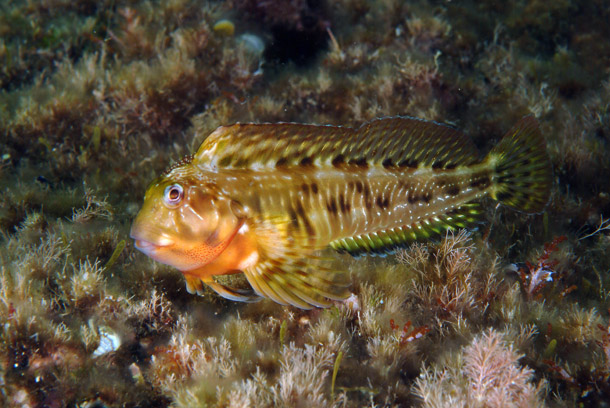
Scartella cristata lives in marine tropical environments, among rocks, coral reefs, tidepools, and shallow rocky areas. It is distinguished by short hair-like appendages on its head, very large eyes, and cirri on its nape.
Written 26 November 2026 from the sources listed below. Each statement was checked against the passage it cites; statements that could not be supported were removed.
Appearance
The molly miller has an elongated body, a relatively high head, and a steep snout profile. Its body and fins have mottled tan, white, and black coloration.[1][2]
The head bears short hair-like appendages and two very large eyes. Cirri occur over the front nostril and eye and along both sides of the nape, with the nape cirri being red and white. The species lacks a fleshy crest on its head.[3][4][5][6]
Each jaw has numerous movable teeth, and the rear of the lower jaw has a stout canine. The dorsal fin has twelve spines and fourteen to fifteen rays.[7][8]
Coloration ranges from dull green to olive and can become quite dark. The head has a dark blotch behind the eye and two dark bars beneath the eye, while dark brown double-bars on the body extend onto the dorsal fin.[9][10][11]
Some individuals have pearly spots along the upper back and upper head, reddish upper portions of their body bars, and a dark brown midline stripe. A dark spot occurs at the front of the dorsal fin.[12][13][14]
Individuals on Sargassum rafts can be entirely yellow. The species reaches a maximum total length of 12 cm.[15][16]
Habitat
The molly miller inhabits marine tropical environments and lives among rocks or coral reefs at depths of zero to ten metres. It also inhabits tidepools and shallow rocky areas.[17][18][19]
The species is often found in empty barnacles and occasionally occurs on Sargassum rafts.[20][21]
The species occurs in the Atlantic Ocean and Mediterranean Sea. Its western Atlantic range extends from Bermuda, Florida, and the northern Gulf of Mexico to Brazil, while its eastern Atlantic range extends from Mauritania and the Canary Islands to Namibia.[22][23][24]
It occurs in the southern Mediterranean, including areas near Milan, Sicily, and the Peloponnese. It is recorded from Florida to northern Brazil and is classified as a non-endemic transatlantic fish of the Greater Caribbean.[25][26][27]
Diet
The molly miller has an omnivorous diet that includes small crustaceans and algae. Recorded food categories include benthic microalgae and macroalgae or seagrasses.[28][29]
Juveniles feed on invertebrates, while adults shift to eating algae.[30]
Reproduction and life cycle
The molly miller is oviparous. Its eggs are demersal and adhesive.[31][32]
Similar species
Western Pacific records attributed to the molly miller are considered doubtful and may represent Scartella emarginata.[33]
Classification of the Molly Miller
| Kingdom | Animalia |
|---|---|
| Phylum | Chordata |
| Subphylum | Vertebrata |
| Infraphylum | Gnathostomata |
| Parvphylum | Osteichthyes |
| Gigaclass | Actinopterygii |
| Superclass | Actinopteri |
| Class | Teleostei (Teleost) |
| Order | Blenniiformes |
| Family | Blenniidae (Blennies) |
| Subfamily | Salariinae |
| Genus | Scartella |
| Species | Scartella cristata (Linnaeus, 1758) |
Where the Molly Miller is found
Checklists and occurrence records place Scartella cristata in 29 countries. GBIF holds 4,547 georeferenced records of it.
Countries
- Bahamas 43
- Barbados 13
- Belize 3
- Bermuda 58
- Bonaire, Saint Eustatius and Saba 8
- Brazil 862
- Cayman Islands 4
- Colombia 22
- Cuba 36
- Curacao 9
- Dominica 4
- France 39
- Greece 44
- Guadeloupe 5
- Honduras 8
- Italy 52
- Jamaica 6
- Malta 21
- Martinique 6
- Mexico 123
- Monaco 4
- Panama 18
- Puerto Rico 33
- Saint Barthelemy 7
- Spain 365
- Trinidad and Tobago 59
- U.S. Virgin Islands 19
- United States 2,669
- Venezuela 7
Regions and cities with the most records
- Texas, United States 369
- Canary Islands, Spain 148
- Florida, United States 148
- Galveston, United States 110
- Texas City, United States 110
- Jupiter, United States 107
- Palm Beach Gardens, United States 107
- Riviera Beach, United States 100
- Pernambuco, Brazil 91
- Ubatuba, Brazil 75
- Palm Springs, United States 65
- West Palm Beach, United States 64
- Lake Worth Beach, United States 63
- Tacoronte, Spain 60
- Vila Velha, Brazil 59
- Greenacres City, United States 58
- Lake Worth Corridor, United States 58
- Puerto del Carmen, Spain 58
- Yaiza, Spain 58
- La Laguna, Spain 56
- Tías, Spain 56
- Santa Cruz de Tenerife, Spain 55
- Teguise, Spain 54
- Arrecife, Spain 53
- San Bartolomé, Spain 53
- Boca Raton, United States 45
- Boca Del Mar, United States 44
- Deerfield Beach, United States 44
- Pompano Beach, United States 44
- Sandalfoot Cove, United States 44
- Parkland, United States 43
- Coconut Creek, United States 42
- Bombinhas, Brazil 41
- Hamilton, Bermuda 40
- Serra, Brazil 40
- Margate, United States 39
18 more countries have a few records outside this range
These countries hold a few records of Scartella cristata but lie outside the range the checklists give for it. Such records are often zoo or garden specimens, museum material or vagrants, so the species is not counted as occurring there.
A number beside a place is its count of GBIF occurrence records. A place without a number comes from a checklist alone. Records show where a species has been observed or collected, which can include escapes and vagrants.
Common names
English
- Molly Miller
Names in 14 other languages
- Albanian
- barburiqi me kreshtë
- Czech
- slizoun hřebínkatý
- Danish
- Hanekam-slimfisk
- Dutch
- Hanenkamslijmvis
- Finnish
- molliluikero
- French
- Blennie Chevelue
- German
- Hahnenkamm-Schleimfisch
- Greek
- Κρυπτοσαλιάρα
- Hebrew
- קרנון מצויץ
- Italian
- Bavosa crestata
- Portuguese
- Blênio-comum, Marachomba-verde
- Russian
- Гребенчатая скартелла
- Spanish
- Blenio Peine, Blénido Crestado, Chivato, blenio peineta, borracho peineta
- Turkish
- Saçlı Horozbina, horozbina
Synonyms
9 other scientific names have been used for this species and are now treated as synonyms of Scartella cristata.
- Adonis cristatus (Linnaeus, 1758)
- Blennius arboreus Bath, 1966
- Blennius asterias Goode & Bean, 1882
- Blennius crinitus Valenciennes, 1836
- Blennius cristatus Linnaeus, 1758
- Blennius microstomus Poey, 1860
- Blennius pinaru Lacepède, 1800
- Scartella cristatus (Linnaeus, 1758)
- Scartella microstoma (Poey, 1860)
Related species
-
Maned BlennyScartella emarginata
- Springer's BlennyScartella springeri
- Island BlennyScartella poiti
- Itajobi BlennyScartella itajobi
- Filamentous RockskipperScartella nuchifilis
- Cape Verde BlennyScartella caboverdiana
-
 False CleanerfishAspidontus taeniatus
-
 Bluestriped FangblennyPlagiotremus rhinorhynchos
Compare
Questions and answers
What is the scientific name of the Molly Miller?
The scientific name of the Molly Miller is Scartella cristata. Written with its author, the full name is Scartella cristata (Linnaeus, 1758).
Which family does the Molly Miller belong to?
Scartella cristata belongs to the family Blenniidae, in the order Blenniiformes and the class Teleostei.
Where is the Molly Miller found?
Checklists and occurrence records place Scartella cristata in 29 countries, including United States, Brazil, Spain, Mexico, Trinidad and Tobago and Bermuda.
What is the conservation status of the Molly Miller?
The IUCN Red List category recorded for Scartella cristata is Least Concern (LC).
Sources
Passages the profile rests on
- The body and fins have a mottled tan, white, and black coloration. Source passage: “Its colour is a mottled tan, white, and black covering the body and fins.” — English Wikipedia
- The body is elongated and the head is relatively high, with a steep snout profile. Source passage: “Body elongate; head relatively high, with steep snout profile;” — biogeodb.stri.si.edu
- The head bears short hair-like appendages and two very large eyes. Source passage: “The head of this fish is covered with short hair-like appendages and has two very large eyes.” — English Wikipedia
- The fish has cirri over the front nostril and eye and along both sides of the nape. Source passage: “cirrus over front nostril, eye and a row of cirri along each side of nape;” — biogeodb.stri.si.edu
- The species lacks a fleshy crest on its head. Source passage: “no fleshy crest on head;” — biogeodb.stri.si.edu
- The cirri on the nape are red and white. Source passage: “nape cirri red and white;” — biogeodb.stri.si.edu
- Each jaw has numerous movable teeth, and the rear of the lower jaw has a stout canine. Source passage: “many movable teeth on each jaw, no teeth on front of roof of mouth, a stout canine at rear of lower jaw;” — biogeodb.stri.si.edu
- The dorsal fin has twelve spines and fourteen to fifteen rays. Source passage: “dorsal fin with shallow notch between spiny and soft parts, XII spines, last one of moderate size, 14-15 rays;” — biogeodb.stri.si.edu
- Its coloration ranges from dull green to olive and can become quite dark. Source passage: “Dull green to olive, sometimes quite dark;” — biogeodb.stri.si.edu
- The head has a dark blotch behind the eye and two dark bars beneath the eye. Source passage: “head with a dark blotch behind eye, 2 dark bars under eye;” — biogeodb.stri.si.edu
- The body has dark brown double-bars that extend onto the dorsal fin. Source passage: “body with dark brown double-bars that extend onto dorsal fin,” — biogeodb.stri.si.edu
- Some individuals have pearly spots along the upper back and upper head. Source passage: “sometimes mixed with pearly spots along upper back and upper head” — biogeodb.stri.si.edu
- Some individuals have reddish upper portions of their body bars and a dark brown midline stripe. Source passage: “sometimes upper part of bars reddish and a dark brown stripe along midline;” — biogeodb.stri.si.edu
- A dark spot occurs at the front of the dorsal fin. Source passage: “a dark spot at front of dorsal fin;” — biogeodb.stri.si.edu
- Individuals on Sargassum rafts can be entirely yellow. Source passage: “fish entirely yellow when on Sargassum rafts” — biogeodb.stri.si.edu
- The species reaches a maximum total length of 12 cm. Source passage: “This species reaches 12 cm (4.7 in) in total length.” — English Wikipedia
- The species inhabits marine tropical environments. Source passage: “The molly miller is a marine tropical fish” — English Wikipedia
- The species lives among rocks or coral reefs at depths of zero to ten metres. Source passage: “lives in rocks or coral reefs 0–10 m below the surface.” — English Wikipedia
- The species inhabits tidepools and shallow rocky areas. Source passage: “Lives in tidepools and shallow rocky areas,” — biogeodb.stri.si.edu
- The species is often found in empty barnacles. Source passage: “often in empty barnacles;” — biogeodb.stri.si.edu
- The species occasionally occurs on Sargassum rafts. Source passage: “also occasionally on Sargassum rafts.” — biogeodb.stri.si.edu
- The species occurs in the Atlantic Ocean and Mediterranean Sea. Source passage: “This species is found in the Atlantic, Mediterranean,” — English Wikipedia
- Its western Atlantic range extends from Bermuda, Florida, and the northern Gulf of Mexico to Brazil. Source passage: “It lives in the western Atlantic from Bermuda, Florida, and northern Gulf of Mexico to Brazil,” — English Wikipedia
- Its eastern Atlantic range extends from Mauritania and the Canary Islands to Namibia. Source passage: “and in the eastern Atlantic from Mauritania and the Canary Islands to Namibia.” — English Wikipedia
- The species occurs in the southern Mediterranean, including areas near Milan, Sicily, and the Peloponnese. Source passage: “The fish can be found in the southern Mediterranean, including near Milan, Sicily, and the Peloponnese (Greece).” — English Wikipedia
- The species is recorded from Florida to northern Brazil. Source passage: “Florida to northern Brazil.” — biogeodb.stri.si.edu
- The species is classified as a non-endemic transatlantic fish of the Greater Caribbean. Source passage: “All species Transatlantic (East+West Atlantic) Greater Caribbean non-endemic” — biogeodb.stri.si.edu
- The species has an omnivorous diet that includes small crustaceans and algae. Source passage: “the small crustaceans and algae that make up its omnivorous diet” — English Wikipedia
- Recorded food categories include benthic microalgae and macroalgae or seagrasses. Source passage: “Benthic microalgae Mobile benthic gastropods/bivalves Sessile crustacea Benthic macroalgae/seagrasses” — biogeodb.stri.si.edu
- Juveniles feed on invertebrates, while adults shift to eating algae. Source passage: “Feed on invertebrates as juveniles and shift to diet of algae as adults” — fishbase.org
- The species is oviparous. Source passage: “This blenny is oviparous;” — English Wikipedia
- Its eggs are demersal and adhesive. Source passage: “its eggs are demersal and adhesive.” — English Wikipedia
- Western Pacific records attributed to this species are considered doubtful and may represent Scartella emarginata. Source passage: “Records from the western Pacific are regarded as doubtful and may refer to the maned blenny (Scartella emarginata).” — English Wikipedia
Data
- Catalogue of Life, 2026-10-16 XR cc by
- Global Biodiversity Information Facility CC BY 4.0
- Wikidata CC0
- GeoNames CC BY 4.0
- Wikimedia Commons per image; credit shown with each image
- Within the Catalogue of Life, this name comes from World Register of Marine Species cc by
This species in other databases
- Catalogue of Life 6Y7Y7
- Wikidata Q1899882
- iNaturalist 120708
- WoRMS urn:lsid:marinespecies.org:taxname:126782
- ITIS 171307
Page built on 29 November 2026. See how the catalog is made and all sources and licences.
Cite this page
ScientificNames.org. (2026). Scartella cristata (Molly Miller). Retrieved November 29, 2026, from https://scientificnames.org/species/scartella-cristata
“Scartella cristata (Molly Miller).” ScientificNames.org, 2026, scientificnames.org/species/scartella-cristata. Accessed 29 Nov. 2026.
ScientificNames.org. “Scartella cristata (Molly Miller).” Accessed November 29, 2026. https://scientificnames.org/species/scartella-cristata.
@misc{scientificnames_scartella_cristata_molly_miller,
  author = {{ScientificNames.org}},
  title = {Scartella cristata (Molly Miller)},
  year = {2026},
  url = {https://scientificnames.org/species/scartella-cristata},
  note = {Accessed 2026-11-29}
}