Species · Fishes
Red Drum Sciaenops ocellatus
The scientific name of the Red Drum is Sciaenops ocellatus. It is a species of fish in the family Sciaenidae (drums), order Perciformes. The name dates from 1766.
- Scientific name
- Sciaenops ocellatus (Linnaeus, 1766)
- Common name
- Red Drum
- Genus
- Sciaenops
- Family
- Sciaenidae (Drums)
- Order
- Perciformes
- Class
- Teleostei
- Red List category
- LC Least Concern
- Environment
- brackish, marine
- Recorded in
- 4 countries
- Name status
- accepted in the Catalogue of Life

Overview
Sciaenops ocellatus occurs along the Atlantic and Gulf of Mexico coasts from Cape Cod, Massachusetts, to Tuxpan, Mexico. It typically has one large black spot near the base of its tail, although individuals can have as many as 12 spots.
Written 26 November 2026 from the sources listed below. Each statement was checked against the passage it cites; statements that could not be supported were removed.
Appearance
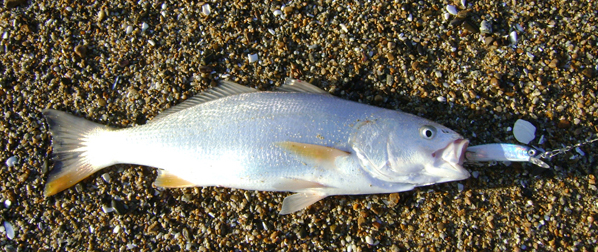
The Red Drum has a dark red back that fades into a white belly. Its body is elongated, with a slightly arched back and a sloping head.[1][2]
The species typically has one large black spot near the base of its tail, but individuals can have as many as 12 spots. Spot counts can differ between the two sides of the body, and the caudal fin has a bluish tip.[3][4][5]
The Red Drum has two dorsal fins. The first has ten hard spines, while the second has one hard spine and numerous soft rays.[6]
The Red Drum can be distinguished from the black drum by its absence of barbels.[7]
Habitat
The Red Drum inhabits oyster bottoms, unvegetated sandy bottoms, and coastal marsh grasses. It also occurs in surf zones, seagrass beds, estuaries, and river mouths.[8][9]
The species occurs in coastal waters at depths of up to 40 meters. Adults usually inhabit saltwater with salinity between 30 and 35 parts per thousand.[10][11]
The Red Drum can tolerate water temperatures ranging from 4 to 34 degrees Celsius.[12]
Diet
Adult Red Drum consume crabs, shrimp, and mullet during summer and autumn. During spring and winter, they primarily consume menhaden, mullet, pinfish, sea robin, lizardfish, spot, Atlantic croaker, and mudminnows.[13][14]
Juveniles primarily consume small grass shrimp, juvenile fish, and minnows. Young Red Drum also feed on small crustaceans and marine worms, while adults consume larger crustaceans, including blue crabs.[15][16][17]
Behaviour
Red Drum may occur individually or in schools. They sometimes form mixed-species schools with black drum and tarpon.[18][19]
Red Drum are active during both daytime and nighttime. The species generally does not defend a territory.[20][21]
Movement of Red Drum is influenced by water temperature and food abundance. During spawning, males produce drumming sounds by vibrating their swim bladders.[22][23]
Reproduction and life cycle
Spawning generally occurs between mid-August and mid-November near tidal inlets. The species exhibits external fertilization, with females releasing eggs that males fertilize.[24][25]
Female Red Drum can produce between half a million and two million eggs per season. The eggs measure approximately 1 mm in diameter and hatch approximately 28 to 30 hours after spawning.[26][27][28]
Larvae are transported into estuaries by currents before settling on seagrass beds. Male Red Drum generally reach sexual maturity at approximately three years of age, while females generally mature at approximately six years.[29][30][31]
Conservation
The Red Drum population has recovered in recent years following size restrictions and the decline of commercial fishing.[32]
Uses
Red Drum are popular recreational gamefish along the United States Atlantic coast and in the Gulf of Mexico. The species is also raised through aquaculture for human consumption.[33][34]
Red Drum are displayed in public aquarium facilities.[35]
Classification of the Red Drum
| Kingdom | Animalia |
|---|---|
| Phylum | Chordata |
| Subphylum | Vertebrata |
| Infraphylum | Gnathostomata |
| Parvphylum | Osteichthyes |
| Gigaclass | Actinopterygii |
| Superclass | Actinopteri |
| Class | Teleostei (Teleost) |
| Order | Perciformes |
| Suborder | Percoidei |
| Family | Sciaenidae (Drums) |
| Genus | Sciaenops (Red Drums) |
| Species | Sciaenops ocellatus (Linnaeus, 1766) |
Where the Red Drum is found
Checklists and occurrence records place Sciaenops ocellatus in 4 countries. GBIF holds 33,201 georeferenced records of it.
Countries
Regions and cities with the most records
- Texas, United States 11,849
- Portland, United States 2,818
- Corpus Christi, United States 2,198
- Louisiana, United States 1,896
- Florida, United States 1,818
- Merritt Island, United States 1,275
- Port Arthur, United States 1,275
- Groves, United States 1,214
- Cocoa, United States 1,199
- Sebastian, United States 1,008
- Rockledge, United States 999
- Palm Bay, United States 857
- Melbourne, United States 757
- West Melbourne, United States 700
- Orange, United States 517
- San Antonio, United States 395
- Nederland, United States 390
- Texas City, United States 353
- Vero Beach, United States 346
- La Marque, United States 335
- Vero Beach South, United States 282
- Dickinson, United States 269
- League City, United States 265
- Florida Ridge, United States 193
- North Carolina, United States 153
- South Carolina, United States 149
- Galveston, United States 144
- Titusville, United States 143
- Lake Jackson, United States 137
- Terrytown, United States 133
- Gretna, United States 132
- New Orleans, United States 131
- Houston, United States 108
- Tampa, United States 103
- Bay City, United States 102
- Waco, United States 89
8 more countries have a few records outside this range
These countries hold a few records of Sciaenops ocellatus but lie outside the range the checklists give for it. Such records are often zoo or garden specimens, museum material or vagrants, so the species is not counted as occurring there.
A number beside a place is its count of GBIF occurrence records. A place without a number comes from a checklist alone. Records show where a species has been observed or collected, which can include escapes and vagrants.
Common names
English
- Red Drum
- Drum
- Redfish
- Spottail Bass
- Spotted Bass
- Tropical Sea Bass
- Channel Bass
Names in 13 other languages
- Chinese
- 星鱸, 眼斑擬石首魚, 紅擬石首魚, 紅鼓魚
- Czech
- smuha červená
- Danish
- Rød trommefisk
- Dutch
- rode ombervis, rode trommelvis
- Finnish
- Punarumpukala
- French
- ombrine ocellée, poisson rouge, tambour rouge
- German
- Roter Umberfisch, roter Trommler
- Korean
- 점성어
- Norwegian Bokmål
- Rødhavgjørs
- Portuguese
- Corvina-vermelha, Corvinão-de-pintas, Peixe-vermelho
- Russian
- Красный горбыль
- Spanish
- Corvina, Corvinón Ocelado, corvineta ocelada
- Swedish
- Röd havsgös, Röd trumfisk
Synonyms
3 other scientific names have been used for this species and are now treated as synonyms of Sciaenops ocellatus.
- Lutjanus triangulum Lacepède, 1802
- Perca ocellata Linnaeus, 1766
- Sciaenops ocellata (Linnaeus, 1766)
Related species
-
 TotoabaTotoaba macdonaldi
-
 Freshwater DrumAplodinotus grunniens
-
 Atlantic CroakerMicropogonias undulatus
-
 MeagreArgyrosomus regius
-
 MullowayArgyrosomus japonicus
-
 Black DrumPogonias cromis
-
 Corvina DrumCilus gilberti
-
 Spotted SeatroutCynoscion nebulosus
Compare
Questions and answers
What is the scientific name of the Red Drum?
The scientific name of the Red Drum is Sciaenops ocellatus. Written with its author, the full name is Sciaenops ocellatus (Linnaeus, 1766).
Which family does the Red Drum belong to?
Sciaenops ocellatus belongs to the family Sciaenidae, in the order Perciformes and the class Teleostei.
Where is the Red Drum found?
Checklists and occurrence records place Sciaenops ocellatus in 4 countries: United States, Mexico, Belize and Martinique.
What is the conservation status of the Red Drum?
The IUCN Red List category recorded for Sciaenops ocellatus is Least Concern (LC).
What other names does the Red Drum have?
Sciaenops ocellatus is also known in English as Drum, Redfish, Spottail Bass, Spotted Bass, Tropical Sea Bass and Channel Bass.
Can red drum be eaten?
Red Drum are raised through aquaculture for human consumption.[34]
Sources
Passages the profile rests on
- The red drum has a dark red back that fades into a white belly. Source passage: “Red drum are a dark red color on the back, which fades into white on the belly.” — English Wikipedia
- The red drum has an elongated body, a slightly arched back, and a sloping head. Source passage: “The body of the red drum is elongate with a slightly arched back and sloping head.” — floridamuseum.ufl.edu
- The species typically has one large black spot near the base of its tail. Source passage: “The most distinguishing mark on the red drum is one large black spot on the upper part of the tail base.” — English Wikipedia
- Individuals can have as many as 12 black spots, with spot counts differing between the two sides of the body. Source passage: “Some fish can be found with up to 12 dots, and it is not uncommon to find a different number of dots on each side.” — animaldiversity.org
- The caudal fin has a bluish tip. Source passage: “The caudal fin has a distinct bluish hue on the tip.” — animaldiversity.org
- The species has two dorsal fins, with ten hard spines on the first fin and one hard spine plus numerous soft rays on the second. Source passage: “There are two dorsal fins, the first of which has ten hard spines and the second with one hard spine and numerous soft rays.” — floridamuseum.ufl.edu
- The red drum can be distinguished from the black drum by its absence of barbels. Source passage: “The red drum can be distinguished from the closely related black drum (Pogonias cromis) by its lack of barbels.” — floridamuseum.ufl.edu
- The species inhabits oyster bottoms, unvegetated sandy bottoms, and coastal marsh grasses. Source passage: “The red drum inhabits areas with oyster bottoms, unvegetated sand bottoms, and in marsh grasses along the coastline.” — animaldiversity.org
- The species is also found in surf zones, seagrass beds, estuaries, and river mouths. Source passage: “it ranges in a wide variety of habitats from surf zones and seagrass beds to estuaries and river mouths.” — floridamuseum.ufl.edu
- The red drum occurs in coastal waters at depths of up to 40 meters. Source passage: “The species will also inhabit deeper coastal waters, at a depth of up to 40 meters.” — animaldiversity.org
- Adult red drum usually inhabit saltwater with salinity between 30 and 35 parts per thousand. Source passage: “adults usually stay in saltwater of 30-35 ppt.” — floridamuseum.ufl.edu
- The species can tolerate water temperatures ranging from 4 to 34 degrees Celsius. Source passage: “Red drums can tolerate a wide range of temperatures, anywhere from 39-93°F (4-34°C).” — floridamuseum.ufl.edu
- Adult red drum consume crabs, shrimp, and mullet during summer and autumn. Source passage: “In the summer and fall, adult red drum feed on crabs, shrimp, and mullet;” — English Wikipedia
- During spring and winter, adults primarily consume menhaden, mullet, pinfish, sea robin, lizardfish, spot, Atlantic croaker, and mudminnows. Source passage: “in the spring and winter, adults primarily feed on menhaden, mullet, pinfish, sea robin, lizardfish, spot, Atlantic croaker, and mudminnows.” — English Wikipedia
- Juvenile red drum primarily consume small grass shrimp, juvenile fish, and minnows. Source passage: “As a juvenile (around 5 months of age), the red drum will have a diet consisting of mainly small grass shrimp ( Palaemonetes ), other small juvenile fish such as spot Leiostomus xanthurus and minnows.” — animaldiversity.org
- Young red drum feed on small crustaceans and marine worms. Source passage: “Young red drum prey upon small crustaceans and marine worms.” — floridamuseum.ufl.edu
- Adult red drum consume larger crustaceans, including blue crabs. Source passage: “Adult drums also feed on larger crustaceans such as the blue crab (Callinectes sapidus).” — floridamuseum.ufl.edu
- Red drum may occur individually or in schools. Source passage: “Drums can be observed solitary or exhibiting schooling behavior.” — floridamuseum.ufl.edu
- The species sometimes forms mixed-species schools with black drum and tarpon. Source passage: “They have been known to school with other species including black drum and tarpon.” — floridamuseum.ufl.edu
- Red drum are active during both daytime and nighttime. Source passage: “The red drum is known to be active both day and night.” — animaldiversity.org
- The species generally does not defend a territory. Source passage: “The red drum generally does not defend a territory.” — animaldiversity.org
- Male red drum produce drumming sounds by vibrating their swim bladders during spawning. Source passage: “Male red drum make a knocking or drumming sound during spawning by vibrating their swim bladders.” — English Wikipedia
- Movement of red drum is influenced by water temperature and food abundance. Source passage: “Movement of the red drum occurs due to the water temperatures as well as the abundance of food.” — animaldiversity.org
- Spawning generally occurs between mid-August and mid-November near tidal inlets. Source passage: “Spawning usually takes place from mid-August to mid-November, often near tidal inlets.” — floridamuseum.ufl.edu
- The species exhibits external fertilization, with females releasing eggs that males fertilize. Source passage: “Once the egg is released by the female, it is fertilized externally by the male.” — animaldiversity.org
- Female red drum can produce between half a million and two million eggs per season. Source passage: “Females can produce one-half to two million eggs per season” — floridamuseum.ufl.edu
- Red drum eggs measure approximately 1 mm in diameter. Source passage: “with each egg measuring approximately 1.0mm in diameter.” — floridamuseum.ufl.edu
- Red drum eggs hatch approximately 28 to 30 hours after spawning. Source passage: “Eggs hatch at approximately 28-30 hours after spawning” — floridamuseum.ufl.edu
- Larvae are transported into estuaries by currents before settling on seagrass beds. Source passage: “These larvae are transported into estuaries via currents before settling onto seagrass beds.” — floridamuseum.ufl.edu
- Male red drum generally reach sexual maturity at approximately three years of age. Source passage: “On average the male red drum become mature by age three (range 1 to 5).” — animaldiversity.org
- Female red drum generally reach sexual maturity at approximately six years of age. Source passage: “Females are generally mature at age six.” — animaldiversity.org
- The red drum population has recovered in recent years following size restrictions and the decline of commercial fishing. Source passage: “Thanks to the slot size limits and the demise of commercial fishing for this species, the red drum has made a recovery in recent years.” — floridamuseum.ufl.edu
- Red drum are popular recreational gamefish along the United States Atlantic coast and in the Gulf of Mexico. Source passage: “The red drum is one of the most popular recreational gamefishes off the U.S. Atlantic coast and in the Gulf of Mexico.” — floridamuseum.ufl.edu
- The species is raised through aquaculture for human consumption. Source passage: “however this species is raised for human consumption through aquaculture efforts.” — floridamuseum.ufl.edu
- Red drum are displayed in public aquarium facilities. Source passage: “It is often displayed in public aquarium facilities.” — floridamuseum.ufl.edu
Data
- Catalogue of Life, 2026-10-16 XR cc by
- Global Biodiversity Information Facility CC BY 4.0
- Wikidata CC0
- GeoNames CC BY 4.0
- Wikimedia Commons per image; credit shown with each image
- Within the Catalogue of Life, this name comes from World Register of Marine Species cc by
This species in other databases
- Catalogue of Life 4VH94
- Wikidata Q2168496
- iNaturalist 128750
- WoRMS urn:lsid:marinespecies.org:taxname:159335
- ITIS 169290
Page built on 26 November 2026. See how the catalog is made and all sources and licences.
Cite this page
ScientificNames.org. (2026). Sciaenops ocellatus (Red Drum). Retrieved November 26, 2026, from https://scientificnames.org/species/sciaenops-ocellatus
“Sciaenops ocellatus (Red Drum).” ScientificNames.org, 2026, scientificnames.org/species/sciaenops-ocellatus. Accessed 26 Nov. 2026.
ScientificNames.org. “Sciaenops ocellatus (Red Drum).” Accessed November 26, 2026. https://scientificnames.org/species/sciaenops-ocellatus.
@misc{scientificnames_sciaenops_ocellatus_red_drum,
  author = {{ScientificNames.org}},
  title = {Sciaenops ocellatus (Red Drum)},
  year = {2026},
  url = {https://scientificnames.org/species/sciaenops-ocellatus},
  note = {Accessed 2026-11-26}
}