Species · Spiders and other arachnids
Philippine Orange Tarantula Selenobrachys philippinus
The scientific name of the Philippine Orange Tarantula is Selenobrachys philippinus. It is a species of arachnid in the family Theraphosidae (tarantulas), order Araneae. The name dates from 1999.
- Scientific name
- Selenobrachys philippinus Schmidt, 1999
- Common name
- Philippine Orange Tarantula
- Genus
- Selenobrachys
- Family
- Theraphosidae (Tarantulas)
- Order
- Araneae
- Class
- Arachnida
- Recorded in
- 1 country
- Name status
- accepted in the Catalogue of Life

Overview
The Philippine Orange Tarantula is native to the Philippines. It has an orange coloration across its entire body and reaches 30 mm in length when the chelicerae are included.
Written 26 November 2026 from the sources listed below. Each statement was checked against the passage it cites; statements that could not be supported were removed.
Appearance
The Philippine Orange Tarantula has an orange coloration across its entire body and a procurved fovea. The retrolateral surface of its chelicerae lacks setae, and its maxillary stridulatory setae are shaped like butter knives.[1][2][3][4]
Its length reaches 30 mm when the chelicerae are included.[5]
Habitat
The Philippine Orange Tarantula is native to the Philippines.[6]
Behaviour
The Philippine Orange Tarantula is an obligate burrower. It is secretive but is usually found outside its burrow.[7][8]
It generally prefers fleeing to fighting and typically hunts by waiting for prey.[9][10]
Classification of the Philippine Orange Tarantula
| Kingdom | Animalia |
|---|---|
| Phylum | Arthropoda |
| Subphylum | Chelicerata |
| Class | Arachnida (Arachnid) |
| Order | Araneae (Spider) |
| Family | Theraphosidae (Tarantulas) |
| Genus | Selenobrachys |
| Species | Selenobrachys philippinus Schmidt, 1999 |
Where the Philippine Orange Tarantula is found
Checklists and occurrence records place Selenobrachys philippinus in 1 country across Asia. GBIF holds 9 georeferenced records of it.
Countries
Range as the checklists state it
Philippines (Negros Is.)
Southern Asia
A number beside a place is its count of GBIF occurrence records. A place without a number comes from a checklist alone. Records show where a species has been observed or collected, which can include escapes and vagrants.
Common names
English
- Philippine Orange Tarantula
- Filipino Orange Tarantula
- Philippine Tangerine Tarantula
Names in 1 other language
- Czech
- sklípkan filipínský
Synonyms
One other scientific name has been used for this species and is now treated as a synonym of Selenobrachys philippinus.
- Orphnaecus philippinus (Schmidt, 1999)
Related species
- Selenobrachys ustromsupasius
-
 Goliath BirdeaterTheraphosa blondi
-
 Gooty Sapphire Ornamental TarantulaPoecilotheria metallica
- Curly Hair TarantulaTliltocatl albopilosus
-
 Mexican Orange-knee TarantulaBrachypelma hamorii
-
 Chilean Rose TarantulaGrammostola rosea
-
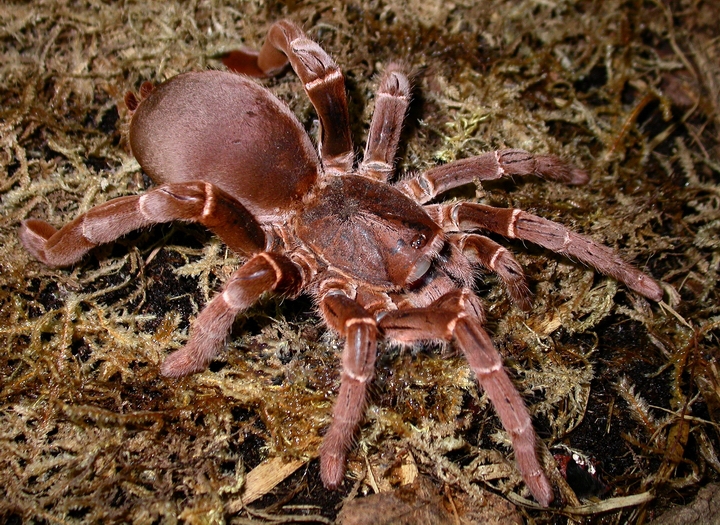 King Baboon SpiderPelinobius muticus
-
 Orange Baboon TarantulaPterinochilus murinus
Compare
Questions and answers
What is the scientific name of the Philippine Orange Tarantula?
The scientific name of the Philippine Orange Tarantula is Selenobrachys philippinus. Written with its author, the full name is Selenobrachys philippinus Schmidt, 1999.
Which family does the Philippine Orange Tarantula belong to?
Selenobrachys philippinus belongs to the family Theraphosidae, in the order Araneae and the class Arachnida.
Where is the Philippine Orange Tarantula found?
Checklists and occurrence records place Selenobrachys philippinus in 1 country: Philippines.
What other names does the Philippine Orange Tarantula have?
Selenobrachys philippinus is also known in English as Filipino Orange Tarantula and Philippine Tangerine Tarantula.
How big can a Philippine Tangerine tarantula get?
Its length reaches 30 mm when the chelicerae are included.[5]
Sources
Passages the profile rests on
- The species has an orange coloration across its entire body. Source passage: “It has an orange in colour throughout the entire body.” — English Wikipedia
- The species has a procurved fovea. Source passage: “The fovea is procurved.” — English Wikipedia
- The retrolateral surface of its chelicerae lacks setae. Source passage: “The retrolateral face of the chelicerae is setae-less” — English Wikipedia
- Its maxillary stridulatory setae are shaped like butter knives. Source passage: “the stridulatory setae on the maxillae are butter knife-shaped.” — English Wikipedia
- Its length reaches 30 mm when the chelicerae are included. Source passage: “30 mm with chelicerae included.” — English Wikipedia
- The species is native to the Philippines. Source passage: “It is native to the Philippines.” — English Wikipedia
- The species is an obligate burrower. Source passage: “This is an obligate burrower tarantula.” — English Wikipedia
- The species is secretive but is usually found outside its burrow. Source passage: “They are quite secretive though they are usually found outside their burrows.” — English Wikipedia
- The species generally prefers fleeing to fighting. Source passage: “They would rather flee than fight” — English Wikipedia
- The species typically hunts by waiting for prey. Source passage: “their usual hunting strategy is just to wait.” — English Wikipedia
Data
- Catalogue of Life, 2026-10-16 XR cc by
- Global Biodiversity Information Facility CC BY 4.0
- Wikidata CC0
- GeoNames CC BY 4.0
- Wikimedia Commons per image; credit shown with each image
- Within the Catalogue of Life, this name comes from The World Spider Catalog cc by
References
- Schmidt, G. (1999b). Selenobrachys philippinus gen. et sp. n. (Araneae: Theraphosidae: Selenocosmiinae), eine neue Theraphosidae sp. von der Insel Negros (Philippinen). Arachnologisches Magazin 7(5/6): 1-13. where the name was published
This species in other databases
Page built on 29 November 2026. See how the catalog is made and all sources and licences.
Cite this page
ScientificNames.org. (2026). Selenobrachys philippinus (Philippine Orange Tarantula). Retrieved November 29, 2026, from https://scientificnames.org/species/selenobrachys-philippinus
“Selenobrachys philippinus (Philippine Orange Tarantula).” ScientificNames.org, 2026, scientificnames.org/species/selenobrachys-philippinus. Accessed 29 Nov. 2026.
ScientificNames.org. “Selenobrachys philippinus (Philippine Orange Tarantula).” Accessed November 29, 2026. https://scientificnames.org/species/selenobrachys-philippinus.
@misc{scientificnames_selenobrachys_philippinus_philippine_orange_tarantula,
  author = {{ScientificNames.org}},
  title = {Selenobrachys philippinus (Philippine Orange Tarantula)},
  year = {2026},
  url = {https://scientificnames.org/species/selenobrachys-philippinus},
  note = {Accessed 2026-11-29}
}