Species · Birds
Juan Fernández Firecrown Sephanoides fernandensis
The scientific name of the Juan Fernández Firecrown is Sephanoides fernandensis. It is a species of bird in the family Trochilidae (hummingbird), order Apodiformes. The name dates from 1831.
- Scientific name
- Sephanoides fernandensis (P. P. King, 1831)
- Common name
- Juan Fernández Firecrown
- Genus
- Sephanoides
- Family
- Trochilidae (Hummingbird)
- Order
- Apodiformes
- Class
- Aves
- Red List category
- CR Critically Endangered
- Recorded in
- 1 country
- Name status
- accepted in the Catalogue of Life

Overview
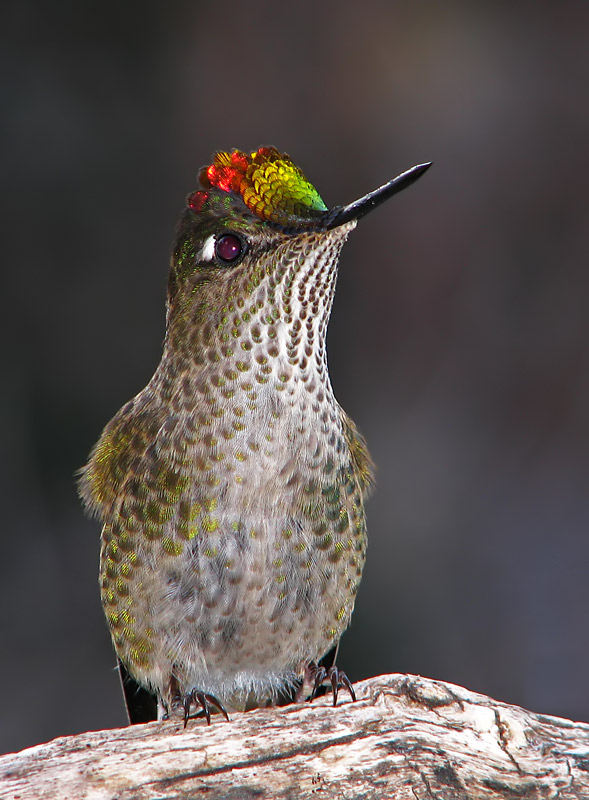
The species is endemic to the Juan Fernández Islands of Chile. Males and females have pronounced differences in plumage, and both sexes have a straight black bill.
Written 26 November 2026 from the sources listed below. Each statement was checked against the passage it cites; statements that could not be supported were removed.
Appearance
Males are predominantly cinnamon-orange, with an iridescent fiery reddish-yellow forehead and crown and dark coppery-gray wings. They measure between 11.5 and 12 cm in length and weigh approximately 10.9 g.[1][2][3]
Females have bluish-green upperparts and an iridescent bluish-purple crown. Their underparts are white, marked with black and green disks, and their wings are slaty-green.[4][5]
The female's central tail feathers and inner webs of the other tail feathers are blue-green, while the outer webs are white. Females measure approximately 10.5 cm in length and weigh approximately 6.8 g.[6][7][8]
Habitat
The species inhabits forests, thickets and gardens, with a preference for shady areas. Breeding records occur at elevations between 120 and 660 m.[9][10]
Males are frequently observed in San Juan Bautista during summer.[11]
Diet
The species obtains nectar from native flowers, particularly Rhaphithamnus venustus and Sonchus brassicifolius. It may also feed on introduced Eucalyptus and Abutilon during autumn and winter.[12][13]
The species consumes small insects captured in flight or gleaned from leaves.[14]
Behaviour
The species moves around the island, apparently searching for flowering plants, but is otherwise sedentary. It feeds while clinging to flowers and prefers shaded blossoms well above ground level.[15][16]
Both sexes defend territories used for foraging, and males hold the more productive territories.[17][18]
The song consists of high-pitched squeaky notes, dry gravelly trills and descending chatters.[19]
Reproduction and life cycle
The breeding season extends from September to mid-November. Females construct small cup-shaped nests from woven fern fibers, other fibers, mosses and spiderweb.[20][21]
Nests are placed on twig tips under cover, typically approximately 4 m above the ground. More than 75% of nests recorded in a 2011 study were located in Myrceugenia fernandeziana trees.[22][23]
Clutches contain two eggs. The incubation period and time to fledging have not been established.[24][25]
Conservation
The Juan Fernández Firecrown is classified as Critically Endangered by the IUCN. Its estimated population comprises 1,500 to 3,500 mature birds, or 3,000 to 5,200 individuals overall, and is believed to be declining.[26][27][28]
Destruction of native trees used for nesting is a major cause of population decline. The spread of introduced zarzamora blackberry and maqui wineberry also contributes to the decline.[29][30]
Domestic and feral cats prey on the species, while introduced rabbits and goats contribute to habitat destruction. Cats and rats have also been implicated in the population decline.[31][32][33]
A conservation partnership began efforts to prevent the species' extinction in 2004. Conservation measures have included planting native species, removing non-native plants and reducing introduced predators and competitors.[34][35]
Classification of the Juan Fernández Firecrown
| Kingdom | Animalia |
|---|---|
| Phylum | Chordata |
| Subphylum | Vertebrata |
| Infraphylum | Gnathostomata |
| Parvphylum | Osteichthyes |
| Megaclass | Tetrapoda |
| Class | Aves (Bird) |
| Order | Apodiformes (Swifts) |
| Family | Trochilidae (Hummingbird) |
| Subfamily | Trochilinae |
| Genus | Sephanoides (Firecrown) |
| Species | Sephanoides fernandensis (P. P. King, 1831) |
Where the Juan Fernández Firecrown is found
Checklists and occurrence records place Sephanoides fernandensis in 1 country across South America. GBIF holds 417 georeferenced records of it.
Countries
Regions and cities with the most records
Range as the checklists state it
South America
A number beside a place is its count of GBIF occurrence records. A place without a number comes from a checklist alone. Records show where a species has been observed or collected, which can include escapes and vagrants.
Common names
English
- Juan Fernández Firecrown
- Juan Fernandez Firecrown
Names in 25 other languages
- Catalan
- Colibrí de les Juan Fernández, colibrí de les illes Juan Fernández
- Chinese
- 火冠蜂鳥, 火冠蜂鸟
- Croatian
- robinzonski kolibrić
- Czech
- kolibřík fernandezský, kolibřík ostrovní
- Danish
- Juan Fernandez-ildkrone, Juan Fernández-ildkrone
- Dutch
- Juan-Fernandezkolibrie, Juan-Fernándezkolibrie
- Esperanto
- fernandezinsula kolibro
- Finnish
- juanfernandezinkolibri, juanfernándezinkolibri
- French
- Colibri robinson, Coquette robinson
- German
- Juan-Fernandez-Kolibri, Juan-Fernández-Kolibri, Kastanienkolibri
- Hungarian
- Juan Fernandez-szigeteki kolibri
- Italian
- Capo di fuoco di Juan Fernandez
- Japanese
- フェルナンデスベニイタダキハチドリ
- Lithuanian
- salinis liepsnavainikis kolibris
- Norwegian
- gullkolibri
- Polish
- fernandezik wyspowy
- Portuguese
- Coroa-de-fogo-de-juan-fernández, beija-flor-das-juan-fernández, colibri-de-joão-fernandes
- Russian
- Рыжая диадема, Фернандесский огненношапочный колибри
- Serbian
- Vatroglavi kolibri sa ostrva Huan Fernandez
- Slovak
- plamienok škoricový
- Spanish
- Colibrí de Juan Fernández, Picaflor de Juan Fernández
- Swedish
- juanfernándezkolibri
- Turkish
- Juan Fernandez Kolibrisi
- Ukrainian
- колібрі фернандеський
- Welsh
- sïedn fflamgorun gwinau
Synonyms
One other scientific name has been used for this species and is now treated as a synonym of Sephanoides fernandensis.
- Trochilus fernandensis P. P. King, 1831
Subspecies and varieties
- Sephanoides fernandensis fernandensis subspecies
- Sephanoides fernandensis leyboldi (Alejandro Selkirk Firecrown) subspecies
Related species
-
 Green-backed FirecrownSephanoides sephaniodes
-
 Bee HummingbirdMellisuga helenae
-
 Anna's HummingbirdCalypte anna
-
 Ruby-throated HummingbirdArchilochus colubris
-
 Rufous HummingbirdSelasphorus rufus
-
 White-booted Racket-tailOcreatus underwoodii
-
 Red-billed StreamertailTrochilus polytmus
-
 Sword-billed HummingbirdEnsifera ensifera
Compare
Questions and answers
What is the scientific name of the Juan Fernández Firecrown?
The scientific name of the Juan Fernández Firecrown is Sephanoides fernandensis. Written with its author, the full name is Sephanoides fernandensis (P. P. King, 1831).
Which family does the Juan Fernández Firecrown belong to?
Sephanoides fernandensis belongs to the family Trochilidae, in the order Apodiformes and the class Aves.
Where is the Juan Fernández Firecrown found?
Checklists and occurrence records place Sephanoides fernandensis in 1 country: Chile.
What is the conservation status of the Juan Fernández Firecrown?
The IUCN Red List category recorded for Sephanoides fernandensis is Critically Endangered (CR).
What other names does the Juan Fernández Firecrown have?
Sephanoides fernandensis is also known in English as Juan Fernandez Firecrown.
Where does the nominate subspecies occur?
The nominate subspecies occurs only on Isla Robinson Crusoe in the Juan Fernández Islands, where its range is restricted to approximately 11 km².[36][37]
Where did the extinct subspecies occur?
The extinct subspecies Sephanoides fernandensis leyboldi has been attributed to Alejandro Selkirk Island.[38]
How many eggs does the species lay?
Clutches contain two eggs.[24]
How many hummingbird species are known to reside on oceanic islands?
The Juan Fernández Firecrown is one of two hummingbirds known to reside on oceanic islands.[39]
Sources
Passages the profile rests on
- Males are predominantly cinnamon-orange, with an iridescent fiery reddish-yellow forehead and crown and dark coppery-gray wings. Source passage: “The male is almost entirely cinnamon-orange. Its forehead and crown are iridescent fiery reddish yellow and the wings a dark coppery gray.” — English Wikipedia
- Males measure between 11.5 and 12 cm in length. Source passage: “Males are 11.5 to 12 cm (4.5 to 4.7 in) long” — English Wikipedia
- Males weigh approximately 10.9 g. Source passage: “weigh about 10.9 g (0.38 oz).” — English Wikipedia
- Females have bluish-green upperparts and an iridescent bluish-purple crown. Source passage: “The female's upperparts are bluish green with an iridescent bluish purple crown.” — English Wikipedia
- Females have white underparts marked with black and green disks and slaty-green wings. Source passage: “Its underparts are pure white with black and green disks and the wings slaty green.” — English Wikipedia
- The female's central tail feathers and inner webs of the other tail feathers are blue-green, while the outer webs are white. Source passage: “The central tail feathers and the inner webs of the others are blue-green and the outer webs white.” — English Wikipedia
- Females measure approximately 10.5 cm in length. Source passage: “Females are about 10.5 cm (4.1 in) long” — English Wikipedia
- Females weigh approximately 6.8 g. Source passage: “weigh about 6.8 g (0.24 oz).” — English Wikipedia
- The species inhabits forests, thickets and gardens, with a preference for shady areas. Source passage: “The species inhabits forests, thickets, and gardens, favoring shady areas.” — English Wikipedia
- Breeding records occur at elevations between 120 and 660 m. Source passage: “All of the breeding records are at elevations between 120 and 660 m (390 and 2,200 ft).” — English Wikipedia
- Males are frequently observed in San Juan Bautista during summer. Source passage: “In summer, males are frequently seen in the island's only town, San Juan Bautista” — English Wikipedia
- The species obtains nectar from native flowers, particularly Rhaphithamnus venustus and Sonchus brassicifolius. Source passage: “The Juan Fernández firecrown forages for nectar at the flowers of native plants, especially Rhaphithamnus venustus and Sonchus brassicifolius.” — English Wikipedia
- The species may feed on introduced Eucalyptus and Abutilon during autumn and winter. Source passage: “It may also feed on introduced Eucalyptus and Abutilon during autumn and winter” — English Wikipedia
- The species consumes small insects captured in flight or gleaned from leaves. Source passage: “In addition to nectar, the species feeds on small insects taken in flight or gleaned from leaves.” — English Wikipedia
- The species moves around the island, apparently searching for flowering plants, but is otherwise sedentary. Source passage: “The Juan Fernández firecrown moves around the island, presumably in search of flowering plants, but is otherwise sedentary.” — English Wikipedia
- The species feeds while clinging to flowers and prefers shaded blossoms well above ground level. Source passage: “It feeds by clinging to the flowers, and favors shaded blossoms well above the ground.” — English Wikipedia
- Both sexes defend territories used for foraging. Source passage: “Both sexes defend foraging territories” — English Wikipedia
- Males hold the more productive foraging territories. Source passage: “with males holding the more productive sites.” — English Wikipedia
- The species produces a song consisting of high-pitched squeaky notes, dry gravelly trills and descending chatters. Source passage: “a medley of high-pitched squeaky notes, dry gravelly trills and descending chatters.” — English Wikipedia
- The breeding season extends from September to mid-November. Source passage: “The Juan Fernández firecrown's breeding season is from September to mid-November.” — English Wikipedia
- Females construct small cup-shaped nests from woven fern fibers, other fibers, mosses and spiderweb. Source passage: “The female constructs a small cup nest of woven fern fibers, other fibers, mosses, and spiderweb” — English Wikipedia
- Nests are placed on twig tips under cover, typically approximately 4 m above the ground. Source passage: “placed on the tip of a twig in cover, typically about 4 m (13 ft) above the ground.” — English Wikipedia
- More than 75% of nests recorded in a 2011 study were located in Myrceugenia fernandeziana trees. Source passage: “A 2011 study found more than 75% of the nests were in Myrceugenia fernandeziana trees.” — English Wikipedia
- Clutches contain two eggs. Source passage: “The clutch size is two eggs.” — English Wikipedia
- The incubation period and time to fledging have not been established. Source passage: “The incubation period and time to fledging are not known.” — English Wikipedia
- The species is classified as Critically Endangered by the IUCN. Source passage: “The IUCN has assessed the Juan Fernández firecrown as Critically Endangered.” — English Wikipedia
- The estimated population comprises 1,500 to 3,500 mature birds, or 3,000 to 5,200 individuals overall. Source passage: “It has an estimated population of 1500 to 3500 mature birds or 3000 to 5200 total individuals” — English Wikipedia
- The species' population is believed to be declining. Source passage: “and the number is believed to be decreasing.” — English Wikipedia
- Destruction of native trees used for nesting is a major cause of population decline. Source passage: “The destruction of native trees, which the species depends on for nest sites, is a major cause of the decline.” — English Wikipedia
- The spread of introduced zarzamora blackberry and maqui wineberry contributes to the species' decline. Source passage: “Also contributing are the spread of exotic zarzamora blackberry (Rubus ulmifolius) and maqui wineberry (Aristotelia chilensis)” — English Wikipedia
- Domestic and feral cats prey on the species. Source passage: “predation by domestic and feral cats” — English Wikipedia
- Introduced rabbits and goats contribute to habitat destruction. Source passage: “destruction by introduced rabbits and goats.” — English Wikipedia
- Cats and rats have been implicated in the species' population decline. Source passage: “and cats and rats have been implicated in the decline.” — depts.washington.edu
- A conservation partnership began efforts to prevent the species' extinction in 2004. Source passage: “A conservation effort was begun in 2004 by a partnership of several organizations” — English Wikipedia
- Conservation measures have included planting native species, removing non-native plants and reducing introduced predators and competitors. Source passage: “Their efforts included planting native species, removing non-native plants, and reducing non-native predators and competitors.” — English Wikipedia
- The nominate subspecies occurs only on Isla Robinson Crusoe in the Juan Fernández Islands. Source passage: “The nominate subspecies of Juan Fernández firecrown is found only on Isla Róbinson Crusoe in the Juan Fernández Islands of Chile.” — English Wikipedia
- The nominate race is restricted to approximately 11 km² on Isla Robinson Crusoe. Source passage: “the nominate race is confined to c. 11 km2 on Isla Robinson Crusoe” — datazone.birdlife.org
- The extinct subspecies Sephanoides fernandensis leyboldi has been attributed to Alejandro Selkirk Island. Source passage: “The putative extinct subspecies S. f. leyboldi is attributed to Alejandro Selkirk Island.” — English Wikipedia
- The species is one of two hummingbirds known to reside on oceanic islands. Source passage: “These hummingbird species are the only two known to reside on oceanic islands (1).” — depts.washington.edu
Data
- Catalogue of Life, 2026-10-16 XR cc by
- Global Biodiversity Information Facility CC BY 4.0
- Wikidata CC0
- GeoNames CC BY 4.0
- Wikimedia Commons per image; credit shown with each image
- Within the Catalogue of Life, this name comes from The Integrated Taxonomic Information System cc0
References
- Gill, Frank, & and Minturn Wright. (2006). Birds of the World: Recommended English Names.
This species in other databases
Page built on 28 November 2026. See how the catalog is made and all sources and licences.
Cite this page
ScientificNames.org. (2026). Sephanoides fernandensis (Juan Fernández Firecrown). Retrieved November 28, 2026, from https://scientificnames.org/species/sephanoides-fernandensis
“Sephanoides fernandensis (Juan Fernández Firecrown).” ScientificNames.org, 2026, scientificnames.org/species/sephanoides-fernandensis. Accessed 28 Nov. 2026.
ScientificNames.org. “Sephanoides fernandensis (Juan Fernández Firecrown).” Accessed November 28, 2026. https://scientificnames.org/species/sephanoides-fernandensis.
@misc{scientificnames_sephanoides_fernandensis_juan_fernandez_firecrown,
  author = {{ScientificNames.org}},
  title = {Sephanoides fernandensis (Juan Fernández Firecrown)},
  year = {2026},
  url = {https://scientificnames.org/species/sephanoides-fernandensis},
  note = {Accessed 2026-11-28}
}