Species · Flowering plants
Serianthes nelsonii
Serianthes nelsonii has no English name on record in the checklists used here. It is a species of flowering plant in the family Fabaceae (bean), order Fabales.
- Scientific name
- Serianthes nelsonii Merr.
- Genus
- Serianthes
- Family
- Fabaceae (Bean)
- Order
- Fabales
- Class
- Magnoliopsida
- Red List category
- CR Critically Endangered
- Recorded in
- 2 countries
- Name status
- accepted in the Catalogue of Life
Overview
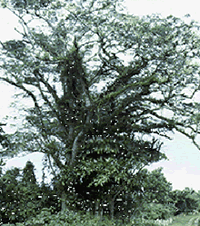
Serianthes nelsonii Merr. is a large flowering tree in the family Fabaceae, order Fabales and class Magnoliopsida. The species is endemic to Guam and Rota in the Mariana Islands. It has bipinnately compound leaves, brush-like flowers with long pinkish filaments, and seedpods containing between one and seven smooth brown seeds.
Written 27 November 2026 from the sources listed below. Each statement was checked against the passage it cites; statements that could not be supported were removed.
Appearance
The species has bipinnately compound leaves. Its flowers are brush-like and have long pinkish filaments.[1][2]
The seedpods contain between one and seven smooth brown seeds.[3]
Habitat
The species occurs in limestone forests on Guam and Rota and grows on limestone substrates.[4][5]
Historical collections were recorded from volcanic substrate in ravine forest at elevations of 120 to 175 metres.[6]
Conservation
Serianthes nelsonii was declared an endangered plant in 1987. It was assessed as critically endangered in 1998 and 2017.[7][8]
The University of Guam started a conservation program for the species in 1998 with assistance from other agencies. Seedlings are being raised on protected lands for transplantation into Guam's wild habitats.[9][10]
The Department of Lands and Natural Resource monitors the species population on Rota and raises seedlings in a nursery.[11]
Only one mature individual remained on Guam before its death was announced in November 2024. The mature Guam individual, known as the mother tree, was located within the Multipurpose Machine Gun Range at Camp Blaz in Ritidian.[12][13]
The mother tree was diagnosed with heart rot and suffered insect infestations in 2019. High winds during Typhoon Mawar toppled the tree in 2023, and it was declared dead in 2024.[14][15]
Seedlings face threats from invasive pigs and deer. Insufficient regeneration is identified as a cause of population decline, while insect predation on seeds and predation on seedlings by invasive ungulates and mealybugs are identified as possible causes.[16][17][18]
The Rota subpopulation is expected to decline as older trees die.[19]
Reproduction and life cycle
A total of 4,007 seeds were collected from the Guam mother tree for outplanting initiatives.[20]
Classification of Serianthes nelsonii
| Kingdom | Plantae |
|---|---|
| Subkingdom | Pteridobiotina |
| Phylum | Tracheophyta |
| Class | Magnoliopsida |
| Order | Fabales |
| Family | Fabaceae (Bean) |
| Genus | Serianthes |
| Species | Serianthes nelsonii Merr. |
Where Serianthes nelsonii is found
Checklists and occurrence records place Serianthes nelsonii in 2 countries. GBIF holds 69 georeferenced records of it.
Countries
Regions and cities with the most records
- Dededo Village, Guam 6
- Hagåtña, Guam 6
- Mangilao Village, Guam 6
- Tamuning-Tumon-Harmon Village, Guam 6
- Yigo Village, Guam 6
- Mangilao, Guam 5
A number beside a place is its count of GBIF occurrence records. A place without a number comes from a checklist alone. Records show where a species has been observed or collected, which can include escapes and vagrants.
Common names
Names in 1 other language
- cha
- Hayun Lago, Hayun Lagu, Håyun lågu, Trongkon Guafi, Trongkon Lago, Trongkon guåfi, Tronkon Guati, tronkon guafi
Related species
-
 Serianthes calycina
- Serianthes myriadenia
- Serianthes rurutensis
-
 Serianthes vitiensis
- Serianthes petitiana
- Serianthes grandiflora
- Serianthes margaretae
- Serianthes melanesica
Compare
Questions and answers
Where is Serianthes nelsonii found?
The species is endemic to Guam and Rota in the Mariana Islands.[21]
How many mature trees have been identified on Rota?
A total of 121 mature trees had been identified on Rota since 1984.[22]
What does the name hayun lågu mean?
The Guam name hayun lågu means northern tree or foreign tree and refers to Rota's position north of Guam.[23]
What does the Rota name trongkon guåfi mean?
The common Rota name trongkon guåfi means fire tree.[24]
Who is commemorated by the species name nelsonii?
The species name nelsonii was chosen to honor Peter Nelson of the Guam Department of Agriculture.[25]
Sources
Passages the profile rests on
- The species has bipinnately compound leaves. Source passage: “It has bipinnately compound leaves and brush-like flowers with long pinkish filaments.” — English Wikipedia
- The flowers are brush-like and have long pinkish filaments. Source passage: “It has bipinnately compound leaves and brush-like flowers with long pinkish filaments.” — English Wikipedia
- The seedpods contain between one and seven smooth brown seeds. Source passage: “Seedpods contain one to seven smooth brown seeds.” — English Wikipedia
- The species occurs in limestone forests on Guam and Rota. Source passage: “The tree is found in limestone forests in Rota and Guam.” — English Wikipedia
- The species occurs on limestone substrates. Source passage: “Serianthes nelsonii occurs on limestone substrates,” — ecos.fws.gov
- Historical collections of the species were recorded from volcanic substrate in ravine forest at elevations of 120 to 175 metres. Source passage: “although some historical collections are known from volcanic substrate in ravine forest at 120 to 175 m (400” — ecos.fws.gov
- Serianthes nelsonii was declared an endangered plant in 1987. Source passage: “Serianthes nelsonii was declared an endangered plant in 1987” — English Wikipedia
- The species was assessed as critically endangered in 1998 and 2017. Source passage: “was assessed as critically endangered in 1998 and again in 2017.” — English Wikipedia
- The University of Guam started a conservation program for the species in 1998 with assistance from other agencies. Source passage: “The University of Guam began a program to save the plant in 1998 with the help of numerous other agencies.” — English Wikipedia
- Seedlings are being raised on protected lands for transplantation into Guam's wild habitats. Source passage: “Serianthes nelsonii seedlings are being raised on protected lands for transplantation back into the wilds of Guam.” — English Wikipedia
- The Department of Lands and Natural Resource monitors the species population on Rota and raises seedlings in a nursery. Source passage: “On Rota, the Department of Lands and Natural Resource is monitoring the plant population and growing seedlings in a plant nursery.” — English Wikipedia
- Only one mature individual remained on Guam before its death was announced in November 2024. Source passage: “Only one mature tree existed on Guam (until November 2024, when it was announced it perished” — English Wikipedia
- The mature Guam individual known as the mother tree was located within the Multipurpose Machine Gun Range at Camp Blaz in Ritidian. Source passage: “Guam's single mature Serianthes nelsonii, known as the "mother tree," existed within the Multipurpose Machine Gun Range at Camp Blaz in Ritidian.” — English Wikipedia
- The mother tree was diagnosed with heart rot and suffered insect infestations in 2019. Source passage: “In 2019, the tree was diagnosed with heart rot and suffered from insect infestations.” — English Wikipedia
- High winds during Typhoon Mawar toppled the mother tree in 2023, and it was declared dead in 2024. Source passage: “High winds during Typhoon Mawar toppled the tree in 2023, and in 2024 it was declared dead.” — English Wikipedia
- Seedlings face threats from invasive pigs and deer. Source passage: “but seedlings face threats from invasive pigs and deer.” — English Wikipedia
- Insufficient regeneration is identified as a cause of the species' population decline. Source passage: “Insufficient regeneration is blamed for the decline of the population.” — English Wikipedia
- Insect predation on seeds and predation on seedlings by invasive ungulates and mealybugs are identified as possible causes of population decline. Source passage: “Possible causes include insect predation on seeds and predation on seedlings by invasive ungulates and mealybugs.” — English Wikipedia
- The Rota subpopulation is expected to decline as older trees die. Source passage: “The subpopulation on Rota is expected to decline as older trees die.” — English Wikipedia
- A total of 4,007 seeds were collected from the Guam mother tree for outplanting initiatives. Source passage: “4,007 seeds have been collected from the mother tree and are being used for outplanting initiatives,” — English Wikipedia
- Serianthes nelsonii is endemic to Guam and Rota in the Mariana Islands. Source passage: “Serianthes nelsonii is a large tree endemic to Guam and Rota of the Mariana Islands.” — English Wikipedia
- A total of 121 mature trees had been identified on Rota since 1984. Source passage: “while 121 mature trees have been identified on Rota since 1984.” — English Wikipedia
- The Guam name hayun lågu means northern tree or foreign tree and refers to Rota's position north of Guam. Source passage: “On Guam, it is known as hayun lågu, meaning "northern tree" or "foreign tree", referring to Rota, which is located north of Guam.” — English Wikipedia
- The common Rota name trongkon guåfi means fire tree. Source passage: “The common name on Rota is trongkon guåfi, meaning "fire tree".” — English Wikipedia
- The species name nelsonii was chosen to honor Peter Nelson of the Guam Department of Agriculture. Source passage: “The species was named "nelsonii" by E.D. Merrill in 1919 to honor Peter Nelson of the Guam Department of Agriculture, the discoverer of the plant.” — English Wikipedia
Data
- Catalogue of Life, 2026-10-16 XR cc by
- Global Biodiversity Information Facility CC BY 4.0
- Wikidata CC0
- GeoNames CC BY 4.0
- Wikimedia Commons per image; credit shown with each image
- Within the Catalogue of Life, this name comes from The World Checklist of Vascular Plants (WCVP): Fabaceae cc by
References
- Philipp. J. Sci. 15: 542 (1919) where the name was published
This species in other databases
- Catalogue of Life 6YHH9
- Wikidata Q548581
- iNaturalist 138579
- World Flora Online wfo-0000192904
- GRIN 320028
Page built on 28 November 2026. See how the catalog is made and all sources and licences.
Cite this page
ScientificNames.org. (2026). Serianthes nelsonii. Retrieved November 28, 2026, from https://scientificnames.org/species/serianthes-nelsonii
“Serianthes nelsonii.” ScientificNames.org, 2026, scientificnames.org/species/serianthes-nelsonii. Accessed 28 Nov. 2026.
ScientificNames.org. “Serianthes nelsonii.” Accessed November 28, 2026. https://scientificnames.org/species/serianthes-nelsonii.
@misc{scientificnames_serianthes_nelsonii,
  author = {{ScientificNames.org}},
  title = {Serianthes nelsonii},
  year = {2026},
  url = {https://scientificnames.org/species/serianthes-nelsonii},
  note = {Accessed 2026-11-28}
}