Species · Mammals
Quokka Setonix brachyurus
The scientific name of the Quokka is Setonix brachyurus. It is a species of mammal in the family Macropodidae (kangaroos), order Diprotodontia. The name dates from 1830.
- Scientific name
- Setonix brachyurus (Quoy & Gaimard, 1830)
- Common name
- Quokka
- Genus
- Setonix
- Family
- Macropodidae (Kangaroos)
- Order
- Diprotodontia
- Class
- Mammalia
- Red List category
- VU Vulnerable
- Recorded in
- 1 country
- Name status
- accepted in the Catalogue of Life

Overview
The Quokka is restricted to southwestern Western Australia, with populations on Rottnest Island, Bald Island and the mainland. The Quokka has coarse, grey-brown fur, a short, broad face and a relatively short, mostly hairless tail.
Written 24 November 2026 from the sources listed below. Each statement was checked against the passage it cites; statements that could not be supported were removed.
Appearance
The Quokka has coarse, grey-brown fur with lighter coloration underneath. Its face is short and broad, with a naked nose and rounded furry ears.[1][2]
The Quokka has a relatively short tail that is mostly hairless. Adults measure 40–54 cm in body length, and the tail measures approximately 25–31 cm.[3][4][5]
Male Quokkas weigh between 2.7 and 4.2 kg, while females weigh between 1.6 and 3.5 kg.[6][7]
Habitat
Mainland Quokkas commonly inhabit dense vegetation beside streams, as well as shrubland and heathland, particularly around swamps. They require habitats close to freshwater.[8][9][10]
Quokkas inhabit semi-arid environments on Rottnest Island. They use Gahnia trifida vegetation as shelter during hot days.[11][12]
Dense swamp vegetation provides protection from mainland predators. Quokkas preferentially occupy scrubland during the early stages following a fire.[13][14]
Diet
Quokkas are browsing herbivores that primarily consume grasses and leaves. They particularly favour plants belonging to the Thomasia genus and prefer fresh, young plant growth.[15][16][17]
Quokkas regurgitate swallowed food and chew their cud.[18]
Behaviour
Quokkas are nocturnal and feed primarily at night. During daylight hours, they shelter in dense vegetation and return to the same daytime shelter on successive days.[19][20][21]
Quokkas create trails through dense vegetation for feeding and escaping predators. They can also climb trees to obtain food.[22][23]
Mainland Quokkas generally live in family groups containing 12–24 individuals. Rottnest Island Quokkas can form groups containing up to 150 individuals.[24][25]
Quokkas can survive for extended periods without food or water. They have color vision.[26][27]
Reproduction and life cycle
The Quokka's gestation period lasts approximately one month, and females generally give birth to one offspring per pregnancy. Females can reproduce from approximately 18 months of age.[28][29][30]
Joeys remain in their mother's pouch for approximately six months. After leaving the pouch, they continue suckling from their mother's teats for approximately two months and are usually weaned by eight months of age.[31][32][33]
The peak breeding season occurs between January and March. On Rottnest Island, the breeding season extends from January through August.[34][35]
Male Quokkas do not provide parental care to their offspring. Mainland females can produce approximately 17 offspring over their lifetimes.[36][37]
Conservation
The Quokka is classified as vulnerable by the IUCN. Introduced European red foxes, cats and dogs threaten mainland populations.[38][39]
Agricultural development, housing expansion and logging have contributed to reductions in Quokka populations. Island populations are less susceptible to declines because Rottnest Island is free of foxes.[40][41]
Uses
Quokkas have been used in medical research investigating muscular dystrophy.[42]
Similar species
Quokkas resemble marsupials belonging to the Petrogale and Macropus giganteus groups.[43]
Classification of the Quokka
| Kingdom | Animalia |
|---|---|
| Phylum | Chordata |
| Subphylum | Vertebrata |
| Infraphylum | Gnathostomata |
| Parvphylum | Osteichthyes |
| Megaclass | Tetrapoda |
| Class | Mammalia (Mammal) |
| Subclass | Theria |
| Infraclass | Metatheria |
| Order | Diprotodontia |
| Suborder | Macropodiformes |
| Family | Macropodidae (Kangaroos) |
| Subfamily | Macropodinae |
| Genus | Setonix (Quokka) |
| Species | Setonix brachyurus (Quoy & Gaimard, 1830) |
Where the Quokka is found
Checklists and occurrence records place Setonix brachyurus in 1 country across Oceania. GBIF holds 2,732 georeferenced records of it.
Countries
Regions and cities with the most records
- Western Australia, Australia 1,071
- Perth, Australia 16
- Bunbury, Australia 4
- Northern Territory, Australia 4
- Tasmania, Australia 4
- South Australia, Australia 3
- Victoria, Australia 3
Range as the checklists state it
Australia
A number beside a place is its count of GBIF occurrence records. A place without a number comes from a checklist alone. Records show where a species has been observed or collected, which can include escapes and vagrants.
Common names
English
- Quokka
- Short-tailed Wallaby
Names in 11 other languages
- Arabic
- كوكا
- Chinese
- 短尾袋鼠
- Czech
- klokan quokka
- Finnish
- kvokka
- German
- Kurzschwanzkänguru
- Greek
- Κουόκα
- Japanese
- クアッカワラビー
- Norwegian Bokmål
- Korthalewallaby
- Polish
- kuoka krótkoogonowa
- Russian
- Квокка
- Turkish
- Kuoka
Synonyms
One other scientific name has been used for this species and is now treated as a synonym of Setonix brachyurus.
- Kangurus brachyurus Quoy & Gaimard, 1830
Related species
- Red KangarooOsphranter rufus
- TenkileDendrolagus scottae
-
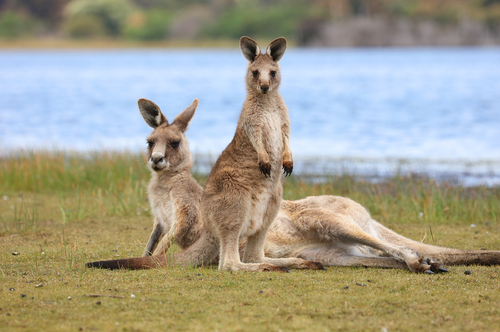 Eastern Grey KangarooMacropus giganteus
-
 Red-necked WallabyNotamacropus rufogriseus
-
 Western Grey KangarooMacropus fuliginosus
-
 Antilopine KangarooOsphranter antilopinus
-
 Swamp WallabyWallabia bicolor
-
 Common WallarooOsphranter robustus
Compare
Questions and answers
What is the scientific name of the Quokka?
The scientific name of the Quokka is Setonix brachyurus. Written with its author, the full name is Setonix brachyurus (Quoy & Gaimard, 1830).
Which family does the Quokka belong to?
Setonix brachyurus belongs to the family Macropodidae, in the order Diprotodontia and the class Mammalia.
Where is the Quokka found?
Checklists and occurrence records place Setonix brachyurus in 1 country: Australia.
What is the conservation status of the Quokka?
The IUCN Red List category recorded for Setonix brachyurus is Vulnerable (VU).
What other names does the Quokka have?
Setonix brachyurus is also known in English as Short-tailed Wallaby.
Why are quokkas so rare?
Mainland Quokka populations have been reduced by introduced European red foxes, cats and dogs, as well as agricultural development, housing expansion and logging.[39][40]
Sources
Passages the profile rests on
- The quokka has coarse, grey-brown fur with lighter coloration underneath. Source passage: “It has short, very coarse and thick grey-brown fur over most of the body with lighter parts underneath.” — australian.museum
- The quokka has a short, broad face, a naked nose and rounded furry ears. Source passage: “Its facial features consist of a naked nose on a short, broad face with rounded furry ears.” — australian.museum
- The quokka has a relatively short tail that is mostly hairless. Source passage: “The tail is relatively short and mostly devoid of hair.” — australian.museum
- Adult quokkas measure 40–54 cm in body length. Source passage: “Body length: 40-54cm, tail: 25-31cm” — australian.museum
- The quokka's tail measures approximately 25–31 cm. Source passage: “Body length: 40-54cm, tail: 25-31cm” — australian.museum
- Male quokkas weigh between 2.7 and 4.2 kg. Source passage: “Males weigh between 2.7 and 4.2 kg” — animaldiversity.org
- Female quokkas weigh between 1.6 and 3.5 kg. Source passage: “females who weigh between 1.6 and 3.5 kg.” — animaldiversity.org
- Mainland quokkas commonly inhabit dense vegetation beside streams. Source passage: “Mainland populations tend to be clustered around dense streamside vegetation” — australian.museum
- Mainland quokkas also inhabit shrubland and heathland, particularly around swamps. Source passage: “but can also be found in shrubland and heath areas, particularly around swamps.” — australian.museum
- Quokkas require habitats close to freshwater. Source passage: “Due to their sumptuous need for water, these animals must reside close to freshwater.” — animaldiversity.org
- Quokkas inhabit semi-arid environments on Rottnest Island. Source passage: “Here Quokkas occupy a wide range of semi-arid areas.” — australian.museum
- Quokkas use Gahnia trifida vegetation as shelter during hot days on Rottnest Island. Source passage: “Plants such as Gahnia trifida provide refuge for this species on hot days on Rottnest Island.” — animaldiversity.org
- Quokkas use dense swamp vegetation for protection from mainland predators. Source passage: “Swampy vegetation provides protection for quokkas on the mainland from their predators.” — animaldiversity.org
- Quokkas preferentially occupy scrubland during the early stages following a fire. Source passage: “Quokkas gravitate towards these scrubland habitats in their early stages after a fire.” — animaldiversity.org
- Quokkas are browsing herbivores that primarily consume grasses and leaves. Source passage: “Quokkas are plant eaters or herbivores.In fact they can be described as browsing herbivores who favour various grasses and leaves” — australian.museum
- Quokkas particularly favour plants belonging to the Thomasia genus. Source passage: “the most popular being plants from the Thomasia species.” — australian.museum
- Quokkas prefer feeding on fresh, young plant growth. Source passage: “Quokkas show a distinct preference for new young growth.” — australian.museum
- Quokkas regurgitate swallowed food and chew their cud. Source passage: “Quokkas do not chew their food, but rather they swallow it, regurgitate it and chew the cud.” — animaldiversity.org
- Quokkas are nocturnal and feed primarily at night. Source passage: “Quokkas are most active at night feeding alone or in small bands.” — australian.museum
- Quokkas shelter in dense vegetation during daylight hours. Source passage: “During the day they will shelter in areas of dense vegetation.” — australian.museum
- Quokkas return to the same daytime shelter on successive days. Source passage: “Quokkas return to the same shelter day to day” — animaldiversity.org
- Quokkas create trails through dense vegetation that they use for feeding and escaping predators. Source passage: “Among the dense vegetation, Quokkas will create paths and trails for use as runways for feeding or escaping predators.” — australian.museum
- Quokkas can climb trees to obtain food. Source passage: “They are able to climb trees to reach a food source.” — australian.museum
- Mainland quokkas generally live in family groups containing 12–24 individuals. Source passage: “Their family group consists of one to two dozen individuals.” — animaldiversity.org
- Rottnest Island quokkas can form groups containing up to 150 individuals. Source passage: “On Rottnest Island, they live in much larger groups of up to 150 individuals.” — animaldiversity.org
- Quokkas can survive for extended periods without food or water. Source passage: “However, they can survive for long periods without food or water.” — australian.museum
- Quokkas have color vision. Source passage: “Unlike wallabies, quokkas have color vision.” — animaldiversity.org
- The quokka's gestation period lasts approximately one month. Source passage: “The gestation period is approximately one month” — animaldiversity.org
- Female quokkas generally give birth to one offspring per pregnancy. Source passage: “Females produces one offspring.” — animaldiversity.org
- Female quokkas can reproduce from approximately 18 months of age. Source passage: “They are able to breed from about eighteen months of age.” — australian.museum
- Quokka joeys remain in their mother's pouch for approximately six months. Source passage: “The young will remain in the pouch for about six months.” — australian.museum
- Quokka joeys continue suckling from their mother's teats for approximately two months after leaving the pouch. Source passage: “After the joey leaves the pouch it will continue to feed at its mother's teats for an extra two months or so.” — australian.museum
- Quokka joeys are usually weaned by eight months of age. Source passage: “Joeys are usually weaned by eight months of age.” — australian.museum
- The peak breeding season for quokkas occurs between January and March. Source passage: “Peak breeding season for Setonix brachyurus occurs between January and March when the weather is cooler.” — animaldiversity.org
- Rottnest Island quokkas have a breeding season extending from January through August. Source passage: “the breeding season on Rottnest Island is shorter (from January to August).” — australian.museum
- Male quokkas do not provide parental care to their offspring. Source passage: “Males provide no parental care” — animaldiversity.org
- Female quokkas can produce approximately 17 offspring over their lifetimes on the mainland. Source passage: “On the mainland, female Quokkas are able to produce about seventeen offspring over a lifetime” — australian.museum
- The quokka is classified as vulnerable by the IUCN. Source passage: “The quokka is now listed as vulnerable in accordance with the IUCN criteria.” — English Wikipedia
- Introduced European red foxes, cats and dogs threaten mainland quokka populations. Source passage: “The mainland populations are threatened by the introduced European red fox Vulpes vulpes . Also, these animals are prey to domesticated cats and dogs” — animaldiversity.org
- Agricultural development, housing expansion and logging have contributed to reductions in quokka populations. Source passage: “Clearing for agricultiral development, the spread of housing and logging have contributed to this” — australian.museum
- Island quokka populations are less susceptible to declines because Rottnest Island is free of foxes. Source passage: “The populations found on Rottnest are less susceptible to decline as the island is fox free.” — australian.museum
- Quokkas have been used in medical research investigating muscular dystrophy. Source passage: “Quokkas are known to suffer from muscular dystrophy and have been employed in medical research in that area.” — australian.museum
- Quokkas resemble marsupials belonging to the Petrogale and Macropus giganteus groups. Source passage: “They are similar in appearance to other marsupials such as Petrogale and Macropus giganteus” — animaldiversity.org
- Rottnest Island quokkas primarily eat succulents and also consume wattle leaves. Source passage: “On Rottnest Island their diet is primarily succulents and to a lesser extent the leaves of wattles.” — australian.museum
Data
- Catalogue of Life, 2026-10-16 XR cc by
- Global Biodiversity Information Facility CC BY 4.0
- Wikidata CC0
- GeoNames CC BY 4.0
- Wikimedia Commons per image; credit shown with each image
- Within the Catalogue of Life, this name comes from The Integrated Taxonomic Information System cc0
References
- In Dumont d'Urville, Voy...de Astrolabe, Zool. vol.1(L'Homme, Mamm. Oiseaux) p.114 where the name was published
- Nowak, Ronald M. (1991). Walker’s Mammals of the World, Vol. 1, 5th Ed.
- Wilson, Don E., and DeeAnn M. Reeder, eds. (1993). Mammal Species of the World: A Taxonomic and Geographic Reference, 2nd Ed., 3rd Printing.
- Wilson, Don E., and DeeAnn M. Reeder, eds. (2005). Mammal Species of the World: A Taxonomic and Geographic Reference, 3rd Ed., Vols. 1 & 2.
- Wilson, Don E., and Russell A. Mittermeier, eds. (2015). Handbook of the Mammals of the World, Vol. 5. Monotremes and Marsupials.
- Burgin, Connor J., Don E. Wilson, Russell A. Mittermeier, Anthony B. Rylands, et al. (2020). Illustrated Checklist of the Mammals of the World. Vol. 1. Monotremata to Rodentia.
This species in other databases
Page built on 24 November 2026. See how the catalog is made and all sources and licences.
Cite this page
ScientificNames.org. (2026). Setonix brachyurus (Quokka). Retrieved November 24, 2026, from https://scientificnames.org/species/setonix-brachyurus
“Setonix brachyurus (Quokka).” ScientificNames.org, 2026, scientificnames.org/species/setonix-brachyurus. Accessed 24 Nov. 2026.
ScientificNames.org. “Setonix brachyurus (Quokka).” Accessed November 24, 2026. https://scientificnames.org/species/setonix-brachyurus.
@misc{scientificnames_setonix_brachyurus_quokka,
  author = {{ScientificNames.org}},
  title = {Setonix brachyurus (Quokka)},
  year = {2026},
  url = {https://scientificnames.org/species/setonix-brachyurus},
  note = {Accessed 2026-11-24}
}