Species · Birds
Arrowhead Warbler Setophaga pharetra
The scientific name of the Arrowhead Warbler is Setophaga pharetra. It is a species of bird in the family Parulidae (new world warbler), order Passeriformes. The name dates from 1847.
- Scientific name
- Setophaga pharetra (Gosse, 1847)
- Common name
- Arrowhead Warbler
- Genus
- Setophaga
- Family
- Parulidae (New World Warbler)
- Order
- Passeriformes
- Class
- Aves
- Red List category
- LC Least Concern
- Recorded in
- 1 country
- Name status
- accepted in the Catalogue of Life
Overview
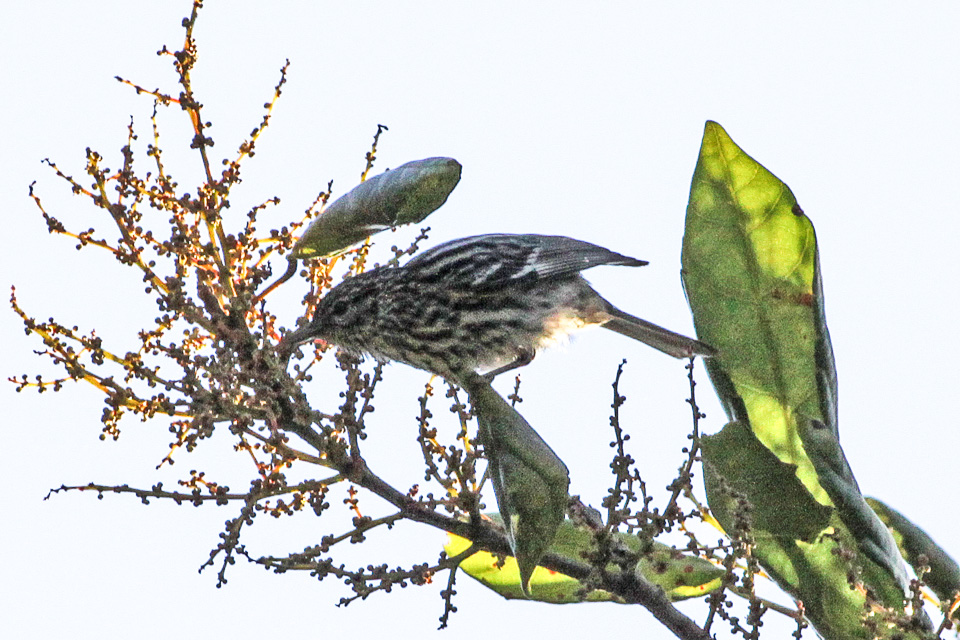
The Arrowhead Warbler (Setophaga pharetra) is a bird in the family Parulidae, order Passeriformes, and class Aves. It is endemic to Jamaica, where it inhabits humid montane forests and also uses humid lowland forests during the non-breeding season. It is distinguished by black arrowhead markings on its whitish underparts and black-and-white streaking on its head and upperparts.
Written 26 November 2026 from the sources listed below. Each statement was checked against the passage it cites; statements that could not be supported were removed.
Similar species
The Arrowhead Warbler forms a superspecies with the Elfin Woods Warbler of Puerto Rico and the Plumbeous Warbler of Guadeloupe and Dominica.[1]
Appearance
The Arrowhead Warbler measures 12.5–13 cm in length and weighs between 9.1 and 10.5 g.[2][3]
Adult males have black-and-white streaking on their heads and upperparts. Their upper wing surfaces are darker, with white-tipped greater and median coverts forming two wing bars.[4][5]
The tail is mostly dark on its upper surface and whitish underneath, with white spots on the tips of the outer two pairs of feathers. The predominantly whitish underparts have black arrowhead markings on the throat, breast, and flanks.[6][7]
Adult females are slightly duller than adult males. Female streaking is described as gray rather than black in at least one account.[8][9]
Both sexes have dark irises, blackish bills, and blackish-brown legs and feet.[10]
Immature birds have brownish-yellow upperparts with faint yellowish-buff streaks, darker wings and tails than adults, and pale brownish-yellow underparts with faint darker streaks.[11][12][13]
Habitat
The Arrowhead Warbler inhabits humid montane forests. During the non-breeding season, it also inhabits humid lowland forests.[14][15]
Diet
The Arrowhead Warbler feeds primarily on insects.[16]
Behaviour
The Arrowhead Warbler forages at all levels of the forest, gleaning prey from leaves, vines, and branches.[17][18]
Its song consists of high-pitched, squeaky notes. Its call is a repeated high-pitched, metallic tic.[19][20]
Reproduction and life cycle
Breeding activity is concentrated between March and June. Breeding has also been recorded in November following autumn rains.[21][22]
The species builds cup-shaped nests from fine roots and lines them with moss and lichen. Nests are typically concealed in bushes, vine tangles, bromeliads, or trees.[23][24]
The clutch contains between two and four eggs. The incubation period, fledging time, and parental care details are unknown.[25][26]
Conservation
The IUCN classifies the Arrowhead Warbler as Least Concern. It was most recently assessed for the IUCN Red List in 2025.[27][28]
The population size is unknown but is believed to be stable. No immediate threats to the species have been identified.[29][30]
The species is considered locally common throughout its range.[31]
Classification of the Arrowhead Warbler
| Kingdom | Animalia |
|---|---|
| Phylum | Chordata |
| Subphylum | Vertebrata |
| Infraphylum | Gnathostomata |
| Parvphylum | Osteichthyes |
| Megaclass | Tetrapoda |
| Class | Aves (Bird) |
| Order | Passeriformes (Passerine) |
| Family | Parulidae (New World Warbler) |
| Genus | Setophaga (Redstarts) |
| Species | Setophaga pharetra (Gosse, 1847) |
Where the Arrowhead Warbler is found
Checklists and occurrence records place Setophaga pharetra in 1 country across North America. GBIF holds 2,637 georeferenced records of it.
Countries
Regions and cities with the most records
- Half Way Tree, Jamaica 1,281
- Kingston, Jamaica 1,272
- Westmoreland, Jamaica 132
- Montego Bay, Jamaica 128
- Barrett Town, Jamaica 126
- Mandeville, Jamaica 103
- Manchester, Jamaica 102
- Savanna-la-Mar, Jamaica 84
- Ocho Rios, Jamaica 28
- Portmore, Jamaica 14
- Hanover, Jamaica 11
- Linstead, Jamaica 4
- Clarendon, Jamaica 3
- May Pen, Jamaica 3
- Spanish Town, Jamaica 3
Range as the checklists state it
Caribbean
A number beside a place is its count of GBIF occurrence records. A place without a number comes from a checklist alone. Records show where a species has been observed or collected, which can include escapes and vagrants.
Common names
English
- Arrowhead Warbler
Names in 25 other languages
- Catalan
- bosquerola de Jamaica
- Chinese
- 尖头林莺, 箭頭林鶯
- Croatian
- jamajčka sjeničica
- Czech
- lesňáček jamajský
- Danish
- Jamaicasanger
- Dutch
- Jamaicazanger
- Esperanto
- jamajka parulio
- Estonian
- jamaika säälik
- Finnish
- jamaikankerttuli
- French
- Paruline de Jamaïque
- German
- Strichelwaldsänger
- Italian
- Parula sagittata
- Japanese
- ヤジリアメリカムシクイ
- Lithuanian
- raibasis krūminukas
- Norwegian
- pilparula
- Polish
- lasówka jamajska
- Portuguese
- mariquita-da-jamaica, mariquita-jamaicana
- Russian
- Пёстрая древесница, Пёстрый лесной певун
- Slovak
- horárik jamajský
- Spanish
- Reinita jamaicana
- Swedish
- jamaicaskogssångare
- Turkish
- Jamaika Ötleğeni
- Ukrainian
- пісняр-лісовик ямайський
- Welsh
- telor pennau saethau
- jam
- Ants picker
Synonyms
2 other scientific names have been used for this species and are now treated as synonyms of Setophaga pharetra.
- Dendroica pharetra (Gosse, 1847)
- Sylvicola pharetra Gosse, 1847
Related species
-
 Yellow-rumped WarblerSetophaga coronata
-
 American Yellow WarblerSetophaga aestiva
-
 American RedstartSetophaga ruticilla
-
 Golden-cheeked WarblerSetophaga chrysoparia
-
 Kirtland's WarblerSetophaga kirtlandii
-
 Northern ParulaSetophaga americana
-
 Cerulean WarblerSetophaga cerulea
-
 Palm WarblerSetophaga palmarum
Compare
Questions and answers
What is the scientific name of the Arrowhead Warbler?
The scientific name of the Arrowhead Warbler is Setophaga pharetra. Written with its author, the full name is Setophaga pharetra (Gosse, 1847).
Which family does the Arrowhead Warbler belong to?
Setophaga pharetra belongs to the family Parulidae, in the order Passeriformes and the class Aves.
Where is the Arrowhead Warbler found?
Checklists and occurrence records place Setophaga pharetra in 1 country: Jamaica.
What is the conservation status of the Arrowhead Warbler?
The IUCN Red List category recorded for Setophaga pharetra is Least Concern (LC).
Sources
Passages the profile rests on
- The Arrowhead Warbler forms a superspecies with the Elfin Woods Warbler of Puerto Rico and the Plumbeous Warbler of Guadeloupe and Dominica. Source passage: “The arrowhead warbler forms a superspecies with the elfin woods warbler (S. angelae) of Puerto Rico and the plumbeous warbler (S. plumbea) of Guadeloupe and Dominica.” — English Wikipedia
- The Arrowhead Warbler measures 12.5–13 cm in length. Source passage: “The arrowhead warbler is 12.5 to 13 cm (4.9 to 5.1 in) long” — English Wikipedia
- The Arrowhead Warbler weighs between 9.1 and 10.5 g. Source passage: “weighs 9.1 to 10.5 g (0.32 to 0.37 oz).” — English Wikipedia
- Adult males have black-and-white streaking on their heads and upperparts. Source passage: “Adult males have a black and white streaked head and upperparts.” — English Wikipedia
- Adult males have darker upper wing surfaces with white-tipped greater and median coverts that form two wing bars. Source passage: “The upper side of their wings is darker and the greater and median coverts have white tips that show as two wing bars.” — English Wikipedia
- The tail is mostly dark on its upper surface and whitish underneath, with white spots on the tips of the outer two pairs of feathers. Source passage: “Their tail is mostly dark above with a whitish underside and white spots at the tips of the outer two pairs of feathers.” — English Wikipedia
- The underparts are predominantly whitish, with black arrowhead markings on the throat, breast, and flanks. Source passage: “Their underparts are mostly whitish with the eponymous black arrowheads on the throat, breast, and flanks.” — English Wikipedia
- Adult females are slightly duller than adult males. Source passage: “Adult females are slightly duller than males” — English Wikipedia
- At least one source describes female streaking as gray rather than black. Source passage: “at least one source states that their streaks are gray rather than black.” — English Wikipedia
- Both sexes have dark irises, blackish bills, and blackish-brown legs and feet. Source passage: “Both sexes have a dark iris, a blackish bill, and blackish brown legs and feet.” — English Wikipedia
- Immature birds have brownish-yellow upperparts with faint yellowish-buff streaks. Source passage: “Immature birds have brownish yellow upperparts with faint yellowish buff streaks.” — English Wikipedia
- Immature birds have darker wings and tails than adults. Source passage: “Their wings and tail are darker than adults'” — English Wikipedia
- Immature birds have pale brownish-yellow underparts with faint darker streaks. Source passage: “their underparts are pale brownish yellow with faint darker streaks.” — English Wikipedia
- The species inhabits humid montane forests. Source passage: “It inhabits humid montane forest” — English Wikipedia
- During the non-breeding season, the species also inhabits humid lowland forests. Source passage: “and also humid lowland forest in the non-breeding season.” — English Wikipedia
- The Arrowhead Warbler feeds primarily on insects. Source passage: “The arrowhead warbler feeds primarily on insects.” — English Wikipedia
- The species forages at all levels of the forest. Source passage: “It forages at all levels of the forest” — English Wikipedia
- While foraging, the species gleans prey from leaves, vines, and branches. Source passage: “gleaning prey from leaves, vines, and branches.” — English Wikipedia
- The species produces a song consisting of high-pitched, squeaky notes. Source passage: “The arrowhead warbler's song is "a series of high-pitched and squeaky notes” — English Wikipedia
- The species gives a repeated high-pitched, metallic tic call. Source passage: “Its call is a repeated "high-pitched, metallic tic".” — English Wikipedia
- Breeding activity is concentrated between March and June. Source passage: “The arrowhead warbler's breeding activity is concentrated between March and June” — English Wikipedia
- Breeding has also been recorded in November following autumn rains. Source passage: “but breeding has also been noted in November after autumn rains.” — English Wikipedia
- The species builds cup-shaped nests from fine roots and lines them with moss and lichen. Source passage: “The nest is a cup made from fine roots lined with moss and lichen.” — English Wikipedia
- Nests are typically concealed in bushes, vine tangles, bromeliads, or trees. Source passage: “It is typically concealed in a bush, vine tangle, bromeliad, or tree.” — English Wikipedia
- The clutch contains between two and four eggs. Source passage: “The clutch is two to four eggs.” — English Wikipedia
- The incubation period, fledging time, and parental care details are unknown. Source passage: “The incubation period, time to fledging, and details of parental care are not known.” — English Wikipedia
- The IUCN classifies the Arrowhead Warbler as Least Concern. Source passage: “The IUCN has assessed the arrowhead warbler as being of Least Concern.” — English Wikipedia
- The Arrowhead Warbler was most recently assessed for the IUCN Red List in 2025. Source passage: “Arrowhead Warbler Setophaga pharetra has most recently been assessed for The IUCN Red List of Threatened Species in 2025.” — iucnredlist.org
- The population size is unknown but is believed to be stable. Source passage: “Its population size is not known but is believed to be stable.” — English Wikipedia
- No immediate threats to the species have been identified. Source passage: “No immediate threats have been identified.” — English Wikipedia
- The species is considered locally common throughout its range. Source passage: “It is considered locally common throughout its range.” — English Wikipedia
Data
- Catalogue of Life, 2026-10-16 XR cc by
- Global Biodiversity Information Facility CC BY 4.0
- Wikidata CC0
- GeoNames CC BY 4.0
- Wikimedia Commons per image; credit shown with each image
- Within the Catalogue of Life, this name comes from The Integrated Taxonomic Information System cc0
This species in other databases
Page built on 28 November 2026. See how the catalog is made and all sources and licences.
Cite this page
ScientificNames.org. (2026). Setophaga pharetra (Arrowhead Warbler). Retrieved November 28, 2026, from https://scientificnames.org/species/setophaga-pharetra
“Setophaga pharetra (Arrowhead Warbler).” ScientificNames.org, 2026, scientificnames.org/species/setophaga-pharetra. Accessed 28 Nov. 2026.
ScientificNames.org. “Setophaga pharetra (Arrowhead Warbler).” Accessed November 28, 2026. https://scientificnames.org/species/setophaga-pharetra.
@misc{scientificnames_setophaga_pharetra_arrowhead_warbler,
  author = {{ScientificNames.org}},
  title = {Setophaga pharetra (Arrowhead Warbler)},
  year = {2026},
  url = {https://scientificnames.org/species/setophaga-pharetra},
  note = {Accessed 2026-11-28}
}