Species · Insects
Moore's Cupid Shijimia moorei
The scientific name of the Moore's Cupid is Shijimia moorei. It is a species of insect in the family Lycaenidae (blues), order Lepidoptera. The name dates from 1889.
- Scientific name
- Shijimia moorei (Leech, 1889)
- Common name
- Moore's Cupid
- Genus
- Shijimia
- Family
- Lycaenidae (Blues)
- Order
- Lepidoptera
- Class
- Insecta
- Recorded in
- 5 countries
- Name status
- accepted in the Catalogue of Life

Overview
Moore's Cupid is a small butterfly belonging to the lycaenid family. Its larval stage feeds on Lysionotus pauciflorus.
Written 27 November 2026 from the sources listed below. Each statement was checked against the passage it cites; statements that could not be supported were removed.
Diet
The larval stage of Moore's Cupid feeds on Lysionotus pauciflorus.[1]
Classification of the Moore's Cupid
| Kingdom | Animalia |
|---|---|
| Phylum | Arthropoda |
| Subphylum | Hexapoda |
| Class | Insecta (Insect) |
| Order | Lepidoptera |
| Superfamily | Papilionoidea |
| Family | Lycaenidae (Blues) |
| Genus | Shijimia |
| Species | Shijimia moorei (Leech, 1889) |
Where the Moore's Cupid is found
Checklists and occurrence records place Shijimia moorei in 5 countries. GBIF holds 85 georeferenced records of it.
Countries
Regions and cities with the most records
- Taiwan, Taiwan 22
- Arunachal Pradesh, India 5
- Kachin State, Myanmar 4
- Assam, India 3
- Digboi, India 3
- Margherita, India 3
A number beside a place is its count of GBIF occurrence records. A place without a number comes from a checklist alone. Records show where a species has been observed or collected, which can include escapes and vagrants.
Common names
English
- Moore's Cupid
- Bicolor Cupid
Names in 3 other languages
- Bengali
- কাজলা রুলকি
- Chinese
- 台灣棋石小灰蝶, 山灰蝶, 棋石灰蝶, 棋石燕小灰蝶, 森灰蝶, 臺灣棋石小灰蝶
- Japanese
- ゴイシツバメシジミ, タイワンゴイシシジミ
Synonyms
One other scientific name has been used for this species and is now treated as a synonym of Shijimia moorei.
- Lycaena moorei Leech, 1889
Subspecies and varieties
- Shijimia moorei taiwana subspecies
Related species
-
 Common BluePolyommatus icarus
-
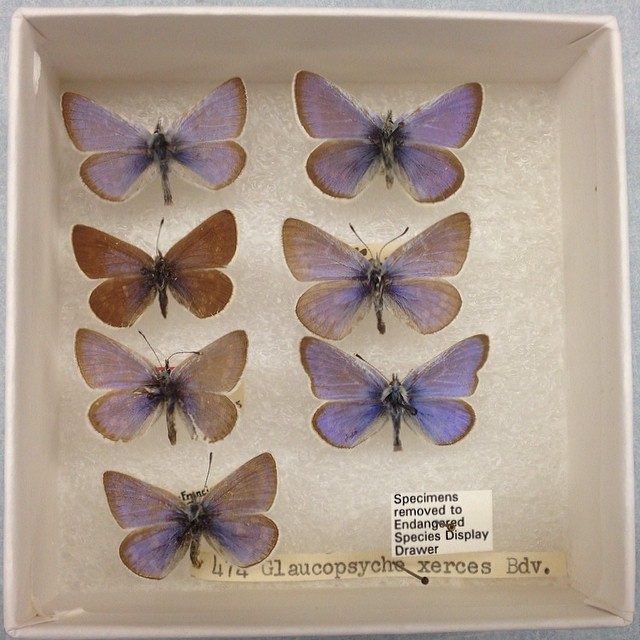 Xerces BlueGlaucopsyche xerces
-
 Adonis BlueLysandra bellargus
-
 Western Pygmy BlueBrephidium exilis
-
 AtalaEumaeus atala
-
 Holly BlueCelastrina argiolus
-
 Long-tailed BlueLampides boeticus
-
 HarvesterFeniseca tarquinius
Compare
Questions and answers
What is the scientific name of the Moore's Cupid?
The scientific name of the Moore's Cupid is Shijimia moorei. Written with its author, the full name is Shijimia moorei (Leech, 1889).
Which family does the Moore's Cupid belong to?
Shijimia moorei belongs to the family Lycaenidae, in the order Lepidoptera and the class Insecta.
Where is the Moore's Cupid found?
Checklists and occurrence records place Shijimia moorei in 5 countries: Taiwan, India, Japan, China and Myanmar.
What other names does the Moore's Cupid have?
Shijimia moorei is also known in English as Bicolor Cupid.
Sources
Passages the profile rests on
- The larval stage of Shijimia moorei feeds on Lysionotus pauciflorus. Source passage: “The larva on feeds on Lysionotus pauciflorus” — English Wikipedia
Data
- Catalogue of Life, 2026-10-16 XR cc by
- Global Biodiversity Information Facility CC BY 4.0
- Wikidata CC0
- GeoNames CC BY 4.0
- Wikimedia Commons per image; credit shown with each image
- Within the Catalogue of Life, this name comes from Global Lepidoptera Index cc by
References
- Leech. (1889). Transactions of the Royal Entomological Society of London. http://www.biodiversitylibrary.org/item/50992#page/136/mode/2up Link where the name was published
This species in other databases
Page built on 28 November 2026. See how the catalog is made and all sources and licences.
Cite this page
ScientificNames.org. (2026). Shijimia moorei (Moore's Cupid). Retrieved November 28, 2026, from https://scientificnames.org/species/shijimia-moorei
“Shijimia moorei (Moore's Cupid).” ScientificNames.org, 2026, scientificnames.org/species/shijimia-moorei. Accessed 28 Nov. 2026.
ScientificNames.org. “Shijimia moorei (Moore's Cupid).” Accessed November 28, 2026. https://scientificnames.org/species/shijimia-moorei.
@misc{scientificnames_shijimia_moorei_moores_cupid,
  author = {{ScientificNames.org}},
  title = {Shijimia moorei (Moore's Cupid)},
  year = {2026},
  url = {https://scientificnames.org/species/shijimia-moorei},
  note = {Accessed 2026-11-28}
}