Species · Other invertebrates
Lucerne Flea Sminthurus viridis
The scientific name of the Lucerne Flea is Sminthurus viridis. It is a species of animal in the family Sminthuridae, order Symphypleona. The name dates from 1758.
- Scientific name
- Sminthurus viridis (Linnæus, C, 1758)
- Common name
- Lucerne Flea
- Genus
- Sminthurus
- Family
- Sminthuridae
- Order
- Symphypleona
- Class
- Collembola
- Environment
- terrestrial
- Recorded in
- 27 countries
- Name status
- accepted in the Catalogue of Life
Overview
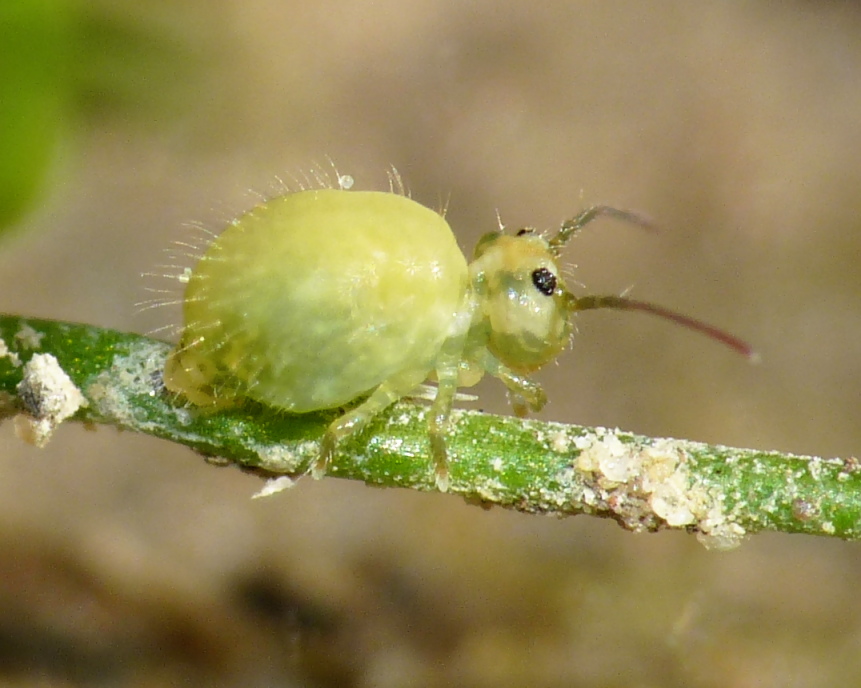
The Lucerne Flea (Sminthurus viridis) is an invertebrate in the family Sminthuridae, order Symphypleona and class Collembola. The species occurs on lucerne plants, in southern Australia and Tasmania, and in South Africa, New Zealand and the Americas. It has a roughly globular body, commonly patchy bright green or yellowish, and feeds mainly on the surface cells of plant leaves.
Written 26 November 2026 from the sources listed below. Each statement was checked against the passage it cites; statements that could not be supported were removed.
Appearance
The Lucerne Flea has a roughly globular body that is commonly patchy bright green or yellowish. Adults commonly reach approximately 3 mm in length.[1][2][3]
The species has a well-developed furcula and mandibulate mouthparts, with only the tips of the mandibles projecting beyond the mouth folds.[4][5]
Habitat
The species commonly occurs on lucerne plants and has been reported on young medic pastures in the Adelaide Hills. Females usually deposit their eggs in damp soil or litter.[6][7][8]
The species originated in Eurasia, particularly Europe, and occurs in southern Australia and Tasmania. It is also present in South Africa, New Zealand and the Americas.[9][10][11]
Diet
The Lucerne Flea feeds mainly on the surface cells of plant leaves.[12]
Behaviour
The species jumps actively when alarmed. Individuals can swarm in large numbers on living plants, particularly members of the Fabaceae.[13][14]
During drought, the species enters aestivation through diapause that delays embryonic development. Eggs that have undergone aestivation hatch at varying intervals after wet conditions return.[15][16]
Reproduction and life cycle
Mature females lay eggs in variable-sized batches and take several minutes to deposit each egg. The eggs are spherical, pale yellow and approximately 0.25 mm in diameter.[17][18][19][20]
Under favourable conditions, most eggs hatch approximately two weeks after being laid, although some require three weeks or longer under favourable breeding conditions.[21][22]
Male individuals produce spermatophores attached to fine stems above the substrate. Females reach sexual maturity during their sixth instar, following their fifth ecdysis.[23][24]
The species may produce approximately four to eight generations annually, depending on regional conditions. Fully mature females may live for two months or longer.[25][26]
Conservation
The species is considered a significant agricultural pest of broadacre crops and pastures. Its pest status varies geographically from negligible to severe, and high population densities can cause sufficient plant damage for it to be considered an agricultural pest.[27][28][29]
Human-assisted dispersal has contributed to the species' spread into new regions. The movement of animal feed, seeds and soil can transport its eggs and live young.[30][31]
Fungal infections have been documented as a cause of mortality in this species.[32]
Similar species
The common name Lucerne Flea does not indicate a close taxonomic relationship with true fleas.[33]
Classification of the Lucerne Flea
| Kingdom | Animalia |
|---|---|
| Phylum | Arthropoda |
| Subphylum | Hexapoda |
| Class | Collembola |
| Order | Symphypleona |
| Suborder | Appendiciphora |
| Infraorder | Sminthuriformia |
| Superfamily | Sminthuroidea |
| Family | Sminthuridae |
| Subfamily | Sminthurinae |
| Genus | Sminthurus |
| Species | Sminthurus viridis (Linnæus, C, 1758) |
Where the Lucerne Flea is found
Checklists and occurrence records place Sminthurus viridis in 27 countries across Europe and Oceania. GBIF holds 3,255 georeferenced records of it.
Countries
- Australia 92
- Austria 128
- Belgium 14
- Croatia 5
- Czechia 4
- Denmark 17
- Estonia 7
- Finland 12
- France 257
- Germany 684
- Greece 101
- Hungary 15
- Iceland 4
- Ireland 56
- Italy 11
- Luxembourg 5
- New Zealand 40
- Norway 104
- Poland 37
- Portugal 122
- Russia 333
- Spain 99
- Sweden 197
- Switzerland 4
- The Netherlands 550
- Ukraine 5
- United Kingdom 352
Regions and cities with the most records
- England, United Kingdom 243
- Komi, Russia 165
- Schleswig-Holstein, Germany 128
- Azores, Portugal 109
- Styria, Austria 109
- Elmschenhagen, Germany 105
- Kiel, Germany 105
- Baden-Wurttemberg, Germany 96
- Preetz, Germany 96
- Gelderland, The Netherlands 93
- Saxony-Anhalt, Germany 83
- Bavaria, Germany 75
- Friesland, The Netherlands 75
- Overijssel, The Netherlands 69
- North Rhine-Westphalia, Germany 60
- Raalte, The Netherlands 60
- Lower Saxony, Germany 57
- Veenendaal, The Netherlands 57
- Kaluga Oblast, Russia 56
- Nijverdal, The Netherlands 54
- Centre-Val de Loire, France 53
- Leonberg, Germany 53
- Barneveld, The Netherlands 52
- Dalfsen, The Netherlands 52
- Graz, Austria 52
- Leek, The Netherlands 52
- Ezhva, Russia 51
- Vaihingen an der Enz, Germany 51
- Epe, The Netherlands 50
- Limburg, The Netherlands 50
- Mühlacker, Germany 50
- Pforzheim, Germany 50
- Zwolle, The Netherlands 50
- Deventer, The Netherlands 49
- Drachten, The Netherlands 49
- New South Wales, Australia 49
5 more countries have a few records outside this range
These countries hold a few records of Sminthurus viridis but lie outside the range the checklists give for it. Such records are often zoo or garden specimens, museum material or vagrants, so the species is not counted as occurring there.
Range as the checklists state it
African Indian Desert
Arctic & Sub-arctic
Caribbean mainland
Central Australia
A number beside a place is its count of GBIF occurrence records. A place without a number comes from a checklist alone. Records show where a species has been observed or collected, which can include escapes and vagrants.
Common names
English
- Lucerne Flea
Names in 5 other languages
- Czech
- podrepka pestrá
- Danish
- Grøn bladkuglespringer, Lucerneloppe
- Dutch
- Gele springstaart, Kogelspringstaart
- German
- Luzernefloh
- Swedish
- lucernloppa
Synonyms
83 other scientific names have been used for this species and are now treated as synonyms of Sminthurus viridis.
- Papirius nigro-maculatus Grujic, NZ, Winkler, D & Daghighi, E, 2023
- Podura viridis Bourlet, C, 1845
- Podura viridis Linnaeus, 1758
- Pulex viridis plantarum Linnaeus, 1736
- Sminthuro viridi Keller, S & Steenberg, T, 1997
- Sminthurus (Setosi) virides Schött, H, 1891
- Sminthurus (Sminthurus) viridis dorsovittata Grinbergs, 1960
- Sminthurus (Sminthurus) viridis irrorata Grinbergs, 1960
- Sminthurus (Sminthurus) viridis speciosa Grinbergs, 1960
- Sminthurus multidentata Salmon, JT, 1943
- Sminthurus nigromaculata Mehrafrooz Mayvan, M, Sadeghi-Namaghi, H & Shayanmehr, M, 2021
- Sminthurus nigromaculatus Reuter, 1892
- Sminthurus sviridis Schött, H, 1893
- Sminthurus viridis Bourlet, C, 1845
- Sminthurus viridis Schött, 1893
- Sminthurus viridis dorso-vittata Ionesco, 1915
- Sminthurus viridis dorsovittata Axelson, 1912
- Sminthurus viridis dorsovittata Stach, 1922
- Sminthurus viridis dorsovittata Handschin, 1924
- Sminthurus viridis dorsovittata Ionesco, 1916
- Sminthurus viridis dorsovittata Kseneman, 1937
- Sminthurus viridis dorsovittata Axelson, 1907
- Sminthurus viridis dorsovittata Stach, 1920
- Sminthurus viridis f. dorsovittata Handschin, E in Dahl, F, 1929
- Sminthurus viridis f. irrorata Handschin, E in Dahl, F, 1929
- Sminthurus viridis f. krasenskyi Janssens, 2024
- Sminthurus viridis f. nigromaculata Handschin, E in Dahl, F, 1929
- Sminthurus viridis f. speciosa Handschin, E in Dahl, F, 1929
- Sminthurus viridis irrorata Stach, 1922
- Sminthurus viridis irrorata Axelson, 1907
- Sminthurus viridis irrorata Handschin, 1924
- Sminthurus viridis irrorata Strebel, 1938
- Sminthurus viridis nigro-maculatus Stach, 1930
- Sminthurus viridis nigro-maculatus Börner, 1900
- Sminthurus viridis nigro-maculatus Salmon, JT, 1964
- Sminthurus viridis nigro-maculatus Parona, 1884
- Sminthurus viridis nigro-maculatus Axelson, 1905
- Sminthurus viridis nigromaculata Grinbergs, 1958
- Sminthurus viridis nigromaculata Stevanovic, 1956
- Sminthurus viridis nigromaculata Stach, 1920
Showing 40 of 83.
Subspecies and varieties
- Sminthurus viridis annulatus subspecies
- Sminthurus viridis caucasicus subspecies
- Sminthurus viridis cinereoviridis subspecies
- Sminthurus viridis elegans subspecies
- Sminthurus viridis infuscatus subspecies
- Sminthurus viridis lineatus subspecies
- Sminthurus viridis pictus subspecies
- Sminthurus viridis sabulosus subspecies
- Sminthurus viridis stscherbakowi subspecies
- Sminthurus viridis tripunctatus subspecies
- Sminthurus viridis viridiflavus subspecies
- Sminthurus viridis xerophilus subspecies
Questions and answers
What is the scientific name of the Lucerne Flea?
The scientific name of the Lucerne Flea is Sminthurus viridis. Written with its author, the full name is Sminthurus viridis (Linnæus, C, 1758).
Which family does the Lucerne Flea belong to?
Sminthurus viridis belongs to the family Sminthuridae, in the order Symphypleona and the class Collembola.
Where is the Lucerne Flea found?
Checklists and occurrence records place Sminthurus viridis in 27 countries, including Germany, The Netherlands, United Kingdom, Russia, France and Sweden.
Sources
Passages the profile rests on
- The species has a roughly globular body. Source passage: “S. viridis has a roughly globular body.” — English Wikipedia
- Its body is commonly patchy bright green or yellowish. Source passage: “commonly is patchy bright green or yellowish.” — English Wikipedia
- Adults commonly reach approximately 3 mm in length. Source passage: “commonly up to about 3 mm in length.” — English Wikipedia
- The species has a well-developed furcula. Source passage: “The species has a well-developed furcula” — English Wikipedia
- Its mouthparts are mandibulate, with only the tips of the mandibles projecting beyond the mouth folds. Source passage: “The mouthparts of S. viridis are mandibulate, meaning that they have biting mouthparts, though only the tips of the mandibles project out of the mouth folds.” — English Wikipedia
- The species commonly occurs on lucerne plants. Source passage: “It commonly occurs on lucerne (an alternative name for alfalfa, hence the first part of the common name).” — English Wikipedia
- The species has been reported on young medic pastures in the Adelaide Hills. Source passage: “Reports have already been received of lucerne flea (Sminthurus viridis) activity on young medic pastures in the Adelaide Hills.” — pir.sa.gov.au
- Females usually deposit their eggs in damp soil or litter. Source passage: “The mature female lays variable batches of eggs, usually in damp soil or litter.” — English Wikipedia
- The species originated in Eurasia, particularly Europe. Source passage: “The species originated in Eurasia, but in particular in Europe.” — English Wikipedia
- The species occurs in southern Australia and Tasmania. Source passage: “It now is present in southern regions of Australia and Tasmania, where it is considered a pest.” — English Wikipedia
- The species is also present in South Africa, New Zealand and the Americas. Source passage: “It also is present in South Africa, New Zealand, and the Americas.” — English Wikipedia
- The species feeds mainly on the surface cells of plant leaves. Source passage: “It feeds mainly on the surface cells of leaves” — English Wikipedia
- The species jumps actively when alarmed. Source passage: “it leaps actively if alarmed.” — English Wikipedia
- Individuals can swarm in large numbers on living plants, particularly members of the Fabaceae. Source passage: “S. viridis often swarms in large numbers on living plants, especially Fabaceae.” — English Wikipedia
- The species enters aestivation during drought through diapause that delays embryonic development. Source passage: “In conditions of drought, they simply enter a state of aestivation in the form of diapause in which embryonic development is delayed.” — English Wikipedia
- Eggs that have undergone aestivation hatch at varying intervals after wet conditions return. Source passage: “eggs that have aestivated hatch at various intervals over period around a week to a month or more after wet conditions return.” — English Wikipedia
- Mature females lay eggs in variable-sized batches. Source passage: “The mature female lays variable batches of eggs” — English Wikipedia
- Females take several minutes to deposit each egg. Source passage: “Oviposition is slow; she takes a few minutes to lay each egg.” — English Wikipedia
- The eggs are spherical and pale yellow. Source passage: “The eggs are spherical, pale yellow” — English Wikipedia
- Its eggs are approximately 0.25 mm in diameter. Source passage: “The eggs are spherical, pale yellow, and only about a 1/4 mm in diameter.” — English Wikipedia
- Under favourable conditions, most eggs hatch approximately two weeks after being laid. Source passage: “under favourable conditions, most eggs hatch in about 2 weeks” — English Wikipedia
- Some eggs require three weeks or longer to hatch under favourable breeding conditions. Source passage: “but some take 3 weeks or more” — English Wikipedia
- Male individuals produce spermatophores attached to fine stems above the substrate. Source passage: “They produce spermatophores mounted on fine stems well above the substrate surface.” — English Wikipedia
- Females reach sexual maturity during their sixth instar, following their fifth ecdysis. Source passage: “The female sheds her skin nine times, but achieves sexual maturity in the sixth instar, that is, after the fifth ecdysis.” — English Wikipedia
- The species may produce approximately four to eight generations annually, depending on regional conditions. Source passage: “roughly four to eight generations a year might occur, depending on the region and conditions.” — English Wikipedia
- Fully mature females may live for two months or longer. Source passage: “The fully mature female might live for two months or more.” — English Wikipedia
- The species is considered a significant agricultural pest of broadacre crops and pastures. Source passage: “The lucerne flea, Sminthurus viridis, also called a springtail, is a significant agricultural pest of broadacre crops and pastures across” — agriculture.vic.gov.au
- The species' pest status varies geographically from negligible to severe. Source passage: “Its pest status varies from negligible to severe, depending on local circumstances.” — English Wikipedia
- High population densities can cause sufficient plant damage for the species to be considered an agricultural pest. Source passage: “when it occurs in especially high densities, it causes enough damage to be regarded as an agricultural pest.” — English Wikipedia
- Human-assisted dispersal has contributed to the species' spread into new regions. Source passage: “However, it has been spread unintentionally by human agency.” — English Wikipedia
- The movement of animal feed, seeds and soil can transport eggs and live young of this species. Source passage: “the movement of eggs and live young in the transportation of animal feed, seeds, and soil.” — English Wikipedia
- Fungal infections have been documented as a cause of mortality in this species. Source passage: “fungal infections have been documented as killing the springtails” — English Wikipedia
- The common name lucerne flea does not indicate a close taxonomic relationship with true fleas. Source passage: “this species is not even remotely related to the fleas.” — English Wikipedia
Data
- Catalogue of Life, 2026-10-16 XR cc by
- Global Biodiversity Information Facility CC BY 4.0
- Wikidata CC0
- GeoNames CC BY 4.0
- Wikimedia Commons per image; credit shown with each image
- Within the Catalogue of Life, this name comes from Checklist of the Collembola of the World cc by
References
- Linnaeus, C., 1758, Syst. Nat. (10) 1: 608 where the name was published
This species in other databases
Page built on 28 November 2026. See how the catalog is made and all sources and licences.
Cite this page
ScientificNames.org. (2026). Sminthurus viridis (Lucerne Flea). Retrieved November 28, 2026, from https://scientificnames.org/species/sminthurus-viridis
“Sminthurus viridis (Lucerne Flea).” ScientificNames.org, 2026, scientificnames.org/species/sminthurus-viridis. Accessed 28 Nov. 2026.
ScientificNames.org. “Sminthurus viridis (Lucerne Flea).” Accessed November 28, 2026. https://scientificnames.org/species/sminthurus-viridis.
@misc{scientificnames_sminthurus_viridis_lucerne_flea,
  author = {{ScientificNames.org}},
  title = {Sminthurus viridis (Lucerne Flea)},
  year = {2026},
  url = {https://scientificnames.org/species/sminthurus-viridis},
  note = {Accessed 2026-11-28}
}