Species · Crustaceans
Socotra Karst Crab Socotra pseudocardisoma
The scientific name of the Socotra Karst Crab is Socotra pseudocardisoma. It is a species of crustacean in the family Potamidae (freshwater crabs), order Decapoda. The name dates from 2002.
- Scientific name
- Socotra pseudocardisoma Cumberlidge & Wranik, 2002
- Common name
- Socotra Karst Crab
- Genus
- Socotra
- Family
- Potamidae (Freshwater Crabs)
- Order
- Decapoda
- Class
- Malacostraca
- Red List category
- EN Endangered
- Environment
- freshwater
- Recorded in
- 1 country
- Name status
- accepted in the Catalogue of Life

Overview
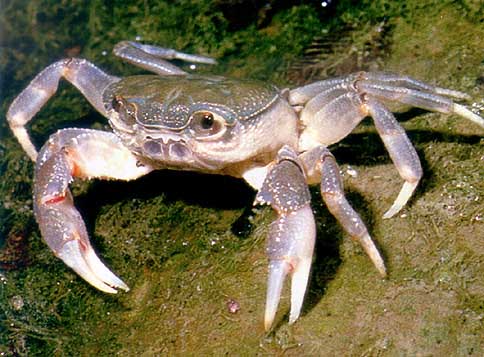
The Socotra Karst Crab (Socotra pseudocardisoma Cumberlidge & Wranik, 2002) is a terrestrial freshwater crab in the family Potamidae, order Decapoda and class Malacostraca. It is endemic to Socotra Island in Yemen, where it inhabits limestone and karst formations. It has a dark carapace with a lightly colored margin and legs that are light yellowish orange with darker coloration around the joints.
Written 27 November 2026 from the sources listed below. Each statement was checked against the passage it cites; statements that could not be supported were removed.
Appearance
The species has a dark carapace bordered by a lightly colored margin. Adult males commonly have a purplish-black carapace with a light brown margin, while adult females commonly have a dark brown carapace with a light yellow margin.[1][2][3]
The crab has a small facial area and a mandibular palp divided into three segments. Its legs are light yellowish orange, with darker coloration around the joints between segments.[4][5]
Juvenile specimens have been recorded with carapace widths of 26–27 millimeters. Adult specimens have been recorded with carapace widths of 77.2–90.5 millimeters.[6][7]
Habitat
The Socotra Karst Crab inhabits holes, crevices and caves in limestone outcrops on Socotra Island. It lives in karst formations and crevices, where individuals are difficult to find.[8][9][10]
Its habitat includes inland semi-arid uplands of Socotra Island, particularly the Diksam Plateau. The species has been recorded at elevations of 700 meters above sea level and at multiple locations at elevations of 700 meters or higher.[11][12][13]
Temporary streams and pools occur within limestone crevices and other limestone features in its habitat. The crab may obtain water from reserves located deeper within the limestone.[14][15]
Diet
Its preferred prey includes small reptiles, insects and native scolopendra.[16]
Captive specimens have consumed both plant and animal tissue. Observations of captive feeding indicate that the species is omnivorous.[17][18]
Behaviour
The crab has not been observed above ground during the dry months from April through October. During wetter months, individuals emerge after sundown to forage above ground.[19][20]
Reproduction and life cycle
Mating between individuals of this species has been observed in captivity. An observed captive mating pair remained in the mating position for approximately one day.[21][22]
Conservation
The species is classified as endangered on the IUCN Red List and was last assessed in 2024. Its population is thought to be decreasing, although its current number of living individuals is unknown.[23][24][25]
Housing developments and livestock farms have contributed to habitat destruction and fragmentation. Roads restrict dispersal by making movement between subpopulations dangerous.[26][27]
The species has historically been threatened by hunting for food.[28]
Classification of the Socotra Karst Crab
| Kingdom | Animalia |
|---|---|
| Phylum | Arthropoda |
| Subphylum | Crustacea |
| Class | Malacostraca |
| Order | Decapoda |
| Suborder | Pleocyemata |
| Infraorder | Brachyura |
| Section | Eubrachyura |
| Subsection | Heterotremata |
| Superfamily | Potamoidea |
| Family | Potamidae (Freshwater Crabs) |
| Subfamily | Potaminae |
| Genus | Socotra |
| Species | Socotra pseudocardisoma Cumberlidge & Wranik, 2002 |
Where the Socotra Karst Crab is found
Checklists and occurrence records place Socotra pseudocardisoma in 1 country. GBIF holds 5 georeferenced records of it.
Countries
A number beside a place is its count of GBIF occurrence records. A place without a number comes from a checklist alone. Records show where a species has been observed or collected, which can include escapes and vagrants.
Common names
English
- Socotra Karst Crab
Related species
-
 Japanese Freshwater CrabGeothelphusa dehaani
-
 Italian Freshwater CrabPotamon fluviatile
-
 Levantine Freshwater CrabPotamon potamios
-
 Singapore Freshwater CrabJohora singaporensis
-
 Iberian Freshwater CrabPotamon ibericum
-
 Rhodes Freshwater CrabPotamon rhodium
-
 Algerian Freshwater CrabPotamon algeriense
-
 Hong Kong South Sea CrabNanhaipotamon hongkongense
Compare
Questions and answers
What is the scientific name of the Socotra Karst Crab?
The scientific name of the Socotra Karst Crab is Socotra pseudocardisoma. Written with its author, the full name is Socotra pseudocardisoma Cumberlidge & Wranik, 2002.
Which family does the Socotra Karst Crab belong to?
Socotra pseudocardisoma belongs to the family Potamidae, in the order Decapoda and the class Malacostraca.
Where is the Socotra Karst Crab found?
Checklists and occurrence records place Socotra pseudocardisoma in 1 country: Yemen.
What is the conservation status of the Socotra Karst Crab?
The IUCN Red List category recorded for Socotra pseudocardisoma is Endangered (EN).
Sources
Passages the profile rests on
- The species has a dark carapace bordered by a lightly colored margin. Source passage: “S. pseudocardisoma has a dark carapace with a lightly colored margin.” — English Wikipedia
- Adult males commonly have a purplish-black carapace with a light brown margin. Source passage: “Males often have a purplish-black carapace bordered by a light brown margin” — English Wikipedia
- Adult females commonly have a dark brown carapace with a light yellow margin. Source passage: “females have a dark brown carapace with a light yellow margin.” — English Wikipedia
- The crab has a small facial area and a mandibular palp divided into three segments. Source passage: “The facial area of the crab is small, with a three segmented mandibular palp.” — English Wikipedia
- Its legs are light yellowish orange, with darker coloration around the joints between segments. Source passage: “The legs are an earthy light yellowish orange, with a darker gradation around the articulations of the leg segments.” — English Wikipedia
- Juvenile specimens have been recorded with carapace widths of 26–27 millimeters. Source passage: “carapace width of 26-27 millimeters as a juvenile” — English Wikipedia
- Adult specimens have been recorded with carapace widths of 77.2–90.5 millimeters. Source passage: “carapace width of 77.2-90.5 millimeters observed in adult specimens.” — English Wikipedia
- The species inhabits holes, crevices and caves in limestone outcrops on Socotra Island. Source passage: “resides in holes, crevices and caves that occur in limestone outcrops” — English Wikipedia
- The species is reported as living in karst formations. Source passage: “Socotra pseudocardisoma, in karst formations” — academia.edu
- The species lives in crevices, where individuals are difficult to find. Source passage: “Socotra pseudocardisoma lives in crevices, and crabs are not easy to ...” — commons.nmu.edu
- Its habitat includes inland semi-arid uplands of Socotra Island, particularly the Diksam Plateau. Source passage: “inland semi-arid uplands of Socotra Island in Yemen, particularly in the Diksam Plateau.” — English Wikipedia
- The species has been recorded at elevations of 700 meters above sea level. Source passage: “S. pseudocardisoma is found at elevations of 700 meters above sea level” — English Wikipedia
- The species has been recorded at multiple locations on Socotra Island at elevations of 700 meters or higher. Source passage: “observed in multiple locations at or above 700 m on the island of Socotra” — English Wikipedia
- Temporary streams and pools occur within limestone crevices and other limestone features in its habitat. Source passage: “Streams and pools can temporarily occur within the crevices and other features of the limestone” — English Wikipedia
- The crab may obtain water from reserves located deeper within the limestone. Source passage: “it may be accessing water reserves that potentially exist deeper within the limestone.” — English Wikipedia
- Its preferred prey includes small reptiles, insects and native scolopendra. Source passage: “Their preferred prey includes small reptiles, insects and native scolopendra” — English Wikipedia
- Captive specimens have consumed both plant and animal tissue. Source passage: “in captivity they have been observed consuming both plant and animal tissue” — English Wikipedia
- Observations of captive feeding indicate that the species is omnivorous. Source passage: “suggesting that this species is omnivorous.” — English Wikipedia
- The crab has not been observed above ground during the dry months from April through October. Source passage: “S. pseudocardisoma has not been observed above ground during the drier months between April and October.” — English Wikipedia
- During wetter months, individuals emerge after sundown to forage above ground. Source passage: “During rainier months, the crab emerges to forage for food above ground after sundown.” — English Wikipedia
- Mating between individuals of this species has been observed in captivity. Source passage: “Mating between members of S. pseudocardisoma has been observed in captivity.” — English Wikipedia
- An observed captive mating pair remained in the mating position for approximately one day. Source passage: “The male and female in this instance remained in the mating position for about a day.” — English Wikipedia
- The species is classified as endangered on the IUCN Red List. Source passage: “This species is marked as endangered” — English Wikipedia
- The species was last assessed in 2024 according to the document. Source passage: “This was last assessed in 2024.” — English Wikipedia
- The species' population is thought to be decreasing, although its current number of living individuals is unknown. Source passage: “Population numbers of S. pseudocardisoma are thought to be decreasing, though the exact number of individuals currently alive is not known.” — English Wikipedia
- Housing developments and livestock farms have contributed to habitat destruction and fragmentation. Source passage: “human developments, such as housing and livestock farms, and roads have contributed increasingly to habitat destruction and fragmentation.” — English Wikipedia
- Roads restrict dispersal by making movement between subpopulations dangerous. Source passage: “It is dangerous for individuals to cross roads to connect with other subpopulations, limiting dispersal.” — English Wikipedia
- The species has historically been threatened by hunting for food. Source passage: “The species has also historically faced the threat of being hunted for food.” — English Wikipedia
Data
- Catalogue of Life, 2026-10-16 XR cc by
- Global Biodiversity Information Facility CC BY 4.0
- Wikidata CC0
- GeoNames CC BY 4.0
- Wikimedia Commons per image; credit shown with each image
- Within the Catalogue of Life, this name comes from World Register of Marine Species cc by
References
- Cumberlidge, N., & Wranik, W. (2002). A new genus and new species of freshwater crab (Potamoidea, Potamidae) from Socotra Island, Yemen. Journal of Natural History, 36: 51–64. https://doi.org/10.1080/713833844 Link where the name was published
This species in other databases
- Catalogue of Life 4XYRZ
- Wikidata Q14362560
- iNaturalist 112728
- WoRMS urn:lsid:marinespecies.org:taxname:442966
Page built on 29 November 2026. See how the catalog is made and all sources and licences.
Cite this page
ScientificNames.org. (2026). Socotra pseudocardisoma (Socotra Karst Crab). Retrieved November 29, 2026, from https://scientificnames.org/species/socotra-pseudocardisoma
“Socotra pseudocardisoma (Socotra Karst Crab).” ScientificNames.org, 2026, scientificnames.org/species/socotra-pseudocardisoma. Accessed 29 Nov. 2026.
ScientificNames.org. “Socotra pseudocardisoma (Socotra Karst Crab).” Accessed November 29, 2026. https://scientificnames.org/species/socotra-pseudocardisoma.
@misc{scientificnames_socotra_pseudocardisoma_socotra_karst_crab,
  author = {{ScientificNames.org}},
  title = {Socotra pseudocardisoma (Socotra Karst Crab)},
  year = {2026},
  url = {https://scientificnames.org/species/socotra-pseudocardisoma},
  note = {Accessed 2026-11-29}
}