Species · Fishes
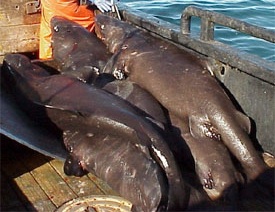
Greenland Shark Somniosus microcephalus
The scientific name of the Greenland Shark is Somniosus microcephalus. It is a species of fish in the family Somniosidae (sleeper sharks), order Squaliformes. The name dates from 1801.
- Scientific name
- Somniosus microcephalus (Bloch & Schneider, 1801)
- Common name
- Greenland Shark
- Genus
- Somniosus
- Family
- Somniosidae (Sleeper Sharks)
- Order
- Squaliformes
- Class
- Elasmobranchii
- Red List category
- VU Vulnerable
- Environment
- brackish, marine
- Recorded in
- 13 countries
- Name status
- accepted in the Catalogue of Life

Overview
Somniosus microcephalus occurs in the North Atlantic and Arctic Oceans, ranging from New England and Canada to Scandinavian waters. It is distinguished by its exceptionally slow swimming speed and an estimated minimum lifespan of 272 years.
Written 24 November 2026 from the sources listed below. Each statement was checked against the passage it cites; statements that could not be supported were removed.
Appearance
The shark has no dorsal fin spines and lacks an anal fin. Its rough skin is covered with curved, pointed denticles.[1][2]
The upper jaw has 48 to 52 thin, unserrated teeth. The lower jaw has 48 to 52 broad, square, interlocking teeth with short, smooth cusps.[3][4]
Adult Greenland sharks commonly grow to approximately 4 to 5 metres in length. The largest confirmed individual measured 6.4 metres and weighed approximately 1,023 kilograms, and females are generally larger than males.[5][6][7]
Habitat
The Greenland shark inhabits cold waters with temperatures between approximately -1.1 and 7.4 degrees Celsius. It commonly inhabits depths between 100 and 1,200 metres and mainly occupies continental and insular shelves.[8][9][10]
During winter, Greenland sharks occupy intertidal regions, river mouths, and shallow bays. They have been observed at depths reaching 2,200 metres, including at 1,749 metres in the Gulf of Mexico.[11][12][13]
Diet
Greenland sharks consume fish including herring, salmon, cod, haddock, halibut, redfish, sculpins, lumpfish, and skates. Seals are an important food source, while small Greenland sharks predominantly consume squid.[14][15][16]
The species scavenges carrion and is attracted to the smell of rotting meat. Individuals have been found with minke whale, moose, horse, and reindeer remains in their stomachs.[17][18][19]
Behaviour
Greenland sharks are slow-moving swimmers with exceptionally low swim speeds for their body size. Their average swimming speed is approximately 0.34 metres per second.[20][21]
They often hover near the seabed while searching for food and may ambush seals while the seals are asleep. They are generally solitary except during mating or when congregating around carrion.[22][23][24]
Reproduction and life cycle
Greenland sharks reproduce through ovoviviparity, with internal fertilization and live birth. Their estimated gestation period is between 8 and 18 years.[25][26][27]
Females may produce up to ten pups in a litter. Newborn pups are estimated to measure approximately 38 to 42 centimetres.[28][29]
Female Greenland sharks have been observed with mating scars on their caudal fins.[30]
Conservation
The Greenland shark is classified as Near Threatened by the World Conservation Union. Its estimated population doubling time exceeds 14 years.[31][32]
Its long gestation period and slow reproductive rate may limit its recovery from overfishing.[26][33]
Uses
Greenland sharks are commercially captured in Norwegian, Icelandic, and Greenland waters for their liver oil. Their dried meat is used for sled dog food and occasionally for human consumption in northern regions.[34][35]
Inuit communities have used Greenland shark skin to make boots. The lower dental bands have been used as knives for cutting hair.[36][37]
Similar species
The Greenland shark is closely related to the Pacific sleeper shark and southern sleeper shark.[38]
Classification of the Greenland Shark
| Kingdom | Animalia |
|---|---|
| Phylum | Chordata |
| Subphylum | Vertebrata |
| Infraphylum | Gnathostomata |
| Parvphylum | Chondrichthyes |
| Class | Elasmobranchii |
| Subclass | Neoselachii |
| Infraclass | Selachii |
| Superorder | Squalomorphi |
| Order | Squaliformes |
| Family | Somniosidae (Sleeper Sharks) |
| Genus | Somniosus (Sleeper Sharks) |
| Species | Somniosus microcephalus (Bloch & Schneider, 1801) |
Where the Greenland Shark is found
Checklists and occurrence records place Somniosus microcephalus in 13 countries. GBIF holds 978 georeferenced records of it.
Countries
- Canada 562
- Denmark 16
- Greenland 72
- Iceland 22
- Ireland 6
- Norway 43
- Russia 11
- Saint Pierre and Miquelon 3
- Svalbard and Jan Mayen 165
- Sweden 21
- The Netherlands 7
- United Kingdom 42
- United States 8
Regions and cities with the most records
- Svalbard, Svalbard and Jan Mayen 103
- Nunavut, Canada 32
- Quebec, Canada 12
- Halifax, Canada 4
- South Denmark, Denmark 3
1 more country has a few records outside this range
These countries hold a few records of Somniosus microcephalus but lie outside the range the checklists give for it. Such records are often zoo or garden specimens, museum material or vagrants, so the species is not counted as occurring there.
A number beside a place is its count of GBIF occurrence records. A place without a number comes from a checklist alone. Records show where a species has been observed or collected, which can include escapes and vagrants.
Common names
English
- Greenland Shark
- Southern Sleeper Shark
- Gray Shark
- Ground Shark
- Gurry Shark
- Sleeper Shark
Names in 16 other languages
- Danish
- Grønlandshaj, havkal
- Dutch
- Groenlandse haai, apekal
- French
- Requin dormeur, laimargue, laimargue atlantique, laimargue du Groenland, lamairgue du Groenland, leiche, requin du Groenland
- German
- Eishai, Grönlandhai
- Lithuanian
- arktinis ryklys
- Northern Sami
- hoakeret, áhkalakkis, áhkolakkis
- Norwegian Bokmål
- håkjerring
- Norwegian Nynorsk
- håkjerring, håmær
- Polish
- rekin polarny
- Russian
- Akula Poliarnaia, акула полярная
- Slovenian
- grenlandski morski pes
- Spanish
- Tiburón Boreal, Tollo De Groenlandia, tiburón de Groenlandia, tiburón ártico
- Swedish
- Haakjaringen, Haaskjardingen, håkäring
- Turkish
- Grönland köpek balığı
- Ukrainian
- Акула полярна гренландська
- Welsh
- Morgwn yr Ynys Las, morgi'r Ynys Las
Synonyms
9 other scientific names have been used for this species and are now treated as synonyms of Somniosus microcephalus.
- Laemargus microcephalus (Bloch & Schneider, 1801)
- Leiodon echinatum Wood, 1846
- Scymnus glacialis Faber, 1829
- Scymnus gunneri Thienemann, 1828
- Scymnus micropterus Valenciennes, 1832
- Somniosus brevipinna Lesueur, 1818
- Squalus borealis Scoresby, 1820
- Squalus microcephalus Bloch & Schneider, 1801
- Squalus norvegianus Blainville, 1825
Related species
-
 Pacific Sleeper SharkSomniosus pacificus
-
 Southern Sleeper SharkSomniosus antarcticus
- Taiwan Sleeper SharkSomniosus cheni
- Frog SharkSomniosus longus
-
 Little Sleeper SharkSomniosus rostratus
-
 Portuguese DogfishCentroscymnus coelolepis
-
 Velvet DogfishZameus squamulosus
-
 Roughskin DogfishCentroscymnus owstonii
Compare
Questions and answers
What is the scientific name of the Greenland Shark?
The scientific name of the Greenland Shark is Somniosus microcephalus. Written with its author, the full name is Somniosus microcephalus (Bloch & Schneider, 1801).
Which family does the Greenland Shark belong to?
Somniosus microcephalus belongs to the family Somniosidae, in the order Squaliformes and the class Elasmobranchii.
Where is the Greenland Shark found?
Checklists and occurrence records place Somniosus microcephalus in 13 countries, including Canada, Svalbard and Jan Mayen, Greenland, Norway, United Kingdom and Iceland.
What is the conservation status of the Greenland Shark?
The IUCN Red List category recorded for Somniosus microcephalus is Vulnerable (VU).
What other names does the Greenland Shark have?
Somniosus microcephalus is also known in English as Southern Sleeper Shark, Gray Shark, Ground Shark, Gurry Shark and Sleeper Shark.
What is a Greenland shark diet?
Greenland sharks consume fish such as herring, salmon, cod, haddock, halibut, redfish, sculpins, lumpfish, and skates. Seals are an important food source, small individuals predominantly consume squid, and the species also scavenges carrion.[14][15][16][18]
Sources
Passages the profile rests on
- The Greenland shark has no dorsal fin spines and lacks an anal fin. Source passage: “No spines are present in the two equally-sized dorsal fins, and the ventral lobe of the caudal fin is slightly elongated. No anal fin is present.” — animaldiversity.org
- The shark has rough skin covered with curved, pointed denticles. Source passage: “The skin is quite rough, exhibiting denticles with curved pointed cusps.” — animaldiversity.org
- The upper jaw has 48 to 52 thin, unserrated teeth. Source passage: “The 48 to 52 teeth of the upper jaw are very thin and pointed, lacking serrations.” — English Wikipedia
- The lower jaw has 48 to 52 broad, square, interlocking teeth with short, smooth cusps. Source passage: “The 48 to 52 lower teeth interlock, are broad and square in shape, and contain short, smooth cusps that point outward.” — English Wikipedia
- Adult Greenland sharks commonly grow to approximately 4 to 5 metres in length. Source passage: “The Greenland shark is one of the largest known existing species of shark, with adults growing to around 4 to 5 m (13 to 16 ft).” — English Wikipedia
- The largest confirmed Greenland shark measured 6.4 metres and weighed approximately 1,023 kilograms. Source passage: “The largest confirmed specimen measured up to 6.4 metres (21 ft) long and weighed around 1,023 kilograms (2,255 lb).” — English Wikipedia
- Female Greenland sharks are generally larger than males. Source passage: “Greenland sharks average in size from 244 to 427 cm (8-14) feet with females being the larger sex.” — floridamuseum.ufl.edu
- The Greenland shark inhabits cold waters with temperatures between approximately -1.1 and 7.4 degrees Celsius. Source passage: “The Greenland shark prefers cold water temperatures (−1.1 to 7.4 °C (30.0 to 45.3 °F))” — English Wikipedia
- The species commonly inhabits waters between 100 and 1,200 metres deep. Source passage: “deep water (100–1,200 m (330–3,940 ft)).” — English Wikipedia
- Greenland sharks mainly inhabit continental and insular shelves. Source passage: “Somniosus microcephalus live mainly on continental and insular shelves.” — animaldiversity.org
- During winter, Greenland sharks occupy intertidal regions, river mouths, and shallow bays. Source passage: “They occupy intertidal regions in addition to some river mouths and shallow bay areas during the winter months” — animaldiversity.org
- The species has been observed at depths reaching 2,200 metres. Source passage: “They have been observed as low as 1200 meters, with one observation at 2200 meters off the coast of Georgia” — animaldiversity.org
- Greenland sharks have been recorded at 1,749 metres in the Gulf of Mexico. Source passage: “In August 2013, researchers from Florida State University caught a Greenland shark in the Gulf of Mexico at a depth of 1,749 m (5,738 ft)” — English Wikipedia
- Greenland sharks consume fish including herring, salmon, cod, haddock, halibut, redfish, sculpins, lumpfish, and skates. Source passage: “They primarily eat fish (herring, salmon, smelt, cod, wolffish, haddock, halibut, redfish, sculpins, lumpfish, and skates) and seals.” — English Wikipedia
- Seals are an important food source for Greenland sharks. Source passage: “They primarily eat fish (herring, salmon, smelt, cod, wolffish, haddock, halibut, redfish, sculpins, lumpfish, and skates) and seals.” — English Wikipedia
- Small Greenland sharks predominantly consume squid. Source passage: “Small Greenland sharks eat predominantly squid, as well as sea birds, crabs, amphipods, sea snails, brittle stars, sea urchins, and jellyfish.” — English Wikipedia
- Greenland sharks have been found with minke whale remains in their stomachs. Source passage: “Some Greenland sharks have been found also to eat minke whale.” — English Wikipedia
- Greenland sharks scavenge carrion and are attracted to the smell of rotting meat. Source passage: “The Greenland shark is known to be a scavenger and is attracted by the smell of rotting meat in the water.” — English Wikipedia
- Greenland sharks have been found with moose, horse, and reindeer remains in their stomachs. Source passage: “Greenland sharks have also been found with remains of moose, horse, and reindeer (in one case an entire reindeer carcass) in their stomachs.” — English Wikipedia
- Greenland sharks are slow-moving swimmers with exceptionally low swim speeds for their body size. Source passage: “this species is sluggish and slow moving, with the lowest swim speed and tail-beat frequency for its size across all fish species” — English Wikipedia
- The species swims at an average speed of approximately 0.34 metres per second. Source passage: “It swims at an average of 0.34 m (1 ft 1 in) per second” — English Wikipedia
- Greenland sharks may ambush seals while the seals are asleep. Source passage: “the sharks are thought to ambush while seals are asleep.” — English Wikipedia
- Greenland sharks often hover near the seabed while searching for food. Source passage: “They spend much of their time hovering near the sea floor in search of food.” — animaldiversity.org
- Greenland sharks are generally solitary except during mating or when congregating around carrion. Source passage: “Greenland sharks are solitary, outside of the mating season or when large groups occur to exploit carrion” — animaldiversity.org
- Greenland sharks reproduce through ovoviviparity and give birth to live young. Source passage: “Greenland sharks are born alive (a process known as ovoviviparity)” — English Wikipedia
- The estimated gestation period of Greenland sharks is between 8 and 18 years. Source passage: “after an estimated gestation period of 8–18 years.” — English Wikipedia
- Fertilization in Greenland sharks occurs internally. Source passage: “Fertilization occurs internally.” — animaldiversity.org
- Greenland sharks may produce up to ten pups in a litter. Source passage: “Some suggest that this species produces up to 10 pups per litter” — English Wikipedia
- Newborn Greenland shark pups are estimated to measure approximately 38 to 42 centimetres. Source passage: “each initially measuring some 38–42 cm (15–17 in) in length.” — English Wikipedia
- Female Greenland sharks have been observed with mating scars on their caudal fins. Source passage: “females have been found with mating scars on their caudal fins.” — animaldiversity.org
- The Greenland shark is classified as Near Threatened by the World Conservation Union in document 2. Source passage: “It is currently listed as “Near Threatened” by the World Conservation Union (IUCN).” — floridamuseum.ufl.edu
- The estimated population doubling time of Greenland sharks exceeds 14 years. Source passage: “with an estimated doubling time of more than 14 years.” — floridamuseum.ufl.edu
- The long gestation period and slow reproductive rate of Greenland sharks may limit their recovery from overfishing. Source passage: “their long gestation period and slow reproductive rate may severely limit their ability to recover from overfishing.” — English Wikipedia
- Greenland sharks are commercially captured in Norwegian, Icelandic, and Greenland waters for their liver oil. Source passage: “the shark supports fisheries in Norwegian, Iceland, and Greenland waters where it is captured for its liver oil.” — floridamuseum.ufl.edu
- Dried Greenland shark meat is used for sled dog food and occasionally for human consumption in northern regions. Source passage: “The dried meat is widely used in Northern regions for sled dog, and occasionally human, consumption.” — floridamuseum.ufl.edu
- Inuit communities have used Greenland shark skin to make boots. Source passage: “Eskimos, for instance, use the dried skin as leather for boots” — floridamuseum.ufl.edu
- The lower dental bands of Greenland sharks have been used as knives for cutting hair. Source passage: “and the lower dental bands of the shark as knives primarily for cutting hair.” — floridamuseum.ufl.edu
- The Greenland shark is closely related to the Pacific sleeper shark and southern sleeper shark. Source passage: “closely related to the Pacific and southern sleeper sharks.” — English Wikipedia
Data
- Catalogue of Life, 2026-10-16 XR cc by
- Global Biodiversity Information Facility CC BY 4.0
- Wikidata CC0
- GeoNames CC BY 4.0
- Wikimedia Commons per image; credit shown with each image
- Within the Catalogue of Life, this name comes from World Register of Marine Species cc by
This species in other databases
Page built on 24 November 2026. See how the catalog is made and all sources and licences.
Cite this page
ScientificNames.org. (2026). Somniosus microcephalus (Greenland Shark). Retrieved November 24, 2026, from https://scientificnames.org/species/somniosus-microcephalus
“Somniosus microcephalus (Greenland Shark).” ScientificNames.org, 2026, scientificnames.org/species/somniosus-microcephalus. Accessed 24 Nov. 2026.
ScientificNames.org. “Somniosus microcephalus (Greenland Shark).” Accessed November 24, 2026. https://scientificnames.org/species/somniosus-microcephalus.
@misc{scientificnames_somniosus_microcephalus_greenland_shark,
  author = {{ScientificNames.org}},
  title = {Somniosus microcephalus (Greenland Shark)},
  year = {2026},
  url = {https://scientificnames.org/species/somniosus-microcephalus},
  note = {Accessed 2026-11-24}
}