Species · Insects
Pacific Cicada Killer Sphecius convallis
The scientific name of the Pacific Cicada Killer is Sphecius convallis. It is a species of insect in the family Crabronidae (sand wasps), order Hymenoptera. The name dates from 1879.
- Scientific name
- Sphecius convallis Patton, 1879
- Common name
- Pacific Cicada Killer
- Genus
- Sphecius
- Family
- Crabronidae (Sand Wasps)
- Order
- Hymenoptera
- Class
- Insecta
- Recorded in
- 2 countries
- Name status
- accepted in the Catalogue of Life

Overview
The Pacific Cicada Killer is a large apoid wasp. The species is reported from Central America and North America.
Written 26 November 2026 from the sources listed below. Each statement was checked against the passage it cites; statements that could not be supported were removed.
Appearance
The Pacific Cicada Killer belongs to the group of large apoid wasps.[1]
Habitat
The species is reported from Central America and North America. It was studied in an aggregation at Ruby, Arizona.[2][3]
Diet
Females hunt cicadas in nearby trees to provision their nests. They provision their offspring with between one and nine paralyzed annual cicadas.[4][5]
Behaviour
At Ruby, Arizona, kingbirds and Greater Roadrunners stole cicada prey from this species. Seventy percent of kingbird attacks on provisioning wasps at Ruby were successful.[6][7]
Conspecific females can steal provisioned nest cells by laying an egg on the cicada and closing the cell.[8]
Reproduction and life cycle
Females emerge in early summer, mate, excavate burrows, and begin provisioning nest cells. They place captured cicadas in individual cells inside their burrows.[9][10]
Females provision their offspring with between one and nine paralyzed annual cicadas.[5]
Classification of the Pacific Cicada Killer
| Kingdom | Animalia |
|---|---|
| Phylum | Arthropoda |
| Subphylum | Hexapoda |
| Class | Insecta (Insect) |
| Order | Hymenoptera (Ants) |
| Suborder | Apocrita (Ants) |
| Infraorder | Aculeata |
| Superfamily | Apoidea (Bees) |
| Family | Crabronidae (Sand Wasps) |
| Subfamily | Bembicinae (Sand Wasps) |
| Tribe | Bembicini |
| Subtribe | Spheciina |
| Genus | Sphecius (Cicadakillers) |
| Species | Sphecius convallis Patton, 1879 |
Where the Pacific Cicada Killer is found
Checklists and occurrence records place Sphecius convallis in 2 countries across North America. GBIF holds 394 georeferenced records of it.
Countries
Regions and cities with the most records
- California, United States 154
- Arizona, United States 126
- Blythe, United States 30
- Palm Desert, United States 30
- Rancho Mirage, United States 30
- La Quinta, United States 24
- Indio, United States 21
- Catalina Foothills, United States 20
- Cathedral City, United States 20
- Coachella, United States 19
- Tucson, United States 19
- Casas Adobes, United States 18
- Flowing Wells, United States 18
- Palm Springs, United States 18
- Nevada, United States 17
- Oro Valley, United States 16
- Baja California Sur, Mexico 14
- Las Vegas, United States 14
- North Las Vegas, United States 14
- Paradise, United States 14
- Sunrise Manor, United States 14
- Whitney, United States 14
- Winchester, United States 14
- Drexel Heights, United States 12
- Tanque Verde, United States 12
- Texas, United States 12
- Henderson, United States 10
- Shafter, United States 10
- Spring Valley, United States 9
- Desert Hot Springs, United States 8
- Enterprise, United States 8
- La Paz, Mexico 8
- New Mexico, United States 7
- Fountain Hills, United States 6
- Mesa, United States 6
- Summerlin South, United States 6
Range as the checklists state it
Middle America
North America
A number beside a place is its count of GBIF occurrence records. A place without a number comes from a checklist alone. Records show where a species has been observed or collected, which can include escapes and vagrants.
Common names
English
- Pacific Cicada Killer
- Pacific Cicada-killer Wasp
Synonyms
2 other scientific names have been used for this species and are now treated as synonyms of Sphecius convallis.
- Sphecius raptor Handlirsch, 1889
- Sphecius speciosus convallis Patton, 1879
Related species
-
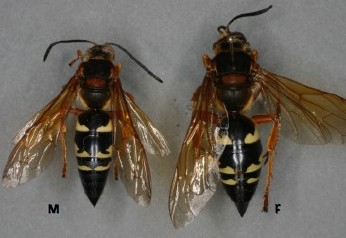 Eastern Cicada KillerSphecius speciosus
-
 Western Cicada KillerSphecius grandis
- Caribbean Cicada-killer WaspSphecius hogardii
- Sphecius antennatus
- Sphecius conicus
- Sphecius nigricornis
- Sphecius lutescens
- Sphecius persa
Compare
Questions and answers
What is the scientific name of the Pacific Cicada Killer?
The scientific name of the Pacific Cicada Killer is Sphecius convallis. Written with its author, the full name is Sphecius convallis Patton, 1879.
Which family does the Pacific Cicada Killer belong to?
Sphecius convallis belongs to the family Crabronidae, in the order Hymenoptera and the class Insecta.
Where is the Pacific Cicada Killer found?
Checklists and occurrence records place Sphecius convallis in 2 countries: United States and Mexico.
What other names does the Pacific Cicada Killer have?
Sphecius convallis is also known in English as Pacific Cicada-killer Wasp.
Sources
Passages the profile rests on
- The species belongs to the group of large apoid wasps. Source passage: “Cicada killers in the genus Sphecius (Dahlbom 1843) are large apoid wasps” — pmc.ncbi.nlm.nih.gov
- The species is reported from Central America and North America. Source passage: “It is found in Central America and North America.” — inaturalist.org
- The species was studied in an aggregation at Ruby, Arizona. Source passage: “Ruby, Arizona (Sphecius convallis Patton)” — pmc.ncbi.nlm.nih.gov
- Females hunt cicadas in nearby trees to provision their nests. Source passage: “Females hunt cicadas in the neighboring trees and sting them, resulting in complete, irreversible paralysis.” — pmc.ncbi.nlm.nih.gov
- Females provision their offspring with between one and nine paralyzed annual cicadas. Source passage: “provision their young with one to as many as nine paralyzed ‘annual’ cicadas.” — pmc.ncbi.nlm.nih.gov
- At Ruby, Arizona, kingbirds and Greater Roadrunners stole cicada prey from this species. Source passage: “Many prey (Tibicen parallelus Davis [Hemiptera: Cicadidae]) were stolen from S. convallis by kingbirds and Greater Roadrunners at Ruby.” — pmc.ncbi.nlm.nih.gov
- Seventy percent of kingbird attacks on provisioning wasps at Ruby were successful. Source passage: “Seventy percent of kingbird attacks on provisioning wasps were successful.” — pmc.ncbi.nlm.nih.gov
- Conspecific females can steal provisioned nest cells by laying an egg on the cicada and closing the cell. Source passage: “conspecific females might kleptoparasitize by laying an egg on the cicada and closing the nest cell.” — pmc.ncbi.nlm.nih.gov
- Females emerge in early summer, mate, excavate burrows, and begin provisioning nest cells. Source passage: “Females emerge in early summer, mate, dig a burrow, and begin provisioning nest cells.” — pmc.ncbi.nlm.nih.gov
- Females place captured cicadas in individual cells inside their burrows. Source passage: “The cicada is sequestered in a cell in the burrow.” — pmc.ncbi.nlm.nih.gov
Data
- Catalogue of Life, 2026-10-16 XR cc by
- Global Biodiversity Information Facility CC BY 4.0
- Wikidata CC0
- GeoNames CC BY 4.0
- Wikimedia Commons per image; credit shown with each image
- Within the Catalogue of Life, this name comes from The Integrated Taxonomic Information System cc0
This species in other databases
Page built on 27 November 2026. See how the catalog is made and all sources and licences.
Cite this page
ScientificNames.org. (2026). Sphecius convallis (Pacific Cicada Killer). Retrieved November 27, 2026, from https://scientificnames.org/species/sphecius-convallis
“Sphecius convallis (Pacific Cicada Killer).” ScientificNames.org, 2026, scientificnames.org/species/sphecius-convallis. Accessed 27 Nov. 2026.
ScientificNames.org. “Sphecius convallis (Pacific Cicada Killer).” Accessed November 27, 2026. https://scientificnames.org/species/sphecius-convallis.
@misc{scientificnames_sphecius_convallis_pacific_cicada_killer,
  author = {{ScientificNames.org}},
  title = {Sphecius convallis (Pacific Cicada Killer)},
  year = {2026},
  url = {https://scientificnames.org/species/sphecius-convallis},
  note = {Accessed 2026-11-27}
}