Species · Insects
African Mantis Sphodromantis lineola
The scientific name of the African Mantis is Sphodromantis lineola. It is a species of insect in the family Mantidae (mantids), order Mantodea. The name dates from 1838.
- Scientific name
- Sphodromantis lineola Burmeister, 1838
- Common name
- African Mantis
- Genus
- Sphodromantis
- Family
- Mantidae (Mantids)
- Order
- Mantodea
- Class
- Insecta
- Environment
- terrestrial
- Recorded in
- 20 countries
- Name status
- accepted in the Catalogue of Life
Overview
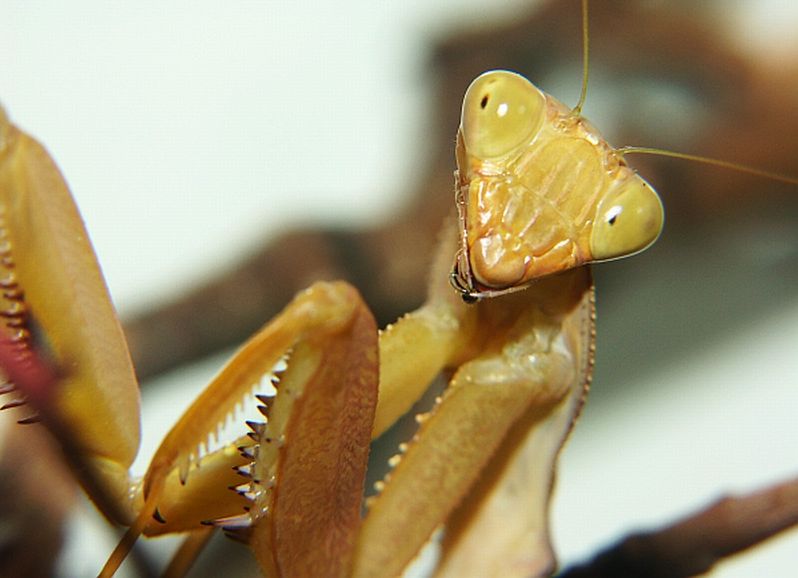
The species is native to the African continent. Adults are commonly green or brown and have robust raptorial forelegs, a triangular head, and a very elongated, narrow prothorax.
Written 26 November 2026 from the sources listed below. Each statement was checked against the passage it cites; statements that could not be supported were removed.
Appearance
Adults are commonly green but can also be brown. Some brown individuals have purple-colored eyes.[1][2]
The species has a triangular head that can rotate through 180 degrees. Its large compound eyes are positioned at the corners of the head, and its visual range is 2–15 m.[3][4][5]
The species has apposition-based compound eyes and a well-developed motion-detection visual system for detecting moving objects. Its prothorax is very elongated and narrow.[6][7][8]
The species has robust raptorial forelegs used to capture prey and defend against predators, as well as long, slender walking legs. Whitish spots or stripes occur on both sides of the forewing in the anterior or flank regions of the abdomen.[9][10][11]
Females have six abdominal segments, whereas males have eight. Nymphs lack wings and curl their abdomens over their bodies.[12][13]
The documented length range for African mantises is 1–17 cm.[14]
Similar species
The African mantis can be distinguished from Sphodromantis baccettii by the absence of blue-black spots on its forearms.[15]
Habitat
The African mantis is native to the African continent.[16][17]
Diet
The African mantis mainly feeds on other insects. It can also capture and consume vertebrates.[18][19]
Behaviour
The African mantis is an ambush predator that waits for prey before striking. It uses visual motion detection and proprioceptive information to locate prey and deliver accurate strikes.[20][21]
The species uses looming visual signals to detect and calculate the movement of approaching organisms or objects. It can also respond to visual cues from objects or organisms that are not familiar prey.[22][23]
Females may consume males after mating. Well-fed females in captivity have been observed not to cannibalize males after copulation.[24][25]
Reproduction and life cycle
Male individuals are attracted to females through olfactory, visual, and tactile signals. Females perform specific antennal movements as part of premating behaviour that attracts males.[26][27]
Female sexual cannibalism has been associated with nutritional requirements for producing additional offspring.[28]
Conservation
The African mantis is used in biological control research.[29]
Uses
The African mantis is sometimes raised in captivity. It has been used in research investigating visual systems and motion detection.[30][31]
The species has also been used to investigate sexual cannibalism in mantises.[32]
Classification of the African Mantis
| Kingdom | Animalia |
|---|---|
| Phylum | Arthropoda |
| Subphylum | Hexapoda |
| Class | Insecta (Insect) |
| Order | Mantodea |
| Suborder | Eumantodea |
| Infraorder | Schizomantodea |
| Parvorder | Artimantodea |
| Nanorder | Cernomantodea |
| Family | Mantidae (Mantids) |
| Subfamily | Tenoderinae |
| Tribe | Paramantini |
| Subtribe | Paramantina |
| Genus | Sphodromantis |
| Species | Sphodromantis lineola Burmeister, 1838 |
Where the African Mantis is found
Checklists and occurrence records place Sphodromantis lineola in 20 countries across Africa. GBIF holds 273 georeferenced records of it.
Countries
- Burkina Faso 3
- Cameroon 30
- Democratic Republic of the Congo 19
- Equatorial Guinea 3
- Eritrea 3
- Ethiopia 3
- Gabon 71
- Ghana 52
- Guinea-Bissau 3
- Ivory Coast 6
- Kenya 3
- Mali 3
- Nigeria 6
- Republic of the Congo 2
- Sierra Leone 7
- Sudan 3
- Tanzania 12
- Togo 32
- Uganda 9
- Zimbabwe 3
Regions and cities with the most records
- Ogooué-Ivindo, Gabon 63
- Basankusu, Democratic Republic of the Congo 6
- Estuaire, Gabon 6
- Équateur, Democratic Republic of the Congo 6
- Volta, Ghana 3
A number beside a place is its count of GBIF occurrence records. A place without a number comes from a checklist alone. Records show where a species has been observed or collected, which can include escapes and vagrants.
Common names
English
- African Mantis
- African Lined Mantis
- African Praying Mantis
Names in 2 other languages
- German
- Ghana-Gottesanbeterin
- Portuguese
- Louva-a-deus-do-Gana
Synonyms
One other scientific name has been used for this species and is now treated as a synonym of Sphodromantis lineola.
- Mantis lineola Burmeister, 1838
Subspecies and varieties
- Sphodromantis lineola lineola subspecies
- Sphodromantis lineola pinguis subspecies
- Sphodromantis lineola speciosa subspecies
Related species
-
 African MantisSphodromantis viridis
-
 Common Green MantisSphodromantis gastrica
-
 Sphodromantis baccettii
- Sphodromantis aurea
- Sphodromantis centralis
- Sphodromantis aethiopica
- Sphodromantis congica
- Sphodromantis pavonina
Compare
Questions and answers
What is the scientific name of the African Mantis?
The scientific name of the African Mantis is Sphodromantis lineola. Written with its author, the full name is Sphodromantis lineola Burmeister, 1838.
Which family does the African Mantis belong to?
Sphodromantis lineola belongs to the family Mantidae, in the order Mantodea and the class Insecta.
Where is the African Mantis found?
Checklists and occurrence records place Sphodromantis lineola in 20 countries, including Gabon, Ghana, Togo, Cameroon, Democratic Republic of the Congo and Tanzania.
What other names does the African Mantis have?
Sphodromantis lineola is also known in English as African Lined Mantis and African Praying Mantis.
Sources
Passages the profile rests on
- Adults are commonly green but can also have brown coloration. Source passage: “S. lineola is often colored green, however they can also be colored different types of brown.” — English Wikipedia
- Some brown individuals have purple-colored eyes. Source passage: “The brown colored individuals have also been observed with purple colored eyes.” — English Wikipedia
- The species has a triangular head that can rotate through 180 degrees. Source passage: “It has a very mobile triangular head that can turn 180°” — sanbi.org
- The species has large compound eyes positioned at the corners of its head. Source passage: “large compound eyes set up in the head’s corners” — sanbi.org
- The species has a visual range of 2–15 m. Source passage: “with a visual range of 2–15 m.” — sanbi.org
- The species has a motion-detection visual system that is well developed for detecting moving objects. Source passage: “Since S. lineola are sit and wait predators they have a well developed motion detection visual system.” — English Wikipedia
- The species has apposition-based compound eyes. Source passage: “This species of mantis like most other species have apposition based compound eyes” — English Wikipedia
- The species has a very elongated and narrow prothorax. Source passage: “The prothorax, first part of the thorax section between the head and the abdomen, is very elongated and narrow.” — sanbi.org
- The species has robust raptorial forelegs used for capturing prey and defending against predators. Source passage: “The raptorial forelegs are their defining feature and African mantises use them to capture prey and defend themselves from predators.” — sanbi.org
- The species has long, slender walking legs. Source passage: “They have long, slender walking legs used for lunging.” — sanbi.org
- The species has whitish spots or stripes on the anterior or flank regions of the abdomen on both sides of the forewing. Source passage: “The African mantis has whitish spots or stripes in the anterior part or the flank of the abdomen on each side of the fore wing.” — sanbi.org
- Female individuals have six abdominal segments, whereas males have eight. Source passage: “females have six and males have eight abdominal segments.” — sanbi.org
- Nymphs lack wings and curl their abdomens over their bodies. Source passage: “Nymphs lack wings and curl the abdomen over the body.” — sanbi.org
- The documented length range for African mantises is 1–17 cm. Source passage: “They are robust insects 1–17 cm in length.” — sanbi.org
- The species can be distinguished from Sphodromantis baccettii by lacking blue-black spots on its forearms. Source passage: “It may be distinguished from S. baccettii by the absence of blue-black spots on its forearms.” — English Wikipedia
- The species is native to the African continent. Source passage: “is a species of praying mantis native to the continent of Africa” — English Wikipedia
- The species is native to Africa. Source passage: “is a species of praying mantis from Africa sometimes raised in captivity.” — inaturalist.org
- The species mainly feeds on other insects. Source passage: “they are mainly insectivores preying on other insects.” — English Wikipedia
- The species can also capture and consume vertebrates. Source passage: “Mantids are also known to be able to capture and feed on vertebrates.” — English Wikipedia
- The species is an ambush predator that waits for prey before striking. Source passage: “Like most praying mantis this species is an ambush predator.” — English Wikipedia
- The species uses visual motion detection and proprioceptive information to locate prey and deliver accurate strikes. Source passage: “They use their well developed motion detection visual systems as well as proprioceptive information to detect prey and then deliver a carefully calculated and extremely accurate strike.” — English Wikipedia
- The species uses looming visual signals to detect and calculate the movement of approaching organisms or objects. Source passage: “They use looming signals in order to detect and calculate other organisms or objects heading towards them using motion-in-depth perception.” — English Wikipedia
- The species can respond to visual cues from objects or organisms that are not familiar prey. Source passage: “They have also demonstrated to respond to visual cues which are not of their usual prey or that they have ever encountered” — English Wikipedia
- Females of this species may consume males after mating. Source passage: “Many mantid species are known to show cannibalism post copulation, S. lineola being one of these species.” — English Wikipedia
- Well-fed females in captivity have been observed not to cannibalize males after copulation. Source passage: “In captivity, under circumstances in which females are well fed, they have been shown to not perform cannibalism on the male mantid after copulation.” — English Wikipedia
- Male individuals are attracted to females through olfactory, visual, and tactile signals. Source passage: “Males are mainly attracted to females through olfactory and visual signals as well as with tactile cues.” — English Wikipedia
- Females perform specific antennal movements as part of premating behaviour that attracts males. Source passage: “Females must perform mainly specific antennal movements as a premating behavior along with hormones in order to attract the attention of the males.” — English Wikipedia
- Female sexual cannibalism has been associated with nutritional requirements for producing additional offspring. Source passage: “Studies have come to the conclusion that this behavior can be attributed female mantids needing nutrition in order to produce more offspring.” — English Wikipedia
- The species is used in biological control research. Source passage: “The African mantises play a vital role in biological control research.” — sanbi.org
- The species is sometimes raised in captivity. Source passage: “sometimes raised in captivity.” — inaturalist.org
- The species has been used in research investigating visual systems and motion detection. Source passage: “They have contributed in the field for theories and topics like the flicker effect idea; the effect of invisible noise on insect motion detection; motion-in-depth perception of mantises;” — English Wikipedia
- The species has been used to investigate sexual cannibalism in mantises. Source passage: “Furthermore, this species has also been used to study the sexual cannibalism behavior seen so often in mantids” — English Wikipedia
Data
- Catalogue of Life, 2026-10-16 XR cc by
- Global Biodiversity Information Facility CC BY 4.0
- Wikidata CC0
- GeoNames CC BY 4.0
- Wikimedia Commons per image; credit shown with each image
- Within the Catalogue of Life, this name comes from Mantodea Species File cc by
References
- Burmeister, H.C.C. (1838) Handb. Ent., Burm., 2. where the name was published
This species in other databases
Page built on 26 November 2026. See how the catalog is made and all sources and licences.
Cite this page
ScientificNames.org. (2026). Sphodromantis lineola (African Mantis). Retrieved November 26, 2026, from https://scientificnames.org/species/sphodromantis-lineola
“Sphodromantis lineola (African Mantis).” ScientificNames.org, 2026, scientificnames.org/species/sphodromantis-lineola. Accessed 26 Nov. 2026.
ScientificNames.org. “Sphodromantis lineola (African Mantis).” Accessed November 26, 2026. https://scientificnames.org/species/sphodromantis-lineola.
@misc{scientificnames_sphodromantis_lineola_african_mantis,
  author = {{ScientificNames.org}},
  title = {Sphodromantis lineola (African Mantis)},
  year = {2026},
  url = {https://scientificnames.org/species/sphodromantis-lineola},
  note = {Accessed 2026-11-26}
}