Species · Mammals
Western Spotted Skunk Spilogale gracilis
The scientific name of the Western Spotted Skunk is Spilogale gracilis. It is a species of mammal in the family Mephitidae (skunks), order Carnivora. The name dates from 1890.
- Scientific name
- Spilogale gracilis Merriam, 1890
- Common name
- Western Spotted Skunk
- Genus
- Spilogale
- Family
- Mephitidae (Skunks)
- Order
- Carnivora
- Class
- Mammalia
- Red List category
- LC Least Concern
- Recorded in
- 3 countries
- Name status
- accepted in the Catalogue of Life

Overview
Spilogale gracilis occurs throughout the western United States, northern Mexico, and southwestern British Columbia, Canada.
Written 26 November 2026 from the sources listed below. Each statement was checked against the passage it cites; statements that could not be supported were removed.
Appearance
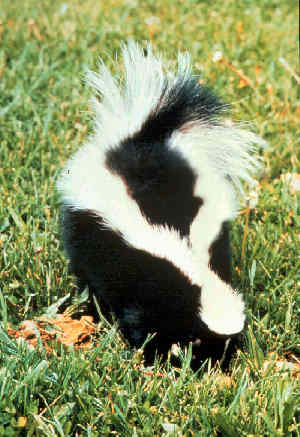
Its tail is conspicuously large, long-haired, and measures 10–16 cm. The underside is white for nearly half its length, and the tip is extensively white.[1][2]
The forefoot claws are longer and more curved than the hind-foot claws, and each foot has five toes. Normally black fur can occasionally appear red or brown, while normally white areas can appear gray or yellow.[3][4][5]
Adults measure approximately 35–45 cm in total length. Adult males weigh between 336 and 734 g, while adult females weigh between 227 and 482 g.[6][7][8]
Male western spotted skunks average 423 mm in length, including a 134 mm tail, and weigh 565 g. Females average 360 mm in length, including a 129 mm tail, and weigh 368 g.[9][10]
Habitat
The Western Spotted Skunk inhabits mixed woodlands, open areas, and farmlands. Suitable habitats include conifer forests, riparian areas, brushy habitats, thickets, and farmlands.[11][12]
The species prefers rocky bluffs and canyon stream beds bordered by brush. In Idaho and Washington, it prefers riparian areas containing brush thickets, while in eastern Oregon and northern Mexico it is often found near cliffs and canyons.[13][14][15]
In Washington, the species generally occurs from sea level to 1,970 feet in the Olympic Mountains. It occasionally occurs at elevations up to 2,950 feet in the Cascade Mountains.[16][17]
Diet
Western Spotted Skunks are nocturnal omnivores that consume insects, small vertebrates, roots, grains, fruits, and berries. Common insect prey includes beetles, grasshoppers, and caterpillars.[18][19]
The species also consumes eggs and carrion, as well as birds, reptiles, amphibians, and berries. Its prey can be as large as the ashy storm petrel.[20][21][22]
Small mammals and insects constitute the bulk of the species' diet in Washington.[23]
Behaviour
Western Spotted Skunks are primarily nocturnal and usually solitary, although two or three females sometimes share a burrow. They generally remain within half a mile of their dens.[24][25][26]
The species is not a true hibernator but may sleep for several weeks during winter. Females may form winter denning groups containing as many as 20 individuals, while males remain solitary.[27][28][29]
When threatened, the species stamps its forefeet and raises its hindquarters. It can spray musk while standing on its forelegs and raising its hindlegs and tail.[30][31]
The Western Spotted Skunk is an agile climber and an excellent digger. It generally ignores nearby people and animals unless disturbed.[32][33]
Reproduction and life cycle
Western Spotted Skunks typically mate in September. After fertilization, embryonic development pauses at the blastocyst stage before implantation several months later.[34][35]
Gestation, including delayed implantation, lasts approximately 230–250 days. Litters typically contain two to five young born in May.[36][37]
Newborn young are blind and almost hairless and weigh approximately 11 g. Young females become sexually mature at approximately four or five months of age.[38][39][40]
Conservation
The Western Spotted Skunk is described as neither endangered nor threatened. Its population in Washington is unknown.[41][42]
Verified occurrences in Washington's Puget Trough have apparently declined substantially since the 1970s. The species remains widespread and common on Washington's Olympic Peninsula according to recent carnivore surveys.[43][44]
Vehicle collisions, trapping, and pest control may be major sources of mortality in many populations.[45]
Uses
Western Spotted Skunks help reduce agricultural and garden pest populations by consuming them.[46]
Similar species
The Western Spotted Skunk is smaller than the striped skunk. It resembles the eastern spotted skunk but has more extensive white markings.[47][48]
Classification of the Western Spotted Skunk
| Kingdom | Animalia |
|---|---|
| Phylum | Chordata |
| Subphylum | Vertebrata |
| Infraphylum | Gnathostomata |
| Parvphylum | Osteichthyes |
| Megaclass | Tetrapoda |
| Class | Mammalia (Mammal) |
| Subclass | Theria |
| Infraclass | Eutheria |
| Order | Carnivora (Carnivores) |
| Suborder | Caniformia (Dog-like Carnivores) |
| Family | Mephitidae (Skunks) |
| Genus | Spilogale (Spotted Skunk) |
| Species | Spilogale gracilis Merriam, 1890 |
Where the Western Spotted Skunk is found
Checklists and occurrence records place Spilogale gracilis in 3 countries across North America. GBIF holds 2,565 georeferenced records of it.
Countries
Regions and cities with the most records
- California, United States 693
- Oregon, United States 242
- New Mexico, United States 119
- Utah, United States 116
- Washington, United States 100
- Texas, United States 78
- Springfield, United States 76
- Arizona, United States 66
- Baja California Sur, Mexico 66
- Colorado, United States 56
- Nevada, United States 37
- Alameda, United States 32
- Albany, United States 32
- Oakland, United States 32
- Berkeley, United States 31
- Lafayette, United States 31
- Moraga, United States 31
- Orinda, United States 31
- San Angelo, United States 31
- Glendale, United States 30
- San Leandro, United States 30
- Walnut Creek, United States 30
- El Cerrito, United States 29
- Los Angeles, United States 29
- East Los Angeles, United States 28
- Poway, United States 27
- Richmond, United States 27
- San Pablo, United States 27
- Altadena, United States 26
- Pasadena, United States 26
- Alhambra, United States 25
- Burbank, United States 25
- La Cañada Flintridge, United States 25
- La Crescenta-Montrose, United States 25
- San Francisco, United States 25
- British Columbia, Canada 24
Range as the checklists state it
Middle America
North America
A number beside a place is its count of GBIF occurrence records. A place without a number comes from a checklist alone. Records show where a species has been observed or collected, which can include escapes and vagrants.
Common names
English
- Western Spotted Skunk
Names in 15 other languages
- Arabic
- ظربان مرقط غربي
- Catalan
- Mofeta pigada
- Chinese
- 西部斑臭鼬
- Dutch
- Westelijk Gevlekt Stinkdier, Westelijke Gevlekte Skunk
- French
- Moufette gracile, mouffette tachetée occidentale
- German
- Westlicher Fleckenskunk, Westliches Fleckenstinktier
- Greek
- Δυτικός Στικτός Μεφίτης
- Italian
- Moffetta macchiata occidentale
- Japanese
- セイブマダラスカンク
- Korean
- 서부얼룩스컹크
- Norwegian Bokmål
- Vestlig Flekkskunk
- Polish
- Skunks plamisty, Skunksik smukły
- Russian
- Малый скунс
- Spanish
- Mofeta moteada occidental, Zorrillo manchado occidental
- Turkish
- Batı benekli kokarcası
Subspecies and varieties
- Spilogale gracilis amphialus subspecies
- Spilogale gracilis gracilis (Canyon Spotted Skunk) subspecies
- Spilogale gracilis latifrons (British Columbia Spotted Skunk) subspecies
- Spilogale gracilis lucasana (Southern Baja California Spotted Skunk) subspecies
- Spilogale gracilis martirensis (Northern Baja California Spotted Skunk) subspecies
- Spilogale gracilis phenax (California Spotted Skunk) subspecies
Related species
-
 Eastern Spotted SkunkSpilogale putorius
-
 Southern Spotted SkunkSpilogale angustifrons
- Pygmy Spotted SkunkSpilogale pygmaea
-
Yucatán Spotted SkunkSpilogale yucatanensis
- Plains Spotted SkunkSpilogale interrupta
- Desert Spotted SkunkSpilogale leucoparia
-
 Striped SkunkMephitis mephitis
-
 Hooded SkunkMephitis macroura
Compare
Questions and answers
What is the scientific name of the Western Spotted Skunk?
The scientific name of the Western Spotted Skunk is Spilogale gracilis. Written with its author, the full name is Spilogale gracilis Merriam, 1890.
Which family does the Western Spotted Skunk belong to?
Spilogale gracilis belongs to the family Mephitidae, in the order Carnivora and the class Mammalia.
Where is the Western Spotted Skunk found?
Checklists and occurrence records place Spilogale gracilis in 3 countries: United States, Mexico and Canada.
What is the conservation status of the Western Spotted Skunk?
The IUCN Red List category recorded for Spilogale gracilis is Least Concern (LC).
Are western spotted skunks rare?
The species is described as neither endangered nor threatened. It remains widespread and common on Washington's Olympic Peninsula, although verified occurrences in Washington's Puget Trough have apparently declined substantially since the 1970s.[41][43][44]
What do western spotted skunks eat?
Western Spotted Skunks are nocturnal omnivores that eat insects, small vertebrates, roots, grains, fruits, and berries. They also consume eggs and carrion, as well as birds, reptiles, and amphibians.[18][20][22]
What is the main diet of a skunk?
In Washington, small mammals and insects constitute the bulk of the Western Spotted Skunk's diet.[23]
Where do western spotted skunks live?
Western Spotted Skunks occur throughout the western United States, northern Mexico, and southwestern British Columbia, Canada.[49]
Sources
Passages the profile rests on
- The tail is conspicuously large, long-haired, and measures 10–16 cm. Source passage: “The animal has a conspicuously large, long-haired tail, measuring 10 to 16 cm (3.9 to 6.3 in).” — English Wikipedia
- The underside of the tail is white for nearly half its length, and its tip is extensively white. Source passage: “The underside of the tail is white for nearly half its length and the tip is extensively white.” — animaldiversity.org
- The forefoot claws are longer and more curved than the hind-foot claws. Source passage: “The claws on the fore-feet are longer, and more curved, than those on the hind feet.” — English Wikipedia
- The normally black fur can occasionally appear red or brown, while normally white areas can appear gray or yellow. Source passage: “In special cases, the normally black areas of the fur can appear in shades of red or brown, and areas of the skunk that traditionally appear white may appear in shades of gray or yellow” — English Wikipedia
- The species has five toes on each foot. Source passage: “They have five toes on each foot” — animaldiversity.org
- Adults measure approximately 35–45 cm in total length. Source passage: “With a total length of 35–45 cm (14–18 in), the western spotted skunk is smaller than the striped skunk” — English Wikipedia
- Adult males weigh between 336 and 734 g. Source passage: “Males, which weigh 336 to 734 g (11.9 to 25.9 oz)” — English Wikipedia
- Adult females weigh between 227 and 482 g. Source passage: “females, at 227 to 482 g (8.0 to 17.0 oz)” — English Wikipedia
- Male western spotted skunks average 423 mm in length, including a 134 mm tail, and weigh 565 g. Source passage: “Males average 423mm in length (134 of that being tail) and 565 g in weight.” — animaldiversity.org
- Female western spotted skunks average 360 mm in length, including a 129 mm tail, and weigh 368 g. Source passage: “Females average 360 mm (129 tail) and 368 g” — animaldiversity.org
- The species inhabits mixed woodlands, open areas, and farmlands. Source passage: “Their habitat is mixed woodlands, open areas, and farmlands.” — English Wikipedia
- Suitable habitats include conifer forests, riparian areas, brushy habitats, thickets, and farmlands. Source passage: “including conifer forests, riparian areas, thickets and brushy habitats, and farmlands.” — wdfw.wa.gov
- In Idaho and Washington, western spotted skunks prefer riparian areas containing brush thickets. Source passage: “In areas such as Idaho and Washington, they prefer riparian areas that have brush thickets in which to hide and forage.” — English Wikipedia
- In eastern Oregon and northern Mexico, the species is often found near cliffs and canyons. Source passage: “members of the species that live in areas such as eastern Oregon or northern Mexico can often be found near cliffs and canyons.” — English Wikipedia
- Western spotted skunks prefer rocky bluffs and canyon stream beds bordered by brush. Source passage: “The western spotted skunk prefers rocky bluffs and brush-bordered canyon stream beds.” — animaldiversity.org
- In Washington, western spotted skunks generally occur from sea level to 1,970 feet in the Olympic Mountains. Source passage: “Western spotted skunks generally occur from sea level to 1,970 feet in elevation in the Olympic Mountains” — wdfw.wa.gov
- The species occasionally occurs at elevations up to 2,950 feet in the Cascade Mountains. Source passage: “and occasionally up to 2,950 feet in the Cascade Mountains.” — wdfw.wa.gov
- Western spotted skunks are nocturnal omnivores that consume insects, small vertebrates, roots, grains, fruits, and berries. Source passage: “Western spotted skunks are nocturnal omnivores, feeding on insects, scorpions, small vertebrates, (such as mice, voles, other rodents, rabbit kits, small birds, small reptiles and amphibians), roots, grains, fruit, and berries.” — English Wikipedia
- Common insect prey includes beetles, grasshoppers, and caterpillars. Source passage: “Common insects eaten include beetles, grasshoppers, and caterpillars.” — English Wikipedia
- The species also consumes eggs and carrion. Source passage: “They also feed on eggs and carrion.” — English Wikipedia
- Western spotted skunks can consume prey as large as the ashy storm petrel. Source passage: “However, they have been found to consume prey as large as the ashy storm petrel.” — English Wikipedia
- The species also eats birds, bird eggs, reptiles, amphibians, berries, fruits, and carrion. Source passage: “this omnivore will also eat carrion, berries, fruit, birds, bird eggs, reptiles, and amphibians.” — wdfw.wa.gov
- Small mammals and insects constitute the bulk of the species' diet in Washington. Source passage: “The bulk of the diet is made up of small mammals and insects” — wdfw.wa.gov
- Western spotted skunks are primarily nocturnal. Source passage: “Western spotted skunks are nocturnal omnivores” — English Wikipedia
- The species is usually solitary, although two or three females sometimes share a burrow. Source passage: “They spend the day in dens, and are usually solitary, although sometimes two or three females will share a single burrow.” — English Wikipedia
- Western spotted skunks generally remain within half a mile of their dens. Source passage: “They usually range within a half a mile of their den” — animaldiversity.org
- Western spotted skunks are not true hibernators but may sleep for several weeks during winter. Source passage: “While they do not engage in true hibernation, they may sleep for several weeks during the winter.” — English Wikipedia
- Females may form winter denning groups containing as many as 20 individuals. Source passage: “During this time, females may den in groups that have been observed as large as 20.” — English Wikipedia
- Males remain solitary during winter. Source passage: “Males remain solitary during the winter.” — English Wikipedia
- The species stamps its forefeet and raises its hindquarters when threatened. Source passage: “When threatened, western spotted skunks display threat behavior, stamping their fore-feet before raising their hind parts in the air and showing their conspicuous warning coloration.” — English Wikipedia
- Western spotted skunks can spray musk while standing on their forelegs and raising their hindlegs and tail. Source passage: “While they can spray by standing on their forelegs and raising their hindlegs and tail in the air” — English Wikipedia
- The species is an agile climber and an excellent digger. Source passage: “S. gracilis is also very mobile - it is an agile climber and an excellent digger” — animaldiversity.org
- The species generally ignores nearby people and animals unless disturbed. Source passage: “Even when other animals or people are in close proximity, skunks will ignore the intruders unless they are disturbed.” — wdfw.wa.gov
- Western spotted skunks typically mate in September. Source passage: “Western spotted skunks typically mate in September when females come into heat” — English Wikipedia
- After fertilization, embryonic development pauses at the blastocyst stage before implantation several months later. Source passage: “After fertilization, the embryo develops to the blastocyst stage, but then becomes dormant for several months before implanting in the uterine wall around April.” — English Wikipedia
- Gestation, including delayed implantation, lasts approximately 230–250 days. Source passage: “Including this period of delayed implantation, gestation lasts 230 to 250 days” — English Wikipedia
- Litters typically contain two to five young born in May. Source passage: “with the litter of two to five young being born in May.” — English Wikipedia
- Newborn western spotted skunks are blind and almost hairless. Source passage: “At birth, the young are blind and almost hairless” — English Wikipedia
- Newborn young weigh approximately 11 g. Source passage: “weighing around 11 g (0.39 oz).” — English Wikipedia
- Young females become sexually mature at approximately four or five months of age. Source passage: “Young females become sexually mature at about 4 or 5 months of age” — animaldiversity.org
- The species is described as neither endangered nor threatened. Source passage: “remains neither endangered nor threatened.” — English Wikipedia
- The population of western spotted skunks in Washington is unknown. Source passage: “The population of western spotted skunk in Washington is unknown.” — wdfw.wa.gov
- Verified occurrences in Washington's Puget Trough have apparently declined substantially since the 1970s. Source passage: “The increased occurrence of opossums and loss and fragmentation of forest habitats due to urban and agricultural development may explain the apparent substantial decline of verified occurrences in the Puget Trough since the 1970s.” — wdfw.wa.gov
- Western spotted skunks remain widespread and common on Washington's Olympic Peninsula according to recent carnivore surveys. Source passage: “Data from numerous recent carnivore surveys on the Olympic Peninsula indicate that western spotted skunks continue to be widespread and common there.” — wdfw.wa.gov
- Vehicle collisions, trapping, and pest control may be major sources of mortality in many populations. Source passage: “Human-created causes, such as vehicle collisions, trapping, and pest control, may be the prevalent sources of mortality in many populations.” — wdfw.wa.gov
- Western spotted skunks help reduce agricultural and garden pest populations by consuming them. Source passage: “Skunks are beneficial to farmers, gardeners, and landowners because they feed on large numbers of agricultural and garden pests.” — wdfw.wa.gov
- The western spotted skunk is smaller than the striped skunk. Source passage: “the western spotted skunk is smaller than the striped skunk (Mephitis mephitis).” — English Wikipedia
- The western spotted skunk resembles the eastern spotted skunk but has more extensive white markings. Source passage: “The western spotted skunk looks much like the eastern spotted skunk except that the white areas are more extensive.” — animaldiversity.org
- The species occurs throughout the western United States, northern Mexico, and southwestern British Columbia, Canada. Source passage: “The western spotted skunk is found throughout the western United States, northern Mexico, and southwestern British Columbia in Canada.” — English Wikipedia
Data
- Catalogue of Life, 2026-10-16 XR cc by
- Global Biodiversity Information Facility CC BY 4.0
- Wikidata CC0
- GeoNames CC BY 4.0
- Wikimedia Commons per image; credit shown with each image
- Within the Catalogue of Life, this name comes from The Integrated Taxonomic Information System cc0
References
- N. Amer. Fauna vol.3 p.83 where the name was published
- Wilson, Don E., and DeeAnn M. Reeder, eds. (1993). Mammal Species of the World: A Taxonomic and Geographic Reference, 2nd Ed., 3rd Printing.
- Wilson, Don E., and DeeAnn M. Reeder, eds. (2005). Mammal Species of the World: A Taxonomic and Geographic Reference, 3rd Ed., Vols. 1 & 2.
- Dragoo, J. W. / Don E. Wilson and Russell A. Mittermeier, eds. (2009). Family Mephitidae (Skunks). Handbook of the Mammals of the World. Vol. 1: Carnivores.
- McDonough, Molly M., Adam W. Ferguson, Robert C. Dowler, Matthew E. Gompper, and Jesús E. Maldonado. (2022). Phylogenomic systematics of the spotted skunks (Carnivora, Mephitidae, Spilogale): Additional species diversity and Pleistocene climate change as a major driver of diversification. Molecular Phylogenetics and Evolution, Vol. 167, 107266.
This species in other databases
Page built on 27 November 2026. See how the catalog is made and all sources and licences.
Cite this page
ScientificNames.org. (2026). Spilogale gracilis (Western Spotted Skunk). Retrieved November 27, 2026, from https://scientificnames.org/species/spilogale-gracilis
“Spilogale gracilis (Western Spotted Skunk).” ScientificNames.org, 2026, scientificnames.org/species/spilogale-gracilis. Accessed 27 Nov. 2026.
ScientificNames.org. “Spilogale gracilis (Western Spotted Skunk).” Accessed November 27, 2026. https://scientificnames.org/species/spilogale-gracilis.
@misc{scientificnames_spilogale_gracilis_western_spotted_skunk,
  author = {{ScientificNames.org}},
  title = {Spilogale gracilis (Western Spotted Skunk)},
  year = {2026},
  url = {https://scientificnames.org/species/spilogale-gracilis},
  note = {Accessed 2026-11-27}
}