Species · Insects
Spilosoma gynephaea
Spilosoma gynephaea has no English name on record in the checklists used here. It is a species of insect in the family Erebidae (erebid moths), order Lepidoptera. The name dates from 1901.
- Scientific name
- Spilosoma gynephaea Hampson, 1901
- Genus
- Spilosoma
- Family
- Erebidae (Erebid Moths)
- Order
- Lepidoptera
- Class
- Insecta
- Name status
- accepted in the Catalogue of Life
Overview
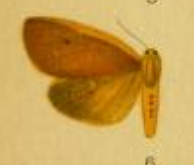
Spilosoma gynephaea occurs in South Africa and Zimbabwe. The male has yellow forewings with fine black streaks along the veins, while the female has orange-brown forewings and fuscous black hindwings.
Written 27 November 2026 from the sources listed below. Each statement was checked against the passage it cites; statements that could not be supported were removed.
Appearance
The male has an orange head, blackish palpi and antennae, and a pale yellow thorax. Its pectus and legs are grey, with orange upper surfaces on the femora.[1][2]
The male has an orange abdomen with dorsal and lateral rows of black spots, except on the first segment, and a grey-white underside. Its forewings are yellow with fine black streaks along the veins, except in the costal area, and its hindwings are pale yellow.[3][4][5]
The female has a deep orange head and thorax, with fuscous pectus, legs, and abdominal underside.[6][7]
The female has orange-brown forewings with orange coloration along the costal area extending beyond the middle, the inner margin, and the cilia. A black point is present at the lower angle of the forewing cell.[8][9]
The female has fuscous black hindwings with a diffuse orange streak on the median nervure. The inner margins, cilia, and discoidal point are orange.[10][11]
The female's hindwing underside is orange, with a large fuscous patch on the terminal area extending from the costa to vein 2.[12]
The male has a wingspan of 36 mm.[13]
Classification of Spilosoma gynephaea
| Kingdom | Animalia |
|---|---|
| Phylum | Arthropoda |
| Subphylum | Hexapoda |
| Class | Insecta (Insect) |
| Order | Lepidoptera |
| Superfamily | Noctuoidea |
| Family | Erebidae (Erebid Moths) |
| Subfamily | Arctiinae |
| Tribe | Arctiini |
| Genus | Spilosoma |
| Species | Spilosoma gynephaea Hampson, 1901 |
Related species
-
 Yellow BearSpilosoma virginica
- White ErmineSpilosoma lubricipeda
-
 Agreeable Tiger MothSpilosoma congrua
-
 Dubious Tiger MothSpilosoma dubia
-
 Water ErmineSpilosoma urticae
-
 Vestal Tiger MothSpilosoma vestalis
-
 Pink-legged Tiger MothSpilosoma latipennis
-
 Wandering Tiger MothSpilosoma vagans
Compare
Questions and answers
Where does Spilosoma gynephaea occur?
It occurs in South Africa and Zimbabwe.[14]
What is the wingspan of the male?
The male has a wingspan of 36 mm.[13]
Sources
Passages the profile rests on
- The male has an orange head, blackish palpi and antennae, and a pale yellow thorax. Source passage: “Head orange; palpi and antennae blackish; thorax pale yellow;” — English Wikipedia
- The male has grey pectus and legs, with orange upper surfaces on the femora. Source passage: “pectus and legs grey, the latter with the femora orange above;” — English Wikipedia
- The male's orange abdomen has dorsal and lateral rows of black spots, except on the first segment, and a grey-white underside. Source passage: “abdomen orange with dorsal and lateral series of black spots except on 1st segment, the ventral surface grey white.” — English Wikipedia
- The male has yellow forewings with fine black streaks along the veins, except in the costal area. Source passage: “Forewing yellow, the veins finely streaked with black except on costal area.” — English Wikipedia
- The male's hindwings are pale yellow. Source passage: “Hindwing pale yellow.” — English Wikipedia
- The female has a deep orange head and thorax. Source passage: “Head and thorax deep orange;” — English Wikipedia
- The female has fuscous pectus, legs, and abdominal underside. Source passage: “pectus, legs, and ventral surface of abdomen fuscous.” — English Wikipedia
- The female has orange-brown forewings with orange coloration along the costal area extending beyond the middle, the inner margin, and the cilia. Source passage: “Forewing orange brown, the costal area to beyond middle, the inner margin finely, and the cilia orange;” — English Wikipedia
- The female has a black point at the lower angle of the forewing cell. Source passage: “a black point at lower angle of cell.” — English Wikipedia
- The female's hindwings are fuscous black, with a diffuse orange streak on the median nervure. Source passage: “Hindwing fuscous black; a diffused orange streak on median nervure;” — English Wikipedia
- The female's hindwings have orange inner margins, cilia, and a discoidal point. Source passage: “the inner margin and cilia orange; an orange discoidal point;” — English Wikipedia
- The female's hindwing underside is orange with a large fuscous patch on the terminal area extending from the costa to vein 2. Source passage: “the underside orange with large fuscous patch on terminal area from costa to vein 2.” — English Wikipedia
- The male has a wingspan of 36 mm. Source passage: “The wingspan of the male is 36 mm” — English Wikipedia
- Spilosoma gynephaea occurs in South Africa and Zimbabwe. Source passage: “It is found in South Africa and Zimbabwe.” — English Wikipedia
Data
- Catalogue of Life, 2026-10-16 XR cc by
- Wikidata CC0
- Wikimedia Commons per image; credit shown with each image
- Within the Catalogue of Life, this name comes from Global Lepidoptera Index cc by
References
- Hampson, G. F. (1901). New species of Syntomidae and Arctiadae. https://www.biodiversitylibrary.org/page/29980213 Link where the name was published
This species in other databases
Page built on 29 November 2026. See how the catalog is made and all sources and licences.
Cite this page
ScientificNames.org. (2026). Spilosoma gynephaea. Retrieved November 29, 2026, from https://scientificnames.org/species/spilosoma-gynephaea
“Spilosoma gynephaea.” ScientificNames.org, 2026, scientificnames.org/species/spilosoma-gynephaea. Accessed 29 Nov. 2026.
ScientificNames.org. “Spilosoma gynephaea.” Accessed November 29, 2026. https://scientificnames.org/species/spilosoma-gynephaea.
@misc{scientificnames_spilosoma_gynephaea,
  author = {{ScientificNames.org}},
  title = {Spilosoma gynephaea},
  year = {2026},
  url = {https://scientificnames.org/species/spilosoma-gynephaea},
  note = {Accessed 2026-11-29}
}