Species · Birds
Biscutate Swift Streptoprocne biscutata
The scientific name of the Biscutate Swift is Streptoprocne biscutata. It is a species of bird in the family Apodidae (swift), order Apodiformes. The name dates from 1866.
- Scientific name
- Streptoprocne biscutata (P. L. Sclater, 1866)
- Common name
- Biscutate Swift
- Genus
- Streptoprocne
- Family
- Apodidae (Swift)
- Order
- Apodiformes
- Class
- Aves
- Red List category
- LC Least Concern
- Recorded in
- 3 countries
- Name status
- accepted in the Catalogue of Life

Overview
Streptoprocne biscutata inhabits montane evergreen forests, lowland evergreen forests, tropical deciduous forests, and scrublands. It has an almost square tail, a wide white breast band, and a narrow white band on the nape and sides of the neck.
Written 26 November 2026 from the sources listed below. Each statement was checked against the passage it cites; statements that could not be supported were removed.
Appearance
The Biscutate Swift has an almost square tail, and males and females have identical plumage. Adults of the nominate subspecies have a sooty brown head that is lighter on the forehead, chin, and around the eyes.[1][2]
The adult body is sooty blackish brown, with a wide white breast band and a narrow white band on the nape and sides of the neck. The outer webs of the wing and tail feathers are blackish, while their inner webs are pale gray brown.[3][4]
Juveniles have grayish white edges on their belly feathers and grayish white tail tips.[5]
The species measures approximately 22 cm in length and weighs approximately 115 g. Streptoprocne biscutata seridoensis is smaller than the nominate subspecies.[6][7][8]
Habitat
The Biscutate Swift inhabits montane evergreen forests and lowland evergreen forests. It also occurs in tropical deciduous forests and more open environments such as scrublands.[9][10][11][12]
Diet
The Biscutate Swift feeds on insects while foraging in the air. Its presumed prey includes insects from multiple orders.[13][14]
Behaviour
The Biscutate Swift forages primarily in flocks consisting only of its own species. It sometimes forages alongside white-collared swifts.[15][16]
The species remains throughout the year in southern Brazil. It occurs in the far northern part of its range during the austral winter, from February through October.[17][18]
Its principal vocalization consists of repeated chee or weep notes.[19]
Reproduction and life cycle
The Biscutate Swift breeds colonially in caves. It constructs its nest from lichen, bryophytes, other plant material, and soil, placing it on a ledge or attaching it to a vertical wall.[20][21][22]
The clutch contains between one and four eggs. Both parents incubate the eggs and care for the offspring.[23][24]
The incubation period lasts approximately 24 days. Young birds fledge approximately 33 days after hatching.[25][26]
Conservation
The Biscutate Swift is assessed as Least Concern by the IUCN. It has a large geographic range, but its population size is unknown and believed to be declining.[27][28]
No immediate threats to the species have been identified. Potential threats include collisions with wires, pesticide bioaccumulation, and climate-related changes in insect populations.[29][30]
Classification of the Biscutate Swift
| Kingdom | Animalia |
|---|---|
| Phylum | Chordata |
| Subphylum | Vertebrata |
| Infraphylum | Gnathostomata |
| Parvphylum | Osteichthyes |
| Megaclass | Tetrapoda |
| Class | Aves (Bird) |
| Order | Apodiformes (Swifts) |
| Family | Apodidae (Swift) |
| Subfamily | Cypseloidinae |
| Genus | Streptoprocne (White-collared Swifts) |
| Species | Streptoprocne biscutata (P. L. Sclater, 1866) |
Where the Biscutate Swift is found
Checklists and occurrence records place Streptoprocne biscutata in 3 countries across South America. GBIF holds 3,339 georeferenced records of it.
Countries
Regions and cities with the most records
- Minas Gerais, Brazil 618
- Rio de Janeiro, Brazil 507
- Bahia, Brazil 465
- Mato Grosso, Brazil 377
- Chapada dos Guimarães, Brazil 352
- Paraná, Brazil 281
- São Paulo, Brazil 232
- Rio Grande do Sul, Brazil 199
- Ceará, Brazil 194
- Cachoeiras de Macacu, Brazil 175
- Santa Bárbara, Brazil 163
- Barão de Cocais, Brazil 160
- Guapimirim, Brazil 134
- São Pedro, Brazil 115
- Teresópolis, Brazil 113
- Santa Catarina, Brazil 109
- Magé, Brazil 89
- Espírito Santo, Brazil 88
- Goiás, Brazil 70
- Nova Friburgo, Brazil 69
- Petrópolis, Brazil 69
- Quixadá, Brazil 63
- Sobral, Brazil 56
- Itatiaia, Brazil 53
- Piauí, Brazil 51
- Piraquara, Brazil 51
- Massapê, Brazil 48
- Meruoca, Brazil 48
- Pinhais, Brazil 48
- Resende, Brazil 43
- São José dos Pinhais, Brazil 43
- Quatro Barras, Brazil 36
- Campos do Jordão, Brazil 34
- Raposos, Brazil 31
- Forquilha, Brazil 29
- Morretes, Brazil 29
Range as the checklists state it
South America
A number beside a place is its count of GBIF occurrence records. A place without a number comes from a checklist alone. Records show where a species has been observed or collected, which can include escapes and vagrants.
Common names
English
- Biscutate Swift
Names in 25 other languages
- Arabic
- سمامة بيسكوتات
- Catalan
- falciot de collar incomplet
- Chinese
- 巴西黑雨燕
- Croatian
- brazilska čiopa
- Czech
- rorýs brazilský
- Danish
- Skjoldsejler
- Dutch
- Witschildgierzwaluw
- Esperanto
- brazila apodo
- Estonian
- brasiilia kosepiiritaja
- Finnish
- brasiliankiitäjä
- French
- Martinet à collier interrompu
- German
- Schildsegler
- Hungarian
- szemellenzős sarlósfecske
- Italian
- Rondone dal collare interrotto, Rondone scudato
- Japanese
- シロエリアマツバメ
- Lithuanian
- šarvuotasis amerikinis čiurlys
- Norwegian
- skjoldseiler
- Polish
- lotniarz brazylijski
- Portuguese
- Andorinhão-de-coleira-falha, andorinhão-de-coleira-interrompida, taperuçu-de-coleira-falha
- Russian
- Бразильский стриж, Щитоносный американский стриж
- Slovak
- sadziar kapucňový
- Spanish
- Vencejo nuca blanca, Vencejo nuquiblanco brasileño
- Swedish
- halvmåneseglare
- Turkish
- Çift Yakalı Ebabil
- Ukrainian
- свіфт бразильський
Synonyms
One other scientific name has been used for this species and is now treated as a synonym of Streptoprocne biscutata.
- Chaetura biscutata P. L. Sclater, 1866
Subspecies and varieties
- Streptoprocne biscutata biscutata subspecies
- Streptoprocne biscutata seridoensis subspecies
Related species
-
 White-collared SwiftStreptoprocne zonaris
-
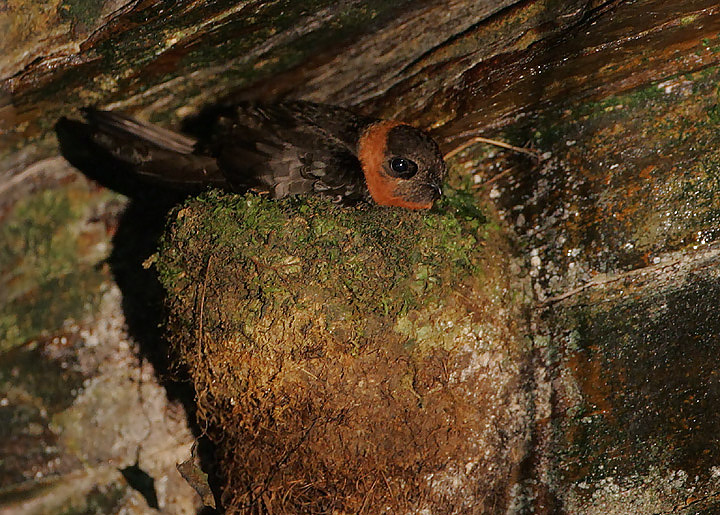 Chestnut-collared SwiftStreptoprocne rutila
-
 White-naped SwiftStreptoprocne semicollaris
- Tepui SwiftStreptoprocne phelpsi
-
 Common SwiftApus apus
-
 Chimney SwiftChaetura pelagica
-
 Edible-nest SwiftletAerodramus fuciphagus
-
 Edible-nest SwiftletAerodramus germani
Compare
Questions and answers
What is the scientific name of the Biscutate Swift?
The scientific name of the Biscutate Swift is Streptoprocne biscutata. Written with its author, the full name is Streptoprocne biscutata (P. L. Sclater, 1866).
Which family does the Biscutate Swift belong to?
Streptoprocne biscutata belongs to the family Apodidae, in the order Apodiformes and the class Aves.
Where is the Biscutate Swift found?
Checklists and occurrence records place Streptoprocne biscutata in 3 countries: Brazil, Argentina and Paraguay.
What is the conservation status of the Biscutate Swift?
The IUCN Red List category recorded for Streptoprocne biscutata is Least Concern (LC).
What is the swift bird famous for?
The Biscutate Swift is distinguished by its almost square tail, wide white breast band, and narrow white band on the nape and sides of the neck.[1][3]
What is special about swift birds?
The Biscutate Swift forages primarily in flocks of its own species, sometimes alongside white-collared swifts. It breeds colonially in caves.[15][16][20]
What are some species of swift birds?
The two recognized subspecies of the Biscutate Swift are Streptoprocne biscutata biscutata and Streptoprocne biscutata seridoensis.[31]
Sources
Passages the profile rests on
- The species has an almost square tail and identical plumage in males and females. Source passage: “It has an almost square tail and the sexes have the same plumage.” — English Wikipedia
- Adults of the nominate subspecies have a sooty brown head that is lighter on the forehead, chin, and around the eyes. Source passage: “Adults of the nominate subspecies have a sooty brown head that is lighter on the forehead, chin, and around the eyes.” — English Wikipedia
- The adult body is sooty blackish brown, with a wide white breast band and a narrow white band on the nape and sides of the neck. Source passage: “Their body is sooty blackish brown except for a wide white band across the breast and a narrow white band on the nape and somewhat on the sides of the neck; the bands do not meet.” — English Wikipedia
- The outer webs of the wing and tail feathers are blackish, while their inner webs are pale gray brown. Source passage: “The wing and tail feathers are blackish on their outer webs and pale gray brown on the inner ones.” — English Wikipedia
- Juveniles have grayish white edges on their belly feathers and grayish white tail tips. Source passage: “Juveniles are similar to adults with the addition of grayish white edges to the belly feathers and the tips of the tail.” — English Wikipedia
- The biscutate swift measures approximately 22 cm in length. Source passage: “The biscutate swift is about 22 cm (8.7 in) long” — English Wikipedia
- The species weighs approximately 115 g. Source passage: “weighs about 115 g (4.1 oz).” — English Wikipedia
- The subspecies Streptoprocne biscutata seridoensis is smaller than the nominate subspecies. Source passage: “Subspecies S. b. seridoensis has essentially the same plumage as the nominate but is smaller.” — English Wikipedia
- The species inhabits montane evergreen forests. Source passage: “It inhabits a variety of landscapes including montane and lowland evergreen forest” — English Wikipedia
- The species inhabits lowland evergreen forests. Source passage: “It inhabits a variety of landscapes including montane and lowland evergreen forest” — English Wikipedia
- The species occurs in tropical deciduous forests. Source passage: “tropical deciduous forest” — English Wikipedia
- The species also inhabits more open environments such as scrublands. Source passage: “and more open habitats like scrublands.” — English Wikipedia
- The biscutate swift feeds on insects while foraging in the air. Source passage: “Like all swifts, the biscutate is an aerial insectivore.” — English Wikipedia
- Its presumed prey includes insects from multiple orders. Source passage: “insects of many orders are their prey.” — English Wikipedia
- The species forages primarily in flocks consisting only of its own species. Source passage: “It forages mostly in single-species flocks” — English Wikipedia
- The species sometimes forages alongside white-collared swifts. Source passage: “but sometimes with white-collared swifts (S. zonaris).” — English Wikipedia
- The species remains throughout the year in southern Brazil. Source passage: “The biscutate swift is a year-round resident in southern Brazil.” — English Wikipedia
- The species occurs in the far northern part of its range during the austral winter, from February through October. Source passage: “It is found in the far north of its range only during the austral winter months of February to October” — English Wikipedia
- The principal vocalization of the species is described as repeated chee or weep notes. Source passage: “The biscutate swift's principal vocalization is described as "chee chee chee chee chee..." or "weep-weep-weep".” — English Wikipedia
- The species breeds colonially in caves. Source passage: “The biscutate swift breeds colonially in caves.” — English Wikipedia
- The nest is constructed from lichen, bryophytes, other plant material, and soil. Source passage: “It builds a nest of lichen, bryophytes, other plant material, and soil” — English Wikipedia
- The species places its nest on a ledge or attaches it to a vertical wall. Source passage: “on a ledge or adhering to a vertical wall.” — English Wikipedia
- The clutch contains between one and four eggs. Source passage: “The clutch size is one to four eggs.” — English Wikipedia
- Both parents incubate the eggs and care for the offspring. Source passage: “Both parents incubate the eggs and care for the young.” — English Wikipedia
- The incubation period lasts approximately 24 days. Source passage: “The incubation period is about 24 days” — English Wikipedia
- Young birds fledge approximately 33 days after hatching. Source passage: “fledging occurs about 33 days after hatch.” — English Wikipedia
- The species is assessed as Least Concern by the IUCN. Source passage: “The IUCN has assessed the biscutate swift as being of Least Concern.” — English Wikipedia
- The species has a large geographic range, but its population size is unknown and believed to be declining. Source passage: “It has a large range, but its population size is unknown and believed to be decreasing.” — English Wikipedia
- No immediate threats to the species have been identified. Source passage: “No immediate threats have been identified.” — English Wikipedia
- Potential threats include collisions with wires, pesticide bioaccumulation, and climate-related changes in insect populations. Source passage: “collisions with wires, bioaccumulation of pesticides, and changes in insect populations due to climate change are possible threats.” — English Wikipedia
- The species has two recognized subspecies: Streptoprocne biscutata biscutata and Streptoprocne biscutata seridoensis. Source passage: “The biscutate swift has two subspecies, the nominate S. b. biscutata and S. b. seridoensis.” — English Wikipedia
Data
- Catalogue of Life, 2026-10-16 XR cc by
- Global Biodiversity Information Facility CC BY 4.0
- Wikidata CC0
- GeoNames CC BY 4.0
- Wikimedia Commons per image; credit shown with each image
- Within the Catalogue of Life, this name comes from The Integrated Taxonomic Information System cc0
References
- Dickinson, Edward C., ed. (2003). The Howard and Moore Complete Checklist of the Birds of the World, 3rd Edition.
- Gill, Frank, & and Minturn Wright. (2006). Birds of the World: Recommended English Names.
This species in other databases
Page built on 29 November 2026. See how the catalog is made and all sources and licences.
Cite this page
ScientificNames.org. (2026). Streptoprocne biscutata (Biscutate Swift). Retrieved November 29, 2026, from https://scientificnames.org/species/streptoprocne-biscutata
“Streptoprocne biscutata (Biscutate Swift).” ScientificNames.org, 2026, scientificnames.org/species/streptoprocne-biscutata. Accessed 29 Nov. 2026.
ScientificNames.org. “Streptoprocne biscutata (Biscutate Swift).” Accessed November 29, 2026. https://scientificnames.org/species/streptoprocne-biscutata.
@misc{scientificnames_streptoprocne_biscutata_biscutate_swift,
  author = {{ScientificNames.org}},
  title = {Streptoprocne biscutata (Biscutate Swift)},
  year = {2026},
  url = {https://scientificnames.org/species/streptoprocne-biscutata},
  note = {Accessed 2026-11-29}
}