Species · Flowering plants
Spine-Leaved Monkey-Orange Strychnos pungens
The scientific name of the Spine-Leaved Monkey-Orange is Strychnos pungens. It is a species of flowering plant in the family Loganiaceae (logania family), order Gentianales.
- Scientific name
- Strychnos pungens Soler.
- Common name
- Spine-Leaved Monkey-Orange
- Genus
- Strychnos
- Family
- Loganiaceae (Logania Family)
- Order
- Gentianales
- Class
- Magnoliopsida
- Red List category
- LC Least Concern
- Recorded in
- 11 countries
- Name status
- accepted in the Catalogue of Life

Overview
Strychnos pungens occurs in mixed woodland in South Africa, including the Witwatersrand and Magaliesberg regions, and extends northward to northern Namibia, northern Botswana, and Zimbabwe. It is distinguished by stiff leaves with sharp, spine-like tips and round fruit that turns yellow when ripe.
Written 26 November 2026 from the sources listed below. Each statement was checked against the passage it cites; statements that could not be supported were removed.
Appearance
Spine-Leaved Monkey-Orange is a tree with short, rigid branches. Its smooth, stiff, opposite leaves are elliptic and have sharp, spine-like tips.[1][2]
The tree usually grows to approximately 5 metres tall. Its round fruit has a smooth, hard shell and measures approximately 120 millimetres in diameter.[3][4][5]
The fruit is bluish-green before turning yellow when ripe.[6]
Habitat
Spine-Leaved Monkey-Orange occurs in mixed woodland.[7]
It occurs in South Africa, including the Witwatersrand and Magaliesberg regions. Its distribution extends northward to northern Namibia, northern Botswana, and Zimbabwe.[8][9]
Diet
The pulp of ripe fruit is edible and rich in citric acid. The seeds are mildly poisonous.[10][11][12]
Similar species
Strychnos pungens is closely related to Strychnos nux-vomica, which is identified as the source of strychnine.[13][14]
Uses
The pulp of ripe fruit is edible.[10]
Classification of the Spine-Leaved Monkey-Orange
| Kingdom | Plantae |
|---|---|
| Subkingdom | Pteridobiotina |
| Phylum | Tracheophyta |
| Class | Magnoliopsida |
| Order | Gentianales |
| Family | Loganiaceae (Logania Family) |
| Tribe | Strychneae |
| Genus | Strychnos (Curare and Strychnine Plants) |
| Species | Strychnos pungens Soler. |
Where the Spine-Leaved Monkey-Orange is found
Checklists and occurrence records place Strychnos pungens in 11 countries across Africa. GBIF holds 729 georeferenced records of it.
Countries
- Angola 46
- Botswana 17
- Democratic Republic of the Congo 48
- Malawi 7
- Mozambique 1
- Namibia 34
- Republic of the Congo 11
- South Africa 496
- Tanzania 28
- Zambia 21
- Zimbabwe 20
Regions and cities with the most records
- Gauteng, South Africa 264
- Pretoria, South Africa 180
- Centurion, South Africa 157
- Limpopo, South Africa 113
- North West, South Africa 85
- Midstream, South Africa 74
- Hartbeespoort, South Africa 40
- Ga-Rankuwa, South Africa 37
- Cullinan, South Africa 28
- Modimolle, South Africa 27
- Mabopane, South Africa 26
- Brits, South Africa 25
- Soshanguve, South Africa 25
- Marikana, South Africa 24
- Bela Bela, South Africa 14
- Midrand, South Africa 13
- Rustenburg, South Africa 11
- Lualaba, Democratic Republic of the Congo 10
- Haut-Katanga, Democratic Republic of the Congo 9
- Katavi, Tanzania 9
- Krugersdorp, South Africa 9
- Mpumalanga, South Africa 9
- Moloto South, South Africa 8
- Thembisa, South Africa 8
- Ekangala, South Africa 7
- Malanje, Angola 7
- Mookgophong, South Africa 7
- Pool, Republic of the Congo 7
- Central, Botswana 6
- Middelburg, South Africa 6
- Johannesburg, South Africa 5
- Malanje, Angola 5
- Randburg, South Africa 5
- Zambezi Region, Namibia 5
- Kwilu, Democratic Republic of the Congo 4
- Lubumbashi, Democratic Republic of the Congo 4
Range as the checklists state it
Congo [Brazzaville]; D. R. Congo [Zaire]; Tanzania; Angola; Zambia; Malawi; Zimbabwe; Mozambique; Namibia; Botswana; South Africa (Limpopo, North-West Prov., Gauteng, Mpulamanga)
A number beside a place is its count of GBIF occurrence records. A place without a number comes from a checklist alone. Records show where a species has been observed or collected, which can include escapes and vagrants.
Common names
English
- Spine-Leaved Monkey-Orange
- Green Monkey Orange
- Klapper-Apple
- Spiny Monkey-orange
- Spiny-Leaved Wild Orange
- Spinyleaf Wild Orange
- Monkey Orange
Names in 12 other languages
- Afrikaans
- Blouklapperbos, Bobbejaanklapper, blouklapper, botterklapperboom, grootklapper, stekelblaarklapper
- Chinese
- 尖葉馬錢
- Russian
- стрихнос колючий
- Tswana
- mogwagwa, mohwahwa, mokwakwa, mokwalakwala, morutla, mutu, tshunya
- her
- omataa, omuhuruhuru
- kwn
- utu
- loz
- mahwahwa, mukola, mwimbili
- mhw
- ghutu, witu
- nso
- mokgwakgwa, morotlue
- sna
- Mugati, Mumbumi, Mutamba-usiku, mudo, mugwati
- ven
- mukubudu, muramba, murudėa
- xuu
- Qoye
Synonyms
4 other scientific names have been used for this species and are now treated as synonyms of Strychnos pungens.
- Strychnos brazzavillensis A.Chev.
- Strychnos occidentalis Soler.
- Strychnos sapinii De Wild.
- Strychnos henriquesiana Baker ambiguous synonym
Related species
-
 Strychnine TreeStrychnos nux-vomica
-
 Monkey OrangeStrychnos spinosa
-
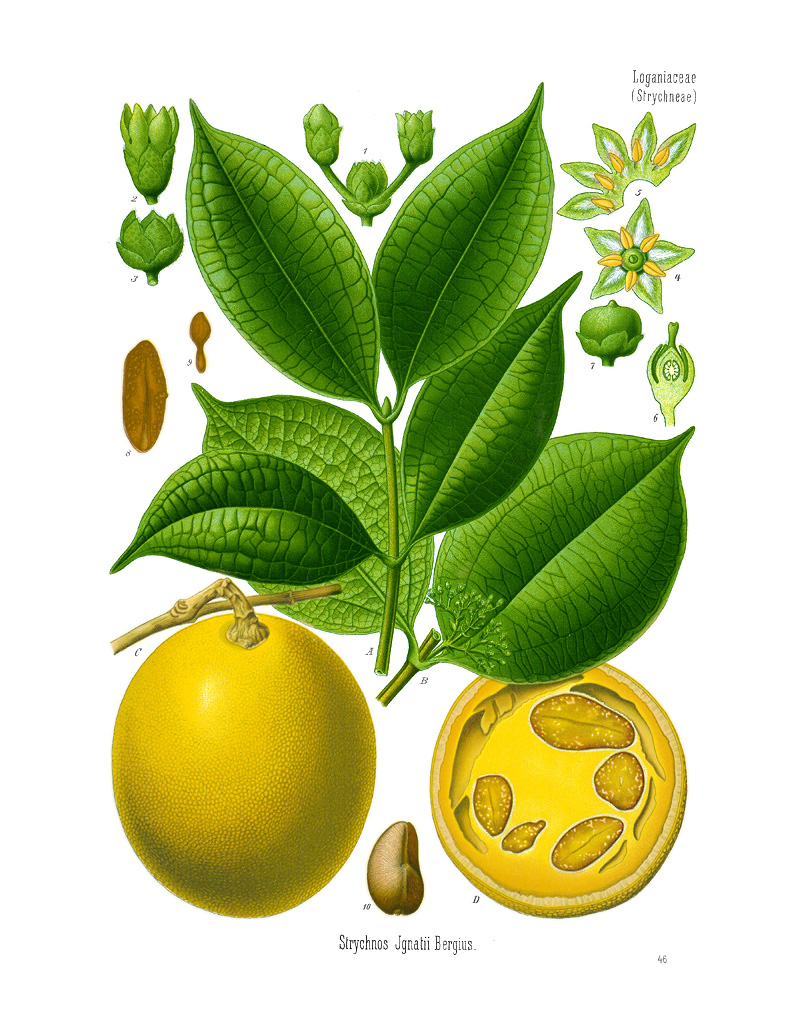 St. Ignatius BeanStrychnos ignatii
-
 Clearing-nut-treeStrychnos potatorum
-
 Hairy-leaved Monkey-orangeStrychnos madagascariensis
-
 Corky Monkey-OrangeStrychnos cocculoides
-
 Strychnine TreeStrychnos psilosperma
-
 Little Monkey-OrangeStrychnos usambarensis
Compare
Questions and answers
What is the scientific name of the Spine-Leaved Monkey-Orange?
The scientific name of the Spine-Leaved Monkey-Orange is Strychnos pungens. Written with its author, the full name is Strychnos pungens Soler..
Which family does the Spine-Leaved Monkey-Orange belong to?
Strychnos pungens belongs to the family Loganiaceae, in the order Gentianales and the class Magnoliopsida.
Where is the Spine-Leaved Monkey-Orange found?
Checklists and occurrence records place Strychnos pungens in 11 countries, including South Africa, Democratic Republic of the Congo, Angola, Namibia, Tanzania and Zambia.
What is the conservation status of the Spine-Leaved Monkey-Orange?
The IUCN Red List category recorded for Strychnos pungens is Least Concern (LC).
What other names does the Spine-Leaved Monkey-Orange have?
Strychnos pungens is also known in English as Green Monkey Orange, Klapper-Apple, Spiny Monkey-orange, Spiny-Leaved Wild Orange, Spinyleaf Wild Orange and Monkey Orange.
Is monkey orange edible?
The pulp of ripe Spine-Leaved Monkey-Orange fruit is edible. Its seeds are mildly poisonous.[10][12]
Sources
Passages the profile rests on
- Strychnos pungens is a tree with short, rigid branches. Source passage: “Branches are short and rigid.” — English Wikipedia
- Its leaves are smooth, stiff, opposite, and elliptic, with sharp, spine-like tips. Source passage: “Leaves are smooth, stiff, opposite, elliptic and with a sharp, spine-like tip.” — English Wikipedia
- Its fruit is round and has a smooth, hard shell. Source passage: “round and with a smooth hard shell” — English Wikipedia
- The tree usually grows to approximately 5 metres tall. Source passage: “Usually about 5 m (16 ft) tall” — English Wikipedia
- Its fruit measures approximately 120 millimetres in diameter. Source passage: “The fruit is large (120 mm (4.7 in) diameter)” — English Wikipedia
- Its fruit is bluish-green before turning yellow when ripe. Source passage: “bluish-green in colour and turning yellow when ripe.” — English Wikipedia
- The species occurs in mixed woodland. Source passage: “occurring in mixed woodland” — English Wikipedia
- Strychnos pungens occurs in South Africa, including the Witwatersrand and Magaliesberg regions. Source passage: “Occurring in South Africa on the Witwatersrand, Magaliesberg” — English Wikipedia
- Its distribution extends northward to northern Namibia, northern Botswana, and Zimbabwe. Source passage: “further north to northern Namibia, northern Botswana and Zimbabwe.” — English Wikipedia
- The pulp of ripe fruit is edible. Source passage: “The pulp of ripe fruit is rich in citric acid and is edible” — English Wikipedia
- The pulp of ripe fruit is rich in citric acid. Source passage: “The pulp of ripe fruit is rich in citric acid” — English Wikipedia
- The seeds of Strychnos pungens are mildly poisonous. Source passage: “but the seeds are mildly poisonous.” — English Wikipedia
- Strychnos pungens is closely related to Strychnos nux-vomica. Source passage: “The tree is a close relative of Strychnos nux-vomica” — English Wikipedia
- Strychnos nux-vomica is identified as the source of strychnine. Source passage: “the source of strychnine.” — English Wikipedia
Data
- Catalogue of Life, 2026-10-16 XR cc by
- Global Biodiversity Information Facility CC BY 4.0
- Wikidata CC0
- GeoNames CC BY 4.0
- Wikimedia Commons per image; credit shown with each image
- Within the Catalogue of Life, this name comes from Synonymic Checklists of the Vascular Plants of the World cc by
References
- Soler. (1893). Bot. Jahrb. Syst. 17: 554 (1893), et in Nat. Pflanzenfam. [Engler & Prantl] IV, 2: 40 (1892). where the name was published
This species in other databases
- Catalogue of Life 537D3
- Wikidata Q7625524
- iNaturalist 595012
- World Flora Online wfo-0000503006
- GRIN 35853
Page built on 28 November 2026. See how the catalog is made and all sources and licences.
Cite this page
ScientificNames.org. (2026). Strychnos pungens (Spine-Leaved Monkey-Orange). Retrieved November 28, 2026, from https://scientificnames.org/species/strychnos-pungens
“Strychnos pungens (Spine-Leaved Monkey-Orange).” ScientificNames.org, 2026, scientificnames.org/species/strychnos-pungens. Accessed 28 Nov. 2026.
ScientificNames.org. “Strychnos pungens (Spine-Leaved Monkey-Orange).” Accessed November 28, 2026. https://scientificnames.org/species/strychnos-pungens.
@misc{scientificnames_strychnos_pungens_spine_leaved_monkey_orange,
  author = {{ScientificNames.org}},
  title = {Strychnos pungens (Spine-Leaved Monkey-Orange)},
  year = {2026},
  url = {https://scientificnames.org/species/strychnos-pungens},
  note = {Accessed 2026-11-28}
}