Species · Birds
Northern Hawk-owl Surnia ulula
The scientific name of the Northern Hawk-owl is Surnia ulula. It is a species of bird in the family Strigidae (owls), order Strigiformes. The name dates from 1758.
- Scientific name
- Surnia ulula (Linnaeus, 1758)
- Common name
- Northern Hawk-owl
- Genus
- Surnia
- Family
- Strigidae (Owls)
- Order
- Strigiformes
- Class
- Aves
- Red List category
- LC Least Concern
- Environment
- terrestrial
- Recorded in
- 22 countries
- Name status
- accepted in the Catalogue of Life
Overview
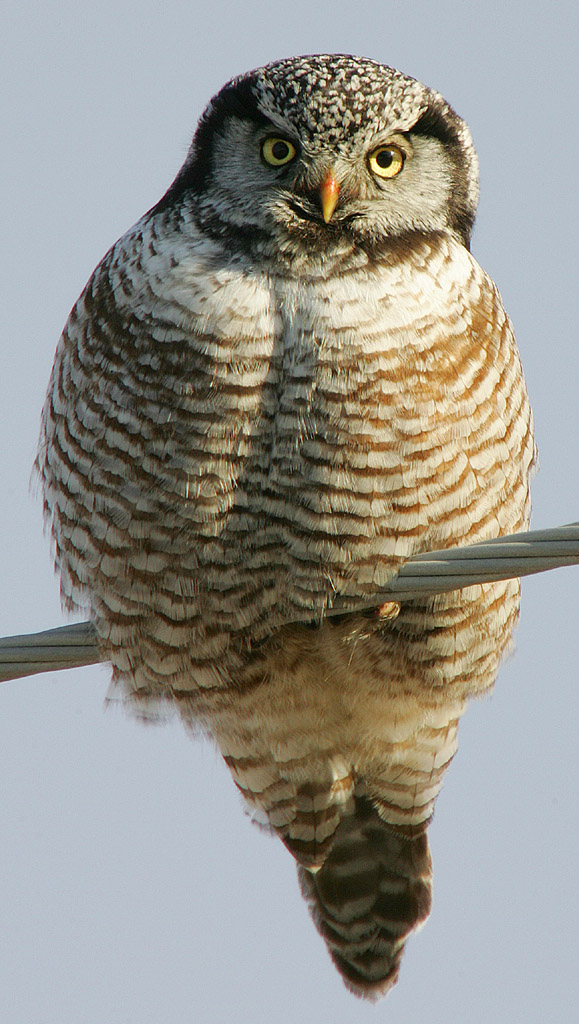
The Northern Hawk-owl is a medium-sized, slender bird in the family Strigidae and order Strigiformes. It occurs across eastern Alaska, Canada, Newfoundland, Siberia, and Central Asia, with the subspecies S. u. tianschanica reaching Xinjiang in China. It has a white face outlined in black, yellow eyes, a long brown-banded tail, and brown-barred underparts.
Written 26 November 2026 from the sources listed below. Each statement was checked against the passage it cites; statements that could not be supported were removed.
Appearance
The Northern Hawk-owl has relatively dark brown upperparts with off-white spotting and a black V-shaped marking on the back of its neck. Its face is white and outlined in black, with a rounded head, yellow eyes, and a curved yellow beak.[1][2]
Its underparts are generally white or off-white with brown barring across the breast and stomach. It has a long, brown-banded tail and narrowly pointed primary feathers.[3][4][5]
Adult birds have rounded tail-feather tips, while first-year birds have pointed tips. The subspecies S. u. ulula has paler underparts with finer barring, S. u. caparoch has browner underparts with heavier barring, and S. u. tianschanica is slightly larger and darker above than the other subspecies.[6][7][8][9]
Male Northern Hawk-Owls measure approximately 35–42.5 cm in length and weigh approximately 300 g. Females measure approximately 37.2–44.7 cm and weigh approximately 340 g, while both sexes have a wingspan of approximately 69–82 cm.[10][11][12][13][14]
Habitat
The Northern Hawk-owl inhabits open coniferous forests and mixed coniferous-deciduous forests. It also occurs in muskegs, clearings, swamp valleys, meadows, and recently burned areas, and generally avoids dense spruce-fir forests.[15][16][17]
Its winter habitat is usually the same as its breeding habitat. It is also associated with fields, meadows, grasslands, forests, woodlands, shrublands, and savannas.[18][19]
Diet
In Eurasia, the Northern Hawk-owl feeds primarily on Microtus voles. The North American subspecies S. u. caparoch feeds on microtine voles.[20][21]
During winter, ground-dwelling birds such as ptarmigan and grouse make up a larger proportion of its prey biomass.[22]
Behaviour
The Northern Hawk-owl is non-migratory and usually remains within its breeding range. It sometimes moves southward during irruptions.[23][24]
It is active during the day as well as at other times and hunts at varying times without an apparent preferred hunting time. It typically hunts by perching and scanning the surrounding area for prey, preferring spruce trees as hunting perches.[25][26][27][28]
It can use its exceptional hearing to locate rodents beneath snow. It can attack animals and people that approach its young too closely.[29][30]
Reproduction and life cycle
Northern Hawk-Owl mating rituals generally begin in early March. A brood typically contains between 3 and 11 eggs.[31][32]
Northern Hawk-Owls commonly nest in the tops of hollow stumps of old dead spruce trees and sometimes nest on cliffsides. North American S. u. caparoch nests are generally located 2–10 m above ground, while Eurasian S. u. ulula nests are generally located 4–5 m above ground.[33][34][35][36]
Conservation
The North American Northern Hawk-Owl population was estimated at 10,000–50,000 pairs. Populations fluctuate in association with small-rodent population cycles.[37][38]
Human fire suppression is believed to negatively affect Northern Hawk-Owl populations by reducing open hunting areas and dead nesting wood.[39]
Uses
The Northern Hawk-owl may be used to hunt small game in Ontario under an appropriate falconry license.[40]
Classification of the Northern Hawk-owl
| Kingdom | Animalia |
|---|---|
| Phylum | Chordata |
| Subphylum | Vertebrata |
| Infraphylum | Gnathostomata |
| Parvphylum | Osteichthyes |
| Megaclass | Tetrapoda |
| Class | Aves (Bird) |
| Order | Strigiformes (Owl) |
| Family | Strigidae (Owls) |
| Subfamily | Surniinae |
| Genus | Surnia (Hawk-Owls) |
| Species | Surnia ulula (Linnaeus, 1758) |
Where the Northern Hawk-owl is found
Checklists and occurrence records place Surnia ulula in 22 countries across Asia and North America. GBIF holds 97,805 georeferenced records of it.
Countries
- Aland Islands 73
- Belarus 3
- Belgium 7
- Canada 2,068
- China 34
- Denmark 4,132
- Estonia 870
- Finland 9,766
- France 6
- Germany 202
- Kazakhstan 9
- Latvia 4
- Lithuania 9
- Mongolia 3
- Norway 24,915
- Poland 13
- Russia 1,823
- Sweden 48,574
- The Netherlands 3,649
- Ukraine 7
- United Kingdom 6
- United States 1,632
Regions and cities with the most records
- Norrbotten, Sweden 4,895
- Västra Götaland, Sweden 4,710
- Västerbotten, Sweden 4,234
- Uppsala, Sweden 4,230
- Västmanland, Sweden 3,916
- Dalfsen, The Netherlands 3,544
- Kampen, The Netherlands 3,544
- Zwolle, The Netherlands 3,544
- Staphorst, The Netherlands 3,543
- Raalte, The Netherlands 3,540
- Epe, The Netherlands 3,536
- Elburg, The Netherlands 3,509
- Jämtland, Sweden 3,501
- Lapland, Finland 3,489
- Dalarna, Sweden 3,310
- Stockholm, Sweden 2,842
- Skåne, Sweden 2,776
- Örebro, Sweden 2,371
- Nordland, Norway 2,161
- Finnmark, Norway 2,117
- Overijssel, The Netherlands 2,100
- Capital Region, Denmark 1,987
- Värmland, Sweden 1,875
- Telemark, Norway 1,795
- Buskerud, Norway 1,684
- Zealand, Denmark 1,661
- Kalmar, Sweden 1,459
- Gelderland, The Netherlands 1,444
- Halland, Sweden 1,338
- Uppsala, Sweden 1,327
- Birkerød, Denmark 1,298
- Hillerød, Denmark 1,296
- Allerød, Denmark 1,295
- Lillerød, Denmark 1,293
- Karlebo, Denmark 1,289
- Hørsholm, Denmark 1,281
Range as the checklists state it
Europe & Northern Asia (excluding China)
North America
Southern Asia
A number beside a place is its count of GBIF occurrence records. A place without a number comes from a checklist alone. Records show where a species has been observed or collected, which can include escapes and vagrants.
Common names
English
- Northern Hawk-Owl
- Hawk Owl
- Northern Hawk Owl
Names in 56 other languages
- Arabic
- بومة الصقر, بومة الصقر الشمالية
- Asturian
- Surnia acuruxa
- Basque
- Hontz gabirai
- Belarusian
- Сава-бярозаўка
- Breton
- Kaouenn an taiga
- Bulgarian
- Ястребова сова
- Catalan
- mussol esparverenc
- Chinese
- 猛鴞, 猛鸮
- Croatian
- sjeverna sova
- Czech
- sovice krahujová
- Danish
- Høgeugle, Owl Høgeugle
- Dutch
- Sperweruil
- Esperanto
- Nizostrigo, norda nizostrigo
- Estonian
- vöötkakk
- Faroese
- Heykugla
- Finnish
- hiiripöllö
- French
- Surnie épervière, chouette épervière, Épervière boréale
- Galician
- Curuxa gabián
- German
- Sperbereule
- Greek
- Γερακόγλαυκα
- Hebrew
- כוס ניצי
- Hungarian
- karvalybagoly
- Icelandic
- Haukugla
- Irish
- Ulchabhán seabhaic, Ulchabhán seabhaic donn
- Italian
- Ulula
- Japanese
- オナガフクロウ
- Kazakh
- Қаршыға жапалақ, Қаршығарең жапалақ
- Korean
- 긴꼬리올빼미
- Latvian
- svītrainā pūce
- Lithuanian
- raiboji pelėda
- Luxembourgish
- Gesträiften Eil
- Mongolian
- Харсун бэгбаатар
- Northern Sami
- Sáhpánskuolfi, bigán, skutnjaloddi
- Norwegian
- haukugle
- Persian
- جغد شاهینی شمالی
- Polish
- sowa jarzębata
- Portuguese
- Coruja-gavião, mocho-gavião, mocho-rabilongo
- Romanian
- Ciuhurez
- Russian
- Северная ястребиная сова, Сирин ястребиный, Ястребиная сова
- Scottish Gaelic
- Hawk-Owl, seabhag-fheasgair, seabhag-oidhche, seabhagan-feasgair, seabhagan-oidhche
- Serbian
- Jastrebača, Јастребача
- Slovak
- krahuľa hôrna
- Slovenian
- skobčja sova
- Spanish
- Búho Gavilán, Cárabo gavilán, Cárabos Gavilán, Lechuza gavilana
- Swedish
- hökuggla
- Turkish
- Atmaca Baykuşu
- Ukrainian
- сова яструбина
- Welsh
- gwalchdylluan
- bak
- Ҡарсыға ябалаҡ
- chv
- Хурчка тӑмани
- cor
- Shawk ny hoie
- glv
- Seabhag oidhche
- kom
- Лун сюзь
- mhr
- тумнавараш
- nav
- Néʼéshjaaʼ bíńdáhii
- sah
- Тойон мэкчиргэ
Synonyms
4 other scientific names have been used for this species and are now treated as synonyms of Surnia ulula.
- Strix ulula Linnaeus, 1758
- Stryx doliata Pallas, PS, 1811
- Surnia funerea
- Surnia ulula pallasi Buturlin, 1907
Subspecies and varieties
- Surnia ulula caparoch (American Hawk Owl) subspecies
- Surnia ulula tianschanica (Tien Shan Hawk Owl) subspecies
- Surnia ulula ulula (Eurasian Northern Hawk Owl) subspecies
Related species
- Surnia robusta
-
 Great Horned OwlBubo virginianus
-
 Barred OwlStrix varia
-
 Eurasian Eagle-owlBubo bubo
-
 Snowy OwlBubo scandiacus
-
 Tawny OwlStrix aluco
-
 Burrowing OwlAthene cunicularia
-
 Great Grey OwlStrix nebulosa
Compare
Questions and answers
What is the scientific name of the Northern Hawk-owl?
The scientific name of the Northern Hawk-owl is Surnia ulula. Written with its author, the full name is Surnia ulula (Linnaeus, 1758).
Which family does the Northern Hawk-owl belong to?
Surnia ulula belongs to the family Strigidae, in the order Strigiformes and the class Aves.
Where is the Northern Hawk-owl found?
Checklists and occurrence records place Surnia ulula in 22 countries, including Sweden, Norway, Finland, Denmark, The Netherlands and Canada.
What is the conservation status of the Northern Hawk-owl?
The IUCN Red List category recorded for Surnia ulula is Least Concern (LC).
What other names does the Northern Hawk-owl have?
Surnia ulula is also known in English as Hawk Owl and Northern Hawk Owl.
Where does the hawk owl live?
The Northern Hawk-owl occurs from eastern Alaska across Canada to Newfoundland, across Siberia, and in Central Asia, with S. u. tianschanica reaching Xinjiang in China. It inhabits open coniferous forests, mixed coniferous-deciduous forests, muskegs, clearings, swamp valleys, and meadows.[15][16][41][42][43]
Sources
Passages the profile rests on
- The Northern Hawk-Owl has relatively dark brown upperparts with off-white spotting, except for a black V-shaped marking on the back of its neck. Source passage: “The plumage is relatively dark brown with an off-white spotting pattern on all dorsal parts of the body with the exception of the back of the neck which boasts a black v-shaped pattern.” — English Wikipedia
- The Northern Hawk-Owl has a white face outlined in black, a rounded head, yellow eyes, and a curved yellow beak. Source passage: “The northern hawk-owl has a white face with a black border, a rounded head, yellow eyes and a curved yellow beak.” — English Wikipedia
- Its underparts are generally white or off-white with brown barring across the breast and stomach. Source passage: “The underbelly is generally white or off-white which continues to the toes with brown bands on the breast and stomach.” — English Wikipedia
- The Northern Hawk-Owl has a long, brown-banded tail. Source passage: “It also has a long tail with brown banding” — English Wikipedia
- The Northern Hawk-Owl has narrowly pointed primary feathers. Source passage: “with a long tail and narrowly pointed primary” — raptor.umn.edu
- Adult Northern Hawk-Owls have rounded tail-feather tips, whereas first-year birds have pointed tips. Source passage: “the tail feather tips are rounded in adults, and pointed in first-year birds.” — English Wikipedia
- The subspecies S. u. ulula has paler underparts with finer barring than the other subspecies. Source passage: “S. u. ulula has paler underparts with fine bars” — English Wikipedia
- The subspecies S. u. caparoch has browner underparts with heavier barring. Source passage: “S. u. caparoch is browner below with heavier barring.” — English Wikipedia
- The subspecies S. u. tianschanica is slightly larger and darker above than the other subspecies. Source passage: “S. u. tianschanica is marginally the largest, and darker above than the other two” — English Wikipedia
- Male Northern Hawk-Owls measure approximately 35–42.5 cm in length. Source passage: “Male northern hawk-owls are generally 35–42.5 cm (13.8–16.7 in) long” — English Wikipedia
- Male Northern Hawk-Owls weigh approximately 300 g. Source passage: “weigh about 300 g (11 oz).” — English Wikipedia
- Female Northern Hawk-Owls measure approximately 37.2–44.7 cm in length. Source passage: “Females are slightly bigger with a length of 37.2–44.7 cm (14.6–17.6 in)” — English Wikipedia
- Female Northern Hawk-Owls weigh approximately 340 g. Source passage: “and a weight of about 340 g (12 oz).” — English Wikipedia
- Both sexes have a wingspan of approximately 69–82 cm. Source passage: “Both male and female have similar wingspans of about 69–82 cm (27–32 in).” — English Wikipedia
- The Northern Hawk-Owl inhabits open coniferous forests and mixed coniferous-deciduous forests. Source passage: “They live mostly in open coniferous forests, or coniferous forests mixed with deciduous species such as larch, birch, poplar, and willow.” — English Wikipedia
- The Northern Hawk-Owl occurs in muskegs, clearings, swamp valleys, meadows, and recently burned areas. Source passage: “They are found in muskegs, clearings, swamp valleys, meadows, or recently burnt areas” — English Wikipedia
- The Northern Hawk-Owl generally avoids dense spruce-fir forests. Source passage: “and generally avoid dense spruce-fir forests.” — English Wikipedia
- Its winter habitat is usually the same as its breeding habitat. Source passage: “Their winter habitat is usually the same as the breeding habitat.” — English Wikipedia
- The Northern Hawk-Owl is associated with fields, meadows, grasslands, forests, woodlands, shrublands, and savannas. Source passage: “Fields, Meadows, and Grasslands, Forests and Woodlands, Shrublands, Savannas” — audubon.org
- In Eurasia, the Northern Hawk-Owl feeds primarily on Microtus voles. Source passage: “In Eurasia the northern hawk-owl is known to feed primarily on Microtus voles.” — English Wikipedia
- The North American subspecies S. u. caparoch feeds on microtine voles. Source passage: “In North America the subspecies S. u. caparoch also feeds upon microtine voles” — English Wikipedia
- During winter, ground-dwelling birds such as ptarmigan and grouse make up a larger proportion of its prey biomass. Source passage: “in the winter a bigger portion of the hawk-owl's prey biomass consists of ground-dwelling birds, such as ptarmigan and grouse.” — English Wikipedia
- The Northern Hawk-Owl is non-migratory and usually remains within its breeding range. Source passage: “It is non-migratory and usually stays within its breeding range” — English Wikipedia
- The Northern Hawk-Owl sometimes moves southward during irruptions. Source passage: “though it sometimes irrupts southward.” — English Wikipedia
- The Northern Hawk-Owl is active during the day as well as at other times. Source passage: “often being active during the day.” — English Wikipedia
- The Northern Hawk-Owl hunts at varying times without an apparent preferred hunting time. Source passage: “although it has been recorded hunting at varying times and does not appear to have a preferred hunting time.” — English Wikipedia
- The Northern Hawk-Owl typically hunts by perching and scanning the surrounding area for prey. Source passage: “The northern hawk-owl will perch and scour the immediate area for prey.” — English Wikipedia
- The Northern Hawk-Owl prefers spruce trees as hunting perches. Source passage: “The preferred perching tree of the northern hawk-owl is the spruce tree.” — English Wikipedia
- The Northern Hawk-Owl can use its exceptional hearing to locate rodents beneath snow. Source passage: “The hawk-owl has exceptional hearing and can plunge into snow to capture rodents below the surface.” — English Wikipedia
- The Northern Hawk-Owl can attack animals and people that approach its young too closely. Source passage: “It has little fear of humans and other potential predators, and will attack fiercely if the young are approached too closely” — English Wikipedia
- Northern Hawk-Owl mating rituals generally begin in early March. Source passage: “The northern hawk-owl generally starts its mating rituals at the beginning of March.” — English Wikipedia
- A Northern Hawk-Owl brood typically contains between 3 and 11 eggs. Source passage: “On average the northern hawk-owl will lay 3–11 eggs per brood.” — English Wikipedia
- Northern Hawk-Owls commonly nest in the tops of hollow stumps of old dead spruce trees. Source passage: “The nest sites are usually the tops of hollow stumps of old dead spruce trees” — English Wikipedia
- Northern Hawk-Owls also sometimes nest on cliffsides. Source passage: “but they have also been known to nest on cliffsides.” — English Wikipedia
- North American S. u. caparoch nests are generally located 2–10 m above ground. Source passage: “These nesting sites are usually 2–10 m (6.6–32.8 ft) above ground for the North American S. u. caparoch” — English Wikipedia
- Eurasian S. u. ulula nests are generally located 4–5 m above ground. Source passage: “and approximately 4–5 m (13–16 ft) above ground for the Eurasian S. u. ulula.” — English Wikipedia
- The North American Northern Hawk-Owl population was estimated at 10,000–50,000 pairs. Source passage: “Duncan and Harris (1997) estimated that this population contains between 10,000 and 50,000 pairs.” — English Wikipedia
- Northern Hawk-Owl populations fluctuate in association with small-rodent population cycles. Source passage: “Populations are known to fluctuate with cycles of small rodents” — English Wikipedia
- Human fire suppression is believed to negatively affect Northern Hawk-Owl populations by reducing open hunting areas and dead nesting wood. Source passage: “Fire suppression by humans is believed to negatively affect northern hawk-owl populations by reducing open areas for hunting and dead wood to nest in.” — English Wikipedia
- The Northern Hawk-Owl may be used to hunt small game in Ontario under an appropriate falconry license. Source passage: “The northern hawk-owl is considered a falconry bird in Ontario, and may be used to hunt small game with a proper license.” — English Wikipedia
- The North American subspecies S. u. caparoch occurs from eastern Alaska across Canada to Newfoundland. Source passage: “The North American subspecies S. u. caparoch spans from eastern Alaska through Canada to Newfoundland” — English Wikipedia
- The subspecies S. u. tianschanica breeds in Central Asia and reaches Xinjiang in China. Source passage: “S. u. tianschanica breeds in Central Asia reaching Xinjiang (China)” — English Wikipedia
- The subspecies S. u. ulula occurs across Siberia. Source passage: “S. u. ulula resides across Siberia reaching its most eastern range.” — English Wikipedia
Data
- Catalogue of Life, 2026-10-16 XR cc by
- Global Biodiversity Information Facility CC BY 4.0
- Wikidata CC0
- GeoNames CC BY 4.0
- Wikimedia Commons per image; credit shown with each image
- Within the Catalogue of Life, this name comes from The Integrated Taxonomic Information System cc0
References
- Syst. Nat. ed. 10 p. 93 where the name was published
- Banks, R. C., R. W. McDiarmid, and A. L. Gardner. (1987). Checklist of Vertebrates of the United States, the U.S. Territories, and Canada. Resource Publication, No. 166.
- Gill, Frank, & and Minturn Wright. (2006). Birds of the World: Recommended English Names.
- Dickinson, E. C., and J. V. Remsen Jr., eds. (2013). The Howard and Moore Complete Checklist of the Birds of the World, 4th Edition, Vol. 1 Non-Passerines.
This species in other databases
- Catalogue of Life 53HF9
- Wikidata Q193192
- iNaturalist 20372
- WoRMS urn:lsid:marinespecies.org:taxname:1484602
- Avibase nohowl
Page built on 26 November 2026. See how the catalog is made and all sources and licences.
Cite this page
ScientificNames.org. (2026). Surnia ulula (Northern Hawk-owl). Retrieved November 26, 2026, from https://scientificnames.org/species/surnia-ulula
“Surnia ulula (Northern Hawk-owl).” ScientificNames.org, 2026, scientificnames.org/species/surnia-ulula. Accessed 26 Nov. 2026.
ScientificNames.org. “Surnia ulula (Northern Hawk-owl).” Accessed November 26, 2026. https://scientificnames.org/species/surnia-ulula.
@misc{scientificnames_surnia_ulula_northern_hawk_owl,
  author = {{ScientificNames.org}},
  title = {Surnia ulula (Northern Hawk-owl)},
  year = {2026},
  url = {https://scientificnames.org/species/surnia-ulula},
  note = {Accessed 2026-11-26}
}