Species · Flowering plants
Big Leaf Mahogany Swietenia macrophylla
The scientific name of the Big Leaf Mahogany is Swietenia macrophylla. It is a species of flowering plant in the family Meliaceae (mahogany family), order Sapindales.
- Scientific name
- Swietenia macrophylla G.King
- Common name
- Big Leaf Mahogany
- Genus
- Swietenia
- Family
- Meliaceae (Mahogany Family)
- Order
- Sapindales
- Class
- Magnoliopsida
- Red List category
- EN Endangered
- Recorded in
- 49 countries
- Name status
- accepted in the Catalogue of Life
Overview
Swietenia macrophylla is native to South America, Mexico and Central America. It commonly reaches 30–40 metres in height, and its fruit develops as a light grey to brown capsule.
Written 26 November 2026 from the sources listed below. Each statement was checked against the passage it cites; statements that could not be supported were removed.
Appearance
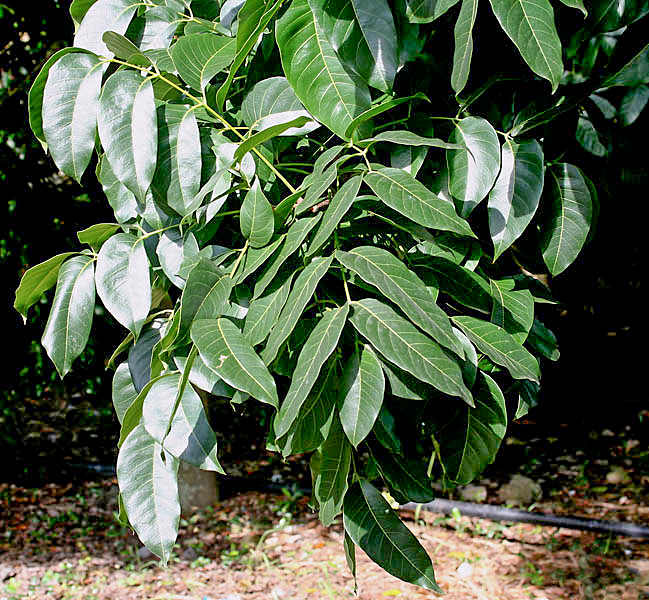
The leaves can reach 45 centimetres in length. Their leaflets occur in even numbers and attach to a central midrib.[1][2]
The fruit develops as a light grey to brown capsule that can reach 40 centimetres in length. The wood has an average chatoyance value above 20 PZC.[3][4][5]
Habitat
Natural populations occur in seasonal transitional evergreen forests in southeastern Pará, Brazil. Adult populations in this area occur in aggregations along seasonal streams.[6][7]
Behaviour
The fruits grow upwards towards the sky.[8]
Reproduction and life cycle
Each fruit capsule may contain 71 winged seeds. The seeds can measure 7–12 centimetres in length.[9][10]
Uses
The wood is used to manufacture furniture, musical instruments, ships, doors and coffins. The species is commercially important for its high-quality timber in neotropical countries.[11][12]
The bark extract has been used as an astringent for wounds, and the bark has occasionally been used for tanning.[13][14]
The seeds are traditionally used in Malaysia to treat hypertension, diabetes and pain. In Indonesia, they have been used as folk medicine for diabetes, hypertension and malaria.[15][16]
An ethnic group in the Bolivian Amazon has used the seeds to treat leishmaniasis and as an abortion medicine. The fruit has also been commercially incorporated into healthcare products intended to improve blood circulation and skin condition.[17][18]
Limonoids and their derivatives are the major phytochemical constituents of the species.[19]
Plantations in Asia provide a major source of internationally traded genuine mahogany timber. India and Fiji are major global suppliers of plantation-grown timber from this species.[20][21]
Conservation
Big Leaf Mahogany was listed in Appendix II of CITES in 2002. This listing identifies it as a species that may face extinction if its trade is not controlled.[22][23]
Large areas of former forests have been converted to other land uses, and the remaining forests are few. The species has been severely overexploited throughout its natural range.[24][25][26]
Classification of the Big Leaf Mahogany
| Kingdom | Plantae |
|---|---|
| Subkingdom | Pteridobiotina |
| Phylum | Tracheophyta |
| Class | Magnoliopsida |
| Order | Sapindales |
| Family | Meliaceae (Mahogany Family) |
| Subfamily | Cedreloideae |
| Genus | Swietenia (Mahogany) |
| Species | Swietenia macrophylla G.King |
Where the Big Leaf Mahogany is found
Checklists and occurrence records place Swietenia macrophylla in 49 countries across Asia, North America, Oceania and South America. GBIF holds 5,239 georeferenced records of it.
Countries
- Australia 3
- Bangladesh 5
- Belize 86
- Bolivia 108
- Brazil 315
- Cambodia
- China 5
- Colombia 919
- Costa Rica 149
- Cuba 11
- Dominica 4
- Dominican Republic 7
- Ecuador 65
- El Salvador 30
- Fiji 19
- French Guiana 6
- French Polynesia 6
- Guadeloupe 25
- Guam 9
- Guatemala 42
- Honduras 24
- India 107
- Indonesia 68
- Jamaica 1
- Malaysia 26
- Martinique 19
- Mexico 2,057
- Micronesia 5
- Montserrat 2
- Myanmar 1
- New Caledonia 6
- Nicaragua 29
- Niue 1
- Northern Mariana Islands 3
- Palau 4
- Panama 59
- Peru 75
- Philippines 102
- Puerto Rico 50
- Saint Lucia 3
- Singapore 8
- Sri Lanka 39
- Taiwan 562
- Thailand 35
- Trinidad and Tobago 24
- United States 56
- Vanuatu
- Venezuela 55
- Vietnam 4
Regions and cities with the most records
- Quintana Roo, Mexico 1,526
- Antioquia, Colombia 722
- Santa Fe de Antioquia, Colombia 710
- Taiwan, Taiwan 340
- Chiayi City, Taiwan 198
- Taibao, Taiwan 190
- Xingang, Taiwan 187
- Chiapas, Mexico 141
- Campeche, Mexico 112
- Fengshan, Taiwan 90
- Veracruz, Mexico 86
- Kaohsiung, Taiwan 84
- Guanacaste Province, Costa Rica 69
- Caldas Department, Colombia 64
- La Dorada, Colombia 64
- Puerto Salgar, Colombia 64
- Yujing, Taiwan 62
- Yongkang, Taiwan 61
- Tainan, Taiwan 55
- Córdoba, Colombia 49
- Honda, Colombia 46
- Cereté, Colombia 45
- Montería, Colombia 45
- San Carlos, Colombia 45
- Santa Cruz Department, Bolivia 45
- Escárcega, Mexico 36
- Puebla, Mexico 36
- San José, Costa Rica 32
- Wufeng, Taiwan 30
- Chaozhou, Taiwan 29
- La Paz Department, Bolivia 28
- Tabasco, Mexico 25
- Puntarenas Province, Costa Rica 24
- Taichung, Taiwan 24
- Antipolo, Philippines 23
- Bagong Silangan, Philippines 23
3 more countries have a few records outside this range
These countries hold a few records of Swietenia macrophylla but lie outside the range the checklists give for it. Such records are often zoo or garden specimens, museum material or vagrants, so the species is not counted as occurring there.
Range as the checklists state it
Taiwan [c]; India [c]; Sri Lanka [c]; Bangladesh [c]; Andaman Isl. [c]; Nicobar Isl. [c]; Myanmar [c]; Cambodia [c]; Vietnam [c]; peninsular Malaysia [c]; Singapore [c]; Borneo [c]; Philippines [c]; Jawa [c]; Lesser Sunda Isl. [c] (Bali [c]); Solomon Isl. [I]; New Caledonia [c]; Vanuatu [c]; Rotuma Isl. [c]; Niue [c]; Fiji [c]; Palau [c] (Koror [c]); Guam [c]; Fed. States of Micronesia [c] (Truk [c], Moen [c], Pohnpei [c]); Hawaii [c] (Oahu [c], West Maui [c]); Mexico (Campeche, Chiapas, Colima, Guanajuato, Guerrero, Hidalgo, Jalisco, Mexico State, Michoacán, Morelos, Nayarit, Oaxaca, Puebla, Queretaro, Quintana Roo, Sinaloa, Tabasco, Veracruz, Yucatán); Guatemala; Belize; Honduras; Nicaragua; Costa Rica; Panama; Cuba [c]; Cayman Isl. [c]; Jamaica [c]; Hispaniola [c]; Puerto Rico [c]; Virgin Isl. [c] (Guana [c], St. John [c], Tortola [c], Virgin Gorda [c]); Montserrat [c]; Guadeloupe [c]; Dominica [c]; Martinique [c]; St. Lucia [c]; St. Vincent [c]; Tobago [c]; Trinidad [c]; Colombia (Bolívar, Boyacá, Chocó, Cundinamarca, Magdalena); Isla Margarita [c]; Venezuela (Aragua, Barinas, Carabobo, Cojedes, Venezuela Distrito Federal, Lara, Mérida, Miranda, Nueva Esparta, Portuguesa, Zulia); French Guiana; Galápagos [c]; Peru; Bolivia (Beni, La Paz, Pando, Santa Cruz); N-Brazil (Pará, Acre)
A number beside a place is its count of GBIF occurrence records. A place without a number comes from a checklist alone. Records show where a species has been observed or collected, which can include escapes and vagrants.
Common names
English
- Big Leaf Mahogany
- Big-leaf Mahogany
- Brazilian Mahogany
- Honduran Mahogany
- Large-leaved Mahogany
- Mahogany
Names in 14 other languages
- Chinese
- 大叶桃花心木, 大葉桃花心木
- Esperanto
- Grandfolia svitenio
- Finnish
- amerikanaitomahonki
- French
- Acajou, Acajou à grandes feuilles, Mahogani Grands Feuilles, mahogany grandes feuilles
- German
- Amerikanischer Mahagoni
- Indonesian
- Mahoni
- Japanese
- オオバマホガニー
- Polish
- mahoniowiec wielkolistny
- Portuguese
- Araputangá, Cedro-i, Cedroaraná, Cedroi, Mogno-da-amazônia, Mogno-do-Brasil, araputanga, caóba
- Slovak
- mahagónovník veľkolistý
- Spanish
- Caoba, Caoba de hoja grande, Mara, Mogno, aguano
- Swedish
- hondurasmahogny
- Thai
- มะฮอกกานีใบใหญ่
- tzh
- tsutsul
Synonyms
5 other scientific names have been used for this species and are now treated as synonyms of Swietenia macrophylla.
- Swietenia belizensis Lundell
- Swietenia candollei Pittier
- Swietenia krukovii Gleason
- Swietenia macrophylla var. marabaensis Ledoux & Lobato
- Swietenia tessmannii Harms
Related species
-
 American MahoganySwietenia mahagoni
-
 Honduras MahoganySwietenia humilis
- Swietenia × aubrevilleana
-
 NeemAzadirachta indica
-
 ChinaberryMelia azedarach
-
 Lansium domesticum
-
 SapeleEntandrophragma cylindricum
-
 Chinese MahoganyToona sinensis
Compare
Questions and answers
What is the scientific name of the Big Leaf Mahogany?
The scientific name of the Big Leaf Mahogany is Swietenia macrophylla. Written with its author, the full name is Swietenia macrophylla G.King.
Which family does the Big Leaf Mahogany belong to?
Swietenia macrophylla belongs to the family Meliaceae, in the order Sapindales and the class Magnoliopsida.
Where is the Big Leaf Mahogany found?
Checklists and occurrence records place Swietenia macrophylla in 49 countries, including Mexico, Colombia, Taiwan, Brazil, Costa Rica and Bolivia.
What is the conservation status of the Big Leaf Mahogany?
The IUCN Red List category recorded for Swietenia macrophylla is Endangered (EN).
What other names does the Big Leaf Mahogany have?
Swietenia macrophylla is also known in English as Big-leaf Mahogany, Brazilian Mahogany, Honduran Mahogany, Large-leaved Mahogany and Mahogany.
Sources
Passages the profile rests on
- The leaves of Swietenia macrophylla can reach 45 centimetres in length. Source passage: “Honduran mahogany is characterised by its large leaves, up to 45 cm (17 in) long.” — English Wikipedia
- The leaflets of Swietenia macrophylla occur in even numbers and attach to a central midrib. Source passage: “The leaflets are even in number and are connected by a central midrib.” — English Wikipedia
- The fruit capsules of Swietenia macrophylla can reach 40 centimetres in length. Source passage: “The fruits of mahogany can reach 40 cm (15.7 in) in length” — English Wikipedia
- The fruit of Swietenia macrophylla develops as a light grey to brown capsule. Source passage: “in a light grey to brown capsule.” — English Wikipedia
- The wood of Swietenia macrophylla has an average chatoyance value above 20 PZC. Source passage: “with an average value above 20 PZC.” — English Wikipedia
- Natural populations of Swietenia macrophylla occur in seasonal transitional evergreen forests in southeastern Pará, Brazil. Source passage: “in seasonal transitional evergreen forests of southeast Pará, Brazil” — science.gov
- Adult Swietenia macrophylla populations in southeastern Pará, Brazil, occur in aggregations along seasonal streams. Source passage: “Adult populations of big-leaf mahogany (Swietenia macrophylla) occur in aggregations along seasonal streams” — science.gov
- The fruits of Swietenia macrophylla grow upwards towards the sky. Source passage: “also called “sky fruit” due to upward trend of its fruits towards the sky” — pmc.ncbi.nlm.nih.gov
- Each fruit capsule of Swietenia macrophylla may contain 71 winged seeds. Source passage: “Each fruit capsule may contain 71 winged seeds.” — English Wikipedia
- The seeds of Swietenia macrophylla can measure 7–12 centimetres in length. Source passage: “The seeds of Honduran mahogany can reach 7 to 12 cm (2.7 to 4.7 in) long.” — English Wikipedia
- Swietenia macrophylla wood is used to manufacture furniture, musical instruments, ships, doors and coffins. Source passage: “Mahogany wood is strong and is usually a source for furniture, musical instruments, ships, doors, coffins, decors.” — English Wikipedia
- Swietenia macrophylla is commercially important for its high-quality timber in neotropical countries. Source passage: “S. macrophylla is important for the economy of many neotropical countries due to its high-quality timber” — pmc.ncbi.nlm.nih.gov
- The bark extract of Swietenia macrophylla has been used as an astringent for wounds. Source passage: “The bark extract has been used as an astringent for wounds” — pmc.ncbi.nlm.nih.gov
- The bark of Swietenia macrophylla has occasionally been used for tanning. Source passage: “used occasionally for tanning” — pmc.ncbi.nlm.nih.gov
- The seeds of Swietenia macrophylla are traditionally used in Malaysia to treat hypertension, diabetes and pain. Source passage: “In Malaysia, the seeds are used traditionally to treat hypertension, diabetes, and relieve pain” — pmc.ncbi.nlm.nih.gov
- The seeds of Swietenia macrophylla have been used as folk medicine for diabetes, hypertension and malaria in Indonesia. Source passage: “In Indonesia, S. macrophylla seeds have been used as a folk medicine for treatment of diabetes, hypertension, and malaria” — pmc.ncbi.nlm.nih.gov
- An ethnic group in the Bolivian Amazon has used Swietenia macrophylla seeds to treat leishmaniasis and as an abortion medicine. Source passage: “An Bolivian Amazonian ethnic group has used the seeds for leishmaniasis and as an abortion medicine” — pmc.ncbi.nlm.nih.gov
- The fruit of Swietenia macrophylla has been commercially incorporated into healthcare products intended to improve blood circulation and skin condition. Source passage: “The fruit of S. macrophylla has been used commercially in health care products for the improvement of blood circulation and skin condition.” — pmc.ncbi.nlm.nih.gov
- Limonoids and their derivatives are the major phytochemical constituents of Swietenia macrophylla. Source passage: “Phytochemical investigations have shown that limonoids and their derivatives are the major constituents of S. macrophylla” — pmc.ncbi.nlm.nih.gov
- Plantations in Asia provide a major source of internationally traded genuine mahogany timber. Source passage: “The mahogany timber grown in these Asian plantations is the major source of international trade in genuine mahogany today.” — English Wikipedia
- India and Fiji are major global suppliers of plantation-grown Swietenia macrophylla timber. Source passage: “with India and Fiji being the major world suppliers.” — English Wikipedia
- Swietenia macrophylla was listed in Appendix II of CITES in 2002. Source passage: “In 2002, S. macrophylla was listed in Appendix II” — pmc.ncbi.nlm.nih.gov
- The Appendix II listing identifies Swietenia macrophylla as a species that may face extinction if its trade is not controlled. Source passage: “species that may face extinction if trade is not controlled” — pmc.ncbi.nlm.nih.gov
- Large areas of former Swietenia macrophylla forests have been converted to other land uses. Source passage: “large areas of former S. macrophylla forests have been converted to other uses” — pmc.ncbi.nlm.nih.gov
- The remaining forests of Swietenia macrophylla are few. Source passage: “and the remaining forests are few” — pmc.ncbi.nlm.nih.gov
- Swietenia macrophylla has been severely overexploited throughout its natural range. Source passage: “Mahogany has been severely overexploited throughout its natural range” — science.gov
Data
- Catalogue of Life, 2026-10-16 XR cc by
- Global Biodiversity Information Facility CC BY 4.0
- Wikidata CC0
- GeoNames CC BY 4.0
- Wikimedia Commons per image; credit shown with each image
- iNaturalist per image; credit shown with each image
- Within the Catalogue of Life, this name comes from Synonymic Checklists of the Vascular Plants of the World cc by
References
- King, G. (1886). Hooker’s Icon. Pl. 16: (1886) t. 1550. where the name was published
This species in other databases
- Catalogue of Life 53K5Y
- Wikidata Q12955947
- iNaturalist 169442
- World Flora Online wfo-0000505131
- GRIN 35955
Page built on 28 November 2026. See how the catalog is made and all sources and licences.
Cite this page
ScientificNames.org. (2026). Swietenia macrophylla (Big Leaf Mahogany). Retrieved November 28, 2026, from https://scientificnames.org/species/swietenia-macrophylla
“Swietenia macrophylla (Big Leaf Mahogany).” ScientificNames.org, 2026, scientificnames.org/species/swietenia-macrophylla. Accessed 28 Nov. 2026.
ScientificNames.org. “Swietenia macrophylla (Big Leaf Mahogany).” Accessed November 28, 2026. https://scientificnames.org/species/swietenia-macrophylla.
@misc{scientificnames_swietenia_macrophylla_big_leaf_mahogany,
  author = {{ScientificNames.org}},
  title = {Swietenia macrophylla (Big Leaf Mahogany)},
  year = {2026},
  url = {https://scientificnames.org/species/swietenia-macrophylla},
  note = {Accessed 2026-11-28}
}