Species · Birds
Rufous-breasted Spinetail Synallaxis erythrothorax
The scientific name of the Rufous-breasted Spinetail is Synallaxis erythrothorax. It is a species of bird in the family Furnariidae (ovenbird), order Passeriformes. The name dates from 1855.
- Scientific name
- Synallaxis erythrothorax P. L. Sclater, 1855
- Common name
- Rufous-breasted Spinetail
- Genus
- Synallaxis
- Family
- Furnariidae (Ovenbird)
- Order
- Passeriformes
- Class
- Aves
- Red List category
- LC Least Concern
- Environment
- terrestrial
- Recorded in
- 5 countries
- Name status
- accepted in the Catalogue of Life

Overview
Synallaxis erythrothorax occurs in Belize, El Salvador, Guatemala, Honduras, and Mexico. Its bright rusty breast blends into its bright rusty wings.
Written 27 November 2026 from the sources listed below. Each statement was checked against the passage it cites; statements that could not be supported were removed.
Appearance
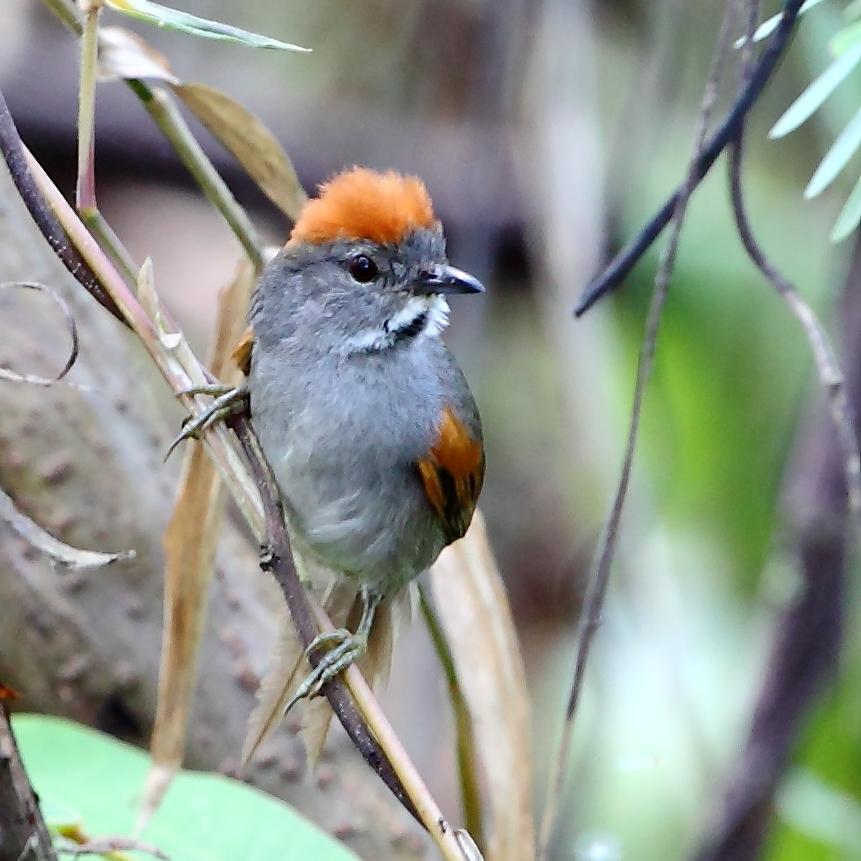
The Rufous-breasted Spinetail measures 13–16 cm in length. Adults weigh between 15 and 19 g, and males and females have the same plumage.[1][2][3]
Adults of the nominate subspecies have sepia-brown coloration on the face, crown, nape, back, rump, and upper tail coverts. The wings are chestnut with brown tips on the flight feathers, while the chestnut-brown tail has black feather shafts.[4][5][6]
The chin and upper throat are slate black with broad white streaks, and the lower throat is uniformly slate black in the nominate subspecies. The breast and sides are deep cinnamon-rufous, the flanks are light brown, and the belly is mottled whitish or mouse gray with an olive tinge.[7][8][9][10][11]
The iris is dark red to reddish brown. The bill is black and sometimes has a brownish base to the lower mandible, while the legs and feet are bright gray to greenish gray.[12][13][14]
Juveniles have light brown upper breasts, flanks, and undertail coverts. Their lower breasts and bellies are pale grayish and mottled with brown.[15][16]
The Pacific subspecies is paler overall than the nominate subspecies and has a gray lower throat rather than a black one.[17][18]
Habitat
The Rufous-breasted Spinetail occupies landscapes characterized by dense vegetation. Its habitats include the edges of lowland evergreen forests, second-growth scrublands, brushy clearings, and swampy areas.[19][20][21][22]
In Guatemala, the species occurs from sea level to elevations of 1,250 m. Outside Guatemala, it occurs up to elevations of 750 m.[23][24]
Diet
Arthropods constitute the main component of the Rufous-breasted Spinetail's diet. The species also eats small berries.[25][26]
Behaviour
The Rufous-breasted Spinetail remains resident throughout its range year-round. It generally forages alone or in pairs, gleaning prey from foliage and the ground in dense vegetation.[27][28][29]
The species' song consists of a nasal sequence of repeated notes followed by a rattling sound. Other vocalizations include a high-pitched call that rises slightly and has a shrieking quality, and a nasal, emphatic vocalization.[30][31][32]
The alarm call is a chatter or trill.[33]
Reproduction and life cycle
The breeding season includes at least the period from late March through September. Both members of a breeding pair participate in nest construction.[34][35]
The nest is a dome made of thorny sticks and may be half again as long as it is high. It has a tunnel entrance and a platform at its entrance.[36][37][38]
The exterior of the nest is covered with pieces of bark and stems from several types of leaves. The inner nest chamber contains a cup made of grass and fine twigs.[39][40]
Most clutches contain three eggs, although four eggs are occasionally laid. Both parents incubate the eggs and feed the nestlings.[41][42]
Incubation lasts 17–18 days. Young birds fledge approximately 15 days after hatching.[43][44]
Conservation
The IUCN classifies the Rufous-breasted Spinetail as Least Concern. Its estimated population is at least 50,000 mature individuals, and its population is believed to be stable.[45][46][47]
No immediate threats to the species have been identified.[48]
Similar species
The White-whiskered Spinetail is identified as the Rufous-breasted Spinetail's sister species.[49]
Classification of the Rufous-breasted Spinetail
| Kingdom | Animalia |
|---|---|
| Phylum | Chordata |
| Subphylum | Vertebrata |
| Infraphylum | Gnathostomata |
| Parvphylum | Osteichthyes |
| Megaclass | Tetrapoda |
| Class | Aves (Bird) |
| Order | Passeriformes (Passerine) |
| Family | Furnariidae (Ovenbird) |
| Genus | Synallaxis (Spinetails) |
| Species | Synallaxis erythrothorax P. L. Sclater, 1855 |
Where the Rufous-breasted Spinetail is found
Checklists and occurrence records place Synallaxis erythrothorax in 5 countries across North America. GBIF holds 15,957 georeferenced records of it.
Countries
Regions and cities with the most records
- Santa Bárbara, Guatemala 2,374
- Patulul, Guatemala 2,372
- Veracruz, Mexico 2,323
- Cayo District, Belize 1,668
- Yepocapa, Guatemala 1,655
- Belize District, Belize 1,526
- Chiapas, Mexico 1,526
- Nanchital de Lázaro Cárdenas del Río, Mexico 1,387
- Minatitlán, Mexico 1,383
- Cosoleacaque, Mexico 1,381
- Escuintla, Guatemala 1,264
- Santa Lucía Cotzumalguapa, Guatemala 1,241
- Petén, Guatemala 1,170
- Stann Creek, Belize 1,165
- Santiago Atitlán, Guatemala 1,135
- Toledo District, Belize 1,026
- San Ignacio, Belize 769
- Oaxaca, Mexico 565
- Chicacao, Guatemala 555
- Catemaco, Mexico 382
- Belmopan, Belize 364
- Flores, Guatemala 346
- San Benito, Guatemala 346
- Palenque, Mexico 325
- Tabasco, Mexico 284
- Cortés Department, Honduras 273
- Orange Walk District, Belize 272
- San Francisco de Yojoa, Honduras 269
- Santa Cruz de Yojoa, Honduras 268
- Alta Verapaz, Guatemala 254
- Quintana Roo, Mexico 211
- Yucatán, Mexico 156
- Atlántida Department, Honduras 149
- Tela, Honduras 139
- San Andrés Tuxtla, Mexico 130
- Cobán, Guatemala 125
Range as the checklists state it
Middle America
A number beside a place is its count of GBIF occurrence records. A place without a number comes from a checklist alone. Records show where a species has been observed or collected, which can include escapes and vagrants.
Common names
English
- Rufous-breasted Spinetail
Names in 24 other languages
- Catalan
- cuaespinós de pit rogenc
- Chinese
- 棕胸針尾雀, 棕胸针尾雀
- Croatian
- meksička trnorepa
- Czech
- ostrochvostka rezavoprsá
- Danish
- Yucatántrådhale
- Dutch
- Roodborststekelstaart
- Esperanto
- rufbrusta sinalakso
- Finnish
- punarintaorneero
- French
- Synallaxe à poitrine rousse
- German
- Rotbrust-Dickichtschlüpfer, Rotbrustschlüpfer
- Italian
- Codaspino pettorossiccio, Codaspinosa pettorosso
- Japanese
- ムネアカオナガカマドドリ
- Lithuanian
- rusvakrūtis dygliauodegis krosnius
- Norwegian
- rustbrystpiggstjert
- Norwegian Bokmål
- rustbryststifthale
- Polish
- ogończyk meksykański
- Portuguese
- chamiceiro-de-peito-ruivo, rabo-espinhoso-de-peito-ruivo
- Russian
- Рыжегрудая иглохвостка, Рыжегрудый иглохвостый печник
- Slovak
- košikárik hrdzavoprsý
- Spanish
- Güitío pecho rufo, Hormiguero Pepito, Pijuí centroamericano
- Swedish
- yucatántaggstjärt
- Turkish
- Yukatan Dikenkuyruğu
- Ukrainian
- пію мексиканський
- Welsh
- llostfain brongoch
Subspecies and varieties
- Synallaxis erythrothorax erythrothorax subspecies
- Synallaxis erythrothorax pacifica subspecies
Related species
-
 Azara's SpinetailSynallaxis azarae
-
 Spix's SpinetailSynallaxis spixi
-
 Pale-breasted SpinetailSynallaxis albescens
-
 Rufous-capped SpinetailSynallaxis ruficapilla
-
 Sooty-fronted SpinetailSynallaxis frontalis
-
 Slaty SpinetailSynallaxis brachyura
-
 Dark-breasted SpinetailSynallaxis albigularis
-
 Stripe-breasted SpinetailSynallaxis cinnamomea
Compare
Questions and answers
What is the scientific name of the Rufous-breasted Spinetail?
The scientific name of the Rufous-breasted Spinetail is Synallaxis erythrothorax. Written with its author, the full name is Synallaxis erythrothorax P. L. Sclater, 1855.
Which family does the Rufous-breasted Spinetail belong to?
Synallaxis erythrothorax belongs to the family Furnariidae, in the order Passeriformes and the class Aves.
Where is the Rufous-breasted Spinetail found?
Checklists and occurrence records place Synallaxis erythrothorax in 5 countries: Belize, Mexico, Guatemala, Honduras and El Salvador.
What is the conservation status of the Rufous-breasted Spinetail?
The IUCN Red List category recorded for Synallaxis erythrothorax is Least Concern (LC).
Sources
Passages the profile rests on
- The species measures 13–16 cm in length. Source passage: “The rufous-breasted spinetail is 13 to 16 cm (5.1 to 6.3 in) long” — English Wikipedia
- Adults weigh between 15 and 19 g. Source passage: “weighs 15 to 19 g (0.53 to 0.67 oz).” — English Wikipedia
- Males and females have the same plumage. Source passage: “The sexes have the same plumage.” — English Wikipedia
- Adults of the nominate subspecies have sepia-brown coloration on the face, crown, nape, back, rump, and upper tail coverts. Source passage: “Adults of the nominate subspecies have a sepia brown face, crown, nape, back, rump and uppertail coverts.” — English Wikipedia
- The wings are chestnut with brown tips on the flight feathers. Source passage: “Their wings are chestnut with brown tips on their flight feathers.” — English Wikipedia
- The tail is chestnut brown and has black feather shafts. Source passage: “Their tail is chestnut brown; the feathers have black shafts.” — English Wikipedia
- The chin and upper throat are slate black with broad white streaks. Source passage: “Their chin and upper throat are slate black with widish white streaks;” — English Wikipedia
- The lower throat is uniformly slate black in the nominate subspecies. Source passage: “their lower throat is solid slate black.” — English Wikipedia
- The breast and sides are deep cinnamon-rufous. Source passage: “Their breast and sides are deep cinnamon rufous,” — English Wikipedia
- The flanks are light brown. Source passage: “their flanks light brown,” — English Wikipedia
- The belly is mottled whitish or mouse gray with an olive tinge. Source passage: “their belly mottled whitish or mouse gray with an olive tinge,” — English Wikipedia
- The iris is dark red to reddish brown. Source passage: “Their iris is dark red to reddish brown,” — English Wikipedia
- The bill is black and sometimes has a brownish base to the lower mandible. Source passage: “their bill black (sometimes with a brownish base to the mandible),” — English Wikipedia
- The legs and feet are bright gray to greenish gray. Source passage: “and their legs and feet bright gray to greenish gray.” — English Wikipedia
- Juveniles have light brown upper breasts, flanks, and undertail coverts. Source passage: “Juveniles have a similar pattern to adults with light brown upper breast, flanks, and undertail coverts” — English Wikipedia
- Juveniles have pale grayish lower breasts and bellies mottled with brown. Source passage: “and pale grayish lower breast and belly mottled with brown.” — English Wikipedia
- The Pacific subspecies is paler overall than the nominate subspecies. Source passage: “Subspecies S. e. pacifica is overall paler than the nominate,” — English Wikipedia
- The Pacific subspecies has a gray lower throat rather than a black one. Source passage: “with a gray (instead of black) lower throat” — English Wikipedia
- The species occupies landscapes characterized by dense vegetation. Source passage: “The species inhabits a variety of landscapes characterized by dense vegetation.” — English Wikipedia
- Its habitats include the edges of lowland evergreen forests. Source passage: “They include the edges of lowland evergreen forest,” — English Wikipedia
- The species occurs in second-growth scrublands. Source passage: “second-growth scrublands,” — English Wikipedia
- The species uses brushy clearings and swampy areas. Source passage: “brushy clearings, and swampy areas.” — English Wikipedia
- In Guatemala, the species occurs from sea level to elevations of 1,250 m. Source passage: “In elevation it ranges from sea level to 1,250 m (4,100 ft) in Guatemala” — English Wikipedia
- Outside Guatemala, the species occurs up to elevations of 750 m. Source passage: “but only to 750 m (2,500 ft) elsewhere.” — English Wikipedia
- Arthropods constitute the main component of the species' diet. Source passage: “The rufous-breasted spinetail feeds mostly on arthropods” — English Wikipedia
- The species also eats small berries. Source passage: “but also includes small berries in its diet.” — English Wikipedia
- The species remains resident throughout its range year-round. Source passage: “The rufous-breasted spinetail is a year-round resident throughout its range.” — English Wikipedia
- The species generally forages alone or in pairs. Source passage: “It usually forages singly or in pairs,” — English Wikipedia
- While foraging, the species gleans prey from foliage and the ground in dense vegetation. Source passage: “gleaning prey from foliage and the ground in dense vegetation.” — English Wikipedia
- The species' song consists of a nasal sequence of repeated notes followed by a rattling sound. Source passage: “The rufous-breasted spinetail's song is "a nasal weet!-weet!-weet!-Wur'r'r'r'r'r".” — English Wikipedia
- One additional vocalization is a high-pitched call that rises slightly and has a shrieking quality. Source passage: “a "very high, rising slightly shrieking wrutuwit-wít-truw"” — English Wikipedia
- The species also gives a nasal, emphatic vocalization. Source passage: “" a nasal, emphatic whit'chew".” — English Wikipedia
- The alarm call is a chatter or trill. Source passage: “Its alarm call is a chatter or trill.” — English Wikipedia
- The breeding season includes at least the period from late March through September. Source passage: “includes at least late March to September.” — English Wikipedia
- Both members of a breeding pair participate in nest construction. Source passage: “Both members of a pair build the nest,” — English Wikipedia
- The nest is a dome made of thorny sticks. Source passage: “a dome of thorny sticks” — English Wikipedia
- The nest may be half again as long as it is high. Source passage: “that may be half again as long as it is high,” — English Wikipedia
- The nest has a tunnel entrance and a platform at its entrance. Source passage: “with a tunnel entrance and a platform at the tunnel entrance.” — English Wikipedia
- The exterior of the nest is covered with pieces of bark and stems from several types of leaves. Source passage: “Its exterior is "thatched" with pieces of bark and stems of several leaf types.” — English Wikipedia
- The inner nest chamber contains a cup made of grass and fine twigs. Source passage: “The inner chamber has a cup of grass and fine twigs.” — English Wikipedia
- Most clutches contain three eggs, although four eggs are occasionally laid. Source passage: “Most clutches are of three eggs but four are sometimes laid.” — English Wikipedia
- Both parents incubate the eggs and feed the nestlings. Source passage: “Both parents incubate the clutch and provision nestlings.” — English Wikipedia
- Incubation lasts 17–18 days. Source passage: “The incubation period is 17 to 18 days” — English Wikipedia
- Young birds fledge approximately 15 days after hatching. Source passage: “and fledging occurs about 15 days after hatch.” — English Wikipedia
- The IUCN classifies the Rufous-breasted Spinetail as Least Concern. Source passage: “The IUCN has assessed the rufous-breasted spinetail as being of Least Concern.” — English Wikipedia
- The species has an estimated population of at least 50,000 mature individuals. Source passage: “its estimated population of at least 50,000 mature individuals” — English Wikipedia
- The species' population is believed to be stable. Source passage: “is believed to be stable.” — English Wikipedia
- No immediate threats to the species have been identified. Source passage: “No immediate threats have been identified.” — English Wikipedia
- The White-whiskered Spinetail is identified as the Rufous-breasted Spinetail's sister species. Source passage: “A study published in 2011 determined that the rufous-breasted spinetail and the white-whiskered spinetail (S. candei) are sister species.” — English Wikipedia
Data
- Catalogue of Life, 2026-10-16 XR cc by
- Global Biodiversity Information Facility CC BY 4.0
- Wikidata CC0
- GeoNames CC BY 4.0
- Wikimedia Commons per image; credit shown with each image
- Within the Catalogue of Life, this name comes from The Integrated Taxonomic Information System cc0
References
- Sclater, & Philip Lutley. (1855). April 24, 1855. Proceedings of the Zoological Society of London, Vol. 23, No. 289. where the name was published
- Gill, Frank, & and Minturn Wright. (2006). Birds of the World: Recommended English Names.
This species in other databases
Page built on 27 November 2026. See how the catalog is made and all sources and licences.
Cite this page
ScientificNames.org. (2026). Synallaxis erythrothorax (Rufous-breasted Spinetail). Retrieved November 27, 2026, from https://scientificnames.org/species/synallaxis-erythrothorax
“Synallaxis erythrothorax (Rufous-breasted Spinetail).” ScientificNames.org, 2026, scientificnames.org/species/synallaxis-erythrothorax. Accessed 27 Nov. 2026.
ScientificNames.org. “Synallaxis erythrothorax (Rufous-breasted Spinetail).” Accessed November 27, 2026. https://scientificnames.org/species/synallaxis-erythrothorax.
@misc{scientificnames_synallaxis_erythrothorax_rufous_breasted_spinetail,
  author = {{ScientificNames.org}},
  title = {Synallaxis erythrothorax (Rufous-breasted Spinetail)},
  year = {2026},
  url = {https://scientificnames.org/species/synallaxis-erythrothorax},
  note = {Accessed 2026-11-27}
}