Species · Birds
Whistling Heron Syrigma sibilatrix
The scientific name of the Whistling Heron is Syrigma sibilatrix. It is a species of bird in the family Ardeidae (heron), order Pelecaniformes. The name dates from 1824.
- Scientific name
- Syrigma sibilatrix (Temminck, 1824)
- Common name
- Whistling Heron
- Genus
- Syrigma
- Family
- Ardeidae (Heron)
- Order
- Pelecaniformes
- Class
- Aves
- Red List category
- LC Least Concern
- Environment
- freshwater, terrestrial
- Recorded in
- 11 countries
- Name status
- accepted in the Catalogue of Life

Overview
Syrigma sibilatrix occurs in the Llanos and Orinoco basin of Colombia and Venezuela, and in eastern Bolivia, Paraguay, western and southern Brazil, Uruguay, Chile, and northeastern Argentina. It is distinguished by its blue-gray upperparts, gold to buff-stained white feathers on the head and underparts, and distinctive, far-carrying whistle.
Written 26 November 2026 from the sources listed below. Each statement was checked against the passage it cites; statements that could not be supported were removed.
Similar species
The Whistling Heron is most closely related to the Capped Heron according to a molecular phylogenetic study published in 2023.[1]
Appearance
Adult Whistling Herons have blue-gray upperparts, except for the lower back, and white feathers stained gold to buff on the sides of the head, neck, breast, and scapular area. Adults also have a fairly large area of bare bluish skin around the eye.[2][3]
The nominate subspecies has a black crown and crest and cinnamon-colored upper wing coverts. The northern subspecies has a slate-gray crown and crest and honey-colored upper wing coverts.[4][5]
The bill is pink with a blue to violet base and a black distal third, while the legs are short and greenish. The Whistling Heron measures between 53 and 64 cm in length.[6][7]
Juveniles have duller plumage than adults, with a lighter crown, light-gray breast, and unstained white throat and sides.[8]
The southern subspecies is larger than the northern subspecies but has a proportionally shorter bill.[9]
Habitat
The Whistling Heron inhabits seasonally flooded savannas, often in drier grassy areas than those used by other herons. It also occupies open waterlogged areas and shallowly submerged terrain.[10][11]
The species particularly favors areas where open habitats are interspersed with woodlots. It also uses human-modified habitats such as pastures and roadsides and frequently perches on fenceposts.[12][13]
Diet
The Whistling Heron eats small animals found in dryland and marsh habitats. It catches flying insects, particularly dragonflies.[14][15]
The species has been observed stealing prey from an aplomado falcon.[16]
Behaviour
The Whistling Heron commonly remains motionless while feeding but can also walk slowly or run after prey. It sometimes catches flying insects while standing.[17][18]
The species generally feeds alone or in pairs but has occasionally been observed in groups of up to 100 individuals. It frequently gathers in groups before roosting for the night.[19][20]
The Whistling Heron produces a distinctive, far-carrying whistle and may give a slow, prolonged whistle when taking off. Its alarm call is a harsh quah-h-h.[21][22][23]
The species flies with fast, duck-like wingbeats and usually does not fully retract its neck.[24]
Reproduction and life cycle
During courtship, Whistling Herons fly back and forth and glide in circles. The species nests individually rather than in colonies.[25][26]
Whistling Herons may nest in mature araucarias or exotic trees. A recorded nest in Argentina was constructed loosely from sticks approximately four metres above the ground in a eucalyptus.[27][28]
The eggs are pale blue and speckled and measure approximately 4.7 by 3.6 cm. The normal clutch consists of three or four eggs.[29][30]
Incubation lasts approximately 28 days. Young Whistling Herons fledge approximately 42 days after hatching.[31][32]
Approximately two young normally fledge from each family group. Whistling Herons continue caring for their young after the young leave the nest.[33][34]
Juveniles beg for food by hissing while holding their wings drooped.[35]
Conservation
The species is common in many parts of its patchy distribution, and no population is considered vulnerable. It benefits from deforestation and some agricultural activities.[36][37]
The northern subspecies occurs in the Llanos and Orinoco basin of Colombia and Venezuela. The southern subspecies occurs in eastern Bolivia, Paraguay, western and southern Brazil, Uruguay, Chile, and northeastern Argentina.[38][39]
The species may be expanding its range northward and eastward in Brazil. It makes seasonal movements in northeastern Venezuela and is absent there from November through January.[40][41]
The species remains present throughout the year in Buenos Aires Province, Argentina.[42]
Uses
Indigenous peoples formerly used the neck plumes of the Whistling Heron as trade items.[43]
Classification of the Whistling Heron
| Kingdom | Animalia |
|---|---|
| Phylum | Chordata |
| Subphylum | Vertebrata |
| Infraphylum | Gnathostomata |
| Parvphylum | Osteichthyes |
| Megaclass | Tetrapoda |
| Class | Aves (Bird) |
| Order | Pelecaniformes (Herons) |
| Family | Ardeidae (Heron) |
| Genus | Syrigma |
| Species | Syrigma sibilatrix (Temminck, 1824) |
Where the Whistling Heron is found
Checklists and occurrence records place Syrigma sibilatrix in 11 countries across South America. GBIF holds 116,931 georeferenced records of it.
Countries
- Argentina 43,599
- Bolivia 3,587
- Brazil 32,579
- Chile 5
- Colombia 19,854
- Ecuador 245
- Guyana 3
- Paraguay 5,475
- Peru 4
- Uruguay 6,062
- Venezuela 5,518
Regions and cities with the most records
- Buenos Aires, Argentina 11,726
- Meta Department, Colombia 10,243
- São Paulo, Brazil 7,130
- Corrientes, Argentina 4,993
- Entre Rios, Argentina 4,890
- Mato Grosso do Sul, Brazil 4,360
- Santa Fe, Argentina 4,078
- Cordoba, Argentina 4,051
- Mato Grosso, Brazil 4,029
- Rio Grande do Sul, Brazil 3,831
- Santos Lugares, Argentina 3,687
- Valentín Alsina, Argentina 3,540
- Casanare Department, Colombia 3,515
- Buenos Aires, Argentina 3,497
- Lanús, Argentina 3,346
- Avellaneda, Argentina 3,308
- Sarandí, Argentina 3,251
- Remedios de Escalada de San Martín, Argentina 3,209
- Quilmes, Argentina 3,200
- Monte Chingolo, Argentina 3,196
- Lomas de Zamora, Argentina 3,162
- Banfield, Argentina 3,160
- Santa Catarina, Brazil 3,110
- Villavicencio, Colombia 2,814
- Minas Gerais, Brazil 2,803
- Restrepo, Colombia 2,403
- Santa Cruz Department, Bolivia 2,312
- Salta, Argentina 2,171
- Rio de Janeiro, Brazil 2,068
- Goiás, Brazil 1,978
- Paraná, Brazil 1,965
- Misiones, Argentina 1,839
- Chaco, Argentina 1,804
- Acacías, Colombia 1,732
- Villa Sarmiento, Argentina 1,350
- Formosa, Argentina 1,336
8 more countries have a few records outside this range
These countries hold a few records of Syrigma sibilatrix but lie outside the range the checklists give for it. Such records are often zoo or garden specimens, museum material or vagrants, so the species is not counted as occurring there.
Range as the checklists state it
South America
A number beside a place is its count of GBIF occurrence records. A place without a number comes from a checklist alone. Records show where a species has been observed or collected, which can include escapes and vagrants.
Common names
English
- Whistling Heron
Names in 29 other languages
- Arabic
- بلشون صافر
- Bulgarian
- Свиреща чапла
- Catalan
- martinet xiulaire
- Chinese
- 中白鷺, 啸鹭
- Croatian
- čaplja zviždara
- Danish
- Pibehejre
- Dutch
- Fluitreiger
- Esperanto
- fajfardeo
- Estonian
- vilehaigur
- Finnish
- viheltäjähaikara
- French
- Aigrette flûte-du-soleil, Héron flûte-du-soleil
- German
- Pfeifreiher
- Hungarian
- fütyülő gém
- Italian
- Airone fischiatore
- Japanese
- キムネゴイ
- Lithuanian
- švilpiančioji gervė
- Norwegian
- plystrehegre
- Papiamento
- Garsa Flùitdó
- Polish
- czapla gwiżdżąca
- Portuguese
- garça-assobiadeira, maria-faceira
- Russian
- Свистящая цапля
- Serbian
- Zviždeća čaplja
- Slovak
- volavka hvízdavá
- Spanish
- Chiflón, Garza chiflona, Garza chiflón, Garza silbadora
- Swedish
- visselhäger
- Turkish
- Islıkçı Balıkçıl
- Ukrainian
- чапля-свистун
- Welsh
- crëyr chwibanog
- grn
- Kuarahy mimby
Synonyms
One other scientific name has been used for this species and is now treated as a synonym of Syrigma sibilatrix.
- Ardea sibilatrix Temminck, 1824
Subspecies and varieties
- Syrigma sibilatrix fostersmithi subspecies
- Syrigma sibilatrix sibilatrix subspecies
Related species
-
 Great Blue HeronArdea herodias
-
 Great EgretArdea alba
-
 Grey HeronArdea cinerea
-
 Little EgretEgretta garzetta
-
 Black-crowned Night HeronNycticorax nycticorax
-
 Green HeronButorides virescens
-
 Western Cattle EgretArdea ibis
-
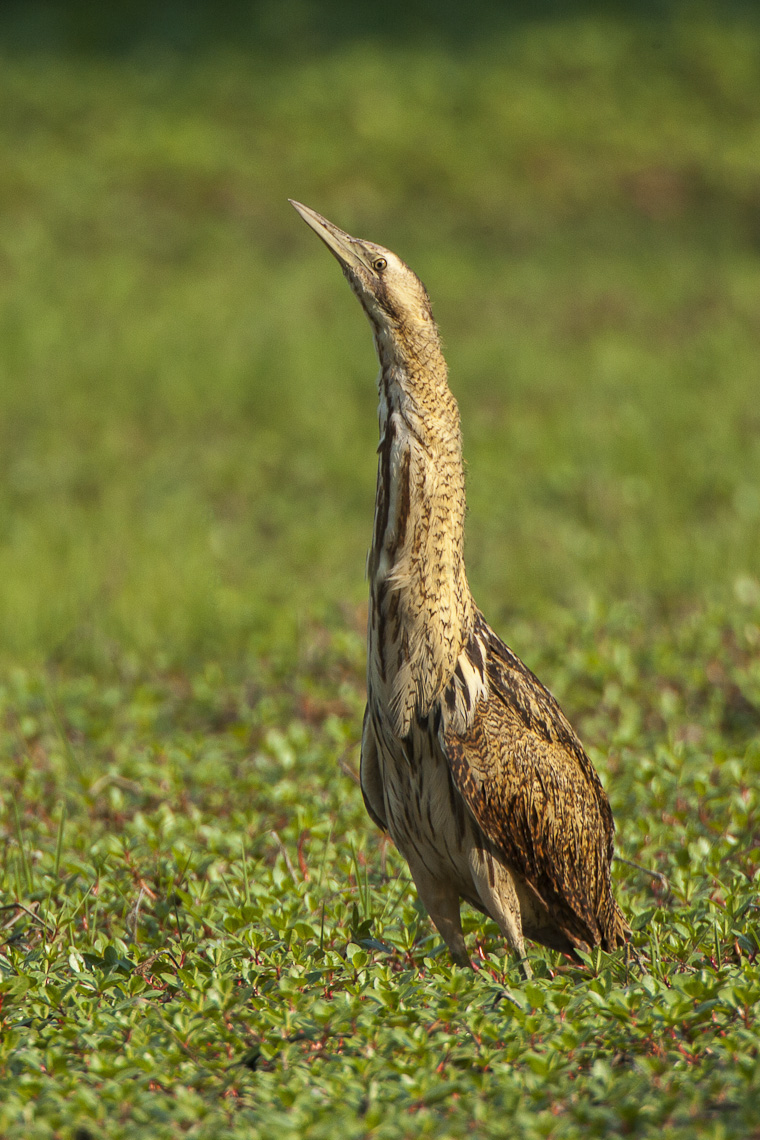 Eurasian BitternBotaurus stellaris
Compare
Questions and answers
What is the scientific name of the Whistling Heron?
The scientific name of the Whistling Heron is Syrigma sibilatrix. Written with its author, the full name is Syrigma sibilatrix (Temminck, 1824).
Which family does the Whistling Heron belong to?
Syrigma sibilatrix belongs to the family Ardeidae, in the order Pelecaniformes and the class Aves.
Where is the Whistling Heron found?
Checklists and occurrence records place Syrigma sibilatrix in 11 countries, including Argentina, Brazil, Colombia, Uruguay, Venezuela and Paraguay.
What is the conservation status of the Whistling Heron?
The IUCN Red List category recorded for Syrigma sibilatrix is Least Concern (LC).
Sources
Passages the profile rests on
- The Whistling Heron is most closely related to the Capped Heron according to a molecular phylogenetic study published in 2023. Source passage: “A molecular phylogenetic study published in 2023 found that within the heron family the whistling heron is most closely related to the capped heron (Pilherodius pileatus).” — English Wikipedia
- Adult Whistling Herons have blue-gray upperparts, except for the lower back, and white feathers stained gold to buff on the sides of the head, neck, breast, and scapular area. Source passage: “In both subspecies, adults' upperparts except the lower back are blue-gray. The feathers of the sides of head, sides of the neck, breast, and scapular area are basically white but are stained gold to buff” — English Wikipedia
- Adults have a fairly large area of bare bluish skin around the eye. Source passage: “there is a fairly big area of bare bluish skin around the eye.” — English Wikipedia
- The nominate subspecies has a black crown and crest and cinnamon-colored upper wing coverts. Source passage: “In the nominate subspecies, the crown and crest (separate plumes up to 4 cm long on the nape) are black and the upper wing coverts are cinnamon-colored” — English Wikipedia
- The northern subspecies has a slate-gray crown and crest and honey-colored upper wing coverts. Source passage: “the crown and crest are slate-gray and the upper wing coverts are honey-colored (or "chamois") in fostersmithi.” — English Wikipedia
- The bill is pink with a blue to violet base and a black distal third, while the legs are short and greenish. Source passage: “The bill is pink with blue to violet at the base and the distal third black, the legs are greenish and rather short” — English Wikipedia
- The Whistling Heron measures between 53 and 64 cm in length. Source passage: “The whistling heron measures 53 to 64 cm in length” — English Wikipedia
- Juveniles have duller plumage than adults, with a lighter crown, light-gray breast, and unstained white throat and sides. Source passage: “Juveniles have the same overall pattern but are duller than adults, with the crown lighter, the breast light gray, and the throat and sides unstained white.” — English Wikipedia
- The southern subspecies is larger than the northern subspecies but has a proportionally shorter bill. Source passage: “The southern subspecies is bigger but has a shorter bill in proportion to the body.” — English Wikipedia
- The species inhabits seasonally flooded savannas, often in drier grassy areas than those used by other herons. Source passage: “It occurs at elevations up to 500 m (with a sight record from 2300 m) in seasonally flooded savanna, often in drier grassy situations than other herons” — English Wikipedia
- The species also occupies open waterlogged areas and shallowly submerged terrain. Source passage: “but also in a wide variety of open waterlogged or shallowly submerged terrain.” — English Wikipedia
- The species particularly favors areas where open habitats are interspersed with woodlots. Source passage: “Because it roosts in trees, it particularly likes regions where open areas are mixed with woodlots.” — English Wikipedia
- The species uses human-modified habitats such as pastures and roadsides and frequently perches on fenceposts. Source passage: “It has no objection to human-altered habitats such as pastures and roadsides, and it often perches on fenceposts.” — English Wikipedia
- The Whistling Heron eats small animals found in dryland and marsh habitats. Source passage: “This species eats any small dryland and marsh animals it can catch” — English Wikipedia
- The species catches flying insects, particularly dragonflies. Source passage: “catching flying insects (notably dragonflies) from a standing position.” — English Wikipedia
- The species has been observed stealing prey from an aplomado falcon. Source passage: “or even pirate (as from an aplomado falcon in one reported incident).” — English Wikipedia
- The Whistling Heron commonly remains motionless while feeding but can also walk slowly or run after prey. Source passage: “It often holds still but also walks very slowly and may use more active techniques, even running after prey” — English Wikipedia
- The species sometimes catches flying insects while standing. Source passage: “catching flying insects (notably dragonflies) from a standing position.” — English Wikipedia
- The species generally feeds alone or in pairs but has occasionally been observed in groups of up to 100 individuals. Source passage: “It typically feeds alone or in pairs, but is sometimes seen in groups up to 100” — English Wikipedia
- The species frequently gathers in groups before roosting for the night. Source passage: “especially before roosting for the night.” — English Wikipedia
- The Whistling Heron produces a distinctive, far-carrying whistle. Source passage: “a distinctive, characteristic, far-carrying, melodious whistle” — English Wikipedia
- The species may give a slow, prolonged whistle when taking off. Source passage: “a slow, drawn-out whistle" when taking off.” — English Wikipedia
- The alarm call of the Whistling Heron is a harsh quah-h-h. Source passage: “The alarm call is a harsh quah-h-h.” — English Wikipedia
- The species flies with fast, duck-like wingbeats and usually does not fully retract its neck. Source passage: “Unlike other herons, in flight it has fast, duck-like wingbeats and usually does not retract its neck fully.” — English Wikipedia
- During courtship, Whistling Herons fly back and forth and glide in circles. Source passage: “In a courtship display, the birds fly back and forth and glide in circles.” — English Wikipedia
- The species nests individually rather than in colonies. Source passage: “This species nests alone, unlike most herons, which nest in colonies.” — English Wikipedia
- Whistling Herons may nest in mature araucarias or exotic trees. Source passage: “It may nest in mature trees such as araucarias or exotic trees.” — English Wikipedia
- A recorded nest in Argentina was constructed loosely from sticks approximately four metres above the ground in a eucalyptus. Source passage: “One nest in Argentina was loosely built of sticks about 4m up in a eucalyptus.” — English Wikipedia
- The eggs are pale blue and speckled and measure approximately 4.7 by 3.6 cm. Source passage: “The eggs are pale blue and speckled, about 4.7 × 3.6 cm” — English Wikipedia
- The normal clutch consists of three or four eggs. Source passage: “the normal clutch is three or four.” — English Wikipedia
- Incubation lasts approximately 28 days. Source passage: “Incubation lasts about 28 days” — English Wikipedia
- Young Whistling Herons fledge approximately 42 days after hatching. Source passage: “young fledge 42 days after hatching.” — English Wikipedia
- Approximately two young normally fledge from each family group. Source passage: “Based on observations of family groups, only two young normally fledge.” — English Wikipedia
- Whistling Herons continue caring for their young after the young leave the nest. Source passage: “Unlike most heron species, whistling herons care for young after leaving the nest” — English Wikipedia
- Juveniles beg for food by hissing while holding their wings drooped. Source passage: “juveniles beg for food by hissing with their wings drooped.” — English Wikipedia
- The species is common in many parts of its patchy distribution, and no population is considered vulnerable. Source passage: “Although patchily distributed, it is common in many areas, with no population considered vulnerable.” — English Wikipedia
- The species benefits from deforestation and some agricultural activities. Source passage: “It benefits from deforestation and some agriculture.” — English Wikipedia
- The northern subspecies occurs in the Llanos and Orinoco basin of Colombia and Venezuela. Source passage: “The subspecies fostersmithi inhabits the Llanos and the Orinoco basin of Colombia and Venezuela.” — English Wikipedia
- The southern subspecies occurs in eastern Bolivia, Paraguay, western and southern Brazil, Uruguay, Chile, and northeastern Argentina. Source passage: “The subspecies sibilatrix inhabits eastern Bolivia, Paraguay, western and southern Brazil, Uruguay, Chile, and northeastern Argentina.” — English Wikipedia
- The species may be expanding its range northward and eastward in Brazil. Source passage: “Recent records suggest that it may be expanding its range northward and eastward in Brazil.” — English Wikipedia
- The species makes seasonal movements in northeastern Venezuela and is absent there from November through January. Source passage: “It makes seasonal movements at least in northeastern Venezuela, where it does not occur from November to January” — English Wikipedia
- The species remains present throughout the year in Buenos Aires Province, Argentina. Source passage: “but remains all year in other areas, such as Buenos Aires Province, Argentina.” — English Wikipedia
- Indigenous peoples formerly used the neck plumes of the Whistling Heron as trade items. Source passage: “Indigenous peoples formerly used its neck plumes as trade items” — English Wikipedia
Data
- Catalogue of Life, 2026-10-16 XR cc by
- Global Biodiversity Information Facility CC BY 4.0
- Wikidata CC0
- GeoNames CC BY 4.0
- Wikimedia Commons per image; credit shown with each image
- Within the Catalogue of Life, this name comes from The Integrated Taxonomic Information System cc0
References
- Gill, Frank, & and Minturn Wright. (2006). Birds of the World: Recommended English Names.
This species in other databases
- Catalogue of Life 542DQ
- Wikidata Q218549
- iNaturalist 5056
- WoRMS urn:lsid:marinespecies.org:taxname:1550122
- Avibase whiher1
Page built on 27 November 2026. See how the catalog is made and all sources and licences.
Cite this page
ScientificNames.org. (2026). Syrigma sibilatrix (Whistling Heron). Retrieved November 27, 2026, from https://scientificnames.org/species/syrigma-sibilatrix
“Syrigma sibilatrix (Whistling Heron).” ScientificNames.org, 2026, scientificnames.org/species/syrigma-sibilatrix. Accessed 27 Nov. 2026.
ScientificNames.org. “Syrigma sibilatrix (Whistling Heron).” Accessed November 27, 2026. https://scientificnames.org/species/syrigma-sibilatrix.
@misc{scientificnames_syrigma_sibilatrix_whistling_heron,
  author = {{ScientificNames.org}},
  title = {Syrigma sibilatrix (Whistling Heron)},
  year = {2026},
  url = {https://scientificnames.org/species/syrigma-sibilatrix},
  note = {Accessed 2026-11-27}
}