Species · Flowering plants
Black Bat Flower Tacca chantrieri
The scientific name of the Black Bat Flower is Tacca chantrieri. It is a species of flowering plant in the family Dioscoreaceae (yam family), order Dioscoreales.
- Scientific name
- Tacca chantrieri André
- Common name
- Black Bat Flower
- Genus
- Tacca
- Family
- Dioscoreaceae (Yam Family)
- Order
- Dioscoreales
- Class
- Liliopsida
- Recorded in
- 13 countries
- Name status
- accepted in the Catalogue of Life

Overview
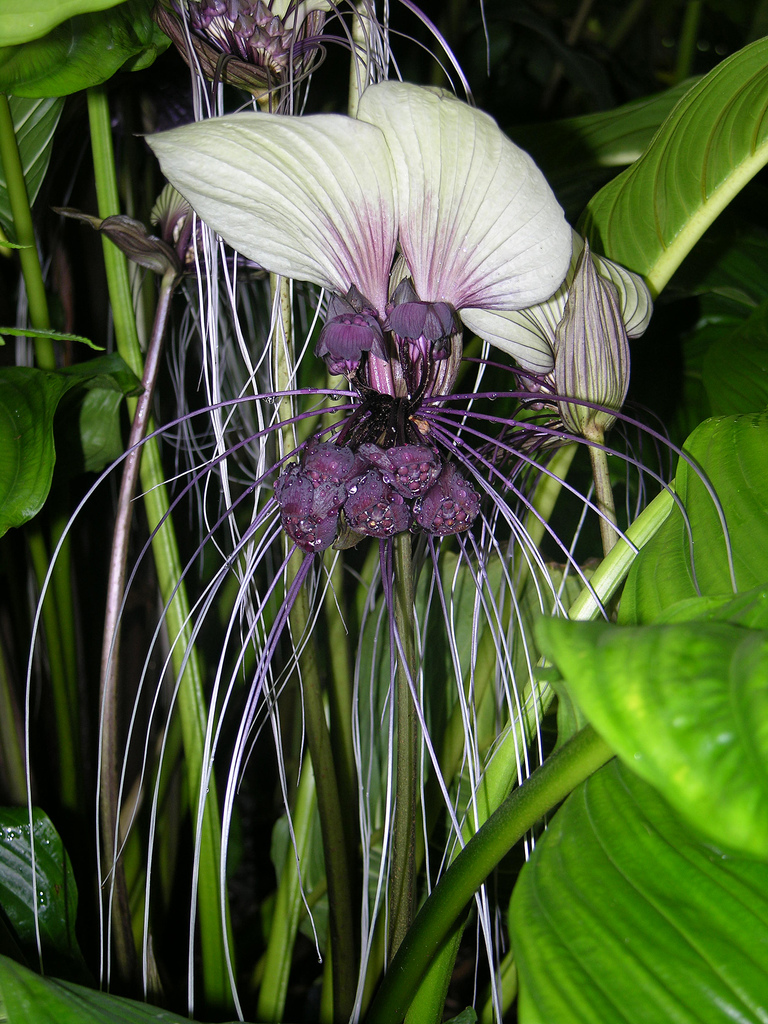
Tacca chantrieri is distinguished by unusual dark flowers with bat-wing-shaped bracts and long, drooping, whisker-like bracteoles.
Written 26 November 2026 from the sources listed below. Each statement was checked against the passage it cites; statements that could not be supported were removed.
Appearance
The Black bat flower produces unusual flowers with large bracts shaped like bat wings. The flowers can be dark brown, purple or green and have six maroon-black petals and six stout stamens.[1][2][3][4]
The flowers produce long, whisker-like bracteoles that hang down from the flower. Each flower can have approximately 30 long, drooping, greenish bracteoles measuring 8–10 inches in length.[5][6][7]
The flowers can reach 12 inches across and have no significant fragrance.[8][9]
The plant typically grows between 50 and 100 centimetres tall.[10]
Habitat
The species prefers moist tropical growing conditions.[11]
Behaviour
The Black bat flower primarily reproduces through autonomous self-pollination. Self-pollination can occur before the flowers open.[12][13]
Flies may enter the flowers while apparently seeking decaying organic matter. The flower's helmet-like stamens make it difficult for visiting insects to escape.[14][15]
Reproduction and life cycle
The plant begins flowering after producing at least two leaves and can flower as many as eight times during one growing season. It flowers from April through July.[16][17][18]
The plant produces flowers on stout stems positioned above its foliage. The flower buds open sequentially.[19][20]
The species can reproduce through rhizome propagation, tuber division and occasionally seeds.[21]
The flowering structures deteriorate rapidly when cut and should remain attached to the plant.[22]
Conservation
The Black bat flower has the widest geographical range among members of its genus. Its geographical range has declined because of overexploitation, habitat destruction and forest fragmentation.[23][24]
Uses
The Black bat flower has been used in traditional Chinese medicine. Its medicinal compounds are found in its rhizomes, which contain saponins and diarylheptanoids.[25][26][27]
Extracts from the species have traditionally been used to treat high blood pressure, gastric ulcers, burns, hepatitis and enteritis.[28]
Root extracts contain taccalonolides E and A, which are microtubule stabilizers. Compounds derived from the species have been described as having anticancer properties because of their cytotoxic activity.[29][30]
Classification of the Black Bat Flower
| Kingdom | Plantae |
|---|---|
| Subkingdom | Pteridobiotina |
| Phylum | Tracheophyta |
| Class | Liliopsida |
| Order | Dioscoreales |
| Family | Dioscoreaceae (Yam Family) |
| Genus | Tacca (Arrowroot) |
| Species | Tacca chantrieri André |
Where the Black Bat Flower is found
Checklists and occurrence records place Tacca chantrieri in 13 countries across Asia. GBIF holds 609 georeferenced records of it.
Countries where it is native or its origin is not stated
- Bangladesh 1
- Cambodia 14
- China 227
- India 21
- Indonesia 18
- Laos 13
- Malaysia 51
- Myanmar 10
- Singapore 18
- Sri Lanka 12
- Thailand 132
- Vietnam 92
Countries where it has been introduced
Regions and cities with the most records
- Yunnan, China 113
- Guangxi, China 38
- Hainan, China 23
- Ayer Itam, Malaysia 22
- Balik Pulau, Malaysia 22
- Batu Feringgi, Malaysia 22
- Bayan Lepas, Malaysia 22
- Butterworth, Malaysia 22
- George Town, Malaysia 22
- Glugor, Malaysia 22
- Jelutong, Malaysia 22
- Kampung Sungai Ara, Malaysia 22
- Kampung Sungai Glugur, Malaysia 22
- Kampung Teluk Air Tawar, Malaysia 22
- Kampung Teluk Kumbar, Malaysia 22
- Paya Terubong, Malaysia 22
- Perai, Malaysia 22
- Permatang Kuching, Malaysia 22
- Relau, Malaysia 22
- Sungai Dua, Malaysia 20
- Bukit Gemuroh, Malaysia 19
- Kepala Batas, Malaysia 19
- Kota Kuala Muda, Malaysia 19
- Anak Bukit, Singapore 17
- Ang Mo Kio New Town, Singapore 17
- Bedok New Town, Singapore 17
- Boon Lay, Singapore 17
- Bukit Panjang New Town, Singapore 17
- Bukit Timah, Singapore 17
- Choa Chu Kang New Town, Singapore 17
- Eunos, Singapore 17
- Jurong East, Singapore 17
- Jurong Town, Singapore 17
- Jurong West, Singapore 17
- Kampong Pasir Ris, Singapore 17
- Keat Hong Village, Singapore 17
9 more countries have a few records outside this range
These countries hold a few records of Tacca chantrieri but lie outside the range the checklists give for it. Such records are often zoo or garden specimens, museum material or vagrants, so the species is not counted as occurring there.
A number beside a place is its count of GBIF occurrence records. A place without a number comes from a checklist alone. Records show where a species has been observed or collected, which can include escapes and vagrants.
Common names
English
- Black Bat Flower
- Batflower
- Cat's-whiskers
- Devil-flower
Names in 14 other languages
- Chinese
- jian gen shu, 箭根, 箭根薯, 老虎鬚
- Czech
- taka velkokvětá
- Dutch
- Vleermuisbloem
- Finnish
- tummaviiksikki
- German
- Fledermausblume
- Japanese
- クロバナタシロイモ, 黒花田代芋
- Lithuanian
- Rudoji karčiuotė
- Polish
- krąpiel Chantriera
- Russian
- Такка Шантрье
- Slovak
- taka veľkokvetá
- Spanish
- Flor murciélago, Flor murciélago negra
- Swedish
- tacca
- Thai
- ค้างคาวดำ, เนระพูสีไทย
- bar
- Fleedermausbleamé
Synonyms
16 other scientific names have been used for this species and are now treated as synonyms of Tacca chantrieri.
- Clerodendron esquirolii H.Lév.
- Schizocapsa breviscapa (Ostenf.) H.Limpr.
- Schizocapsa itagakii Yamam.
- Tacca chantieri Andre
- Tacca chantrieri f. chantrieri
- Tacca chantrieri f. macrantha (H. Limpr.) H. Limpr.
- Tacca esquirolii (H.Lév.) Rehder
- Tacca garrettii Craib
- Tacca lancifolia var. breviscapa Ostenf.
- Tacca macrantha H.Limpr.
- Tacca minor Ridl.
- Tacca paxiana H.Limpr.
- Tacca roxburghii H.Limpr.
- Tacca vespertilio Ridl.
- Tacca wilsonii H.Limpr.
- Clerodendrum esquirolii H.Lév. ambiguous synonym
Related species
-
 White Bat FlowerTacca integrifolia
-
 Polynesian ArrowrootTacca leontopetaloides
- Tacca palmata
- Tacca plantaginea
- Tacca cristata
- Tacca maculata
- Tacca parkeri
- Tacca ampliplacenta
Compare
Questions and answers
What is the scientific name of the Black Bat Flower?
The scientific name of the Black Bat Flower is Tacca chantrieri. Written with its author, the full name is Tacca chantrieri André.
Which family does the Black Bat Flower belong to?
Tacca chantrieri belongs to the family Dioscoreaceae, in the order Dioscoreales and the class Liliopsida.
Where is the Black Bat Flower found?
Checklists and occurrence records place Tacca chantrieri in 13 countries, including China, Thailand, Vietnam, Malaysia, India and Indonesia.
What other names does the Black Bat Flower have?
Tacca chantrieri is also known in English as Batflower, Cat's-whiskers and Devil-flower.
How often does a bat flower bloom?
The plant can flower as many as eight times during one growing season. It flowers from April through July.[17][18]
Are bat flowers rare?
The species has the widest geographical range among members of its genus, but its geographical range has declined because of overexploitation, habitat destruction and forest fragmentation.[23][24]
Sources
Passages the profile rests on
- The plant produces unusual black flowers. Source passage: “It is an unusual plant in that it has black flowers.” — English Wikipedia
- Its flowers have large bracts shaped like bat wings. Source passage: “T. chantrieri has bracts that look like wings and are large in area.” — English Wikipedia
- Its flowers can have dark brown, purple, or green coloration. Source passage: “T. chantrieri's colors range from dark brown, purple, and even sometimes green.” — English Wikipedia
- Its flowers have six maroon-black petals and six stout stamens. Source passage: “that open as six-petaled, maroon-black, inch-wide flowers with six stout stamens.” — uaex.uada.edu
- The plant produces long, whisker-like bracteoles that hang from its flowers. Source passage: “The bracteoles look like long whiskers hanging from a bat” — English Wikipedia
- The flower's bracteoles can measure 8–10 inches long. Source passage: “that can be 8-10 inches in length.” — English Wikipedia
- The plant produces approximately 30 long, drooping, greenish bracteoles per flower. Source passage: “Next come a set of 30 or so long, drooping, greenish whiskers (called bracteoles)” — uaex.uada.edu
- Its flowers have no significant fragrance. Source passage: “Flowers have no significant fragrance.” — uaex.uada.edu
- Its flowers can reach 12 inches across. Source passage: “The flower can be up to 12 inches across.” — English Wikipedia
- The plant typically grows between 50 and 100 centimetres tall. Source passage: “Its height can range anywhere from 50–100 cm tall.” — English Wikipedia
- The species prefers moist tropical growing conditions. Source passage: “T. chantrieri prefers environments similar to its native region with tropical, moist conditions.” — English Wikipedia
- The species primarily reproduces through autonomous self-pollination. Source passage: “most seeds produced by T. chantrieri resulted from autonomous self-pollination.” — English Wikipedia
- Self-pollination can occur before the flowers open. Source passage: “pollen bundles on most stigmas indicated self-pollination which occurs prior to flower opening.” — English Wikipedia
- Flies may enter the flowers while apparently seeking decaying organic matter. Source passage: “Flies may enter through the opening in the flower and crawl inside thinking that there is decaying matter in the center of the flower.” — English Wikipedia
- The flower's helmet-like stamens make it difficult for visiting insects to escape. Source passage: “It is the "helmet-like stamens" that make it incredibly difficult for the insect to leave the flower.” — English Wikipedia
- The plant begins flowering after producing at least two leaves. Source passage: “T. chantrieri will begin its flowering process after at least two leaves have grown.” — English Wikipedia
- The plant can flower as many as eight times during one growing season. Source passage: “It can bloom up to 8 times in one growing season.” — English Wikipedia
- The species flowers from April through July. Source passage: “T. chantrieri flowers from April to July.” — English Wikipedia
- The plant produces flowers on stout stems positioned above its foliage. Source passage: “The flowers are held aloft on stout stems above the foliage” — uaex.uada.edu
- The flower buds open sequentially. Source passage: “The flower buds, which open sequentially” — uaex.uada.edu
- The species can reproduce through rhizome propagation, tuber division, and occasionally seeds. Source passage: “The bat flower can be propagated by the rhizome, tuber division, and sometimes seeds.” — English Wikipedia
- The flowering structures deteriorate rapidly when cut, so they should remain attached to the plant. Source passage: “The flowering parts of T. chantrieri should be left uncut, if cut the flower will quickly decline.” — English Wikipedia
- The species has the widest geographical range among members of its genus. Source passage: “It covers the widest geographical range of its genus.” — English Wikipedia
- The species' geographical range has declined because of overexploitation, habitat destruction, and forest fragmentation. Source passage: “However, its range has been lessened due to overexploitation, habitat destruction, and forest fragmentation.” — English Wikipedia
- The species has been used in traditional Chinese medicine. Source passage: “The bat flower has been commonly used in traditional Chinese medicine.” — English Wikipedia
- The medicinal compounds associated with the species are found in its rhizomes. Source passage: “These qualities lie in T. chantrieri's rhizomes or root stalks.” — English Wikipedia
- The species' rhizomes contain saponins and diarylheptanoids. Source passage: “Rhizomes in T. chantrieri contain a wide range of medicinal compounds such as saponins and diarylheptanoids.” — English Wikipedia
- Extracts from the species have traditionally been used to treat high blood pressure, gastric ulcers, burns, hepatitis, and enteritis. Source passage: “These medicinal extracts commonly treat ailments such as: high blood pressure, gastric ulcers, burns, hepatitis, and enteritis.” — English Wikipedia
- The species' root extracts contain taccalonolides E and A, which are microtubule stabilizers. Source passage: “Taccalonolides E and A are microtubule stabilizers that are also derived from root extracts of T. chantrieri.” — English Wikipedia
- Compounds derived from the species have been described as having anticancer properties because of their cytotoxic activity. Source passage: “These agents have anticancer properties due to its cytotoxic activity.” — English Wikipedia
- The species can be cultivated either outdoors in the ground or indoors as a houseplant. Source passage: “It can be both an in ground plant and a house plant” — English Wikipedia
- The species grows well in low- to medium-light conditions. Source passage: “it flourishes in low to medium lighted areas.” — English Wikipedia
- The plant's rhizomes prefer moist, tropical, nutrient-rich growing conditions. Source passage: “T. chantrieri's rhizomes prefer a moist, tropical, and densely nutrient based biome.” — English Wikipedia
Data
- Catalogue of Life, 2026-10-16 XR cc by
- Global Biodiversity Information Facility CC BY 4.0
- Wikidata CC0
- GeoNames CC BY 4.0
- Wikimedia Commons per image; credit shown with each image
- Within the Catalogue of Life, this name comes from The World Checklist of Vascular Plants (WCVP) cc by
References
- Rev. Hort. (Paris) 73: 541 (1901) where the name was published
This species in other databases
- Catalogue of Life 7BCC2
- Wikidata Q1427686
- iNaturalist 343837
- World Flora Online wfo-0000567593
- GRIN 36172
Page built on 27 November 2026. See how the catalog is made and all sources and licences.
Cite this page
ScientificNames.org. (2026). Tacca chantrieri (Black Bat Flower). Retrieved November 27, 2026, from https://scientificnames.org/species/tacca-chantrieri
“Tacca chantrieri (Black Bat Flower).” ScientificNames.org, 2026, scientificnames.org/species/tacca-chantrieri. Accessed 27 Nov. 2026.
ScientificNames.org. “Tacca chantrieri (Black Bat Flower).” Accessed November 27, 2026. https://scientificnames.org/species/tacca-chantrieri.
@misc{scientificnames_tacca_chantrieri_black_bat_flower,
  author = {{ScientificNames.org}},
  title = {Tacca chantrieri (Black Bat Flower)},
  year = {2026},
  url = {https://scientificnames.org/species/tacca-chantrieri},
  note = {Accessed 2026-11-27}
}