Species · Fishes
White Cloud Mountain Minnow Tanichthys albonubes
The scientific name of the White Cloud Mountain Minnow is Tanichthys albonubes. It is a species of fish in the family Cyprinidae (carps), order Cypriniformes. The name dates from 1932.
- Scientific name
- Tanichthys albonubes Lin, 1932
- Common name
- White Cloud Mountain Minnow
- Genus
- Tanichthys
- Family
- Cyprinidae (Carps)
- Order
- Cypriniformes
- Class
- Teleostei
- Red List category
- DD Data Deficient
- Environment
- freshwater
- Recorded in
- 5 countries
- Name status
- accepted in the Catalogue of Life
Overview
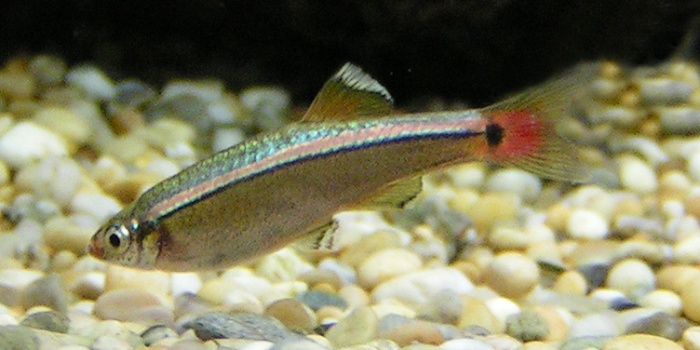
White Cloud Mountain Minnow is a freshwater fish in the family Cyprinidae, order Cypriniformes and class Teleostei. The species is native to China. It is an opportunistic omnivore that forms shoals and reaches approximately 4 cm in overall length.
Written 26 November 2026 from the sources listed below. Each statement was checked against the passage it cites; statements that could not be supported were removed.
Appearance
Males generally have brighter coloration and slimmer bodies than females. Their dorsal and anal fins are wide and fan-shaped, while female fins are triangular and wedge-shaped.[1][2]
Females have a whiter, distended abdomen.[3]
Diet
The White Cloud Mountain Minnow is an opportunistic omnivore. Its natural diet commonly includes aquatic plants and insect larvae, and it particularly favors mosquitoes and shrimp.[4][5][6]
During extreme ecological pressure, the fish may consume fruits, nuts and carcasses of other pond-dwelling organisms. In captivity, it readily accepts standard flake or pellet food.[7][8]
Behaviour
The species forms shoals and is most comfortable in groups of at least five individuals. Individuals kept alone may become timid and lose their bright coloration.[9][10]
The species is generally peaceful and can coexist with other fish that are not large enough to eat it. In aquaria, it usually swims at the top or middle levels and rarely approaches the bottom.[11][12]
The fish can jump out of aquaria on rare occasions.[13]
Reproduction and life cycle
The species is an egg-scatterer that releases eggs freely among vegetation. Males attempt to attract females by displaying their fins.[14][15]
The parents generally do not cannibalize their offspring and can remain in the breeding tank. The eggs hatch within 48 to 60 hours.[16][17]
Conservation
The species is described as practically extinct in its native habitat because of pollution and tourism. It was believed to be extinct for over 20 years in 1980.[18][19]
An apparently native population was discovered on Hainan Island after the species had been believed extinct for over 20 years.[20]
Uses
The species is frequently kept in aquaria and is sometimes used in ponds intended for frog breeding. It can control mosquito breeding in ponds.[21][22][23]
The species is widely available through the aquarium trade because it is bred on farms.[24]
Habitat
The White Cloud Mountain Minnow is a freshwater fish.[25]
The species is described as hardy and tolerant of cold water. It can survive aquarium water temperatures as low as 5 °C.[26][27]
Classification of the White Cloud Mountain Minnow
| Kingdom | Animalia |
|---|---|
| Phylum | Chordata |
| Subphylum | Vertebrata |
| Infraphylum | Gnathostomata |
| Parvphylum | Osteichthyes |
| Gigaclass | Actinopterygii |
| Superclass | Actinopteri |
| Class | Teleostei (Teleost) |
| Order | Cypriniformes |
| Family | Cyprinidae (Carps) |
| Subfamily | Xenocypridinae |
| Genus | Tanichthys (White Cloud Minnows) |
| Species | Tanichthys albonubes Lin, 1932 |
Where the White Cloud Mountain Minnow is found
Checklists and occurrence records place Tanichthys albonubes in 5 countries. GBIF holds 86 georeferenced records of it.
Countries
Regions and cities with the most records
- Guangdong, China 15
- New South Wales, Australia 9
- Guangzhou, China 6
- Queensland, Australia 4
- Saint-Benoît, Reunion 4
- Foshan, China 3
- Hawaii, United States 3
- Hilo, United States 3
- Saint-André, Reunion 3
1 more country has a few records outside this range
These countries hold a few records of Tanichthys albonubes but lie outside the range the checklists give for it. Such records are often zoo or garden specimens, museum material or vagrants, so the species is not counted as occurring there.
A number beside a place is its count of GBIF occurrence records. A place without a number comes from a checklist alone. Records show where a species has been observed or collected, which can include escapes and vagrants.
Common names
English
- White Cloud Mountain Minnow
- Mountain Minnow
Names in 11 other languages
- Chinese
- Kardinalfisch, 唐魚, 唐鱼
- Czech
- kardinálka čínská
- Danish
- Skybjergfisk
- German
- Kardinälchen
- Japanese
- アカヒレ
- Korean
- 백운산(白雲山)
- Polish
- kardynałek chiński
- Russian
- Кардинал
- Spanish
- Neón Chino
- Thai
- ปลาเมฆขาว, ปลาไวท์คลาวด์
- Turkish
- Bulut Balığı
Synonyms
2 other scientific names have been used for this species and are now treated as synonyms of Tanichthys albonubes.
- Aphyocypris pooni Herre, 1939
- Aphyocypris poosi Herre,1939
Related species
-
 Vietnamese Cardinal MinnowTanichthys micagemmae
- Tanichthys kuehnei
- Lemon White Cloud MinnowTanichthys thacbaensis
- Tanichthys albiventris
-
 GoldfishCarassius auratus
-
 Common CarpCyprinus carpio
- ZebrafishDanio rerio
-
 Grass CarpCtenopharyngodon idella
Compare
Questions and answers
What is the scientific name of the White Cloud Mountain Minnow?
The scientific name of the White Cloud Mountain Minnow is Tanichthys albonubes. Written with its author, the full name is Tanichthys albonubes Lin, 1932.
Which family does the White Cloud Mountain Minnow belong to?
Tanichthys albonubes belongs to the family Cyprinidae, in the order Cypriniformes and the class Teleostei.
Where is the White Cloud Mountain Minnow found?
Checklists and occurrence records place Tanichthys albonubes in 5 countries: China, Australia, South Africa, Reunion and United States.
What is the conservation status of the White Cloud Mountain Minnow?
The IUCN Red List category recorded for Tanichthys albonubes is Data Deficient (DD).
What other names does the White Cloud Mountain Minnow have?
Tanichthys albonubes is also known in English as Mountain Minnow.
What is the average lifespan of a white cloud mountain minnow?
A typical lifespan is five years or longer.[28]
What are the different types of white cloud minnows?
Males and females differ in appearance. Males generally have brighter coloration, slimmer bodies and wide, fan-shaped dorsal and anal fins. Females have triangular, wedge-shaped fins and a whiter, distended abdomen.[1][2][3]
What fish can live with white cloud minnows?
The species is generally peaceful and can coexist with other fish that are not large enough to eat it.[11]
How big can a white cloud mountain minnow get?
The species reaches approximately 4 cm in overall length.[29]
What food do white cloud minnows eat?
They are opportunistic omnivores. Their natural diet commonly includes aquatic plants and insect larvae, particularly mosquitoes and shrimp. In captivity, they readily accept standard flake or pellet food.[4][5][6][8]
Sources
Passages the profile rests on
- Males generally have brighter coloration and slimmer bodies than females. Source passage: “The male generally has brighter colors and a slimmer body” — English Wikipedia
- Male dorsal and anal fins are wide and fan-shaped, while female fins are triangular and wedge-shaped. Source passage: “the male's dorsal and anal fins are wide and fan-shaped, whereas those of the female are triangular and wedge-shaped.” — English Wikipedia
- Females have a whiter, distended abdomen. Source passage: “Females also present a whiter, distended abdomen.” — English Wikipedia
- The species is an opportunistic omnivore. Source passage: “The White Cloud Mountain minnow is an opportunistic omnivore.” — English Wikipedia
- Its natural diet commonly includes aquatic plants and insect larvae. Source passage: “It will commonly feed on a variety of aquatic plants and insect larvae.” — English Wikipedia
- The species particularly favors mosquitoes and shrimp. Source passage: “They particularly relish mosquito and shrimp.” — English Wikipedia
- During extreme ecological pressure, the fish may consume fruits, nuts, and carcasses of other pond-dwelling organisms. Source passage: “including fruits, nuts, and in extreme cases mountain minnows have been observed scavenging off carcasses of fellow pond dwelling organisms.” — English Wikipedia
- In captivity, the fish readily accepts standard flake or pellet food. Source passage: “Standard flake or pellet food is accepted readily.” — English Wikipedia
- The species forms shoals and is most comfortable in groups of at least five individuals. Source passage: “They are shoaling fish, and feel most comfortable in a group of at least five.” — English Wikipedia
- Individuals kept alone may become timid and lose their bright coloration. Source passage: “An individual of these minnows kept alone may become timid and lose its bright color.” — English Wikipedia
- The species is generally peaceful and can coexist with other fish that are not large enough to eat it. Source passage: “White Clouds are generally peaceful and happy to coexist with other fish, as long as they are not put in a tank with larger fish that may eat them.” — English Wikipedia
- In aquaria, the fish usually swims at the top or middle levels and rarely approaches the bottom. Source passage: “The minnows are usually top or middle-level swimmers and rarely swim close to the bottom of a tank.” — English Wikipedia
- The species can jump out of aquaria on rare occasions. Source passage: “White Clouds have been known to jump out on rare occasions.” — English Wikipedia
- The species is an egg-scatterer that releases eggs freely among vegetation. Source passage: “White Clouds are egg-scatterers, dropping their eggs freely amongst the vegetation.” — English Wikipedia
- Males attempt to attract females by displaying their fins. Source passage: “Males will attempt to attract females by displaying their fins, often alongside one another.” — English Wikipedia
- The parents generally do not cannibalize their offspring and can remain in the breeding tank. Source passage: “Because they do not generally cannibalize their offspring, the parents can be left in the tank.” — English Wikipedia
- The eggs hatch within 48 to 60 hours. Source passage: “White cloud eggs hatch within 48 to 60 hours.” — English Wikipedia
- The species is described as practically extinct in its native habitat because of pollution and tourism. Source passage: “The White Cloud Mountain minnow is practically extinct in its native habitat, due to pollution and tourism.” — English Wikipedia
- The species was believed to be extinct for over 20 years in 1980. Source passage: “It was believed to be extinct for over 20 years in 1980” — English Wikipedia
- An apparently native population was discovered on Hainan Island after the species had been believed extinct for over 20 years. Source passage: “an apparently native population of this fish was discovered on Hainan Island, well away from the White Cloud Mountain.” — English Wikipedia
- The species is frequently kept in aquaria. Source passage: “often kept in an aquarium.” — English Wikipedia
- The fish is sometimes used in ponds intended for frog breeding. Source passage: “the White Cloud Mountain minnow is sometimes used as a pond fish, especially in ponds intended for frogs to breed.” — English Wikipedia
- The species can control mosquito breeding in ponds. Source passage: “White Cloud Mountain minnows will effectively control the breeding of mosquitoes.” — English Wikipedia
- The species is widely available through the aquarium trade because it is bred on farms. Source passage: “They are bred in farms and are easily available through the aquarium trade.” — English Wikipedia
- The species is a freshwater fish. Source passage: “a hardy species of freshwater fish and coldwater fish” — English Wikipedia
- The species is described as hardy and tolerant of cold water. Source passage: “The White Cloud Mountain Minnow (Tanichthys albonubes) is a hardy species of freshwater fish and coldwater fish often kept in aquaria.” — inaturalist.org
- The species can survive aquarium water temperatures as low as 5 °C. Source passage: “it can survive water temperatures down to 5 °C (41 °F).” — English Wikipedia
- A typical lifespan is five years or longer. Source passage: “A typical lifespan can last for five years or longer.” — English Wikipedia
- The species reaches approximately 4 cm in overall length. Source passage: “This species grows to approximately 4 cm (1.6 in)) in overall length” — English Wikipedia
- The species is native to China. Source passage: “This species is native to China.” — English Wikipedia
- The species was discovered at White Cloud Mountain in Guangzhou, Guangdong Province, during approximately the 1930s. Source passage: “The species was discovered at White Cloud Mountain in the city of Guǎngzhōu in the province of Guǎngdōng around the 1930s” — English Wikipedia
Data
- Catalogue of Life, 2026-10-16 XR cc by
- Global Biodiversity Information Facility CC BY 4.0
- Wikidata CC0
- GeoNames CC BY 4.0
- Wikimedia Commons per image; credit shown with each image
- iNaturalist per image; credit shown with each image
- Within the Catalogue of Life, this name comes from World Register of Marine Species cc by
References
- Lin, S.-Y. (1932). New cyprinid fishes from White Cloud Mountain, Canton. Lingnan Science Journal, Canton, 11 (3): 379–383. where the name was published
This species in other databases
- Catalogue of Life 54P94
- Wikidata Q1136461
- iNaturalist 113767
- WoRMS urn:lsid:marinespecies.org:taxname:1014958
- ITIS 163764
Page built on 27 November 2026. See how the catalog is made and all sources and licences.
Cite this page
ScientificNames.org. (2026). Tanichthys albonubes (White Cloud Mountain Minnow). Retrieved November 27, 2026, from https://scientificnames.org/species/tanichthys-albonubes
“Tanichthys albonubes (White Cloud Mountain Minnow).” ScientificNames.org, 2026, scientificnames.org/species/tanichthys-albonubes. Accessed 27 Nov. 2026.
ScientificNames.org. “Tanichthys albonubes (White Cloud Mountain Minnow).” Accessed November 27, 2026. https://scientificnames.org/species/tanichthys-albonubes.
@misc{scientificnames_tanichthys_albonubes_white_cloud_mountain_minnow,
  author = {{ScientificNames.org}},
  title = {Tanichthys albonubes (White Cloud Mountain Minnow)},
  year = {2026},
  url = {https://scientificnames.org/species/tanichthys-albonubes},
  note = {Accessed 2026-11-27}
}