Species · Mammals
Mountain Tapir Tapirus pinchaque
The scientific name of the Mountain Tapir is Tapirus pinchaque. It is a species of mammal in the family Tapiridae (tapirs), order Perissodactyla. The name dates from 1829.
- Scientific name
- Tapirus pinchaque (Roulin, 1829)
- Common name
- Mountain Tapir
- Genus
- Tapirus
- Family
- Tapiridae (Tapirs)
- Order
- Perissodactyla
- Class
- Mammalia
- Red List category
- EN Endangered
- Recorded in
- 2 countries
- Name status
- accepted in the Catalogue of Life

Overview
Tapirus pinchaque occurs in the Eastern and Central Cordilleras of Colombia, Ecuador, and northern Peru. It has long, woolly fur and is the smallest of the four widely recognized tapir species.
Written 26 November 2026 from the sources listed below. Each statement was checked against the passage it cites; statements that could not be supported were removed.
Appearance
Mountain tapirs have black or very dark brown fur, sometimes flecked with pale hairs. Their fur is paler on the underside, around the anal region, and on the cheeks.[1][2]
A white band surrounds the lips, although its extent varies between individuals. The ears usually have white bands along their upper surfaces.[3][4]
Their fur is long and woolly, particularly on the undersides and flanks, and can reach at least 3.5 cm in length in some individuals. They have small, stubby tails and long, flexible proboscises.[5][6][7]
Each front foot has four toes, while each back foot has three toes. The toes have large nails, padded soles, and pale pink or grey patches of bare skin extending above them.[8][9][10]
Adult mountain tapirs have paired patches of bare skin on their rumps that may indicate sexual maturity. Their eyes change from blue in young animals to pale brown as they age.[11][12]
Adults are usually approximately 1.8 metres long and measure between 0.75 and 1 metre at the shoulder. They typically weigh between 136 and 250 kg, with females generally weighing approximately 25 to 100 kg more than males.[13][14][15][16]
Habitat
Mountain tapirs inhabit cloud forests and páramo ecosystems, commonly at elevations between 2,000 and 4,300 metres. They are restricted to certain parts of the Andean Mountain Range in northwestern South America.[17][18][19]
During the wet season, mountain tapirs tend to inhabit Andean forests. During drier months, they move into páramo habitats.[20][21]
Continuous areas of cloud forest and páramo are required for mountain tapirs to breed successfully and maintain healthy populations.[22]
Diet
Mountain tapirs are herbivores that consume leaves, grasses, and bromeliads. Common foods in the wild include lupins, Gynoxys, ferns, and umbrella plants.[23][24]
They visit natural salt licks to obtain essential minerals and sometimes consume agricultural crops.[25][26]
Behaviour
Mountain tapirs are generally shy and solitary. They spend their waking hours independently foraging along established tapir paths.[27][28]
They communicate with other members of their species through high-pitched whistles. They frequently wallow and swim in water.[29][30]
Mountain tapirs are generally crepuscular but are more active during daylight than other tapir species. They generally sleep from midnight until dawn, preferring areas with dense vegetation cover.[31][32][33]
They sometimes stand on their hind legs to reach elevated plants and grasp them with their snouts. They rely on smell, taste, and sensitive proboscis bristles to compensate for poor eyesight.[34][35]
Mountain tapirs mark territories using dung piles, urine, and tree rubbings. Individual territories generally overlap and cover more than 800 hectares.[36][37]
Reproduction and life cycle
Female mountain tapirs have an estrous cycle lasting approximately 30 days and typically breed once every two years. Gestation lasts approximately 392 or 393 days.[38][39][40]
Females generally give birth to one offspring at a time. Newborns weigh approximately 5.4 to 6.2 kg and have brown coats marked with yellowish-white spots and stripes.[41][42][43]
Weaning begins at approximately three months of age, and mothers continue caring for their offspring for approximately 18 months. Mountain tapirs reach sexual maturity at approximately three years of age.[44][45][46]
Conservation
The mountain tapir was classified as Endangered by the IUCN in 1996. Deforestation for agriculture and mining, together with poaching, are major threats.[47][48]
Fragmentation of the surviving range may have reduced mountain tapir populations below the level needed to maintain genetic diversity. The species is protected in Peru's National Sanctuary Tabaconas Namballe.[49][50]
Mountain tapirs have been identified as a keystone species of the high Andes. They contribute to seed dispersal because many seeds they consume successfully germinate in their dung.[51][52]
Uses
Mountain tapirs have historically been hunted for their meat and hides. Their toes, proboscises, and intestines have been used in local folk medicine and as aphrodisiacs.[53][54]
Similar species
The Brazilian tapir is identified as the Mountain Tapir's closest relative.[55]
Classification of the Mountain Tapir
| Kingdom | Animalia |
|---|---|
| Phylum | Chordata |
| Subphylum | Vertebrata |
| Infraphylum | Gnathostomata |
| Parvphylum | Osteichthyes |
| Megaclass | Tetrapoda |
| Class | Mammalia (Mammal) |
| Subclass | Theria |
| Infraclass | Eutheria |
| Order | Perissodactyla (Odd-toed Ungulates) |
| Family | Tapiridae (Tapirs) |
| Genus | Tapirus |
| Species | Tapirus pinchaque (Roulin, 1829) |
Where the Mountain Tapir is found
Checklists and occurrence records place Tapirus pinchaque in 2 countries across South America. GBIF holds 3,180 georeferenced records of it.
Countries
Regions and cities with the most records
- Napo, Ecuador 1,067
- Tolima Department, Colombia 963
- Zamora Chinchipe, Ecuador 347
- Cauca Department, Colombia 205
- Loja, Ecuador 183
- Huila Department, Colombia 91
- Risaralda Department, Colombia 87
- Tungurahua Province, Ecuador 87
- Circasia, Colombia 86
- Pelileo, Ecuador 83
- Dosquebradas, Colombia 69
- Santa Rosa de Cabal, Colombia 69
- Pereira, Colombia 67
- Loja, Ecuador 62
- Quindío Department, Colombia 32
- Calarcá, Colombia 20
- Armenia, Colombia 13
- Sucumbíos, Ecuador 13
- Orellana Province, Ecuador 12
- Imbabura, Ecuador 9
- Valle del Cauca Department, Colombia 9
- Ibarra, Ecuador 8
- Morona-Santiago Province, Ecuador 7
- Pichincha, Ecuador 7
- Isnos, Colombia 6
- Atuntaqui, Ecuador 5
- Azuay, Ecuador 5
- Otavalo, Ecuador 4
- Anaime, Colombia 3
- Antioquia, Colombia 3
- Chinchiná, Colombia 3
- Nariño, Colombia 3
- Putumayo Department, Colombia 3
1 more country has a few records outside this range
These countries hold a few records of Tapirus pinchaque but lie outside the range the checklists give for it. Such records are often zoo or garden specimens, museum material or vagrants, so the species is not counted as occurring there.
Range as the checklists state it
South America
A number beside a place is its count of GBIF occurrence records. A place without a number comes from a checklist alone. Records show where a species has been observed or collected, which can include escapes and vagrants.
Common names
English
- Mountain Tapir
- Andean Tapir
- Woolly Tapir
Names in 26 other languages
- Arabic
- تابير جبلي
- Catalan
- Tapir de muntanya
- Chinese
- 山貘
- Croatian
- Planinski tapir
- Czech
- tapír horský
- Danish
- Bjergtapir
- Dutch
- Bergtapir
- Estonian
- Mägitaapir
- Finnish
- andientapiiri
- French
- Tapir des Andes, Tapir pinchaque
- German
- Andentapir, Wolltapir
- Greek
- Ορεινός Τάπιρος
- Hebrew
- טפיר הרים
- Hungarian
- hegyi tapír
- Italian
- Tapiro delle Ande
- Japanese
- ヤマバク
- Korean
- 산맥
- Lithuanian
- Kalninis tapyras
- Norwegian Bokmål
- Andestapir, Fjelltapir
- Polish
- tapir górski
- Portuguese
- Anta-andina
- Russian
- Горный тапир
- Spanish
- Danta Cordillerana, Danta De Monta, Danta Lanuda, Danta Negra, Danta apizarrada, Danta de Montaña, Danta de Páramo, Gran Bestia
- Thai
- สมเสร็จภูเขา
- Turkish
- Dağ tapiri
- Ukrainian
- Гірський тапір, Тапір гірський
Synonyms
3 other scientific names have been used for this species and are now treated as synonyms of Tapirus pinchaque.
- Tapir pinchaque Roulin, 1829
- Tapirus ecuadorensis Gray, 1872
- Tapirus terrestris peruvianus Gray, 1872
Related species
-
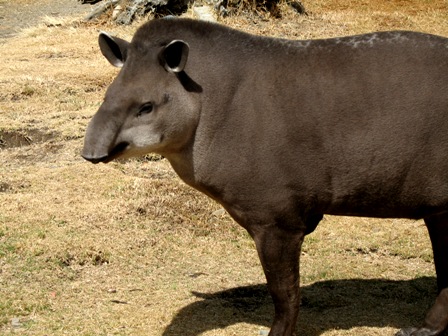 South American TapirTapirus terrestris
- Tapirus webbi
- Tapirus lundeliusi
- Tapirus leucogenys
- Baird's TapirTapirella bairdii
- Asian TapirAcrocodia indica
Compare
Questions and answers
What is the scientific name of the Mountain Tapir?
The scientific name of the Mountain Tapir is Tapirus pinchaque. Written with its author, the full name is Tapirus pinchaque (Roulin, 1829).
Which family does the Mountain Tapir belong to?
Tapirus pinchaque belongs to the family Tapiridae, in the order Perissodactyla and the class Mammalia.
Where is the Mountain Tapir found?
Checklists and occurrence records place Tapirus pinchaque in 2 countries: Ecuador and Colombia.
What is the conservation status of the Mountain Tapir?
The IUCN Red List category recorded for Tapirus pinchaque is Endangered (EN).
What other names does the Mountain Tapir have?
Tapirus pinchaque is also known in English as Andean Tapir and Woolly Tapir.
Sources
Passages the profile rests on
- Mountain tapirs have black or very dark brown fur, sometimes flecked with pale hairs. Source passage: “Mountain tapirs are black or very dark brown, with occasional pale hairs flecked in amongst the darker fur.” — English Wikipedia
- The fur is paler on the underside, around the anal region, and on the cheeks. Source passage: “The fur becomes noticeably paler on the underside, around the anal region, and on the cheeks.” — English Wikipedia
- A white band surrounds the lips, although its extent varies between individuals. Source passage: “A distinct white band runs around the lips, although it may vary in extent” — English Wikipedia
- Mountain tapirs usually have white bands along the upper surfaces of their ears. Source passage: “there are usually also white bands along the upper surface of the ears.” — English Wikipedia
- Mountain tapirs have long, woolly fur, particularly on their undersides and flanks. Source passage: “Unlike all other species of tapir, the fur is long and woolly, especially on the underside and flanks” — English Wikipedia
- Their fur can reach at least 3.5 cm in length in some individuals. Source passage: “reaching 3.5 cm (1.4 in) or more in some individuals.” — English Wikipedia
- Mountain tapirs have small, stubby tails and long, flexible proboscises. Source passage: “they have small, stubby tails and long, flexible proboscises.” — English Wikipedia
- Each front foot has four toes, while each back foot has three toes. Source passage: “They have four toes on each front foot and three toes on each back foot” — English Wikipedia
- Their toes have large nails and are supported by padded soles. Source passage: “each with large nails and supported by a padded sole.” — English Wikipedia
- A pale pink or grey patch of bare skin extends above each toe. Source passage: “A patch of bare skin, pale pink or grey in colour, extends just above each toe.” — English Wikipedia
- Adult mountain tapirs have paired patches of bare skin on their rumps that may indicate sexual maturity. Source passage: “In adults, the rump has paired patches of bare skin, which may help to indicate sexual maturity.” — English Wikipedia
- The eyes change from blue in young animals to pale brown as they age. Source passage: “The eyes are initially blue, but change to a pale brown as the animal ages.” — English Wikipedia
- Adult mountain tapirs are usually approximately 1.8 metres long. Source passage: “Adults are usually around 1.8 m (5 ft 11 in) in length” — English Wikipedia
- Adults typically measure between 0.75 and 1 metre at the shoulder. Source passage: “0.75 to 1 m (2 ft 6 in to 3 ft 3 in) in height at the shoulder.” — English Wikipedia
- Adult mountain tapirs typically weigh between 136 and 250 kg. Source passage: “They typically weigh between 136 and 250 kg (300 and 551 lb)” — English Wikipedia
- Females generally weigh approximately 25 to 100 kg more than males. Source passage: “females tend to be around 25 to 100 kg (55 to 220 lb) heavier than the males.” — English Wikipedia
- Mountain tapirs inhabit cloud forests and páramo ecosystems. Source passage: “The mountain tapir is found in the cloud forests and páramo” — English Wikipedia
- Mountain tapirs commonly inhabit elevations between 2,000 and 4,300 metres. Source passage: “It commonly lives at elevations between 2,000 and 4,300 metres (6,600 and 14,100 ft)” — English Wikipedia
- Mountain tapirs are restricted to certain parts of the Andean Mountain Range in northwestern South America. Source passage: “It is found only in certain portions of the Andean Mountain Range in northwestern South America.” — English Wikipedia
- During the wet season, mountain tapirs tend to inhabit Andean forests. Source passage: “During the wet season, mountain tapirs tend to inhabit the forests of the Andes” — English Wikipedia
- During drier months, mountain tapirs move into páramo habitats. Source passage: “while during the drier months, they move to the páramo” — English Wikipedia
- Mountain tapirs require continuous areas of cloud forest and páramo to breed successfully and maintain healthy populations. Source passage: “The species needs continuous stretches of cloud forest and páramo, rather than isolated patches, to successfully breed and maintain a healthy population” — English Wikipedia
- Mountain tapirs are herbivores that consume leaves, grasses, and bromeliads. Source passage: “Tapirs are herbivores, and eat a wide range of plants, including leaves, grasses, and bromeliads.” — English Wikipedia
- Common foods of wild mountain tapirs include lupins, Gynoxys, ferns, and umbrella plants. Source passage: “In the wild, particularly common foods include lupins, Gynoxys, ferns, and umbrella plants.” — English Wikipedia
- Mountain tapirs visit natural salt licks to obtain essential minerals. Source passage: “It also seeks out natural salt licks to satisfy its need for essential minerals.” — English Wikipedia
- Mountain tapirs sometimes consume agricultural crops. Source passage: “Since they will eat crops when available” — English Wikipedia
- Mountain tapirs are generally shy and solitary animals. Source passage: “But for the most part, mountain tapirs are shy and lead solitary lives” — English Wikipedia
- Mountain tapirs spend their waking hours independently foraging along established tapir paths. Source passage: “spending their waking hours foraging for food on their own along well-worn tapir paths.” — English Wikipedia
- Mountain tapirs communicate with other members of their species through high-pitched whistles. Source passage: “mountain tapirs communicate through high-pitched whistles” — English Wikipedia
- Mountain tapirs frequently wallow and swim in water. Source passage: “and in water, where they often wallow and swim.” — English Wikipedia
- Mountain tapirs are generally crepuscular but are more active during daylight than other tapir species. Source passage: “Mountain tapirs are generally crepuscular, although they are more active during the day than other species of tapirs.” — English Wikipedia
- Mountain tapirs generally sleep from midnight until dawn. Source passage: “They sleep from roughly midnight to dawn” — English Wikipedia
- Mountain tapirs prefer sleeping in areas with dense vegetation cover. Source passage: “and prefer to bed down in areas with heavy vegetation cover.” — English Wikipedia
- Mountain tapirs sometimes stand on their hind legs to reach elevated plants and grasp them with their snouts. Source passage: “they will sometimes rear up on their hind legs to reach and then grab with their prehensile snouts.” — English Wikipedia
- Mountain tapirs rely on smell, taste, and sensitive proboscis bristles to compensate for poor eyesight. Source passage: “Though their eyesight is lacking, they get by on their keen senses of smell and taste, as well as the sensitive bristles on their proboscises.” — English Wikipedia
- Mountain tapirs mark territories using dung piles, urine, and tree rubbings. Source passage: “Males will frequently mark their territory with dung piles, urine, and rubbings on trees” — English Wikipedia
- Individual mountain tapir territories generally overlap and cover more than 800 hectares. Source passage: “The territories of individuals usually overlap, with each animal claiming over 800 hectares (3.1 sq mi)” — English Wikipedia
- Female mountain tapirs have an estrous cycle lasting approximately 30 days. Source passage: “Female mountain tapirs have a 30-day estrous cycle” — English Wikipedia
- Female mountain tapirs typically breed once every two years. Source passage: “and typically breed only once every other year.” — English Wikipedia
- Mountain tapir gestation lasts approximately 392 or 393 days. Source passage: “After a gestation period of 392 or 393 days” — English Wikipedia
- Female mountain tapirs generally give birth to one offspring at a time. Source passage: “the female gives birth to a single young; multiple births are very rare.” — English Wikipedia
- Newborn mountain tapirs weigh approximately 5.4 to 6.2 kg. Source passage: “Newborn mountain tapirs weigh about 5.4 to 6.2 kg (12 to 14 lb)” — English Wikipedia
- Newborn mountain tapirs have brown coats marked with yellowish-white spots and stripes. Source passage: “have a brown coat with yellowish-white spots and stripes.” — English Wikipedia
- Weaning of young mountain tapirs begins at approximately three months of age. Source passage: “Weaning begins at around three months of age.” — English Wikipedia
- Mother mountain tapirs continue caring for their offspring for approximately 18 months. Source passage: “but the mother continues to care for her young for around 18 months.” — English Wikipedia
- Mountain tapirs reach sexual maturity at approximately three years of age. Source passage: “Mountain tapirs reach sexual maturity at age three” — English Wikipedia
- The mountain tapir was classified as Endangered by the IUCN in 1996. Source passage: “classified as "Endangered" by the IUCN in 1996.” — English Wikipedia
- Deforestation for agriculture and mining, together with poaching, are major threats to mountain tapirs. Source passage: “Today, deforestation for agriculture and mining, along with poaching are the main threats to the species.” — English Wikipedia
- Fragmentation of the surviving range may have reduced mountain tapir populations below the level needed to maintain genetic diversity. Source passage: “Due to the fragmentation of its surviving range, populations may already have fallen below the level required to sustain genetic diversity.” — English Wikipedia
- Mountain tapirs are protected in Peru's National Sanctuary Tabaconas Namballe. Source passage: “In Peru, it is protected in the National Sanctuary Tabaconas Namballe.” — English Wikipedia
- Mountain tapirs have been identified as a keystone species of the high Andes. Source passage: “have been identified as a keystone species of the high Andes.” — English Wikipedia
- Mountain tapirs contribute to seed dispersal because many seeds they consume successfully germinate in their dung. Source passage: “A relatively high proportion of plant seeds eaten by mountain tapirs successfully germinate in their dung” — English Wikipedia
- Mountain tapirs have historically been hunted for their meat and hides. Source passage: “Historically, mountain tapirs have been hunted for their meat and hides” — English Wikipedia
- Mountain tapir toes, proboscises, and intestines have been used in local folk medicine and as aphrodisiacs. Source passage: “the toes, proboscises, and intestines are used in local folk medicines and as aphrodisiacs.” — English Wikipedia
- The Brazilian tapir is identified as the mountain tapir's closest relative. Source passage: “mountain tapirs diverged from its closest relative, the Brazilian tapir” — English Wikipedia
Data
- Catalogue of Life, 2026-10-16 XR cc by
- Global Biodiversity Information Facility CC BY 4.0
- Wikidata CC0
- GeoNames CC BY 4.0
- Wikimedia Commons per image; credit shown with each image
- Within the Catalogue of Life, this name comes from The Integrated Taxonomic Information System cc0
References
- Ann. Sci. Nat. Zool. vol.18 p.46 where the name was published
- Fish and Wildlife Service, U. S. (1974). Taking, Possession, Transportation, Sale, Purchase, Barter, Exportation, and Importation of Wildlife. Federal Register, Vol. 39, No. 3.
- Wilson, Don E., and DeeAnn M. Reeder, eds. (1993). Mammal Species of the World: A Taxonomic and Geographic Reference, 2nd Ed., 3rd Printing.
- Wilson, Don E., and F. Russell Cole. (2000). Common Names of Mammals of the World.
- Wilson, Don E., and DeeAnn M. Reeder, eds. (2005). Mammal Species of the World: A Taxonomic and Geographic Reference, 3rd Ed., Vols. 1 & 2.
- Padilla, Miguel, Robert C. Dowler, and Craig C. Downer. (2010). Tapirus pinchaque (Perissodactyla: Tapiridae). Mammalian Species, Vol. 42, No. 863.
- Wilson, D. E., and R. A. Mittermeier, eds. (2011). Handbook of the Mammals of the World, Vol. 2: Hoofed Mammals.
- Groves, Colin, & and Peter Grubb. (2011). Ungulate Taxonomy.
- Burgin, Connor J., Don E. Wilson, Russell A. Mittermeier, Anthony B. Rylands, et al. (2020). Illustrated Checklist of the Mammals of the World. Vol. 1. Monotremata to Rodentia.
This species in other databases
Page built on 26 November 2026. See how the catalog is made and all sources and licences.
Cite this page
ScientificNames.org. (2026). Tapirus pinchaque (Mountain Tapir). Retrieved November 26, 2026, from https://scientificnames.org/species/tapirus-pinchaque
“Tapirus pinchaque (Mountain Tapir).” ScientificNames.org, 2026, scientificnames.org/species/tapirus-pinchaque. Accessed 26 Nov. 2026.
ScientificNames.org. “Tapirus pinchaque (Mountain Tapir).” Accessed November 26, 2026. https://scientificnames.org/species/tapirus-pinchaque.
@misc{scientificnames_tapirus_pinchaque_mountain_tapir,
  author = {{ScientificNames.org}},
  title = {Tapirus pinchaque (Mountain Tapir)},
  year = {2026},
  url = {https://scientificnames.org/species/tapirus-pinchaque},
  note = {Accessed 2026-11-26}
}