Species · Insects
Mealworm Tenebrio molitor
The scientific name of the Mealworm is Tenebrio molitor. It is a species of insect in the family Tenebrionidae (darkling beetle), order Coleoptera. The name dates from 1758.
- Scientific name
- Tenebrio molitor Linnaeus, 1758
- Common name
- Mealworm
- Genus
- Tenebrio
- Family
- Tenebrionidae (Darkling Beetle)
- Order
- Coleoptera
- Class
- Insecta
- Environment
- terrestrial
- Recorded in
- 33 countries
- Name status
- accepted in the Catalogue of Life

Overview
Adult beetles commonly inhabit forest leaf litter and can be found beneath rocks and logs. The species undergoes complete metamorphosis through egg, larval, pupal, and adult stages.
Written 24 November 2026 from the sources listed below. Each statement was checked against the passage it cites; statements that could not be supported were removed.
Appearance
Adult beetles are dark brown or black. They have evenly divided linear grooves running along the abdomen and four tarsal segments on each hind leg.[1][2][3]
The adult yellow mealworm beetle has a more rectangular abdomen with a blunt end than the black mealworm beetle. Its larvae are lighter in color than those of the black mealworm beetle.[4][5]
Larvae are white during their first instar and gradually become brown after the second instar. Their cuticle varies in pigmentation from tan to black.[6][7]
Pupae are initially whitish and become brown as they develop.[8]
Adult beetles generally measure between 1.25 and 1.8 centimetres in length. Larvae can reach approximately 3.2 centimetres or approximately 25 millimetres in length.[9][10][11]
Eggs measure approximately 1.25 millimetres in length. Pupae measure approximately 0.5–0.75 inches in length.[12][13]
Habitat
Adult beetles commonly inhabit forest leaf litter and can be found beneath rocks and logs. Larvae can occur near human food-storage facilities.[14][15][16]
The species prefers warmer climates and relatively high humidity.[17]
Diet
Larvae feed on vegetation and dead insects. The beetles consume decaying leaves, sticks, grasses, plants, insects, and animals.[18][19]
Mealworm larvae can be reared on wheat bran supplemented with carrot, orange, or red cabbage. Larvae receiving these supplements achieve greater growth rates than larvae fed wheat bran alone.[20][21]
Behaviour
Adult beetles generally prefer dark environments and physical contact with surrounding objects. They are predominantly nocturnal but can also be active in dark environments during daylight.[22][23]
When threatened, beetles can adopt a defensive position by flipping onto their heads. They also spray defensive chemicals from their rear scent glands.[24][25]
Infected males develop avoidance behavior toward feces containing tapeworms.[26]
Reproduction and life cycle
The species undergoes complete metamorphosis with egg, larval, pupal, and adult stages. Females lay approximately 500 eggs during their adult lifespan and deposit them in soft ground.[27][28][29]
Eggs hatch between four and nineteen days after oviposition. Larvae undergo between nine and twenty molts before pupation, which occurs after the final larval molt.[30][31][32]
Males release sex pheromones that attract females and transfer sperm packets using their aedeagus. Female beetles prefer larger males over smaller males during mating.[33][34][35]
Uses
The species has been used in biomedical research. Mealworms are used as food for pets, livestock, and humans.[36][37]
Larvae are bred and sold as bird food and fish bait.[38]
The species has potential for sustainable human food production because of its nutritional profile and low environmental impact.[39]
Classification of the Mealworm
| Kingdom | Animalia |
|---|---|
| Phylum | Arthropoda |
| Subphylum | Hexapoda |
| Class | Insecta (Insect) |
| Order | Coleoptera (Beetle) |
| Suborder | Polyphaga |
| Series | Cucujiformia |
| Superfamily | Tenebrionoidea |
| Family | Tenebrionidae (Darkling Beetle) |
| Subfamily | Tenebrioninae |
| Tribe | Tenebrionini |
| Genus | Tenebrio (Mealworm Beetles) |
| Species | Tenebrio molitor Linnaeus, 1758 |
This name was added to the Catalogue of Life from a contributing dataset by automated merging and has not yet been reviewed by its editors.
Where the Mealworm is found
Checklists and occurrence records place Tenebrio molitor in 33 countries. GBIF holds 9,150 georeferenced records of it.
Countries
- Austria 315
- Belarus 12
- Belgium 38
- Bulgaria 20
- Canada 280
- Czechia 36
- Denmark 94
- Estonia 175
- Finland 394
- France 474
- Germany 853
- Greece 7
- Hungary 72
- Italy 24
- Latvia 27
- Lithuania 39
- Luxembourg 51
- Mexico 8
- Norway 395
- Poland 320
- Portugal 4
- Romania 11
- Russia 295
- Serbia 32
- Slovakia 5
- Slovenia 4
- Spain 86
- Sweden 1,394
- Switzerland 1,202
- The Netherlands 436
- Ukraine 100
- United Kingdom 566
- United States 1,381
Regions and cities with the most records
- England, United Kingdom 526
- Kalmar, Sweden 233
- North Rhine-Westphalia, Germany 203
- Oslo, Norway 183
- Vaud, Switzerland 181
- Oslo, Norway 163
- Bern, Switzerland 162
- Lillestrøm, Norway 157
- Skåne, Sweden 154
- Asker, Norway 153
- Östergötland, Sweden 133
- Geneva, Switzerland 126
- Stockholm, Sweden 126
- Piekary Śląskie, Poland 117
- Tarnowskie Góry, Poland 117
- Île-de-France, France 117
- Bavaria, Germany 116
- Salzburg, Austria 116
- Geneva, Switzerland 112
- Uppsala, Sweden 108
- Ticino, Switzerland 104
- Bern, Switzerland 103
- Lausanne, Switzerland 102
- Upper Austria, Austria 97
- Ontario, Canada 94
- Västra Götaland, Sweden 94
- Zurich, Switzerland 86
- Solna, Sweden 83
- Stockholm, Sweden 83
- Salzburg, Austria 82
- Täby, Sweden 82
- Valais, Switzerland 81
- Michigan, United States 80
- Lower Saxony, Germany 79
- Sollentuna, Sweden 78
- Lugano, Switzerland 76
14 more countries have a few records outside this range
These countries hold a few records of Tenebrio molitor but lie outside the range the checklists give for it. Such records are often zoo or garden specimens, museum material or vagrants, so the species is not counted as occurring there.
A number beside a place is its count of GBIF occurrence records. A place without a number comes from a checklist alone. Records show where a species has been observed or collected, which can include escapes and vagrants.
Common names
English
- Mealworm
- Common Mealworm
- Common Mealworm Beetle
- Giant Common Mealworm Beetle
- Mealworm Beetle
- Yellow Mealworm Beetle
- Yellow Mealworm
Names in 26 other languages
- Arabic
- خنفساء دود الطحين الشائعة
- Armenian
- Ալերորդ
- Asturian
- cocu la fariña
- Catalan
- Manganella
- Chinese
- 麵包蟲, 黃粉蟲, 黄拟步甲, 黄粉甲, 黄粉虫
- Czech
- potemník moučný
- Danish
- Almindelig melskrubbe, Brun skyggebille, Melbille, Melorm, Melskrubbe
- Dutch
- Gewone meeltor, Meelwormkever, meeltor, meelworm
- Estonian
- Harilik jahumardikas
- Finnish
- jauhopukki
- French
- Ténébrion à neuf stries lisses, ténébrion meunier
- German
- Mehlkäfer, Mehlwurm
- Hungarian
- Közönséges lisztbogár, lisztbogár
- Icelandic
- Mjölbjalla
- Japanese
- チャイロコメノゴミムシダマシ
- Korean
- 갈색거저리
- Latvian
- Miltu melnulis
- Lithuanian
- Didysis Milčius
- Norwegian Bokmål
- stor melbille
- Polish
- Mącznik młynarek
- Portuguese
- Bicho-da-farinha
- Russian
- Большой мучной хрущак, Мучной хрущак большой / Мучной жук
- Slovak
- múčiar obyčajný
- Swedish
- mjölbagge, mjölmask, stor mjölbagge, vanlig mjölbagge
- Turkish
- Un Kurdu
- Ukrainian
- Хрущак борошняний
Related species
-
 Dark MealwormTenebrio obscurus
- Tenebrio opacus
- Tenebrio angulatus
- Tenebrio barbarus
- Tenebrio erraticus
- Tenebrio pedicularius
- Desert Ironclad BeetleAsbolus verrucosus
-
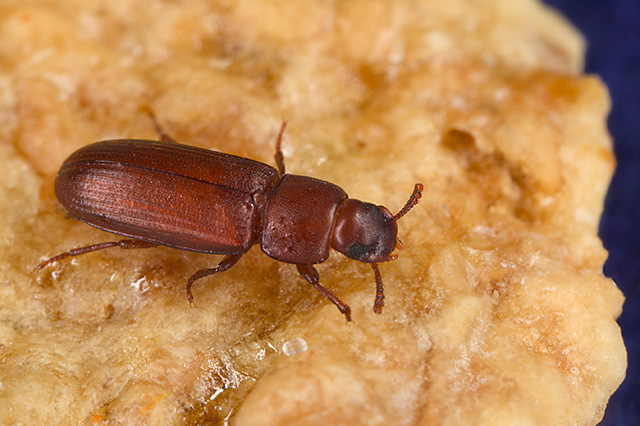 Red Flour BeetleTribolium castaneum
Compare
Questions and answers
What is the scientific name of the Mealworm?
The scientific name of the Mealworm is Tenebrio molitor. Written with its author, the full name is Tenebrio molitor Linnaeus, 1758.
Which family does the Mealworm belong to?
Tenebrio molitor belongs to the family Tenebrionidae, in the order Coleoptera and the class Insecta.
Where is the Mealworm found?
Checklists and occurrence records place Tenebrio molitor in 33 countries, including Sweden, United States, Switzerland, Germany, United Kingdom and France.
What other names does the Mealworm have?
Tenebrio molitor is also known in English as Common Mealworm, Common Mealworm Beetle, Giant Common Mealworm Beetle, Mealworm Beetle, Yellow Mealworm Beetle and Yellow Mealworm.
What did mealworms turn into?
Mealworms develop into pupae after their final larval molt. The pupae subsequently develop into adult beetles.[27][32]
Why do humans eat mealworms?
Mealworms are used as food for humans. The species has potential for sustainable human food production because of its nutritional profile and low environmental impact.[37][39]
Sources
Passages the profile rests on
- Adult Tenebrio molitor beetles are dark brown or black. Source passage: “T. molitor is dark brown or black as an adult” — English Wikipedia
- The adult beetle has evenly divided linear grooves running along its abdomen. Source passage: “The yellow mealworm beetle can be differentiated from other beetles, due to the linear grooves that are evenly divided and run along the abdomen.” — English Wikipedia
- The hind legs of the beetle have four tarsal segments. Source passage: “The beetle has only four tarsal segments on its hind legs.” — English Wikipedia
- The adult yellow mealworm beetle has a more rectangular abdomen with a blunt end than the black mealworm beetle. Source passage: “The abdomen of the adult black mealworm beetle is more rounded and ends in a pointed tip, as opposed to the more rectangular and blunt-ended abdomen of the yellow mealworm beetle.” — English Wikipedia
- The larvae are lighter in color than those of the black mealworm beetle. Source passage: “The larvae of T. molitor are lighter colored than those of T. obscurus.” — English Wikipedia
- Larvae are white during their first instar and gradually become brown after the second instar. Source passage: “Larvae are white in the first instar and gradually turn brown after the second instar.” — English Wikipedia
- The larval cuticle varies in pigmentation from tan to black. Source passage: “Cuticular color (pigmentation of the cuticle) is a heritable component and varies from tan to black.” — English Wikipedia
- The pupae are initially whitish and become brown as they develop. Source passage: “The new pupa is whitish and turns brown over time.” — English Wikipedia
- Adult beetles generally measure between 1.25 and 1.8 centimetres in length. Source passage: “Adults are generally 1.25 to 1.8 centimetres (0.49 to 0.71 in) in length.” — English Wikipedia
- Larvae can reach approximately 3.2 centimetres in length. Source passage: “larvae up to 1.25 inches (3.2 cm) long” — English Wikipedia
- Larvae can reach approximately 25 millimetres in length. Source passage: “The Yellow Mealworm will reach a length of approximately 25mm.” — macalester.edu
- The eggs measure approximately 1.25 millimetres in length. Source passage: “The eggs are white, bean shaped, and about 1.25mm in length.” — macalester.edu
- Pupae measure approximately 0.5–0.75 inches in length. Source passage: “While in the pupae stage they are between .5-.75 inches in length” — macalester.edu
- Adult beetles commonly inhabit forest leaf litter. Source passage: “The leaf-litter is one of the main habitats in which an adult Yellow Mealworm Beetle will choose to reside.” — macalester.edu
- Adult beetles can be found beneath rocks and logs. Source passage: “they will often be found there as well as underneath rocks and logs” — macalester.edu
- Larvae can occur near human food-storage facilities. Source passage: “Yellow Mealworm larvae will also be found around locations of human food storage.” — macalester.edu
- The species prefers warmer climates and relatively high humidity. Source passage: “The yellow mealworm beetle prefers a warmer climate and higher humidity.” — English Wikipedia
- Larvae feed on vegetation and dead insects. Source passage: “During the larval stage, the mealworms feed on vegetation and dead insects” — English Wikipedia
- The beetles consume decaying leaves, sticks, grasses, plants, insects, and animals. Source passage: “They will eat decaying leaves, sticks, grasses, plants, as well as insects and animals3, 5.” — macalester.edu
- Mealworm larvae can be reared on wheat bran supplemented with carrot, orange, or red cabbage. Source passage: “Mealworm larvae were grown on wheat bran or wheat bran enriched with carrot, orange, or red cabbage for four weeks.” — pmc.ncbi.nlm.nih.gov
- Larvae fed diets supplemented with carrot, orange, or red cabbage achieved greater growth rates than larvae fed wheat bran alone. Source passage: “Mealworm larvae fed on carrot-, orange-, and red cabbage-supplemented diets had improved growth rates” — pmc.ncbi.nlm.nih.gov
- Adult beetles generally prefer dark environments and physical contact with surrounding objects. Source passage: “Yellow Mealworm Beetles prefer the darkness and being in contact with other objects.” — macalester.edu
- The beetles are predominantly nocturnal but can also be active in dark environments during daylight. Source passage: “They are mostly nocturnal but will also be seen active in dark environments during the day3, 5.” — macalester.edu
- When threatened, beetles can adopt a defensive position by flipping onto their heads. Source passage: “When they feel endangered they flip onto their head, taking a defensive position.” — macalester.edu
- Threatened beetles spray defensive chemicals from their rear scent glands. Source passage: “The beetles then spray chemicals from their rear scent gland towards the danger.” — macalester.edu
- Infected males develop avoidance behavior toward feces containing tapeworms. Source passage: “the infected males develop an avoidance behavior for feces that harbor the tapeworm” — English Wikipedia
- The species undergoes complete metamorphosis with egg, larval, pupal, and adult stages. Source passage: “T. molitor goes through four life stages: egg, larva, pupa, and adult.” — English Wikipedia
- Females lay approximately 500 eggs during their adult lifespan. Source passage: “Over her adult lifespan of about 6–12 months, a female will, on average, lay about 500 eggs.” — English Wikipedia
- Females lay their eggs in soft ground. Source passage: “Within a few days, the female burrows into soft ground and lays eggs.” — English Wikipedia
- Eggs hatch between four and nineteen days after oviposition. Source passage: “The eggs hatch 4 to 19 days after the female oviposits.” — English Wikipedia
- Larvae undergo between nine and twenty molts before pupation. Source passage: “molt between each larval stage, or instar (9 to 20 instars).” — English Wikipedia
- Pupation occurs after the final larval molt. Source passage: “After the final molt, they pupate.” — English Wikipedia
- Males release sex pheromones that attract females. Source passage: “Male mealworm beetles release a sex pheromone to attract females to mate.” — English Wikipedia
- Males transfer sperm packets using their aedeagus. Source passage: “Males insert sperm packets with their aedeagus.” — English Wikipedia
- Female beetles prefer larger males over smaller males during mating. Source passage: “A larger male was preferred and mated with first compared to a smaller male mate.” — English Wikipedia
- The species has been used in biomedical research. Source passage: “Tenebrio molitor has been used in biomedical research.” — English Wikipedia
- Mealworms are used as food for pets, livestock, and humans. Source passage: “their high nutrient content makes them a viable food source for pet food, protein-rich animal feed, or even human nutrition” — English Wikipedia
- Larvae are bred and sold as bird food and fish bait. Source passage: “Humans breed and sell them for bird food and fish bait while they are in the larvae stage of their life cycle.” — macalester.edu
- The species has potential for sustainable human food production because of its nutritional profile and low environmental impact. Source passage: “Mealworms (Tenebrio molitor) have a great potential to serve as a sustainable food source for humans due to their favorable nutrient profile and low environmental impact.” — pmc.ncbi.nlm.nih.gov
Data
- Catalogue of Life, 2026-10-16 XR cc by
- Global Biodiversity Information Facility CC BY 4.0
- Wikidata CC0
- GeoNames CC BY 4.0
- Wikimedia Commons per image; credit shown with each image
- Within the Catalogue of Life, this name comes from World Register of Marine Species cc by
References
- Linnæus, Carolus. 1758. Systema naturae per regna tria naturae, secundum classes, ordines, genera, species, cum characteribus, differentiis, synonymis, locis. Laurentii Salvii, Holmiae [= Stockholm]. Vol. Tomus I, Editio decima, reformata: i-ii, 1-824. where the name was published
This species in other databases
- Catalogue of Life THDPS
- Wikidata Q225965
- iNaturalist 131970
- WoRMS urn:lsid:marinespecies.org:taxname:1489840
- ITIS 187243
- NCBI Taxonomy txid7067
Page built on 24 November 2026. See how the catalog is made and all sources and licences.
Cite this page
ScientificNames.org. (2026). Tenebrio molitor (Mealworm). Retrieved November 24, 2026, from https://scientificnames.org/species/tenebrio-molitor
“Tenebrio molitor (Mealworm).” ScientificNames.org, 2026, scientificnames.org/species/tenebrio-molitor. Accessed 24 Nov. 2026.
ScientificNames.org. “Tenebrio molitor (Mealworm).” Accessed November 24, 2026. https://scientificnames.org/species/tenebrio-molitor.
@misc{scientificnames_tenebrio_molitor_mealworm,
  author = {{ScientificNames.org}},
  title = {Tenebrio molitor (Mealworm)},
  year = {2026},
  url = {https://scientificnames.org/species/tenebrio-molitor},
  note = {Accessed 2026-11-24}
}