Species · Fishes
Eulachon Thaleichthys pacificus
The scientific name of the Eulachon is Thaleichthys pacificus. It is a species of fish in the family Osmeridae (smelt), order Osmeriformes. The name dates from 1836.
- Scientific name
- Thaleichthys pacificus (Richardson, 1836)
- Common name
- Eulachon
- Genus
- Thaleichthys
- Family
- Osmeridae (Smelt)
- Order
- Osmeriformes
- Class
- Teleostei
- Red List category
- LC Least Concern
- Environment
- brackish, freshwater, marine
- Recorded in
- 2 countries
- Name status
- accepted in the Catalogue of Life

Overview
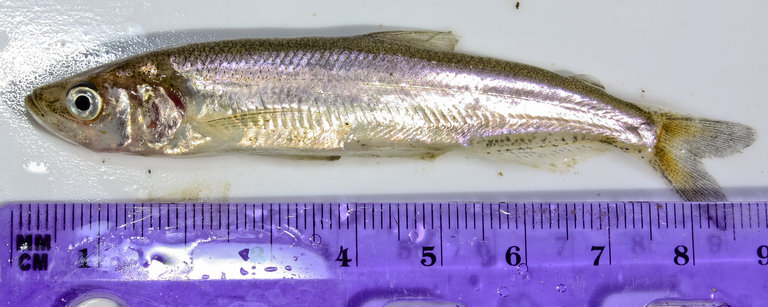
Eulachon have large canine-like teeth on the vomer bone, a sickle-shaped adipose fin, and concentric striations on the operculum and suboperculum.
Written 26 November 2026 from the sources listed below. Each statement was checked against the passage it cites; statements that could not be supported were removed.
Appearance
Adults have brown or blue backs, silvery-white or light-blue sides, and white undersides. Their fine, sparse speckling is restricted to their backs, and they have striae on the operculum that distinguish them from other smelts.[1][2][3]
Eulachon have large canine-like teeth on the vomer bone, 19 to 31 anal-fin rays, and 4–6 gill rakers on the upper half of the gill arch. Their adipose fin is sickle-shaped, and their operculum and suboperculum have concentric striations.[4][5][6][7]
Male eulachon have longer paired fins than females. Ripe males develop prominent breeding tubercles on their fins.[8][9]
Eulachon change from blue-silver in salt water to gray-brown and green during their movement into freshwater.[10]
Habitat
Eulachon primarily spawn in rivers with substantial spring snowmelt. Their spawning rivers are generally slow-moving because the fish are weak swimmers.[11][12]
Clean gravel is required for spawning, while freshet flows help transport larvae to estuaries and the ocean.[13]
Diet
Adult eulachon primarily consume euphausiids, also known as krill. Juvenile and adult eulachon feed mainly on euphausiids.[14][15]
Postlarval and juvenile eulachon consume planktonic crustaceans, particularly adult copepods.[16]
Eulachon also feed on fish eggs, insect larvae, ocean debris, and small crustaceans.[17]
Behaviour
Eulachon spend most of their adult lives in the ocean before returning to freshwater to spawn. They spend three to six years at sea before returning to spawn.[18][19]
As the spawning season approaches, eulachon gather in large schools near the mouths of spawning rivers. They sometimes mix with Northern Anchovy and Pacific Herring in schools.[20][21]
Juvenile eulachon form schools near the ocean floor. They do not perform daily vertical migrations from their preferred depths.[22][23]
Spawning runs generally begin with males, followed by females around the middle of the run.[24]
Reproduction and life cycle
Adult eulachon typically spawn between two and five years of age. They generally mature between two and four years of age.[25][26]
Spawning migration usually begins when river temperatures are between 0 and 10 degrees Celsius. Eulachon spawn in rivers between December and June.[27][28]
Eulachon eggs hatch in freshwater within 21 to 40 days depending on water temperature. Newly hatched larvae measure between 4 and 8 mm long.[29][30]
Conservation
The southern distinct population segment of eulachon was listed as threatened under the Endangered Species Act in 2010. The 2022 five-year review concluded that its threatened designation remained appropriate.[31][32]
The southern population segment experienced an abrupt abundance decline beginning in the mid-1990s. Overharvest, pollution, freshwater spawning habitat loss, and climate change are identified as threats to the species.[33][34]
Offshore shrimp fishery bycatch is among the major threats to the southern population segment.[35]
Potential overharvest from commercial, personal-use, and subsistence fisheries is identified as the main threat to eulachon in Alaska.[36]
Uses
Eulachon have traditionally been an important food and trade item for Indigenous communities along the Pacific Coast. They are processed to produce an oil known as eulachon grease.[37][38]
Harvested eulachon may be fried, dried, smoked, or canned.[39]
Classification of the Eulachon
| Kingdom | Animalia |
|---|---|
| Phylum | Chordata |
| Subphylum | Vertebrata |
| Infraphylum | Gnathostomata |
| Parvphylum | Osteichthyes |
| Gigaclass | Actinopterygii |
| Superclass | Actinopteri |
| Class | Teleostei (Teleost) |
| Order | Osmeriformes |
| Suborder | Osmeroidei |
| Family | Osmeridae (Smelt) |
| Genus | Thaleichthys (Eulachons) |
| Species | Thaleichthys pacificus (Richardson, 1836) |
Where the Eulachon is found
Checklists and occurrence records place Thaleichthys pacificus in 2 countries. GBIF holds 126,713 georeferenced records of it.
Countries
Regions and cities with the most records
- Sooke, Canada 1,480
- Richmond, Canada 735
- Vancouver, Canada 443
- Riley Park, Canada 311
- Victoria-Fraserview, Canada 214
- Oak Bay, Canada 202
- Oregon, United States 202
- Victoria, Canada 202
- Esquimalt, Canada 196
- Camas, United States 174
- Gresham, United States 173
- Happy Valley, United States 173
- Troutdale, United States 172
- West Vancouver, Canada 168
- Washougal, United States 160
- Delta, Canada 158
- Orchards, United States 142
- Central Saanich, Canada 117
- Colwood, Canada 112
- Saanich, Canada 110
- Langford, Canada 107
- Five Corners, United States 73
- Vancouver, United States 71
- Portland, United States 68
- Salmon Creek, United States 67
- Hazel Dell, United States 66
- Alaska, United States 64
- Bethany, United States 62
- North Vancouver, Canada 61
- Milwaukie, United States 56
- Beaverton, United States 53
- Nanaimo, Canada 43
- Harewood, Canada 41
- British Columbia, Canada 39
- Courtenay, Canada 36
- Washington, United States 22
A number beside a place is its count of GBIF occurrence records. A place without a number comes from a checklist alone. Records show where a species has been observed or collected, which can include escapes and vagrants.
Common names
English
- Eulachon
- Hooligan
- Candlefish
Names in 7 other languages
- Danish
- Kertesmelt
- French
- eulakane
- Japanese
- ユーラコン
- Polish
- olakon
- Russian
- Тихоокеанская корюшка, тихоокеанский талеихт, эулахон
- hai
- Hum
- thp
- Swíwe
Synonyms
5 other scientific names have been used for this species and are now treated as synonyms of Thaleichthys pacificus.
- Lestidium parri Chapman, 1939
- Osmerus albatrossis Jordan & Gilbert, 1898
- Osmerus pacificus (Richardson, 1836)
- Salmo pacificus Richardson, 1836
- Thaleichthys stevensi Girard, 1858
Related species
-
 CapelinMallotus villosus
-
 ShishamoSpirinchus lanceolatus
-
 European SmeltOsmerus eperlanus
-
 Rainbow SmeltOsmerus mordax
-
 Delta SmeltHypomesus transpacificus
-
 WakasagiHypomesus nipponensis
-
 Longfin SmeltSpirinchus thaleichthys
-
 Pond SmeltHypomesus olidus
Compare
Questions and answers
What is the scientific name of the Eulachon?
The scientific name of the Eulachon is Thaleichthys pacificus. Written with its author, the full name is Thaleichthys pacificus (Richardson, 1836).
Which family does the Eulachon belong to?
Thaleichthys pacificus belongs to the family Osmeridae, in the order Osmeriformes and the class Teleostei.
Where is the Eulachon found?
Checklists and occurrence records place Thaleichthys pacificus in 2 countries: Canada and United States.
What is the conservation status of the Eulachon?
The IUCN Red List category recorded for Thaleichthys pacificus is Least Concern (LC).
What other names does the Eulachon have?
Thaleichthys pacificus is also known in English as Hooligan and Candlefish.
Sources
Passages the profile rests on
- Adults have brown or blue backs, silvery-white or light-blue sides, and white undersides. Source passage: “Adult coloration is brown or blue on the back extending to the top of the head, lighter to silvery white or light blue on the sides, and white on the ventral surface” — English Wikipedia
- Adults have fine, sparse speckling restricted to their backs. Source passage: “speckling is extra fine, sparse, and restricted to the back.” — English Wikipedia
- Adults have striae on the operculum that distinguish them from other smelts. Source passage: “Adults have striae on their operculum that aid in distinguishing Thaleichthys pacificus from other smelt.” — English Wikipedia
- The species has large canine-like teeth on the vomer bone and 19 to 31 anal-fin rays. Source passage: “Eulachon are distinguished by the large canine-like teeth on the vomer bone and 19 to 31 rays in the anal fin.” — English Wikipedia
- The adipose fin is sickle-shaped. Source passage: “Like salmon and trout they have an adipose fin (aft of the dorsal); it is sickle-shaped.” — English Wikipedia
- Eulachon have 4–6 gill rakers on the upper half of the gill arch. Source passage: “having 4–6 gill rakers on the upper half of the gill arch (others have 8–14 gill rakers)” — fisheries.noaa.gov
- Eulachon have concentric striations on their operculum and suboperculum. Source passage: “distinct concentric striations on the operculum and suboperculum (gill plate).” — fisheries.noaa.gov
- Male eulachon have longer paired fins than females. Source passage: “The paired fins are longer in male fish than in females.” — English Wikipedia
- Ripe males develop prominent breeding tubercles on their fins. Source passage: “All fins have well-developed breeding tubercles (raised tissue "bumps") in ripe males, but these are poorly developed or absent in females.” — English Wikipedia
- Eulachon change from blue-silver in salt water to gray-brown and green during their movement into freshwater. Source passage: “Eulachon are generally blue-silver in color in salt water, turning to gray-brown and green when moving into fresh water at spawning time.” — adfg.alaska.gov
- Eulachon primarily spawn in rivers with substantial spring snowmelt. Source passage: “Spawns primarily in rivers with significant spring snow melt.” — swap.oregon.gov
- Eulachon spawning rivers are generally slow-moving because the fish are weak swimmers. Source passage: “Eulachon spawning rivers are typically slow moving waterways since eulachon are weak swimmers” — adfg.alaska.gov
- Clean gravel is required for spawning, while freshet flows help transport larvae to estuaries and the ocean. Source passage: “Clean gravel needed for spawning and freshet flows to flush larvae to the estuary and ocean.” — swap.oregon.gov
- Adult eulachon primarily consume euphausiids, which are also known as krill. Source passage: “with euphausiids (aka, “krill”) being the primary prey.” — fisheries.noaa.gov
- Juvenile and adult eulachon feed mainly on euphausiids. Source passage: “As juveniles and adults they feed mainly on euphausiids, a small shrimp-like crustacean sometimes called krill.” — adfg.alaska.gov
- Postlarval and juvenile eulachon consume planktonic crustaceans, particularly adult copepods. Source passage: “Postlarval and juvenile (20–157 mm) eulachon consume various planktonic crustaceans, particularly adult copepods.” — fisheries.noaa.gov
- Eulachon feed primarily on plankton, fish eggs, insect larvae, ocean debris, and small crustaceans. Source passage: “Eulachon feed primarily on plankton as well as fish eggs, insect larvae, ocean debris and small crustaceans.” — English Wikipedia
- Eulachon spend most of their adult lives in the ocean before returning to freshwater to spawn. Source passage: “Eulachon, as anadromous fish, spend most of their adult lives in the ocean but return to their natal freshwater streams and rivers to spawn and die.” — English Wikipedia
- Eulachon spend three to six years at sea before returning to spawn. Source passage: “After three to six years at sea, they return as adults to spawn.” — adfg.alaska.gov
- Eulachon gather in large schools near the mouths of spawning rivers as the spawning season approaches. Source passage: “As the spawning season approaches, eulachon gather in large schools off the mouths of their spawning streams and rivers.” — adfg.alaska.gov
- Eulachon sometimes mix with Northern Anchovy and Pacific Herring in schools. Source passage: “Eulachon sometimes mix with other small schooling forage fish, such as Northern Anchovy and Pacific Herring.” — swap.oregon.gov
- Juvenile eulachon form schools near the ocean floor. Source passage: “Juvenile eulachon will school near the bottom in the ocean” — swap.oregon.gov
- Eulachon juveniles do not perform daily vertical migrations from their preferred depths. Source passage: “Eulachon do not undergo diel vertical migrations from their preferred depths.” — fisheries.noaa.gov
- Spawning runs generally begin with males, followed by females around the middle of the run. Source passage: “The eulachon run is characteristic for the early portion being almost entirely male, with females following about midway through the run to its conclusion.” — English Wikipedia
- Adult eulachon typically spawn between two and five years of age. Source passage: “Adult eulachon typically spawn at age 2–5.” — fisheries.noaa.gov
- Eulachon generally mature between two and four years of age. Source passage: “Eulachon mature sometime between 2 and 4 years of age.” — swap.oregon.gov
- Spawning migration usually begins when river temperatures are between 0 and 10 degrees Celsius. Source passage: “The spawning migration typically begins when river temperatures are between 0 and 10⁰ C” — fisheries.noaa.gov
- Eulachon spawn in rivers between December and June. Source passage: “Eulachon spawn in rivers sometime between December and June.” — swap.oregon.gov
- Eulachon eggs hatch in freshwater within 21 to 40 days depending on water temperature. Source passage: “The eggs hatch in freshwater in 21 to 40 days, depending on the water temperature.” — adfg.alaska.gov
- Newly hatched larvae measure between 4 and 8 mm long. Source passage: “newly hatched larvae (4–8 mm in length)” — fisheries.noaa.gov
- The southern distinct population segment of eulachon was listed as threatened under the Endangered Species Act in 2010. Source passage: “On March 16, 2010, NOAA announced that the Southern DPS of eulachon will be listed as threatened under the ESA” — English Wikipedia
- The 2022 five-year review concluded that the southern population segment's threatened designation remained appropriate. Source passage: “The 2022 ESA five-year review concluded that the DPS’s threatened designation remained appropriate.” — fisheries.noaa.gov
- The southern distinct population segment experienced an abrupt abundance decline beginning in the mid-1990s. Source passage: “experienced an abrupt decline in abundance throughout its range, beginning in the mid-1990s.” — fisheries.noaa.gov
- Overharvest, pollution, freshwater spawning habitat loss, and climate change are identified as threats to the species. Source passage: “Overall, the species faces multiple threats, including overharvest, pollution, loss of freshwater spawning habitat due to logging, diversion and dam construction and climate change.” — English Wikipedia
- Offshore shrimp fishery bycatch is among the major threats to the southern population segment. Source passage: “eulachon bycatch in offshore shrimp fisheries were also ranked within the top four threats in all areas of the DPS.” — fisheries.noaa.gov
- Potential overharvest from commercial, personal-use, and subsistence fisheries is identified as the main threat to eulachon in Alaska. Source passage: “Potential overharvest from commercial, personal use or subsistence fisheries is the main threat to the resource.” — adfg.alaska.gov
- Eulachon have traditionally been an important food and trade item for Indigenous communities along the Pacific Coast. Source passage: “Indigenous communities of the Pacific Coast from California to Alaska have long made eulachon an important part of their diet, as well as a valuable trade item” — English Wikipedia
- Eulachon are processed to produce an oil known as eulachon grease. Source passage: “Eulachon are also processed for their rich oil.” — English Wikipedia
- Harvested eulachon may be fried, dried, smoked, or canned. Source passage: “They may also be fried, dried, smoked, or canned.” — English Wikipedia
Data
- Catalogue of Life, 2026-10-16 XR cc by
- Global Biodiversity Information Facility CC BY 4.0
- Wikidata CC0
- GeoNames CC BY 4.0
- Wikimedia Commons per image; credit shown with each image
- Within the Catalogue of Life, this name comes from World Register of Marine Species cc by
This species in other databases
- Catalogue of Life 7C5HL
- Wikidata Q348917
- iNaturalist 113994
- WoRMS urn:lsid:marinespecies.org:taxname:282959
- ITIS 162051
Page built on 26 November 2026. See how the catalog is made and all sources and licences.
Cite this page
ScientificNames.org. (2026). Thaleichthys pacificus (Eulachon). Retrieved November 26, 2026, from https://scientificnames.org/species/thaleichthys-pacificus
“Thaleichthys pacificus (Eulachon).” ScientificNames.org, 2026, scientificnames.org/species/thaleichthys-pacificus. Accessed 26 Nov. 2026.
ScientificNames.org. “Thaleichthys pacificus (Eulachon).” Accessed November 26, 2026. https://scientificnames.org/species/thaleichthys-pacificus.
@misc{scientificnames_thaleichthys_pacificus_eulachon,
  author = {{ScientificNames.org}},
  title = {Thaleichthys pacificus (Eulachon)},
  year = {2026},
  url = {https://scientificnames.org/species/thaleichthys-pacificus},
  note = {Accessed 2026-11-26}
}