Species · Birds
Sooretama Slaty Antshrike Thamnophilus ambiguus
The scientific name of the Sooretama Slaty Antshrike is Thamnophilus ambiguus. It is a species of bird in the family Thamnophilidae (antbird), order Passeriformes. The name dates from 1825.
- Scientific name
- Thamnophilus ambiguus Swainson, 1825
- Common name
- Sooretama Slaty Antshrike
- Genus
- Thamnophilus
- Family
- Thamnophilidae (Antbird)
- Order
- Passeriformes
- Class
- Aves
- Red List category
- LC Least Concern
- Recorded in
- 1 country
- Name status
- accepted in the Catalogue of Life

Overview
The Sooretama Slaty Antshrike (Thamnophilus ambiguus Swainson, 1825) is a monotypic bird in the family Thamnophilidae, order Passeriformes, class Aves. It is endemic to Brazil, occurring along the coast from southern Sergipe to Rio de Janeiro state and inland along the Doce River valley in Minas Gerais. It measures 14–15 cm in length and exhibits pronounced plumage differences between adult males and females.
Written 27 November 2026 from the sources listed below. Each statement was checked against the passage it cites; statements that could not be supported were removed.
Appearance
Adult males have a black forehead and crown with several gray spots on the forehead. Their back is gray with a central black spot and a concealed white patch between the scapulars.[1][2]
Adult males have black wings and wing coverts marked with white spots and edges, and black tails with white feather tips and spots. Their underparts are gray, often paler on the throat and belly.[3][4][5]
Adult females have a warm tawny-brown crown and an olive-gray back with a clay-colored tinge and a few black feather tips. Their wings are dark brown with white spots and edges, and the flight feathers have pale clay-colored edges.[6][7][8]
Adult females have dark brown tails with white feather tips and spots. Their underparts combine clay and smoke-gray colors, with paler throats and bellies.[9][10]
Habitat
The Sooretama Slaty Antshrike inhabits the understory and mid-story of evergreen forests. It also occupies woodlands on sandy soil and nearby secondary forests.[11][12]
It favors forest edges and gaps created by fallen trees. It occurs from sea level to elevations of 700 m.[13][14]
Diet
The Sooretama Slaty Antshrike feeds mostly on insects and other arthropods.[15]
Behaviour
The species usually forages alone, in pairs, or in small family groups. It generally forages between 1 and 10 m above the ground, but occasionally reaches heights of 25 m.[16][17]
It searches for prey by hopping through thickets and vine tangles and gleaning from vegetation while reaching or lunging from perches. It also captures prey through short upward sallies and by taking prey from ground leaf litter.[18][19]
The species frequently joins mixed-species feeding flocks and has only rarely been observed following army ant swarms.[20][21]
The species is presumed to remain in its range throughout the year.[22]
Reproduction and life cycle
The breeding season of the Sooretama Slaty Antshrike has not been established. Recently fledged young have been observed in November.[23][24]
The species builds a cup-shaped nest suspended from a branch fork.[25]
Conservation
The IUCN classifies the Sooretama Slaty Antshrike as Least Concern. Its population size is unknown, but the population is believed to be stable.[26][27][28]
No immediate threats to the species have been identified. It is considered fairly common and occurs in several protected areas.[29][30]
Uses
The species was described by William Swainson in 1825. It was formerly classified as a subspecies of Thamnophilus punctatus, and a 1997 study resulted in the separation of the slaty antshrike into six species, including the Sooretama Slaty Antshrike.[31][32][33]
Its song consists of a cackling sequence that begins high, rises, and ends in a short rattle that sometimes descends. Its call includes a level, high-pitched cackling sound described as 'witwitwit' or 'witrrr'.[34][35]
Classification of the Sooretama Slaty Antshrike
| Kingdom | Animalia |
|---|---|
| Phylum | Chordata |
| Subphylum | Vertebrata |
| Infraphylum | Gnathostomata |
| Parvphylum | Osteichthyes |
| Megaclass | Tetrapoda |
| Class | Aves (Bird) |
| Order | Passeriformes (Passerine) |
| Family | Thamnophilidae (Antbird) |
| Genus | Thamnophilus (Antshrikes) |
| Species | Thamnophilus ambiguus Swainson, 1825 |
Where the Sooretama Slaty Antshrike is found
Checklists and occurrence records place Thamnophilus ambiguus in 1 country across South America. GBIF holds 8,130 georeferenced records of it.
Countries
Regions and cities with the most records
- Rio de Janeiro, Brazil 3,243
- Bahia, Brazil 2,279
- Espírito Santo, Brazil 1,620
- Ipanema, Brazil 833
- Rocinha, Brazil 795
- Leblon, Brazil 790
- Vidigal, Brazil 779
- Porto Seguro, Brazil 749
- Barra da Tijuca, Brazil 721
- Catete, Brazil 712
- Niterói, Brazil 707
- Minas Gerais, Brazil 698
- Estácio, Brazil 685
- Rio de Janeiro, Brazil 671
- Botafogo, Brazil 667
- Santa Teresa, Brazil 667
- Cachoeiras de Macacu, Brazil 620
- Santa Cruz Cabrália, Brazil 612
- São Gonçalo, Brazil 480
- Sooretama, Brazil 468
- Freguesia, Brazil 419
- Cordovil, Brazil 409
- Acari, Brazil 349
- Coronel Fabriciano, Brazil 321
- Timóteo, Brazil 284
- Ipaba, Brazil 276
- Viana, Brazil 260
- Casimiro de Abreu, Brazil 249
- Cabo Frio, Brazil 241
- São João de Meriti, Brazil 228
- Duque de Caxias, Brazil 227
- Itacaré, Brazil 226
- São Pedro da Aldeia, Brazil 223
- Cariacica, Brazil 209
- Vitória, Brazil 209
- Vila Velha, Brazil 192
Range as the checklists state it
South America
A number beside a place is its count of GBIF occurrence records. A place without a number comes from a checklist alone. Records show where a species has been observed or collected, which can include escapes and vagrants.
Common names
English
- Sooretama Slaty Antshrike
- Sooretama Slaty-Antshrike
Names in 22 other languages
- Catalan
- batarà pissarrós de Sooretama
- Chinese
- 索瑞蚁鵙, 索里塔馬藍灰蟻鵙
- Croatian
- soretamska mravarica
- Czech
- mravenčík sooretamský
- Danish
- Sooretama Myretornskade
- Dutch
- Sooretamamierklauwier
- Esperanto
- sooretama formikulo
- Finnish
- rannikkopuumuura
- French
- Batara de Sooretama
- German
- Sooretama-Tropfenameisenwürger, Sooretamaameisenwürger, Sooretamatropfenameisenwürger
- Italian
- Averla formichiera ardesia di Sooretama
- Japanese
- ソーレタマハイイロモズ
- Lithuanian
- skalūninė medšarkinė skruzdlesė
- Norwegian
- leiremaurvarsler
- Polish
- chronka atlantycka
- Portuguese
- choca-de-sooretama, formigueiro-ardósia-de-sooretama
- Russian
- Атлантический колючник
- Slovak
- batara sooretamská
- Spanish
- Batará pizarroso de Sooretama
- Swedish
- sooretamamyrtörnskata
- Turkish
- Sooretama Gri Karıncaavcısı
- Ukrainian
- сорокуш прибережний
Synonyms
6 other scientific names have been used for this species and are now treated as synonyms of Thamnophilus ambiguus.
- Thamnophilus feirugineus Swainson, WJ, 1825
- Thamnophilus heterocercus Berlepsch, HHCL, 1907
- Thamnophilus naevius ambiguus Swainson, WJ, 1825
- Thamnophilus nigricans Wied-Neuwied, M, 1831
- Thamnophilus pileatus Swainson, WJ, 1825
- Thamnophilus punctatus ambiguus Swainson, WJ, 1825
Related species
-
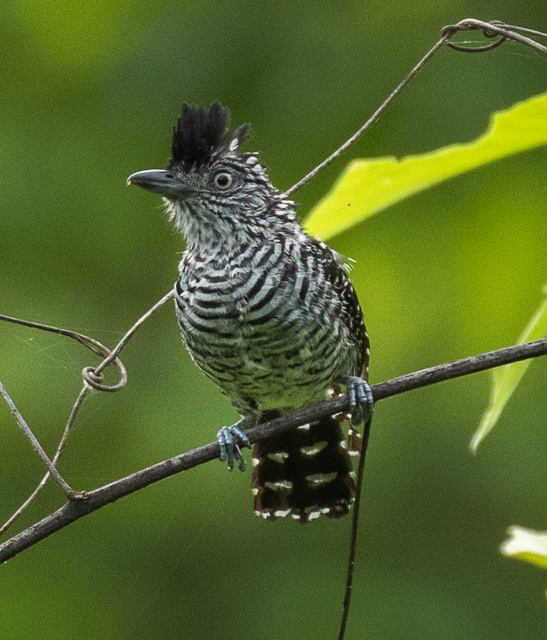 Barred AntshrikeThamnophilus doliatus
-
 Black-crowned AntshrikeThamnophilus atrinucha
-
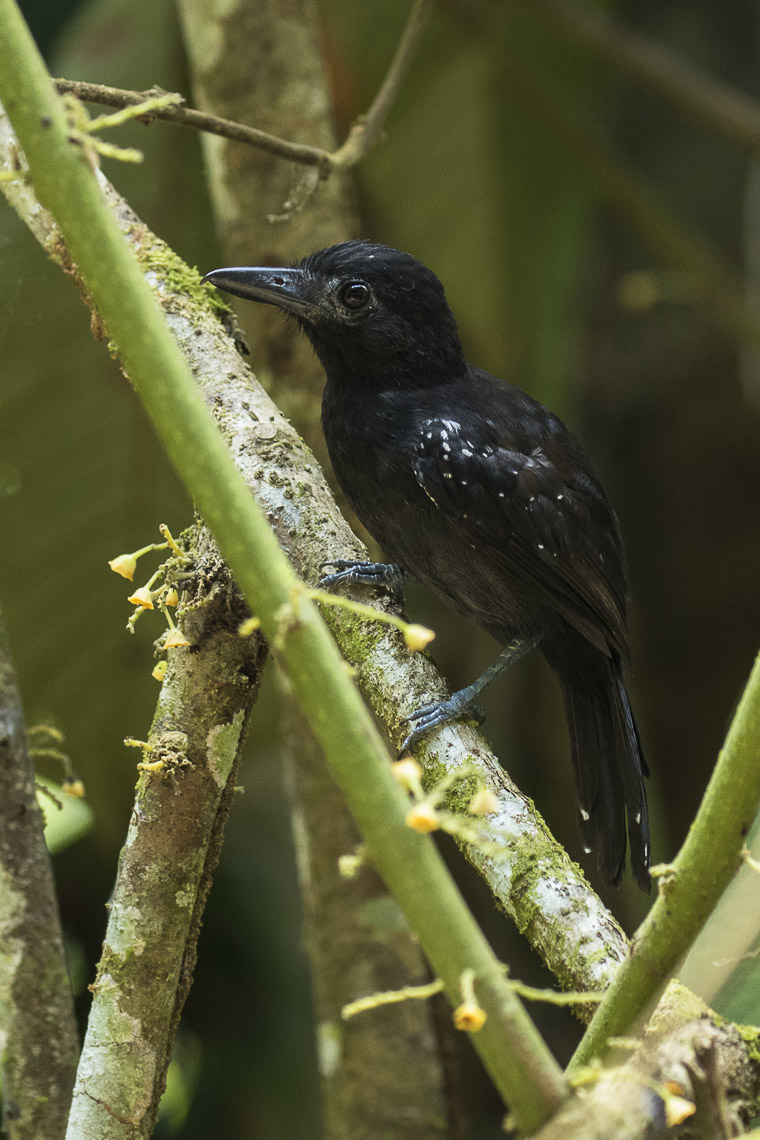 Black-hooded AntshrikeThamnophilus bridgesi
-
 Variable AntshrikeThamnophilus caerulescens
-
 Bar-crested AntshrikeThamnophilus multistriatus
-
 Acre AntshrikeThamnophilus divisorius
-
 Amazonian AntshrikeThamnophilus amazonicus
-
 Rufous-capped AntshrikeThamnophilus ruficapillus
Compare
Questions and answers
What is the scientific name of the Sooretama Slaty Antshrike?
The scientific name of the Sooretama Slaty Antshrike is Thamnophilus ambiguus. Written with its author, the full name is Thamnophilus ambiguus Swainson, 1825.
Which family does the Sooretama Slaty Antshrike belong to?
Thamnophilus ambiguus belongs to the family Thamnophilidae, in the order Passeriformes and the class Aves.
Where is the Sooretama Slaty Antshrike found?
Checklists and occurrence records place Thamnophilus ambiguus in 1 country: Brazil.
What is the conservation status of the Sooretama Slaty Antshrike?
The IUCN Red List category recorded for Thamnophilus ambiguus is Least Concern (LC).
What other names does the Sooretama Slaty Antshrike have?
Thamnophilus ambiguus is also known in English as Sooretama Slaty-Antshrike.
Where does the Sooretama Slaty Antshrike live?
It is endemic to Brazil. Its coastal range extends from southern Sergipe to Rio de Janeiro state, and its inland range extends along the Doce River valley in Minas Gerais.[36][37][38]
What habitats does the Sooretama Slaty Antshrike occupy?
It inhabits the understory and mid-story of evergreen forests, woodlands on sandy soil, and nearby secondary forests. It favors forest edges and gaps created by fallen trees.[11][12][13]
What does the Sooretama Slaty Antshrike eat?
Its diet consists mostly of insects and other arthropods.[15]
How does the Sooretama Slaty Antshrike forage?
It usually forages alone, in pairs, or in small family groups, generally between 1 and 10 m above the ground. It searches for prey in thickets and vine tangles, gleans from vegetation, makes short upward sallies, and takes prey from ground leaf litter.[16][17][18][19]
Sources
Passages the profile rests on
- Adult males have a black forehead and crown with several gray spots on the forehead. Source passage: “Adult males have a black forehead and crown with a few gray spots on the former.” — English Wikipedia
- Adult males have a gray back with a central black spot and a concealed white patch between the scapulars. Source passage: “Their back is gray with a black spot in the middle and a hidden white patch between the scapulars.” — English Wikipedia
- Adult males have black wings and wing coverts marked with white spots and edges. Source passage: “Their wings and wing coverts are black with white spots and edges.” — English Wikipedia
- Adult males have black tails with white feather tips and spots. Source passage: “Their tail is black with white tips and spots on the feathers.” — English Wikipedia
- Adult males have gray underparts that are often paler on the throat and belly. Source passage: “Their underparts are gray that is often whiter on the throat and belly.” — English Wikipedia
- Adult females have a warm tawny-brown crown. Source passage: “Adult females have a warm tawny-brown crown.” — English Wikipedia
- Adult females have an olive-gray back with a clay-colored tinge and a few black feather tips. Source passage: “Their back is olive-gray with a clay-colored tinge and a few black feather tips.” — English Wikipedia
- Adult females have dark brown wings with white spots and edges, and pale clay-colored edges on the flight feathers. Source passage: “Their wings are dark brown with white spots and edges and pale clay edges on the flight feathers.” — English Wikipedia
- Adult females have dark brown tails with white feather tips and spots. Source passage: “Their tail is dark brown with white tips and spots on the feathers.” — English Wikipedia
- Adult females have underparts combining clay and smoke-gray colors, with paler throats and bellies. Source passage: “Their underparts are mixed clay and smoke-gray and are whiter on the throat and belly.” — English Wikipedia
- The species inhabits the understory and mid-story of evergreen forests. Source passage: “It inhabits the understorey to mid-storey of evergreen forest” — English Wikipedia
- The species also occupies woodlands on sandy soil and nearby secondary forests. Source passage: “woodlands on sandy soil, and nearby secondary forest.” — English Wikipedia
- The species favors forest edges and gaps created by fallen trees. Source passage: “It everywhere favors the forest edge and gaps within it caused by fallen trees.” — English Wikipedia
- The species occurs from sea level to elevations of 700 m. Source passage: “In elevation it occurs from sea level to 700 m (2,300 ft).” — English Wikipedia
- The species' diet consists mostly of insects and other arthropods. Source passage: “but is mostly insects and other arthropods.” — English Wikipedia
- The species usually forages alone, in pairs, or in small family groups. Source passage: “It usually forages singly, in pairs, or in small family groups” — English Wikipedia
- The species generally forages between 1 and 10 m above the ground, but occasionally reaches heights of 25 m. Source passage: “mostly between 1 and 10 m (3 and 33 ft) of the ground though sometimes as high as 25 m (82 ft).” — English Wikipedia
- The species searches for prey by hopping through thickets and vine tangles and gleaning from vegetation while reaching or lunging from perches. Source passage: “It hops through thickets and vine tangles, gleaning prey from leaves, branches, and vines while reaching and lunging from a perch” — English Wikipedia
- The species also captures prey through short upward sallies and by taking prey from ground leaf litter. Source passage: “it also makes short upward sallies and takes prey from leaf litter on the ground.” — English Wikipedia
- The species frequently joins mixed-species feeding flocks. Source passage: “It often joins mixed-species feeding flocks” — English Wikipedia
- The species has only rarely been observed following army ant swarms. Source passage: “and has only seldom been observed following army ant swarms.” — English Wikipedia
- The species is presumed to remain in its range throughout the year. Source passage: “The Sooretama slaty antshrike is presumed to be a year-round resident throughout its range.” — English Wikipedia
- The breeding season of the species has not been established. Source passage: “The Sooretama slaty antshrike's breeding season has not been defined” — English Wikipedia
- Recently fledged young have been observed in November. Source passage: “recently fledged young have been seen in November.” — English Wikipedia
- The species builds a cup-shaped nest suspended from a branch fork. Source passage: “Its nest is a cup suspended in a branch fork.” — English Wikipedia
- The IUCN classifies the species as Least Concern. Source passage: “The IUCN has assessed the Sooretama slaty antshrike as being of Least Concern.” — English Wikipedia
- The population size of the species is unknown. Source passage: “Its population size is not known” — English Wikipedia
- The species' population is believed to be stable. Source passage: “and is believed to be stable.” — English Wikipedia
- No immediate threats to the species have been identified. Source passage: “No immediate threats have been identified.” — English Wikipedia
- The species is considered fairly common and occurs in several protected areas. Source passage: “It is considered fairly common and occurs in several protected areas.” — English Wikipedia
- The species was described by William Swainson in 1825. Source passage: “The Sooretama slaty antshrike was described by the English naturalist William Swainson in 1825” — English Wikipedia
- The species was formerly classified as a subspecies of Thamnophilus punctatus. Source passage: “It was later treated as a subspecies of T. punctatus” — English Wikipedia
- A 1997 study resulted in the separation of the slaty antshrike into six species, including this species. Source passage: “Following the results of a study published in 1997, the slaty antshrike was split into six species, of which the Sooretama slaty antshrike is one.” — English Wikipedia
- The species' song consists of a cackling sequence that begins high, rises, and ends in a short rattle that sometimes descends. Source passage: “cackling series, starting high and rising, then finishing as a short, sometimes descending rattle” — English Wikipedia
- The species' call includes a level, high-pitched cackling sound described as 'witwitwit' or 'witrrr'. Source passage: “level high, cackling 'witwitwit' or 'witrrr'” — English Wikipedia
- The Sooretama Slaty Antshrike is endemic to Brazil. Source passage: “It is endemic to Brazil.” — English Wikipedia
- Its coastal Brazilian range extends from southern Sergipe to Rio de Janeiro state. Source passage: “found in southeastern Brazil coastally from southern Sergipe to Rio de Janeiro state” — English Wikipedia
- The species' inland range extends along the Doce River valley in Minas Gerais. Source passage: “and inland up the Doce River valley in Minas Gerais.” — English Wikipedia
Data
- Catalogue of Life, 2026-10-16 XR cc by
- Global Biodiversity Information Facility CC BY 4.0
- Wikidata CC0
- GeoNames CC BY 4.0
- Wikimedia Commons per image; credit shown with each image
- Within the Catalogue of Life, this name comes from The Integrated Taxonomic Information System cc0
References
- Swainson, & William John. (1825). The characters and descriptions of several Birds belonging to the genus Thamnophilus. The Zoological Journal, Vol. 2, No. 5. where the name was published
This species in other databases
Page built on 27 November 2026. See how the catalog is made and all sources and licences.
Cite this page
ScientificNames.org. (2026). Thamnophilus ambiguus (Sooretama Slaty Antshrike). Retrieved November 27, 2026, from https://scientificnames.org/species/thamnophilus-ambiguus
“Thamnophilus ambiguus (Sooretama Slaty Antshrike).” ScientificNames.org, 2026, scientificnames.org/species/thamnophilus-ambiguus. Accessed 27 Nov. 2026.
ScientificNames.org. “Thamnophilus ambiguus (Sooretama Slaty Antshrike).” Accessed November 27, 2026. https://scientificnames.org/species/thamnophilus-ambiguus.
@misc{scientificnames_thamnophilus_ambiguus_sooretama_slaty_antshrike,
  author = {{ScientificNames.org}},
  title = {Thamnophilus ambiguus (Sooretama Slaty Antshrike)},
  year = {2026},
  url = {https://scientificnames.org/species/thamnophilus-ambiguus},
  note = {Accessed 2026-11-27}
}