Species · Birds
Blackish-grey Antshrike Thamnophilus nigrocinereus
The scientific name of the Blackish-grey Antshrike is Thamnophilus nigrocinereus. It is a species of bird in the family Thamnophilidae (antbird), order Passeriformes. The name dates from 1855.
- Scientific name
- Thamnophilus nigrocinereus P. L. Sclater, 1855
- Common name
- Blackish-grey Antshrike
- Genus
- Thamnophilus
- Family
- Thamnophilidae (Antbird)
- Order
- Passeriformes
- Class
- Aves
- Red List category
- LC Least Concern
- Recorded in
- 5 countries
- Name status
- accepted in the Catalogue of Life

Overview
The Blackish-grey Antshrike (Thamnophilus nigrocinereus) is a polymorphic bird in the family Thamnophilidae, order Passeriformes and class Aves. It inhabits the northern Amazon Basin in Brazil, Colombia, French Guiana and Venezuela. It exhibits sexual dimorphism, with generally blackish-gray adult males and reddish-brown adult females in the nominate subspecies.
Written 27 November 2026 from the sources listed below. Each statement was checked against the passage it cites; statements that could not be supported were removed.
Appearance
The species measures 15–17 cm in length and weighs 28–32 g.[1][2]
The species exhibits sexual dimorphism. Adult males of the nominate subspecies are generally blackish gray, with a black crown and a hidden white patch between their scapulars. Their wings have a brownish tinge, and their scapulars, wing coverts and flight feathers have white edges; the tail feathers have white tips.[3][4][5][6][7][8][9]
Adult females of the nominate subspecies have a blackish-gray crown and face. Their upperparts are dark gray with a reddish-brown tinge, and their underparts are reddish-brown, darkest across the breast.[10][11][12]
Habitat
The species primarily inhabits forested landscapes closely associated with rivers, generally occupying the forest understory and mid-story.[13][14]
In Colombia and Venezuela, it occurs mainly in seasonally flooded savanna woodland on white-sand soils and in gallery forest. In coastal French Guiana, it inhabits mangroves and inland river edges.[15][16]
In the Brazilian Amazon, it occupies river islands and riverside várzea and igapó forests. It also occurs around the edges of clearings near rivers, and on larger islands in the Amazon Delta it occupies elevated ground surrounded by seasonally flooded lower areas.[17][18][19]
The species occurs below 400 m elevation in Colombia, 200 m in Venezuela and 350 m in Brazil.[20]
Diet
The species feeds on insects and other arthropods.[21]
Behaviour
The species is presumed to remain in its range throughout the year. It usually forages alone or in pairs and rarely joins mixed-species feeding flocks.[22][23]
The species forages by hopping between branches and making short flights and jumps from perches. It often drops onto prey on the ground.[24][25]
In Brazilian Amazonia, the species forages into the forest mid-story.[26]
Reproduction and life cycle
The breeding season includes March in the Orinoco River basin. The only documented nests of the species were found in French Guiana.[27][28]
The species builds deep cup-shaped nests woven from plant fibers and bound with spider silk. Both sexes participate in nest construction, and the nests are suspended in branch forks, usually in gray mangrove trees.[29][30][31]
The species lays clutches of two eggs. The incubation period, fledging time and parental care details remain undocumented because all observed nests were predated.[32][33]
Conservation
The IUCN assessed the species as Least Concern in 2023. Its population size is unknown and its population is believed to be decreasing.[34][35][36]
Accelerating deforestation for agriculture, livestock ranching and selective logging is identified as the primary threat. The species is considered particularly vulnerable to habitat fragmentation and edge effects.[37][38]
The species is common in Colombia and locally fairly common in Venezuela and Brazil. It occurs in several protected areas, including indigenous reserved zones.[39][40]
Classification of the Blackish-grey Antshrike
| Kingdom | Animalia |
|---|---|
| Phylum | Chordata |
| Subphylum | Vertebrata |
| Infraphylum | Gnathostomata |
| Parvphylum | Osteichthyes |
| Megaclass | Tetrapoda |
| Class | Aves (Bird) |
| Order | Passeriformes (Passerine) |
| Family | Thamnophilidae (Antbird) |
| Genus | Thamnophilus (Antshrikes) |
| Species | Thamnophilus nigrocinereus P. L. Sclater, 1855 |
Where the Blackish-grey Antshrike is found
Checklists and occurrence records place Thamnophilus nigrocinereus in 5 countries across South America. GBIF holds 3,086 georeferenced records of it.
Countries
Regions and cities with the most records
- Amazonas, Brazil 457
- Meta Department, Colombia 452
- Guainía Department, Colombia 384
- Vichada Department, Colombia 323
- Casanare Department, Colombia 288
- Novo Airão, Brazil 266
- Vaupés, Colombia 255
- Mitú, Colombia 246
- Guaviare Department, Colombia 156
- Pará, Brazil 140
- San José del Guaviare, Colombia 123
- Rémire-Montjoly, French Guiana 76
- Cayenne, French Guiana 75
- Matoury, French Guiana 75
- Villavicencio, Colombia 59
- Amazonas, Venezuela 57
- Restrepo, Colombia 54
- Puerto Carreño, Colombia 53
- Roraima, Brazil 52
- Caracaraí, Brazil 28
- Puerto López, Colombia 27
- Borba, Brazil 19
- São Gabriel da Cachoeira, Brazil 18
- Almeirim, Brazil 17
- Amapá, Brazil 15
- Acacías, Colombia 13
- Arauca Department, Colombia 13
- Yopal, Colombia 11
- Ananindeua, Brazil 10
- Marituba, Brazil 10
- Santarém, Brazil 10
- Belém, Brazil 9
- Cametá, Brazil 9
- Macapá, Brazil 6
- Santana, Brazil 6
- Abaetetuba, Brazil 5
Range as the checklists state it
South America
A number beside a place is its count of GBIF occurrence records. A place without a number comes from a checklist alone. Records show where a species has been observed or collected, which can include escapes and vagrants.
Common names
English
- Blackish-grey Antshrike
- Blackish-gray Antshrike
Names in 23 other languages
- Catalan
- batarà cendrós
- Chinese
- 黑灰蚁鵙, 黑灰蟻鵙
- Croatian
- krupnokljuna mravarica
- Czech
- mravenčík šedočerný
- Danish
- Sortgrå Myretornskade
- Dutch
- Zwart-grijze Mierklauwier
- Esperanto
- griznigra formikulo
- Finnish
- tummapuumuura
- French
- Batara demi-deuil
- German
- Graubauch-Wollrücken, Graubauchwollrücken, Schwarzgrau-Ameisenwürger, Schwarzgrauer Ameisenwürger
- Italian
- Averla formichiera grigionera
- Japanese
- シラナミアリモズ
- Lithuanian
- juosvoji medšarkinė skruzdlesė
- Norwegian
- sotmaurvarsler
- Polish
- chronka ciemna
- Portuguese
- choca-preta-e-cinza, formigueiro-preto-e-cinzento
- Russian
- Серо-чёрный колючник, Серобрюхая сорокопутовая муравьеловка
- Slovak
- batara černastá
- Spanish
- Batará ceniciento
- Swedish
- gråsvart myrtörnskata
- Turkish
- İsrengi Karıncaavcısı
- Ukrainian
- сорокуш сірочеревий
- Welsh
- morgrugydd llwytu
Subspecies and varieties
- Thamnophilus nigrocinereus cinereoniger subspecies
- Thamnophilus nigrocinereus huberi subspecies
- Thamnophilus nigrocinereus kulczynskii subspecies
- Thamnophilus nigrocinereus nigrocinereus subspecies
- Thamnophilus nigrocinereus tschudii subspecies
Related species
-
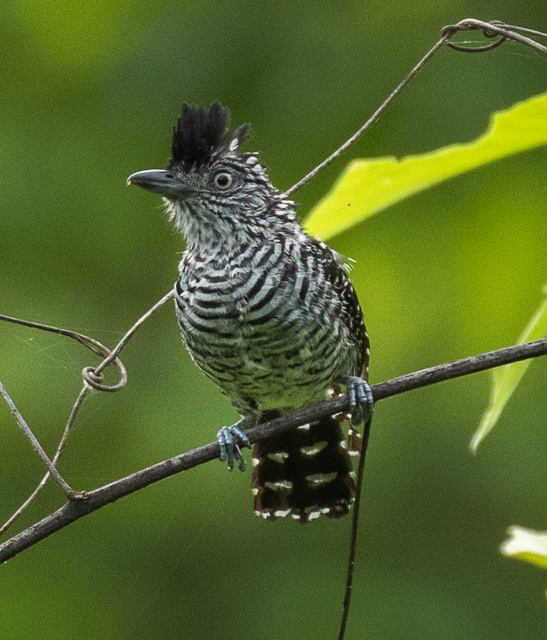 Barred AntshrikeThamnophilus doliatus
-
 Black-crowned AntshrikeThamnophilus atrinucha
-
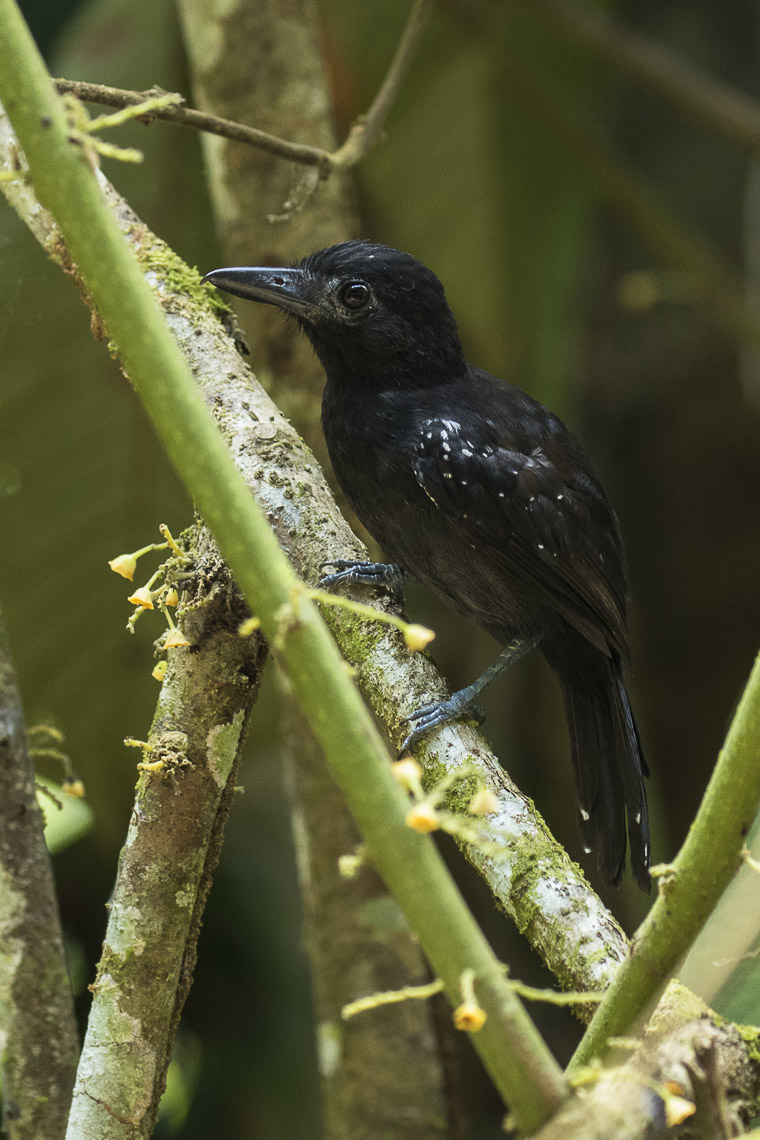 Black-hooded AntshrikeThamnophilus bridgesi
-
 Variable AntshrikeThamnophilus caerulescens
-
 Bar-crested AntshrikeThamnophilus multistriatus
-
 Acre AntshrikeThamnophilus divisorius
-
 Amazonian AntshrikeThamnophilus amazonicus
-
 Rufous-capped AntshrikeThamnophilus ruficapillus
Compare
Questions and answers
What is the scientific name of the Blackish-grey Antshrike?
The scientific name of the Blackish-grey Antshrike is Thamnophilus nigrocinereus. Written with its author, the full name is Thamnophilus nigrocinereus P. L. Sclater, 1855.
Which family does the Blackish-grey Antshrike belong to?
Thamnophilus nigrocinereus belongs to the family Thamnophilidae, in the order Passeriformes and the class Aves.
Where is the Blackish-grey Antshrike found?
Checklists and occurrence records place Thamnophilus nigrocinereus in 5 countries: Colombia, Brazil, Venezuela, French Guiana and Peru.
What is the conservation status of the Blackish-grey Antshrike?
The IUCN Red List category recorded for Thamnophilus nigrocinereus is Least Concern (LC).
What other names does the Blackish-grey Antshrike have?
Thamnophilus nigrocinereus is also known in English as Blackish-gray Antshrike.
Who described the Blackish-grey Antshrike and when?
Philip Sclater described the species in 1855 under the name Thamnophilus nigrocinereus.[41]
How many recognized subspecies does the species have?
The species has five recognized subspecies.[42]
Sources
Passages the profile rests on
- The species measures 15–17 cm in length. Source passage: “The blackish-grey antshrike is 15 to 17 cm (5.9 to 6.7 in) long” — English Wikipedia
- The species weighs 28–32 g. Source passage: “weighs 28 to 32 g (0.99 to 1.1 oz).” — English Wikipedia
- The species exhibits sexual dimorphism. Source passage: “This species exhibits sexual dimorphism.” — English Wikipedia
- Adult males of the nominate subspecies are generally blackish gray. Source passage: “Adult males of the nominate subspecies T. n. nigrocinereus are generally blackish gray.” — English Wikipedia
- Adult males of the nominate subspecies have a black crown. Source passage: “Their crown is black;” — English Wikipedia
- Adult males of the nominate subspecies have a hidden white patch between their scapulars. Source passage: “has a hidden white patch between their scapulars.” — English Wikipedia
- Adult males of the nominate subspecies have brownish-tinged wings. Source passage: “Their wings have a brownish tinge.” — English Wikipedia
- Adult males of the nominate subspecies have white edges on their scapulars, wing coverts and flight feathers. Source passage: “Their scapulars, wing coverts, and flight feathers have white edges” — English Wikipedia
- Adult males of the nominate subspecies have white-tipped tail feathers. Source passage: “their tail feathers have white tips.” — English Wikipedia
- Adult females of the nominate subspecies have a blackish-gray crown and face. Source passage: “Adult females have a blackish gray crown and face.” — English Wikipedia
- Adult females of the nominate subspecies have dark gray upperparts with a reddish-brown tinge. Source passage: “Their upperparts are dark gray with a reddish brown tinge,” — English Wikipedia
- Adult females of the nominate subspecies have reddish-brown underparts, darkest across the breast. Source passage: “their underparts are a reddish brown that is darkest across their breast.” — English Wikipedia
- The species primarily inhabits forested landscapes closely associated with rivers. Source passage: “The blackish-grey antshrike inhabits a variety of landscapes, most of which are forested and closely tied to rivers.” — English Wikipedia
- The species generally occupies the forest understory and mid-story. Source passage: “In all habitats it favors the understorey to mid-storey.” — English Wikipedia
- In Colombia and Venezuela, the species occurs mainly in seasonally flooded savanna woodland on white-sand soils and in gallery forest. Source passage: “In Colombia and Venezuela it mostly occurs in seasonally flooded savanna woodland on white-sand soils and in gallery forest.” — English Wikipedia
- In coastal French Guiana, the species inhabits mangroves and inland river edges. Source passage: “In coastal French Guiana it occurs in mangroves and further inland along river edges.” — English Wikipedia
- In the Brazilian Amazon, the species occupies river islands and riverside várzea and igapó forests. Source passage: “it occurs on river islands and riverside "mainland" várzea and igapó forest” — English Wikipedia
- In Brazil, the species also occurs around the edges of clearings near rivers. Source passage: “and also around the edges of clearings near rivers.” — English Wikipedia
- On larger islands in the Amazon Delta, the species occupies elevated ground surrounded by seasonally flooded lower areas. Source passage: “On larger island in the Amazon Delta it occurs on higher ground that is surrounded by seasonally flooded lower areas.” — English Wikipedia
- The species occurs below 400 m elevation in Colombia, 200 m in Venezuela and 350 m in Brazil. Source passage: “In elevation it occurs below 400 m (1,300 ft) in Colombia, to 200 m (700 ft) in Venezuela, and to 350 m (1,100 ft) in Brazil.” — English Wikipedia
- The species feeds on insects and other arthropods. Source passage: “The blackish-grey antshrike feeds on insects and other arthropods.” — English Wikipedia
- The species is presumed to remain in its range throughout the year. Source passage: “The blackish-grey antshrike is presumed to be a year-round resident throughout its range.” — English Wikipedia
- The species usually forages alone or in pairs and rarely joins mixed-species feeding flocks. Source passage: “It usually forages singly or in pairs and seldom joins mixed-species feeding flocks.” — English Wikipedia
- The species forages by hopping between branches and making short flights and jumps from perches. Source passage: “It forages while hopping among branches and with short flights, commonly reaching or making short jumps from a perch.” — English Wikipedia
- The species often drops onto prey on the ground. Source passage: “It often drops onto prey on the ground.” — English Wikipedia
- In Brazilian Amazonia, the species forages into the forest mid-story. Source passage: “In Brazilian Amazonia the species forages up into the forest's mid-storey.” — English Wikipedia
- The breeding season of the species includes March in the Orinoco River basin. Source passage: “Its breeding season includes March in the Orinoco River basin.” — English Wikipedia
- The only documented nests of the species were found in French Guiana. Source passage: “The only documented nests were in French Guiana.” — English Wikipedia
- The species builds deep cup-shaped nests woven from plant fibers and bound with spider silk. Source passage: “They were deep cups woven of fibers from vines and other vegetation and bound with spider silk.” — English Wikipedia
- Both sexes participate in nest construction. Source passage: “Both sexes built the nests.” — English Wikipedia
- The nests are suspended in branch forks, usually in gray mangrove trees. Source passage: “They were suspended in branch forks, usually gray mangrove Laguncularia racemosa.” — English Wikipedia
- The species lays clutches of two eggs. Source passage: “The clutch size was two eggs.” — English Wikipedia
- The incubation period, fledging time and parental care details remain undocumented because all observed nests were predated. Source passage: “The incubation period, time to fledging, and details of parental care are not known because all of the nests were predated.” — English Wikipedia
- The IUCN assessed the species as Least Concern in 2023. Source passage: “The IUCN originally in 2004 assessed the blackish-grey antshrike as being of Least Concern, then in 2012 uplisted it to Near Threatened, and in 2023 returned it to of Least Concern.” — English Wikipedia
- The population size of the species is unknown and its population is believed to be decreasing. Source passage: “its population size is not known and is believed to be decreasing.” — English Wikipedia
- The species has been most recently assessed for the IUCN Red List in 2023. Source passage: “has most recently been assessed for The IUCN Red List of Threatened Species in 2023.” — iucnredlist.org
- Accelerating deforestation for agriculture, livestock ranching and selective logging is identified as the primary threat to the species. Source passage: “The primary threat to this species is accelerating deforestation in its range for agricultural purposes, livestock ranching and selective logging.” — English Wikipedia
- The species is considered particularly vulnerable to habitat fragmentation and edge effects. Source passage: “It is thought likely to be particularly susceptible to fragmentation and edge effects.” — English Wikipedia
- The species is common in Colombia and locally fairly common in Venezuela and Brazil. Source passage: “It is considered common in Colombia and locally fairly common in Venezuela and Brazil.” — English Wikipedia
- The species occurs in several protected areas, including indigenous reserved zones. Source passage: “It occurs in several protected areas including indigenous reserved zones.” — English Wikipedia
- Philip Sclater described the species in 1855 under the name Thamnophilus nigrocinereus. Source passage: “The blackish-grey antshrike was described by the English zoologist Philip Sclater in 1855 and given the binomial name Thamnophilus nigrocinereus.” — English Wikipedia
- The species has five recognized subspecies. Source passage: “It has these five subspecies:” — English Wikipedia
Data
- Catalogue of Life, 2026-10-16 XR cc by
- Global Biodiversity Information Facility CC BY 4.0
- Wikidata CC0
- GeoNames CC BY 4.0
- Wikimedia Commons per image; credit shown with each image
- Within the Catalogue of Life, this name comes from The Integrated Taxonomic Information System cc0
References
- Sclater, & Philip Lutley. (1855). Characters of Six New Species of the Genus Thamnophilus. Proceedings of the Zoological Society of London, Vol. 23. where the name was published
- Gill, Frank, & and Minturn Wright. (2006). Birds of the World: Recommended English Names.
This species in other databases
Page built on 29 November 2026. See how the catalog is made and all sources and licences.
Cite this page
ScientificNames.org. (2026). Thamnophilus nigrocinereus (Blackish-grey Antshrike). Retrieved November 29, 2026, from https://scientificnames.org/species/thamnophilus-nigrocinereus
“Thamnophilus nigrocinereus (Blackish-grey Antshrike).” ScientificNames.org, 2026, scientificnames.org/species/thamnophilus-nigrocinereus. Accessed 29 Nov. 2026.
ScientificNames.org. “Thamnophilus nigrocinereus (Blackish-grey Antshrike).” Accessed November 29, 2026. https://scientificnames.org/species/thamnophilus-nigrocinereus.
@misc{scientificnames_thamnophilus_nigrocinereus_blackish_grey_antshrike,
  author = {{ScientificNames.org}},
  title = {Thamnophilus nigrocinereus (Blackish-grey Antshrike)},
  year = {2026},
  url = {https://scientificnames.org/species/thamnophilus-nigrocinereus},
  note = {Accessed 2026-11-29}
}