Species · Birds
Blue-crowned Parakeet Thectocercus acuticaudatus
The scientific name of the Blue-crowned Parakeet is Thectocercus acuticaudatus. It is a species of bird in the family Psittacidae (macaws), order Psittaciformes. The name dates from 1818.
- Scientific name
- Thectocercus acuticaudatus (Vieillot, 1818)
- Common name
- Blue-crowned Parakeet
- Genus
- Thectocercus
- Family
- Psittacidae (Macaws)
- Order
- Psittaciformes
- Class
- Aves
- Recorded in
- 14 countries
- Name status
- accepted in the Catalogue of Life

Overview
The Blue-crowned Parakeet is the only member of the monotypic genus Thectocercus. It inhabits savanna-like environments, woodland, and forest margins. It has predominantly green plumage, a blue head, and a pale beak.
Written 26 November 2026 from the sources listed below. Each statement was checked against the passage it cites; statements that could not be supported were removed.
Appearance
The Blue-crowned Parakeet has predominantly green plumage, a blue head, and a pale beak. The nominate subspecies has dull blue feathers on its forehead, crown, cheeks, and ears.[1][2]
The species has a ring of white featherless skin around each eye, which is bright orange-yellow in T. acuticaudata neumanni. Its breast feathers can be blue-tinged but are more commonly green or yellow-green.[3][4]
The closed wings match the body's coloration, while the extended wings display blue-brown coloring that becomes chestnut on the outer flight feathers. The upper surfaces of the tail feathers are green, while their undersides are maroon to red-brown.[5][6]
The species has pink-brown legs and grey-brown claws. Its upper mandible is horn-colored and tapers to a needle-sharp grey-black tip.[7][8]
Juveniles of the nominate subspecies and T. acuticaudata neumanni have a horn-colored lower mandible that fades to grey-black by their second year. Eastern, central, and northern subspecies retain a horn-colored lower mandible into adulthood.[9][10]
Young birds are born with red coloring around the head.[11]
Habitat
The Blue-crowned Parakeet inhabits savanna-like environments, woodland, and forest-margin habitats. It avoids dense humid forests such as the Amazon.[12][13][14][15]
The species is native to a large area of South America extending from eastern Colombia to Curacao and northern Argentina.[16]
Reproduction and life cycle
The Blue-crowned Parakeet nests in holes in trees. A typical clutch contains three to four eggs.[17][18]
The female incubates the eggs for 26 days. Chicks leave the nest approximately 52 days after hatching.[19][20]
Behaviour
The Blue-crowned Parakeet is social and can be quite loud at times.[21][22]
It is relatively capable of talking compared with other conures.[23]
Classification of the Blue-crowned Parakeet
| Kingdom | Animalia |
|---|---|
| Phylum | Chordata |
| Subphylum | Vertebrata |
| Infraphylum | Gnathostomata |
| Parvphylum | Osteichthyes |
| Megaclass | Tetrapoda |
| Class | Aves (Bird) |
| Order | Psittaciformes (Parrot) |
| Family | Psittacidae (Macaws) |
| Genus | Thectocercus |
| Species | Thectocercus acuticaudatus (Vieillot, 1818) |
Where the Blue-crowned Parakeet is found
Checklists and occurrence records place Thectocercus acuticaudatus in 14 countries across North America, Oceania and South America. GBIF holds 52,701 georeferenced records of it.
Countries
- Argentina 18,337
- Bolivia 2,889
- Brazil 4,075
- Chile 11
- Colombia 2,233
- Curacao 1,796
- Italy 7
- Paraguay 1,898
- Peru 109
- Portugal 4,644
- Puerto Rico 5
- Spain 461
- United States 14,006
- Venezuela 2,230
Regions and cities with the most records
- Florida, United States 12,685
- Lauderdale Lakes, United States 5,681
- Lauderhill, United States 5,638
- Plantation, United States 5,629
- Oakland Park, United States 5,587
- Fort Lauderdale, United States 5,575
- Davie, United States 5,536
- Hollywood, United States 5,521
- Sunrise, United States 5,515
- Dania Beach, United States 5,505
- North Lauderdale, United States 5,134
- Tamarac, United States 5,132
- Margate, United States 5,059
- Cordoba, Argentina 4,987
- Pompano Beach, United States 4,984
- Coconut Creek, United States 4,940
- Cooper City, United States 4,893
- Pembroke Pines, United States 4,720
- Alfornelos, Portugal 4,638
- Pontinha, Portugal 4,638
- Belas, Portugal 4,637
- Olival, Portugal 4,637
- Alfragide, Portugal 4,636
- Amadora, Portugal 4,636
- Benfica, Portugal 4,636
- Buraca, Portugal 4,636
- Campo Grande, Portugal 4,636
- Carnide, Portugal 4,636
- Damaia, Portugal 4,636
- Falagueira, Portugal 4,636
- Odivelas, Portugal 4,636
- Queluz, Portugal 4,636
- Ramada, Portugal 4,636
- Belém, Portugal 4,635
- Carnaxide, Portugal 4,635
- Linda-a-Velha, Portugal 4,635
Range as the checklists state it
North America
South America
Oceania
A number beside a place is its count of GBIF occurrence records. A place without a number comes from a checklist alone. Records show where a species has been observed or collected, which can include escapes and vagrants.
Common names
English
- Blue-crowned Parakeet
- Blue-crowned Conure
- Sharp-tailed Conure
Names in 28 other languages
- Arabic
- ببغاء أزرق التاج
- Bulgarian
- Синьочела аратинга
- Catalan
- aratinga de cap blau
- Chinese
- 冠藍鸚哥, 蓝冠鹦哥
- Croatian
- plavoglava jandaja
- Czech
- aratinga dlouhoocasý, aratinga modročelý
- Danish
- Blåkindet Aratinga
- Dutch
- Blauwkoparatinga
- Esperanto
- blukrona papago
- Estonian
- sinipea-aratinga
- Finnish
- sinipääaratti
- French
- Conure à tête bleue
- German
- Spitzschwanzsittich
- Hungarian
- kékhomlokú aratinga, ékfarkú aratinga
- Italian
- Aratinga testablù
- Japanese
- トガリオインコ
- Lithuanian
- mėlynvainikė aratinga
- Norwegian
- blåhodeparakitt
- Papiamento
- Prikichi Kabes Blou, Prikichi Kabez Blou
- Polish
- szmaragdzianka
- Portuguese
- aratinga-de-testa-azul, periquitão, periquitão-de-cabeça-azul, periquitão-de-testa-azul
- Russian
- Синелобая аратинга
- Serbian
- Plavoglava aratinga
- Slovak
- klinochvost modročelý
- Spanish
- Aratinga cabeciazul, Calancate Común, Calancate cabeza azul, Carapaico, Loro Cabeza Azul
- Swedish
- blåkronad parakit
- Turkish
- Mavi Alınlı Papağan
- Ukrainian
- аратинга синьолобий
Synonyms
4 other scientific names have been used for this species and are now treated as synonyms of Thectocercus acuticaudatus.
- Aratinga acuticauda (Vieillot, 1818)
- Aratinga acuticaudata (Vieillot, 1818)
- Psittacara acuticaudatus (Vieillot, 1818)
- Psittacus acuticaudatus Vieillot, 1818
Subspecies and varieties
- Thectocercus acuticaudatus acuticaudatus subspecies
- Thectocercus acuticaudatus haemorrhous subspecies
- Thectocercus acuticaudatus koenigi (Venezuelan Blue-crowned Parakeet) subspecies
- Thectocercus acuticaudatus neoxenus (Margarita Blue-crowned Parakeet) subspecies
- Thectocercus acuticaudatus neumanni (Bolivian Blue-crowned Parakeet) subspecies
Related species
-
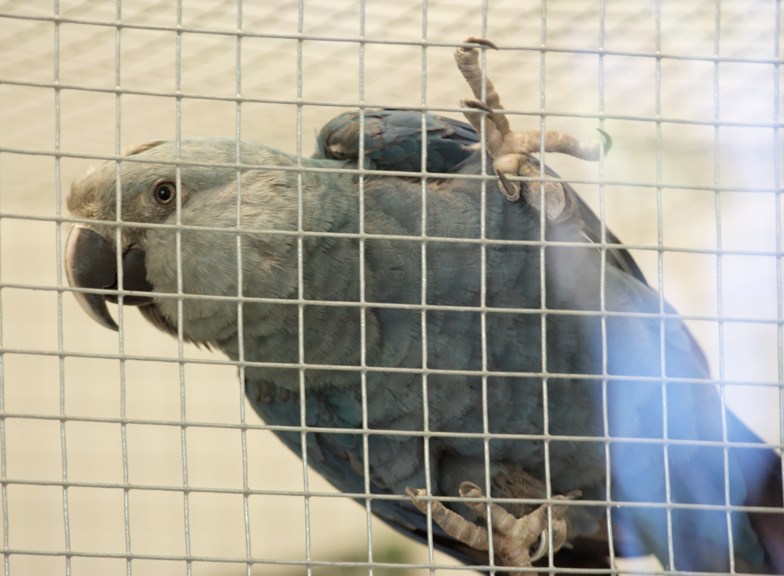 Spix's MacawCyanopsitta spixii
-
 Grey ParrotPsittacus erithacus
-
 Scarlet MacawAra macao
-
 Hyacinth MacawAnodorhynchus hyacinthinus
-
 Blue-and-yellow MacawAra ararauna
-
 Sun ConureAratinga solstitialis
-
 Green ParakeetPsittacara holochlorus
-
 Green-cheeked ParakeetPyrrhura molinae
Compare
Questions and answers
What is the scientific name of the Blue-crowned Parakeet?
The scientific name of the Blue-crowned Parakeet is Thectocercus acuticaudatus. Written with its author, the full name is Thectocercus acuticaudatus (Vieillot, 1818).
Which family does the Blue-crowned Parakeet belong to?
Thectocercus acuticaudatus belongs to the family Psittacidae, in the order Psittaciformes and the class Aves.
Where is the Blue-crowned Parakeet found?
Checklists and occurrence records place Thectocercus acuticaudatus in 14 countries, including Argentina, United States, Portugal, Brazil, Bolivia and Colombia.
What other names does the Blue-crowned Parakeet have?
Thectocercus acuticaudatus is also known in English as Blue-crowned Conure and Sharp-tailed Conure.
Do blue crowned conures talk?
The Blue-crowned Parakeet is relatively capable of talking compared with other conures.[23]
Sources
Passages the profile rests on
- The species has predominantly green plumage, a blue head, and a pale beak. Source passage: “a small green Neotropical parrot with a blue head and pale beak” — English Wikipedia
- The nominate subspecies has dull blue feathers on its forehead, crown, cheeks, and ears. Source passage: “with dull blue coloring on the forehead, crown, cheeks, and ears in the nominate” — English Wikipedia
- The species has a ring of white featherless skin around each eye, which is bright orange-yellow in T. acuticaudata neumanni. Source passage: “It has a ring of white featherless skin around each eye, though this is bright orange-yellow in wild T. acuticaudata neumanni.” — English Wikipedia
- The breast feathers can be blue-tinged but are more commonly green or yellow-green. Source passage: “The breast feathers may also be tinged with blue, though they are more commonly green to yellow-green.” — English Wikipedia
- The closed wings match the body's coloration, while the extended wings display blue-brown coloring that becomes chestnut on the outer flight feathers. Source passage: “Closed wing coloring matches that of the body while extended wings show blue-brown, becoming chestnut on the outer flight feathers.” — English Wikipedia
- The upper surfaces of the tail feathers are green, while their undersides are maroon to red-brown. Source passage: “The tail feathers are green on top, maroon to red-brown on the underside” — English Wikipedia
- The species has pink-brown legs and grey-brown claws. Source passage: “Legs are pink-brown with grey-brown claws.” — English Wikipedia
- The upper mandible is horn-colored and tapers to a needle-sharp grey-black tip. Source passage: “The upper mandible is horn-colored, tapering to a needle-sharp, grey-black tip.” — English Wikipedia
- Juveniles of the nominate subspecies and T. acuticaudata neumanni have a horn-colored lower mandible that fades to grey-black by their second year. Source passage: “In the southern and western nominate and subspecies neumanni, the lower mandible is horn-colored in juveniles, fading to grey-black by the bird's second year.” — English Wikipedia
- Eastern, central, and northern subspecies retain a horn-colored lower mandible into adulthood. Source passage: “The remaining eastern, central and northern subspecies retain the horn-colored lower mandible throughout adulthood.” — English Wikipedia
- Young birds are born with red coloring around the head. Source passage: “Blue-crowns are born with red coloring around the head” — English Wikipedia
- The species inhabits savanna-like environments. Source passage: “They inhabit savanna-like habitats” — English Wikipedia
- The species occurs in woodland and forest-margin habitats. Source passage: “woodland and forest margins” — English Wikipedia
- The species avoids dense humid forests such as the Amazon. Source passage: “but avoid dense humid forest such as the Amazon.” — English Wikipedia
- The species is also described as inhabiting savanna-like habitats, woodland, and forest margins. Source passage: “They inhabit savanna-like habitats, woodland and forest margins” — inaturalist.org
- The species is native to a large area of South America extending from eastern Colombia to Curacao and northern Argentina. Source passage: “native to large parts of South America, from eastern Colombia to Curacao in the southern Caribbean, and to the northern region of Argentina.” — English Wikipedia
- The species nests in holes in trees. Source passage: “The blue-crowned parakeet's nest is a hole in a tree.” — English Wikipedia
- A typical clutch contains three to four eggs. Source passage: “there are usually three to four in a clutch.” — English Wikipedia
- The female incubates the eggs for 26 days. Source passage: “The female incubates the eggs for 26 days” — English Wikipedia
- Chicks leave the nest approximately 52 days after hatching. Source passage: “the chicks fledge from the nest about 52 days after hatching.” — English Wikipedia
- The species is social. Source passage: “They are social birds” — English Wikipedia
- The species can be quite loud at times. Source passage: “They can also be quite loud at times.” — English Wikipedia
- The species is relatively capable of talking compared with other conures. Source passage: “are relatively good talkers compared to other conures.” — English Wikipedia
Data
- Catalogue of Life, 2026-10-16 XR cc by
- Global Biodiversity Information Facility CC BY 4.0
- Wikidata CC0
- GeoNames CC BY 4.0
- Wikimedia Commons per image; credit shown with each image
- Within the Catalogue of Life, this name comes from The Integrated Taxonomic Information System cc0
References
- Uehling, Jennifer J., Jason Tallant, and Stephen Pruett-Jones / Pruett-Jones, Stephen, ed. (2021). Introduced and Naturalized Parrots in the Contiguous United States. Naturalized Parrots of the World. Distribution, Ecology, and Impacts of the World’s Most Colorful Colonizers.
- VanderWerf, Eric A., and Nicholoas P. Kalodimos / Pruett-Jones, Stephen, ed. (2021). Status of Naturalized Parrots in the Hawaiian Islands. Naturalized Parrots of the World. Distribution, Ecology, and Impacts of the World’s Most Colorful Colonizers.
This species in other databases
Page built on 27 November 2026. See how the catalog is made and all sources and licences.
Cite this page
ScientificNames.org. (2026). Thectocercus acuticaudatus (Blue-crowned Parakeet). Retrieved November 27, 2026, from https://scientificnames.org/species/thectocercus-acuticaudatus
“Thectocercus acuticaudatus (Blue-crowned Parakeet).” ScientificNames.org, 2026, scientificnames.org/species/thectocercus-acuticaudatus. Accessed 27 Nov. 2026.
ScientificNames.org. “Thectocercus acuticaudatus (Blue-crowned Parakeet).” Accessed November 27, 2026. https://scientificnames.org/species/thectocercus-acuticaudatus.
@misc{scientificnames_thectocercus_acuticaudatus_blue_crowned_parakeet,
  author = {{ScientificNames.org}},
  title = {Thectocercus acuticaudatus (Blue-crowned Parakeet)},
  year = {2026},
  url = {https://scientificnames.org/species/thectocercus-acuticaudatus},
  note = {Accessed 2026-11-27}
}