Species · Spiders and other arachnids
Karwar Burrowing Spider Thrigmopoeus truculentus
The scientific name of the Karwar Burrowing Spider is Thrigmopoeus truculentus. It is a species of arachnid in the family Theraphosidae (tarantulas), order Araneae. The name dates from 1899.
- Scientific name
- Thrigmopoeus truculentus Pocock, 1899
- Common name
- Karwar Burrowing Spider
- Genus
- Thrigmopoeus
- Family
- Theraphosidae (Tarantulas)
- Order
- Araneae
- Class
- Arachnida
- Red List category
- NT Near Threatened
- Recorded in
- 1 country
- Name status
- accepted in the Catalogue of Life

Overview
Thrigmopoeus truculentus is endemic to the Western Ghats region of India, including Karnataka, Goa and Maharashtra. Its burrow entrances often have a trumpet-bell shape, with rims reinforced by wet mud and spider silk.
Written 27 November 2026 from the sources listed below. Each statement was checked against the passage it cites; statements that could not be supported were removed.
Appearance
The species' burrow entrances often have a trumpet-bell shape, with rims reinforced by wet mud and spider silk. Some individuals construct entrances with a porch-like extension formed by the extended dorsal rim.[1][2]
Habitat
The species has been recorded on vertical roadside and trekking-path embankments in Coorg and in other locations in Goa, Maharashtra and Karnataka. Its burrows have been found between 0.5 and 5 metres above ground in Coorg and Uttara Kannada districts.[3][4]
The species commonly occupies embankments with dense overhead canopy or locations in ghat areas receiving little direct sunlight. Burrows without overhead canopy have been observed only rarely.[5][6]
Behaviour
Some individuals construct burrow entrances with a porch-like extension formed by the extended dorsal rim. The species also reinforces some entrances with nearby twigs and dry leaves to prevent collapse and extend the passage used for entry and exit.[2][7]
Conservation
The species is threatened by habitat fragmentation, habitat degradation, soil erosion, development activities and pet trade. Road widening, tree cutting, soil erosion, tourism and embankment maintenance are identified as causes of habitat degradation affecting the species.[8][9]
The species was originally assessed as narrowly missing the Vulnerable category in the 2008 IUCN Red List and was subsequently placed in the Near Threatened category.[10]
Classification of the Karwar Burrowing Spider
| Kingdom | Animalia |
|---|---|
| Phylum | Arthropoda |
| Subphylum | Chelicerata |
| Class | Arachnida (Arachnid) |
| Order | Araneae (Spider) |
| Family | Theraphosidae (Tarantulas) |
| Genus | Thrigmopoeus |
| Species | Thrigmopoeus truculentus Pocock, 1899 |
Where the Karwar Burrowing Spider is found
Checklists and occurrence records place Thrigmopoeus truculentus in 1 country across Asia. GBIF holds 139 georeferenced records of it.
Countries
Regions and cities with the most records
- Karnataka, India 63
- Someshwar, India 17
- Maharashtra, India 11
- Sirsi, India 11
- Dandeli, India 7
- Goa, India 7
- Curchorem, India 5
- Madikeri, India 5
- Haliyal, India 4
- Kārkala, India 4
- Curti, India 3
- Kerala, India 3
- Ponda, India 3
- Sāvantvādi, India 3
- Tīrthahalli, India 3
Range as the checklists state it
India
A number beside a place is its count of GBIF occurrence records. A place without a number comes from a checklist alone. Records show where a species has been observed or collected, which can include escapes and vagrants.
Common names
English
- Karwar Burrowing Spider
- Gao Purple
- Karwar Large Burrowing Spider
- Lesser Goa Mustard Tarantula
Names in 1 other language
- Czech
- sklípkan hrubochlupý
Related species
- Notable Large Burrowing SpiderThrigmopoeus insignis
-
 Goliath BirdeaterTheraphosa blondi
-
 Gooty Sapphire Ornamental TarantulaPoecilotheria metallica
- Curly Hair TarantulaTliltocatl albopilosus
-
 Mexican Orange-knee TarantulaBrachypelma hamorii
-
 Chilean Rose TarantulaGrammostola rosea
-
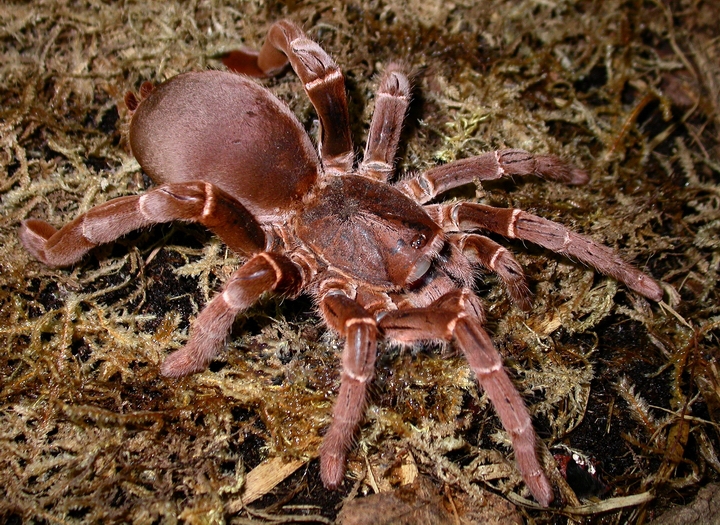 King Baboon SpiderPelinobius muticus
-
 Orange Baboon TarantulaPterinochilus murinus
Compare
Questions and answers
What is the scientific name of the Karwar Burrowing Spider?
The scientific name of the Karwar Burrowing Spider is Thrigmopoeus truculentus. Written with its author, the full name is Thrigmopoeus truculentus Pocock, 1899.
Which family does the Karwar Burrowing Spider belong to?
Thrigmopoeus truculentus belongs to the family Theraphosidae, in the order Araneae and the class Arachnida.
Where is the Karwar Burrowing Spider found?
Checklists and occurrence records place Thrigmopoeus truculentus in 1 country: India.
What is the conservation status of the Karwar Burrowing Spider?
The IUCN Red List category recorded for Thrigmopoeus truculentus is Near Threatened (NT).
What other names does the Karwar Burrowing Spider have?
Thrigmopoeus truculentus is also known in English as Gao Purple, Karwar Large Burrowing Spider and Lesser Goa Mustard Tarantula.
Sources
Passages the profile rests on
- The species' burrow entrances often have a trumpet-bell shape, with rims reinforced by wet mud and spider silk. Source passage: “The entrances of burrows belonging to T. truculentus is often shaped like a trumpet-bell, the rim of which is consolidated with wet mud and spider silk.” — English Wikipedia
- Some individuals construct burrow entrances with a porch-like extension formed by the extended dorsal rim. Source passage: “In some cases a porch like entrance is seen due to the extended dorsal rim of the burrow.” — English Wikipedia
- The species has been recorded on vertical roadside and trekking-path embankments in Coorg and in other locations in Goa, Maharashtra and Karnataka. Source passage: “It has been recorded from vertical bunds along the roads and trek paths in Coorg as well as other locations in Goa, Maharashtra and Karnataka.” — English Wikipedia
- Its burrows have been found between 0.5 and 5 metres above ground in Coorg and Uttara Kannada districts. Source passage: “Burrows of Thrigmopoeus truculentus were found in 0.5-5m height from the ground in Coorg and Uttara Kannada districts.” — English Wikipedia
- The species commonly occupies embankments with dense overhead canopy or locations in ghat areas receiving little direct sunlight. Source passage: “The burrows are found on bunds with high canopy or in the ghat areas were direct sunlight was minimum.” — English Wikipedia
- Burrows without overhead canopy have been observed only rarely. Source passage: “Only very few sightings of burrows without canopy are observed.” — English Wikipedia
- The species reinforces some burrow entrances with nearby twigs and dry leaves to prevent collapse and extend the passage used for entry and exit. Source passage: “Often the burrow entrance is reinforced with adjacent twigs, dry leaves and other such artifacts that prevents it from collapsing, as it also offers an extended passage during entry and exit for the inmate of the burrows.” — English Wikipedia
- The species is threatened by habitat fragmentation, habitat degradation, soil erosion, development activities and pet trade. Source passage: “Thrigmopoeus truculentus is threatened by fragmentation, habitat degradation, soil erosion, developmental activities and pet trade.” — English Wikipedia
- Road widening, tree cutting, soil erosion, tourism and embankment maintenance are identified as causes of habitat degradation affecting the species. Source passage: “Habitat degradation is caused by the widening of roads where T. truculentus build its burrows, cutting of trees, soil erosion, tourism and other such human infleuence and bund maintenance.” — English Wikipedia
- The species was originally assessed as narrowly missing the Vulnerable category in the 2008 IUCN Red List and was subsequently placed in the Near Threatened category. Source passage: “T. truculentus originally barely missed the vulnerable category as listed in the 2008 IUCN Red List of Threatened Animals, However, due to the continuing decline inferred in its area of occupancy, in the quality of habitat and population, T. truculentus has since been put in the Near-threatened species category.” — English Wikipedia
Data
- Catalogue of Life, 2026-10-16 XR cc by
- Global Biodiversity Information Facility CC BY 4.0
- Wikidata CC0
- GeoNames CC BY 4.0
- Wikimedia Commons per image; credit shown with each image
- Within the Catalogue of Life, this name comes from The World Spider Catalog cc by
References
- Pocock, R. I. (1899d). Diagnoses of some new Indian Arachnida. Journal of the Bombay Natural History Society 12(4): 744-753. where the name was published
This species in other databases
Page built on 27 November 2026. See how the catalog is made and all sources and licences.
Cite this page
ScientificNames.org. (2026). Thrigmopoeus truculentus (Karwar Burrowing Spider). Retrieved November 27, 2026, from https://scientificnames.org/species/thrigmopoeus-truculentus
“Thrigmopoeus truculentus (Karwar Burrowing Spider).” ScientificNames.org, 2026, scientificnames.org/species/thrigmopoeus-truculentus. Accessed 27 Nov. 2026.
ScientificNames.org. “Thrigmopoeus truculentus (Karwar Burrowing Spider).” Accessed November 27, 2026. https://scientificnames.org/species/thrigmopoeus-truculentus.
@misc{scientificnames_thrigmopoeus_truculentus_karwar_burrowing_spider,
  author = {{ScientificNames.org}},
  title = {Thrigmopoeus truculentus (Karwar Burrowing Spider)},
  year = {2026},
  url = {https://scientificnames.org/species/thrigmopoeus-truculentus},
  note = {Accessed 2026-11-27}
}