Species · Flowering plants
Largeflower Ground-Daisy Townsendia grandiflora
The scientific name of the Largeflower Ground-Daisy is Townsendia grandiflora. It is a species of flowering plant in the family Asteraceae (composite), order Asterales.
- Scientific name
- Townsendia grandiflora Nutt.
- Common name
- Largeflower Ground-Daisy
- Genus
- Townsendia
- Family
- Asteraceae (Composite)
- Order
- Asterales
- Class
- Magnoliopsida
- Recorded in
- 1 country
- Name status
- accepted in the Catalogue of Life
Overview
Written 27 November 2026 from the sources listed below. Each statement was checked against the passage it cites; statements that could not be supported were removed.
Appearance
Its leaves can be spoon-shaped, oblanceolate, or narrow like grass blades, and attach to both the base and stems. They are usually 2–4 centimeters long and 0.1–0.5 centimeters wide.[1][2][3]
The plant commonly grows between 3 and 15 centimeters tall, although exceptional individuals can reach 30 centimeters or remain as short as 2 centimeters.[4]
Each stem typically bears a single terminal flowering head. The flowering involucre usually measures 10–14 millimeters in diameter.[5][6]
Each flowering head usually contains 20–40 ray flowers with predominantly white petals that may have pink, purple, or violet coloration. The central disk flowers are yellow or greenish-yellow, and each head usually contains 80 to more than 120 disk flowers.[7][8][9][10]
Its seeds have hairy surfaces and a persistent pappus longer than the seed. They measure 3.5 to more than 4 millimeters long.[11][12]
Habitat
The species commonly inhabits dry foothill and mesa slopes, grasslands, and eroded gypsum-bearing shale. It also occurs in somewhat eroded or rocky locations, including hillsides, banks, and mesas.[13][14]
In Nebraska and Wyoming, the species often grows on sandy soils. In Colorado, it often grows on steep clay banks.[15][16]
Reproduction and life cycle
The species flowers in its native habitat from June through August, with occasional flowering continuing into September.[17]
The species is propagated by seed.[18]
Conservation
NatureServe has not evaluated the species since 1988.[19]
Uses
Largeflower Ground-Daisy is cultivated by rock garden enthusiasts for its relatively large daisy-like flowers. It is also cultivated in rock gardens outside its native range.[20][21]
Cultivated plants require well-drained soil. When suitable soil is unavailable, they can be grown in a mixture of equal parts well-composted leaves and sand.[22][23]
In wet climates, the species is grown in troughs to improve control of soil conditions and moisture. Cultivated plants prefer partial sunlight or a west-facing position shaded from the south.[24][25]
Similar species
Townsendia eximia and Townsendia formosa are identified as species closely resembling Largeflower Ground-Daisy.[26][27]
Classification of the Largeflower Ground-Daisy
| Kingdom | Plantae |
|---|---|
| Subkingdom | Pteridobiotina |
| Phylum | Tracheophyta |
| Class | Magnoliopsida |
| Order | Asterales |
| Family | Asteraceae (Composite) |
| Subfamily | Asteroideae |
| Tribe | Astereae |
| Subtribe | Astranthiinae |
| Genus | Townsendia (Townsend Daisy) |
| Species | Townsendia grandiflora Nutt. |
Where the Largeflower Ground-Daisy is found
Checklists and occurrence records place Townsendia grandiflora in 1 country across North America. GBIF holds 896 georeferenced records of it.
Countries
Regions and cities with the most records
- Colorado, United States 441
- Nebraska, United States 82
- Dakota Ridge, United States 74
- Fort Collins, United States 74
- Lakewood, United States 72
- Columbine, United States 66
- Golden, United States 63
- Wheat Ridge, United States 63
- Arvada, United States 61
- Ken Caryl, United States 61
- Loveland, United States 60
- Littleton, United States 56
- Colorado Springs, United States 54
- Englewood, United States 49
- Wyoming, United States 49
- Boulder, United States 48
- Westminster, United States 48
- Security-Widefield, United States 47
- Highlands Ranch, United States 43
- Greenwood Village, United States 38
- New Mexico, United States 36
- Louisville, United States 34
- Broomfield, United States 32
- Lafayette, United States 30
- Denver, United States 27
- Castle Rock, United States 23
- Longmont, United States 21
- Sherrelwood, United States 21
- Fountain, United States 20
- Centennial, United States 18
- Parker, United States 16
- Cheyenne, United States 9
- Northglenn, United States 9
- Thornton, United States 9
- Windsor, United States 9
- South Dakota, United States 7
Range as the checklists state it
USA (Colorado, Nebraska, New Mexico, South Dakota, Wyoming)
A number beside a place is its count of GBIF occurrence records. A place without a number comes from a checklist alone. Records show where a species has been observed or collected, which can include escapes and vagrants.
Common names
English
- Largeflower Ground-Daisy
- Largeflower Townsend Daisy
Names in 1 other language
- Slovak
- astra veľkokvetá
Related species
-
 Hooker's Townsend DaisyTownsendia hookeri
-
 Cushion TownsendiaTownsendia condensata
-
 Stemless Townsend DaisyTownsendia exscapa
-
 Common Townsend DaisyTownsendia leptotes
-
 Tufted Townsend DaisyTownsendia scapigera
-
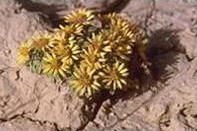 Last Chance Townsend DaisyTownsendia aprica
- Rothrock's Townsend DaisyTownsendia rothrockii
- Showy TownsendiaTownsendia florifera
Compare
Questions and answers
What is the scientific name of the Largeflower Ground-Daisy?
The scientific name of the Largeflower Ground-Daisy is Townsendia grandiflora. Written with its author, the full name is Townsendia grandiflora Nutt..
Which family does the Largeflower Ground-Daisy belong to?
Townsendia grandiflora belongs to the family Asteraceae, in the order Asterales and the class Magnoliopsida.
Where is the Largeflower Ground-Daisy found?
Checklists and occurrence records place Townsendia grandiflora in 1 country: United States.
What other names does the Largeflower Ground-Daisy have?
Townsendia grandiflora is also known in English as Largeflower Townsend Daisy.
Sources
Passages the profile rests on
- Its leaves can be spoon-shaped, oblanceolate, or narrow like grass blades. Source passage: “They may be spoon shaped (spatulate), shaped like a reversed lance head with the wider portion past the midpoint (oblanceolate), or narrow like a blade of grass.” — English Wikipedia
- Its leaves attach to both the base and stems of the plant. Source passage: “The leaves of Townsendia grandiflora attach to both the base and the stems of the plant.” — English Wikipedia
- Its leaves are usually 2–4 centimeters long and 0.1–0.5 centimeters wide. Source passage: “The leaves are usually 2–4 centimeters long (occasionally as long as 9 centimeters) and 0.1–0.5 centimeters wide” — English Wikipedia
- The plant commonly grows between 3 and 15 centimeters tall, although exceptional individuals can reach 30 centimeters or remain as short as 2 centimeters. Source passage: “Townsendia grandiflora is a small herbaceous plant that commonly grows 3–15 centimeters tall, but may be as tall as 30 centimeters or hug the ground at just 2 centimeters in exceptional circumstances.” — English Wikipedia
- Its flowering involucre usually measures 10–14 millimeters in diameter. Source passage: “The bract-covered supporting base of the flowers packed together into the flowering head (the involucre) is a half sphere in shape and usually 10–14 millimeters in diameter” — English Wikipedia
- Each stem typically bears a single terminal flowering head. Source passage: “The flowering heads are located at the end of the stems, with only one on each stem.” — English Wikipedia
- Each flowering head usually contains 20–40 ray flowers with predominantly white petals that may have pink, purple, or violet coloration. Source passage: “The flowering head will have 20 to 40 ray flowers arranged around the edge with the showy petals 7–15 millimeters long” — English Wikipedia
- The ray petals are predominantly white but can show pink, purple, or violet coloration. Source passage: “The ray flowers are predominately white, but will often have a slight pink or purple tint or even be quite violet.” — English Wikipedia
- The central disk flowers are yellow or greenish-yellow. Source passage: “The tightly-packed disk flowers in the center of the flowering head are yellow, but have also been described as greenish-yellow.” — English Wikipedia
- Each flowering head usually contains 80 to more than 120 disk flowers. Source passage: “There are usually 80 to more than 120 disk flowers, but occasionally will be as few as 60.” — English Wikipedia
- Its seeds have hairy surfaces and a persistent pappus longer than the seed. Source passage: “They have a hairy surface and a persistent pappus that is longer than the seed.” — English Wikipedia
- Its seeds measure 3.5 to more than 4 millimeters long. Source passage: “The seeds of Townsendia grandiflora (technically called a cypselae, but often incorrectly called an achene) are 3.5 to more than 4 millimeters long.” — English Wikipedia
- The species commonly inhabits dry foothill and mesa slopes, grasslands, and eroded gypsum-bearing shale. Source passage: “It is commonly found on the dry slopes of foothills and mesas, in grasslands, and on eroded shales that contain gypsum.” — English Wikipedia
- The species occurs in somewhat eroded or rocky locations, including hillsides, banks, and mesas. Source passage: “They are usually found in somewhat eroded or rocky areas such as the sides of hills, banks, and mesas.” — English Wikipedia
- In Nebraska and Wyoming, the species often grows on sandy soils. Source passage: “It often grows on sandy soils in Nebraska and Wyoming” — English Wikipedia
- In Colorado, the species often grows on steep clay banks. Source passage: “or on strongly sloped clay banks in Colorado.” — English Wikipedia
- The species flowers in its native habitat from June through August, with occasional flowering continuing into September. Source passage: “In their native habitat they bloom any time from June through August, with occasional stragglers still flowering in September.” — English Wikipedia
- The species is propagated by seed. Source passage: “Propagation is by seed.” — English Wikipedia
- NatureServe has not evaluated the species since 1988. Source passage: “NatureServe has not evaluated Townsendia grandiflora since 1988.” — English Wikipedia
- Townsendia grandiflora is cultivated by rock garden enthusiasts for its relatively large daisy-like flowers. Source passage: “they are nonetheless grown by rock garden enthusiasts for their relatively large daisy-like flowers.” — English Wikipedia
- The species is cultivated in rock gardens outside its native range. Source passage: “Largeflower ground-daisy is grown in rock gardens, even outside its native range.” — English Wikipedia
- Cultivated plants require well-drained soil. Source passage: “It requires well-drained soil” — English Wikipedia
- The species can be cultivated in a mixture of equal parts well-composted leaves and sand when suitable soil is unavailable. Source passage: “When a suitable soil is not available, they can grow in a mixture of equal parts well-composted leaves and sand.” — English Wikipedia
- In wet climates, the species is grown in troughs to improve control of soil conditions and moisture. Source passage: “and is grown in troughs in wet climates to better control soil conditions and moisture levels.” — English Wikipedia
- Cultivated plants prefer partial sunlight or a west-facing position shaded from the south. Source passage: “They prefer half-sun conditions where they receive direct sun for only part of the day or a west facing position with shade from the south.” — English Wikipedia
- Townsendia eximia is identified as one of the species most closely resembling Townsendia grandiflora. Source passage: “The relatives that most closely resemble Townsendia grandiflora are Townsendia eximia and Townsendia formosa.” — English Wikipedia
- Townsendia formosa is identified as another species closely resembling Townsendia grandiflora. Source passage: “The relatives that most closely resemble Townsendia grandiflora are Townsendia eximia and Townsendia formosa.” — English Wikipedia
Data
- Catalogue of Life, 2026-10-16 XR cc by
- Global Biodiversity Information Facility CC BY 4.0
- Wikidata CC0
- GeoNames CC BY 4.0
- Within the Catalogue of Life, this name comes from Synonymic Checklists of the Vascular Plants of the World cc by
References
- Nutt. (1840). Trans. Amer. Philos. Soc., n. s. 7: 306 (1840). where the name was published
This species in other databases
- Catalogue of Life 57L83
- Wikidata Q15559750
- iNaturalist 169842
- World Flora Online wfo-0000082861
- GRIN 479842
Page built on 29 November 2026. See how the catalog is made and all sources and licences.
Cite this page
ScientificNames.org. (2026). Townsendia grandiflora (Largeflower Ground-Daisy). Retrieved November 29, 2026, from https://scientificnames.org/species/townsendia-grandiflora
“Townsendia grandiflora (Largeflower Ground-Daisy).” ScientificNames.org, 2026, scientificnames.org/species/townsendia-grandiflora. Accessed 29 Nov. 2026.
ScientificNames.org. “Townsendia grandiflora (Largeflower Ground-Daisy).” Accessed November 29, 2026. https://scientificnames.org/species/townsendia-grandiflora.
@misc{scientificnames_townsendia_grandiflora_largeflower_ground_daisy,
  author = {{ScientificNames.org}},
  title = {Townsendia grandiflora (Largeflower Ground-Daisy)},
  year = {2026},
  url = {https://scientificnames.org/species/townsendia-grandiflora},
  note = {Accessed 2026-11-29}
}