Species · Birds
Blyth's Tragopan Tragopan blythii
The scientific name of the Blyth's Tragopan is Tragopan blythii. It is a species of bird in the family Phasianidae (quail), order Galliformes. The name dates from 1870.
- Scientific name
- Tragopan blythii (Jerdon, 1870)
- Common name
- Blyth's Tragopan
- Genus
- Tragopan
- Family
- Phasianidae (Quail)
- Order
- Galliformes
- Class
- Aves
- Red List category
- VU Vulnerable
- Recorded in
- 5 countries
- Name status
- accepted in the Catalogue of Life

Overview
Tragopan blythii occurs in Bhutan, northeastern India, northern Myanmar, southeastern Tibet, and China. It is the largest species in the genus Tragopan.
Written 26 November 2026 from the sources listed below. Each statement was checked against the passage it cites; statements that could not be supported were removed.
Appearance
Adult males have a rusty red head, yellow facial skin, and small white spots on their backs. A black band extends from the base of the bill to the crown, with another band behind the eyes.[1][2]
Males have two pale blue horns that become erect during mating. They also have a brightly colored throat flap that can be expanded during mating season.[3][4]
Females have predominantly dark brown plumage with black, buff, and white mottling.[5]
Habitat
Blyth's Tragopan prefers the undergrowth of evergreen oak and rhododendron forests. It also uses dark and quiet places as habitat.[6][7]
The species occupies higher elevations than most bird species.[8]
Diet
Wild Blyth's Tragopans consume seeds, berries, fruits, and buds. They are primarily vegetarian and show a preference for berries and fruit.[9][10]
Captive Blyth's Tragopans usually eat insects, worms, and small frogs.[11]
Behaviour
Blyth's Tragopans move up and down mountain slopes in search of food. They may descend the slopes when vegetation dries out.[12][13]
The species is not known to travel long distances frequently because of climatic differences between areas. It has been suggested that individuals travel in groups of four to five.[14][15]
Reproduction and life cycle
The mating season begins in April and continues into May. Males use elaborate displays to attract females, including bowing and scraping the ground with slightly raised wings and fully dilated horns.[16][17][18]
After fertilization, a female can lay between two and five eggs. Egg incubation lasts approximately 28 days.[19][20]
Newly hatched offspring resemble adult females. Male offspring develop red neck plumage during their first spring moult and attain full adult plumage during their second year.[21][22][23]
Local accounts from Nagaland describe nests in trees, stumps, and small bushes rather than on the ground. Reported nest heights range from six to twenty feet above the ground.[24][25]
Nests are constructed from sticks and lined with smaller vegetation such as grass or weeds.[26]
Conservation
Blyth's Tragopan is classified as vulnerable in document 1 and is listed as endangered by the United States Fish and Wildlife Service. Its population is estimated at approximately 2,500 to 9,999 birds.[27][28][29]
The species is legally protected in every country where it occurs. Deforestation in northeastern India is identified as a major factor in its population decline.[30][31]
Hunting for food, including snaring and shooting, threatens populations in Nagaland and Arunachal Pradesh. Grazing and slash-and-burn agriculture in Bhutan are significant threats.[32][33]
Habitat fragmentation divides the species into smaller subpopulations.[34]
Uses
Blyth's Tragopan is the state bird of Nagaland.[35]
The common name commemorates English zoologist Edward Blyth, who lived from 1810 to 1873.[36]
Classification of the Blyth's Tragopan
| Kingdom | Animalia |
|---|---|
| Phylum | Chordata |
| Subphylum | Vertebrata |
| Infraphylum | Gnathostomata |
| Parvphylum | Osteichthyes |
| Megaclass | Tetrapoda |
| Class | Aves (Bird) |
| Order | Galliformes (Fowls) |
| Family | Phasianidae (Quail) |
| Genus | Tragopan (Tragopans) |
| Species | Tragopan blythii (Jerdon, 1870) |
Where the Blyth's Tragopan is found
Checklists and occurrence records place Tragopan blythii in 5 countries across Asia. GBIF holds 1,825 georeferenced records of it.
Countries
Regions and cities with the most records
- Arunachal Pradesh, India 324
- Nagaland, India 214
- Kohima, India 141
- Chin State, Myanmar 75
- Mizoram, India 44
- Manipur, India 38
- Lawngtlai, India 25
- Saiha, India 25
- Trashigang District, Bhutan 25
- Zunheboto, India 23
- Serchhīp, India 16
- Assam, India 14
- Kachin State, Myanmar 14
- Kakching, India 12
- Moirāng, India 12
- Kiphire, India 11
- Mon, India 11
- Sagaing Region, Myanmar 11
- Hāflong, India 9
- Tuensang, India 9
- Mayāng Imphāl, India 8
- Yunnan, China 8
- Samdrup Jongkhar, Bhutan 5
- Churāchāndpur, India 4
- Phek, India 4
- Samtse District, Bhutan 4
- Ukhrul, India 4
- Sylhet Division, Bangladesh 3
2 more countries have a few records outside this range
These countries hold a few records of Tragopan blythii but lie outside the range the checklists give for it. Such records are often zoo or garden specimens, museum material or vagrants, so the species is not counted as occurring there.
Range as the checklists state it
Southern Asia
A number beside a place is its count of GBIF occurrence records. A place without a number comes from a checklist alone. Records show where a species has been observed or collected, which can include escapes and vagrants.
Common names
English
- Blyth's Tragopan
- Blyth's Tragopan Pheasant
- Blyth’s Tragopan
- Grey-bellied Tragopan
Names in 29 other languages
- Arabic
- ترجبان بليث, دراج المقرن بليث
- Bengali
- ব্লাইদের ট্রাগোপ্যান
- Chinese
- 灰腹角雉
- Croatian
- crvenoprsi tragopan
- Czech
- satyr Blythův, satyr žlutolící
- Danish
- Nagaland-tragopan, Nagalandtragopan
- Dutch
- Blyths Saterhoen
- Esperanto
- grizventra tragopano
- Estonian
- nagalandi helmesfaasan (nagalandi tragopan)
- Finnish
- burmantragopaani
- French
- Tragopan de Blyth
- German
- Blyth-Tragopan, Blythtragopan
- Hindi
- बाईथ का ट्रैगो
- Hungarian
- fehérhasú tragopán
- Italian
- Tragopan di Blyth
- Japanese
- ミヤマジュケイ
- Korean
- 블라이스주계
- Lithuanian
- Blaito satyras
- Norwegian
- rubinfasan
- Polish
- tragopan żółtolicy
- Portuguese
- tragopana-de-barriga-branca, tragopâ-de-barriga-branca, tragopã-de-barrig-branca, tragopã-de-barriga-branca
- Russian
- Серобрюхий трагопан
- Serbian
- Crvenogrudi tragopan
- Slovak
- tragopan žltolíci
- Spanish
- Tragopán Oriental, Tragopán de Blyth
- Swedish
- gråbukig tragopan
- Turkish
- Sarı Yüzlü Tragopan
- Ukrainian
- трагопан сірогрудий
- Welsh
- ffesant gorniog Blyth
Subspecies and varieties
- Tragopan blythii blythii subspecies
- Tragopan blythii molesworthi subspecies
Related species
-
 Western TragopanTragopan melanocephalus
-
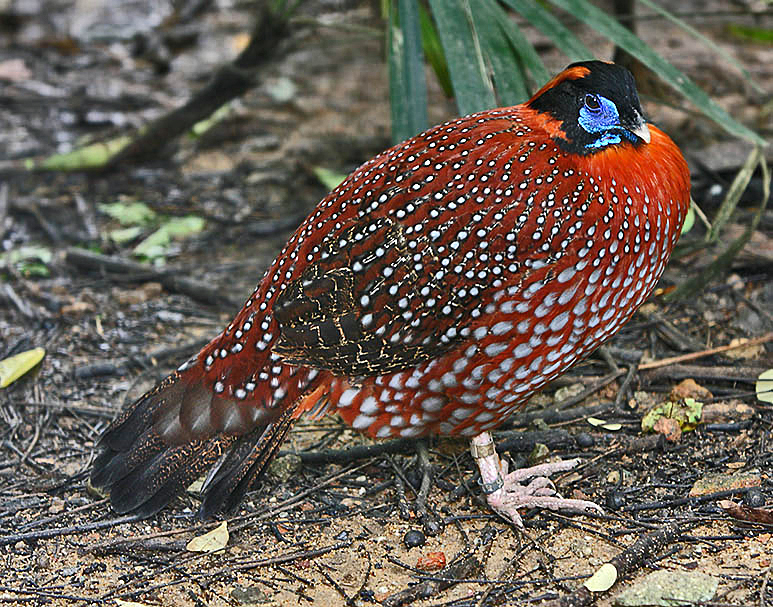 Temminck's TragopanTragopan temminckii
-
 Satyr TragopanTragopan satyra
-
 Cabot's TragopanTragopan caboti
-
 Red JunglefowlGallus gallus
-
 Wild TurkeyMeleagris gallopavo
-
 Indian PeafowlPavo cristatus
-
 Rock PtarmiganLagopus muta
Compare
Questions and answers
What is the scientific name of the Blyth's Tragopan?
The scientific name of the Blyth's Tragopan is Tragopan blythii. Written with its author, the full name is Tragopan blythii (Jerdon, 1870).
Which family does the Blyth's Tragopan belong to?
Tragopan blythii belongs to the family Phasianidae, in the order Galliformes and the class Aves.
Where is the Blyth's Tragopan found?
Checklists and occurrence records place Tragopan blythii in 5 countries: India, Myanmar, Bhutan, China and Bangladesh.
What is the conservation status of the Blyth's Tragopan?
The IUCN Red List category recorded for Tragopan blythii is Vulnerable (VU).
What other names does the Blyth's Tragopan have?
Tragopan blythii is also known in English as Blyth's Tragopan Pheasant, Blyth’s Tragopan and Grey-bellied Tragopan.
What is blyth Tragopan?
Blyth's Tragopan is a bird in the family Phasianidae, order Galliformes, and class Aves. It is the largest species in the genus Tragopan.[37]
Sources
Passages the profile rests on
- Adult males have a rusty red head, yellow facial skin, and small white spots on their backs. Source passage: “It is recognized by its rusty red head, yellow facial skin, and that it is spotted with small white dots on its back called ocelli.” — English Wikipedia
- Adult males have a black band extending from the base of the bill to the crown and another behind the eyes. Source passage: “A black band extends from the base of the bill to the crown coupled with another black band extending behind the eyes.” — English Wikipedia
- Males have two pale blue horns that become erect during mating. Source passage: “males have two pale blue horns that become erect during mating.” — English Wikipedia
- Male birds have a brightly colored throat flap that can be expanded during mating season. Source passage: “Its lappet, a decorated flap, hangs from the throat and is brightly colored. This lappet can be expanded and exposed during mating season as well.” — English Wikipedia
- Females have predominantly dark brown plumage with black, buff, and white mottling. Source passage: “Overall, they are dark brown with a mixture of black, buff and white mottling.” — English Wikipedia
- The species prefers the undergrowth of evergreen oak and rhododendron forests. Source passage: “Tragopan blythii normally flocks to wooded areas as it prefers the undergrowth of evergreen oak and rhododendron forests” — English Wikipedia
- The species also uses dark and quiet places as habitat. Source passage: “and other dark, quiet places.” — English Wikipedia
- Blyth's tragopan occupies higher elevations than most bird species. Source passage: “This bird lives at a higher elevation than most birds.” — English Wikipedia
- Wild Blyth's tragopans consume seeds, berries, fruits, and buds. Source passage: “In the wild, they consume seeds, berries, fruits, and buds.” — English Wikipedia
- Blyth's tragopans are primarily vegetarian and show a preference for berries and fruit. Source passage: “While they are primarily vegetarians, most birds have a predilection for berries and fruit.” — English Wikipedia
- Captive Blyth's tragopans usually eat insects, worms, and small frogs. Source passage: “Captive birds usually consume insects, worms, and even small frogs.” — English Wikipedia
- The species moves up and down mountain slopes in search of food. Source passage: “The bird primarily moves up and down the slopes in search for food.” — English Wikipedia
- Blyth's tragopans may descend mountain slopes when vegetation dries out. Source passage: “In this case, they may move down mountain sides for more comfortable living conditions and a readier food supply.” — English Wikipedia
- The species is not known to travel long distances frequently because of climatic differences between areas. Source passage: “It is, however, uncommon for this species to travel far, due to the change in climate from area to area.” — English Wikipedia
- Blyth's tragopans have been suggested to travel in groups of four to five individuals. Source passage: “it is suggested that they travel together in groups of four to five” — English Wikipedia
- The mating season begins in April and continues into May. Source passage: “Blyth's tragopan starts mating in April and continues well into May.” — English Wikipedia
- Males use elaborate displays to attract females. Source passage: “The males advertise themselves with flamboyant displays to attract females.” — English Wikipedia
- Male courtship displays can include bowing and scraping the ground with slightly raised wings and fully dilated horns. Source passage: “Mating display may involve bowing and scraping the ground with their wings slightly raised and their flesh horns fully dilated” — English Wikipedia
- A female can lay between two and five eggs after fertilization. Source passage: “she can lay up to two to five eggs.” — English Wikipedia
- Egg incubation lasts approximately 28 days. Source passage: “The incubation period for eggs lasts for about twenty-eight days.” — English Wikipedia
- Newly hatched offspring resemble adult females. Source passage: “After hatching, the offspring has a similar appearance to the female hen.” — English Wikipedia
- Male offspring develop red neck plumage during their first spring moult. Source passage: “The male tragopans acquire red on their neck during the first spring moult.” — English Wikipedia
- Males attain full adult plumage during their second year. Source passage: “During the second year of life, full adult plumage is attained in the tragopan.” — English Wikipedia
- Local accounts from Nagaland describe nests in trees, stumps, and small bushes rather than on the ground. Source passage: “the natives of Nagaland have stated that the nests are never on the ground, but are found in trees, stumps, and small bushes.” — English Wikipedia
- Reported nest heights range from six to twenty feet above the ground. Source passage: “The heights range from six to twenty feet above the ground.” — English Wikipedia
- Nests are constructed from sticks and lined with smaller vegetation such as grass or weeds. Source passage: “The nests are made of sticks with a lining of smaller vegetation such as grass or weeds.” — English Wikipedia
- Blyth's tragopan is classified as vulnerable in document 1. Source passage: “Blyth's tragopan (Tragopan blythii) or the grey-bellied tragopan is a pheasant that is a vulnerable species.” — English Wikipedia
- The species is listed as endangered by the United States Fish and Wildlife Service. Source passage: “Blyth's tragopan pheasant (Tragopan blythii) Listing Status: Endangered.” — ecos.fws.gov
- The population is estimated at approximately 2,500 to 9,999 birds. Source passage: “The total population is estimated to be about 2,500 to 9,999 birds.” — English Wikipedia
- The species is legally protected in every country where it occurs. Source passage: “This species is legally protected in all countries in which it is found.” — English Wikipedia
- Deforestation in northeastern India is identified as a major factor in the species' population decline. Source passage: “In north-east India, deforestation is a major factor in the decreasing population of T. blythii” — English Wikipedia
- Hunting for food, including snaring and shooting, threatens populations in Nagaland and Arunachal Pradesh. Source passage: “In Nagaland and Arunachal Pradesh, the pheasant is being hunted for food with large-scale snaring and are also regularly shot with guns and slingshots.” — English Wikipedia
- Grazing and slash-and-burn agriculture in Bhutan are significant threats to the species. Source passage: “High levels of grazing and slash and burn agriculture in Bhutan are also significant threats.” — English Wikipedia
- Habitat fragmentation divides the species into smaller subpopulations. Source passage: “The population of the tragopan is believed to be declining because of these threats which are also dividing up the populations into smaller subpopulations due to fragmentation.” — English Wikipedia
- Blyth's tragopan is the state bird of Nagaland. Source passage: “It is the state bird of Nagaland.” — English Wikipedia
- The common name commemorates English zoologist Edward Blyth, who lived from 1810 to 1873. Source passage: “The common name commemorates Edward Blyth (1810–1873), English zoologist” — English Wikipedia
- Blyth's tragopan is the largest species in the genus Tragopan. Source passage: “Blyth's tragopan pheasant is the largest of the genus Tragopan.” — English Wikipedia
Data
- Catalogue of Life, 2026-10-16 XR cc by
- Global Biodiversity Information Facility CC BY 4.0
- Wikidata CC0
- GeoNames CC BY 4.0
- Wikimedia Commons per image; credit shown with each image
- Within the Catalogue of Life, this name comes from The Integrated Taxonomic Information System cc0
References
- Dickinson, Edward C., ed. (2003). The Howard and Moore Complete Checklist of the Birds of the World, 3rd Edition.
- Gill, Frank, & and Minturn Wright. (2006). Birds of the World: Recommended English Names.
- Dickinson, E. C., and J. V. Remsen Jr., eds. (2013). The Howard and Moore Complete Checklist of the Birds of the World, 4th Edition, Vol. 1 Non-Passerines.
This species in other databases
Page built on 29 November 2026. See how the catalog is made and all sources and licences.
Cite this page
ScientificNames.org. (2026). Tragopan blythii (Blyth's Tragopan). Retrieved November 29, 2026, from https://scientificnames.org/species/tragopan-blythii
“Tragopan blythii (Blyth's Tragopan).” ScientificNames.org, 2026, scientificnames.org/species/tragopan-blythii. Accessed 29 Nov. 2026.
ScientificNames.org. “Tragopan blythii (Blyth's Tragopan).” Accessed November 29, 2026. https://scientificnames.org/species/tragopan-blythii.
@misc{scientificnames_tragopan_blythii_blyths_tragopan,
  author = {{ScientificNames.org}},
  title = {Tragopan blythii (Blyth's Tragopan)},
  year = {2026},
  url = {https://scientificnames.org/species/tragopan-blythii},
  note = {Accessed 2026-11-29}
}