Species · Insects
Heath Ochre Trapezites phigalia
The scientific name of the Heath Ochre is Trapezites phigalia. It is a species of insect in the family Hesperiidae (skipper), order Lepidoptera. The name dates from 1868.
- Scientific name
- Trapezites phigalia (Hewitson, 1868)
- Common name
- Heath Ochre
- Genus
- Trapezites
- Family
- Hesperiidae (Skipper)
- Order
- Lepidoptera
- Class
- Insecta
- Recorded in
- 1 country
- Name status
- accepted in the Catalogue of Life
Overview
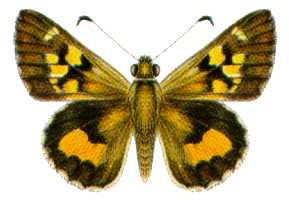
The Heath Ochre (Trapezites phigalia) is a butterfly in the family Hesperiidae, order Lepidoptera and class Insecta. It primarily inhabits eucalypt woodlands, open forests and coastal heathland. Adults are brown with yellow or orange wing markings, including a broad yellow-orange band on each hindwing.
Written 27 November 2026 from the sources listed below. Each statement was checked against the passage it cites; statements that could not be supported were removed.
Appearance
Adult butterflies are brown on their upper surfaces and brownish-grey underneath, with yellow or orange wing markings. Each forewing has a black central area containing three yellow spots, a median yellow spot near the dorsum and a subapical band of three pale spots.[1][2]
Females have larger yellow wing spots than males.[3]
The eggs are cream-coloured and dome-shaped, with approximately 21 longitudinal ribs. They measure approximately 1.2 mm in diameter.[4][5]
The larvae are pinkish-grey and have roughly textured dark brown heads. They can reach 28 mm in length, depending on their instar.[6][7]
The pupae are brown and covered with a waxy grey powder. They measure approximately 19 mm in length.[8][9]
Habitat
The Heath Ochre primarily inhabits eucalypt woodlands, open forests and coastal heathland.[10]
The species is endemic to Australia and occurs in New South Wales, Queensland, South Australia and Victoria.[11]
Diet
Adult butterflies feed readily at flowers.[12]
Behaviour
Adult butterflies fly quickly and close to the ground. Adult males engage in hilltopping and establish territories less than a metre above the ground.[13][14]
Larvae construct vertical shelters from silk and debris at the bases of their host plants. They rest in these shelters during the day and emerge to feed at night.[15][16]
Larvae overwinter inside their shelters.[17]
Reproduction and life cycle
Females lay individual eggs on the undersides of host plant leaves.[18]
Pupation can take place inside the larval shelter or in a curled dead leaf near the host plant's base.[19]
The species produces one generation annually. Adults emerge primarily in October and November.[20][21]
Conservation
The species is recorded as not listed under the Queensland Nature Conservation Act status field.[22]
Classification of the Heath Ochre
| Kingdom | Animalia |
|---|---|
| Phylum | Arthropoda |
| Subphylum | Hexapoda |
| Class | Insecta (Insect) |
| Order | Lepidoptera |
| Superfamily | Papilionoidea |
| Family | Hesperiidae (Skipper) |
| Subfamily | Trapezitinae |
| Genus | Trapezites (Ochres) |
| Species | Trapezites phigalia (Hewitson, 1868) |
Where the Heath Ochre is found
Checklists and occurrence records place Trapezites phigalia in 1 country. GBIF holds 1,149 georeferenced records of it.
Countries
Regions and cities with the most records
- Victoria, Australia 429
- New South Wales, Australia 365
- Balwyn North, Australia 178
- Burwood, Australia 177
- Queensland, Australia 144
- Canberra, Australia 114
- Australian Capital Territory, Australia 111
- Tuggeranong, Australia 110
- Hornsby, Australia 85
- Sydney, Australia 74
- Adelaide Hills, Australia 63
- South Australia, Australia 63
- Adelaide, Australia 62
- Parramatta, Australia 52
- Mount Barker, Australia 51
- Central Coast, Australia 28
- Warragul, Australia 26
- Melbourne, Australia 24
- Bendigo, Australia 16
- Liverpool, Australia 16
- Newcastle, Australia 12
- Grafton, Australia 11
- Geelong, Australia 9
- Torquay, Australia 9
- Frankston East, Australia 7
- Bathurst, Australia 6
- Logan City, Australia 6
- Traralgon, Australia 6
- Ballarat, Australia 3
- Toowoomba, Australia 3
A number beside a place is its count of GBIF occurrence records. A place without a number comes from a checklist alone. Records show where a species has been observed or collected, which can include escapes and vagrants.
Common names
English
- Heath Ochre
Synonyms
4 other scientific names have been used for this species and are now treated as synonyms of Trapezites phigalia.
- Hesperia phigalia Hewitson, 1868
- Telesto phlaea Plötz, 1884
- Trapezites phila Waterhouse, 1937
- Trapezites phillyra Miskin, 1889
Related species
-
 Splendid OchreTrapezites symmomus
- Southern Silver OchreTrapezites praxedes
-
 Eliena SkipperTrapezites eliena
-
 Small Orange OchreTrapezites heteromacula
-
 Northern Silver OchreTrapezites maheta
-
 Brown OchreTrapezites iacchus
-
 Silver-studded OchreTrapezites iacchoides
-
 Black-ringed OchreTrapezites petalia
Compare
Questions and answers
What is the scientific name of the Heath Ochre?
The scientific name of the Heath Ochre is Trapezites phigalia. Written with its author, the full name is Trapezites phigalia (Hewitson, 1868).
Which family does the Heath Ochre belong to?
Trapezites phigalia belongs to the family Hesperiidae, in the order Lepidoptera and the class Insecta.
Where is the Heath Ochre found?
Checklists and occurrence records place Trapezites phigalia in 1 country: Australia.
What is another name for the Heath Ochre?
It is also known as the phigalia skipper.[23]
Where does the Heath Ochre occur?
It is endemic to Australia and occurs in New South Wales, Queensland, South Australia and Victoria.[11]
When do adult Heath Ochres emerge?
Adults emerge primarily in October and November.[21]
How many generations does the species produce each year?
The species produces one generation annually.[20]
Sources
Passages the profile rests on
- Adult butterflies are brown on their upper surfaces and brownish-grey underneath, with yellow or orange wing markings. Source passage: “Trapezites phigalia adults are brown above and brownish-grey below with yellow or orange markings on the wings” — English Wikipedia
- Each forewing has a black central area containing three yellow spots, a median yellow spot near the dorsum, and a subapical band of three pale spots. Source passage: “the forewings each exhibit a black central area containing three yellow spots, a median yellow spot near the dorsum, and a subapical band of three pale spots” — English Wikipedia
- Females have larger yellow wing spots than males. Source passage: “the yellow spots on the wings are larger on females.” — English Wikipedia
- The eggs are cream-coloured and dome-shaped, with approximately 21 longitudinal ribs. Source passage: “Eggs are dome shaped, cream in colour, measuring approximately 1.2 mm (0.047 in) in diameter with approximately 21 longitudinal ribs.” — English Wikipedia
- The eggs measure approximately 1.2 mm in diameter. Source passage: “measuring approximately 1.2 mm (0.047 in) in diameter” — English Wikipedia
- The larvae are pinkish-grey and have roughly textured dark brown heads. Source passage: “Larvae are pinkish-grey with a roughly-textured dark brown head” — English Wikipedia
- Larvae can reach 28 mm in length, depending on their instar. Source passage: “measuring up to 28 mm (1.1 in) in length depending on instar.” — English Wikipedia
- The pupae are brown and covered with a waxy grey powder. Source passage: “Pupae are brown, covered with a waxy grey powder” — English Wikipedia
- The pupae measure approximately 19 mm in length. Source passage: “measuring approximately 19 mm (0.75 in) in length.” — English Wikipedia
- The species primarily inhabits eucalypt woodlands, open forests and coastal heathland. Source passage: “It is primarily found in eucalypt woodlands, open forests, and coastal healthland habitats.” — English Wikipedia
- The species is endemic to Australia and occurs in New South Wales, Queensland, South Australia and Victoria. Source passage: “It is endemic to Australia, where it occurs in New South Wales, Queensland, South Australia and Victoria.” — English Wikipedia
- Adult butterflies feed readily at flowers. Source passage: “readily feeding at flowers.” — English Wikipedia
- Adult butterflies fly quickly and close to the ground. Source passage: “Adults fly fast and close to the ground” — English Wikipedia
- Adult males engage in hilltopping and establish territories less than a metre above the ground. Source passage: “Adult males engage in hilltopping and establish territories within a meter of the ground.” — English Wikipedia
- Larvae construct vertical shelters from silk and debris at the bases of their host plants. Source passage: “the larvae construct a vertical shelter from silk and debris at the base of the host plant” — English Wikipedia
- Larvae rest in their shelters during the day and emerge to feed at night. Source passage: “resting in their shelter during the day and emerging to feed at night.” — English Wikipedia
- Larvae overwinter inside their shelters. Source passage: “Larvae overwinter inside their larval shelters.” — English Wikipedia
- Females lay individual eggs on the undersides of host plant leaves. Source passage: “Adult females lay their eggs singly on the undersides of the leaves of the species' host plants” — English Wikipedia
- Pupation can take place inside the larval shelter or in a curled dead leaf near the host plant's base. Source passage: “Pupation may occur inside the larval shelter or in a curled dead leaf near the base of the host plant.” — English Wikipedia
- The species produces one generation annually. Source passage: “There is a single generation each year” — English Wikipedia
- Adults emerge primarily in October and November. Source passage: “with adults emerging primarily in October and November.” — English Wikipedia
- The species is recorded as not listed under the Queensland Nature Conservation Act status field. Source passage: “NCA Status:Not listed.” — wildnet.science-data.qld.gov.au
- The species is also known as the phigalia skipper. Source passage: “commonly known as the heath ochre or phigalia skipper” — English Wikipedia
Data
- Catalogue of Life, 2026-10-16 XR cc by
- Global Biodiversity Information Facility CC BY 4.0
- Wikidata CC0
- GeoNames CC BY 4.0
- Wikimedia Commons per image; credit shown with each image
- Within the Catalogue of Life, this name comes from Global Lepidoptera Index cc by
References
- Hewitson, W. C. (1868). Descriptions of one hundred new species of Hesperidae. Part II. 2, 25–56. https://www.biodiversitylibrary.org/page/59683470 Link where the name was published
This species in other databases
Page built on 28 November 2026. See how the catalog is made and all sources and licences.
Cite this page
ScientificNames.org. (2026). Trapezites phigalia (Heath Ochre). Retrieved November 28, 2026, from https://scientificnames.org/species/trapezites-phigalia
“Trapezites phigalia (Heath Ochre).” ScientificNames.org, 2026, scientificnames.org/species/trapezites-phigalia. Accessed 28 Nov. 2026.
ScientificNames.org. “Trapezites phigalia (Heath Ochre).” Accessed November 28, 2026. https://scientificnames.org/species/trapezites-phigalia.
@misc{scientificnames_trapezites_phigalia_heath_ochre,
  author = {{ScientificNames.org}},
  title = {Trapezites phigalia (Heath Ochre)},
  year = {2026},
  url = {https://scientificnames.org/species/trapezites-phigalia},
  note = {Accessed 2026-11-28}
}