Species · Insects
Confused Flour Beetle Tribolium confusum
The scientific name of the Confused Flour Beetle is Tribolium confusum. It is a species of insect in the family Tenebrionidae (darkling beetle), order Coleoptera. The name dates from 1868.
- Scientific name
- Tribolium confusum Jaquelin Du Val, 1868
- Common name
- Confused Flour Beetle
- Genus
- Tribolium
- Family
- Tenebrionidae (Darkling Beetle)
- Order
- Coleoptera
- Class
- Insecta
- Environment
- terrestrial
- Recorded in
- 21 countries
- Name status
- accepted in the Catalogue of Life

Overview
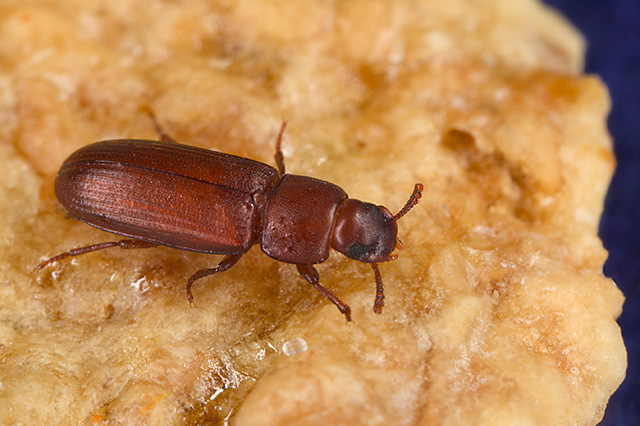
The Confused Flour Beetle is a serious pest of stored grain and grain products. The species commonly inhabits flour mills, bakeries, and warehouses, and occurs in stored grain supplies. Adults are reddish-brown and measure approximately 3–6 mm in length.
Written 26 November 2026 from the sources listed below. Each statement was checked against the passage it cites; statements that could not be supported were removed.
Appearance
Adults measure approximately 3–6 mm in length, with another recorded measurement of approximately 3.5 mm.[1][2]
Larvae are light honey-colored, with a slightly darkened head and a forked abdominal tip. They are approximately 6 mm long.[3][4]
Eggs are white or colorless and covered with sticky material.[5]
Habitat
The species commonly inhabits flour mills, bakeries, and warehouses. Adults and other life stages occur in stored grain supplies, and the species is associated with flour and other stored food products.[6][7][8]
The ancestral habitat of the species is considered to have included rotting logs and spaces beneath tree bark.[9]
Diet
The beetle feeds on broken grain and cannot feed on whole, undamaged grain. Recorded food items include flour, rice, dried fruit, nuts, and beans.[10][11]
The species has been observed feeding on cracked barley but cannot feed and develop on cracked white rice.[12][13]
Larvae feed on flour and processed grains such as cornmeal. The species has also been reared on wheat flour containing 5% dry brewer's yeast.[14][15]
A mixture of wheat bran, endosperm, and germ in equal proportions supports greater growth than any of these dietary components individually.[16]
In woody habitats, the species is associated with feeding on plant and animal detritus and insect eggs and pupae.[17]
Behaviour
Adults and larvae commonly cannibalize eggs. Adults have also been observed cannibalizing pupae and larvae, but do not cannibalize other adults.[18][19][20]
Females cannibalize more frequently than males.[21]
The species exhibits kin selection, with sibling-reared larvae developing fully an average of 2.2 days earlier than larvae reared in unrelated groups.[22]
Adults are not known to fly. When agitated or crowded, beetles may secrete quinines.[23][24]
The species is attracted to the odors of five tested wood species. These odors were more attractive to the beetles than odors from their usual food.[25][26]
The species is attracted to synthetic mellein.[27]
Reproduction and life cycle
Females can lay approximately 200–500 eggs during their lifetime and have an average fecundity of 400–500 eggs. They may continue laying eggs for more than a year.[28][29][30]
Eggs are deposited directly in flour or other food material, or attached to container surfaces. They hatch within 3–5 days at temperatures of 32–35°C.[31][32]
The average egg-to-adult development period is 26 days at 32–35°C and relative humidity above 70%.[33]
Larvae undergo between five and eleven instars, with seven or eight being usual.[34]
The minimum developmental temperature is approximately 20–22°C. The maximum developmental temperature is approximately 37.5–40°C under either low or high relative humidity.[35][36]
Adults can live for approximately three years and may live longer than three years.[37][38]
Classification of the Confused Flour Beetle
| Kingdom | Animalia |
|---|---|
| Phylum | Arthropoda |
| Subphylum | Hexapoda |
| Class | Insecta (Insect) |
| Order | Coleoptera (Beetle) |
| Suborder | Polyphaga |
| Series | Cucujiformia |
| Superfamily | Tenebrionoidea |
| Family | Tenebrionidae (Darkling Beetle) |
| Subfamily | Tenebrioninae |
| Tribe | Triboliini |
| Genus | Tribolium (Flour Beetles) |
| Species | Tribolium confusum Jaquelin Du Val, 1868 |
This name was added to the Catalogue of Life from a contributing dataset by automated merging and has not yet been reviewed by its editors.
Where the Confused Flour Beetle is found
Checklists and occurrence records place Tribolium confusum in 21 countries. GBIF holds 1,829 georeferenced records of it.
Countries
- Australia 141
- Austria 14
- Canada 33
- Denmark 21
- Estonia 32
- Finland 54
- France 18
- Germany 36
- Luxembourg 4
- New Caledonia 3
- New Zealand 17
- Norway 71
- Poland 114
- Romania 7
- Spain 8
- Sweden 42
- Switzerland 156
- The Netherlands 70
- Ukraine 7
- United Kingdom 130
- United States 851
Regions and cities with the most records
- New South Wales, Australia 104
- Arizona, United States 82
- Kentucky, United States 79
- Lexington, United States 70
- Lexington-Fayette, United States 70
- Colorado, United States 54
- Utah, United States 53
- Georgetown, United States 49
- Nicholasville, United States 49
- Sydney, Australia 42
- Allschwil, Switzerland 39
- Basel, Switzerland 39
- Casas Adobes, United States 39
- Catalina Foothills, United States 39
- Drexel Heights, United States 39
- Flowing Wells, United States 39
- Lörrach, Germany 39
- Muttenz, Switzerland 39
- Oro Valley, United States 39
- Reinach, Switzerland 39
- Rheinfelden, Germany 39
- Riehen, Switzerland 39
- Saint-Louis, France 39
- Tanque Verde, United States 39
- Tucson, United States 39
- Weil am Rhein, Germany 39
- Iowa, United States 38
- Schopfheim, Germany 38
- England, United Kingdom 37
- Ames, United States 35
- Geneva, Switzerland 34
- Illinois, United States 34
- Bern, Switzerland 33
- Elmwood Park, United States 33
- Grand Junction, United States 32
- Kansas, United States 32
9 more countries have a few records outside this range
These countries hold a few records of Tribolium confusum but lie outside the range the checklists give for it. Such records are often zoo or garden specimens, museum material or vagrants, so the species is not counted as occurring there.
A number beside a place is its count of GBIF occurrence records. A place without a number comes from a checklist alone. Records show where a species has been observed or collected, which can include escapes and vagrants.
Common names
English
- Confused Flour Beetle
Names in 21 other languages
- Afrikaans
- Malkopmeelkewer
- Arabic
- خنفساء الدقيق المتشابهة, خنفساء الطحين الفوضوية, خنفساء الطحين المشوشة
- Chinese
- 扁拟谷盗, 扁擬榖盜, 拟谷盗, 杂拟粉甲, 杂拟谷盗
- Croatian
- mali brašnar
- Czech
- potemník skladištní
- Danish
- Amerikansk rismelbille, Lille melskrubbe
- Dutch
- Bruine zwartlijf, Gewelfde bruine zwartlijf, Gewone rijstmeelkever, Kleine meeltor, Rijstmeelkever
- Estonian
- Ruuge-jahumardikas
- Finnish
- hinkalokuoriainen
- French
- tribolium brun de la farine
- German
- Amerikanischer Reismehlkäfer
- Icelandic
- Sterkjubjalla
- Japanese
- ヒラタコクヌストモドキ
- Korean
- 어리쌀도둑거저리
- Norwegian Bokmål
- rismelbille
- Polish
- trojszyk ulec
- Russian
- Малый мучной хрущак, Хрущак мучной малый
- Slovak
- potemník skladový
- Swedish
- rismjölbagge
- Turkish
- Kırma Biti
- Ukrainian
- Хрущак малий
Related species
-
 Red Flour BeetleTribolium castaneum
-
 Destructive Flour BeetleTribolium destructor
-
 Black Flour BeetleTribolium madens
- Tribolium namibiensis
- Tribolium ferrugineum
- Tribolium anaphe
- Tribolium arndti
- Tribolium bremeri
Compare
Questions and answers
What is the scientific name of the Confused Flour Beetle?
The scientific name of the Confused Flour Beetle is Tribolium confusum. Written with its author, the full name is Tribolium confusum Jaquelin Du Val, 1868.
Which family does the Confused Flour Beetle belong to?
Tribolium confusum belongs to the family Tenebrionidae, in the order Coleoptera and the class Insecta.
Where is the Confused Flour Beetle found?
Checklists and occurrence records place Tribolium confusum in 21 countries, including United States, Switzerland, Australia, United Kingdom, Poland and Norway.
Sources
Passages the profile rests on
- Adults measure approximately 3–6 mm in length. Source passage: “Both the confused flour beetle and red flour beetle are small, about 3–6 mm (1⁄8–1⁄4 in) in length” — English Wikipedia
- Adults measure approximately 3.5 mm in length. Source passage: “Adult beetles are approximately 3.5 mm (1/7”).” — extension.entm.purdue.edu
- Larvae are light honey-colored and have a slightly darkened head and forked abdominal tip. Source passage: “They are a light honey color and about 6 mm (1/4”) long. The head and a distinctive forked process at the tip of the abdomen are slightly darkened.” — extension.entm.purdue.edu
- Larvae are approximately 6 mm long. Source passage: “They are a light honey color and about 6 mm (1/4”) long.” — extension.entm.purdue.edu
- Eggs are white or colorless and covered with sticky material. Source passage: “They are white or colorless and covered by a sticky material to which flour can adhere.” — extension.entm.purdue.edu
- The species commonly inhabits flour mills, bakeries, and warehouses. Source passage: “The confused flour beetle is typically found in mills, bakeries, and warehouses, feeding on cereal grains.” — English Wikipedia
- Adults and other life stages occur in stored grain supplies. Source passage: “The beetle can be found in grain supplies at any stage of its life.” — English Wikipedia
- The species is associated with flour and other stored food products. Source passage: “Flour beetles can be found infesting a variety of grain and food materials.” — extension.entm.purdue.edu
- The ancestral habitat of the species is considered to have included rotting logs and spaces beneath tree bark. Source passage: “It is considered that Tribolium have originally occurred primarily in rotting logs and under tree bark” — pmc.ncbi.nlm.nih.gov
- The beetle feeds on broken grain and cannot feed on whole, undamaged grain. Source passage: “While confused (and red) flour beetles cannot feed on whole, undamaged grain, they are often found in large numbers in infested grains, feeding on broken grain, grain dust” — English Wikipedia
- Its recorded food items include flour, rice, dried fruit, nuts, and beans. Source passage: “other household food items such as flour, rice, dried fruit, nuts, and beans.” — English Wikipedia
- The species has been observed feeding on cracked barley. Source passage: “it has been observed to feed on cracked barley” — English Wikipedia
- The species cannot feed and develop on cracked white rice. Source passage: “while being unable to feed and develop from cracked white rice sources.” — English Wikipedia
- Larvae feed on flour and processed grains such as cornmeal. Source passage: “Larvae typically feed on flour and processed grain such as cornmeal and flour.” — English Wikipedia
- The species has been reared on wheat flour containing 5% dry brewer's yeast. Source passage: “They were reared on wheat flour (‘Yukichikara’; Sugawara Seifun Seimen Kojo, Iwate, Japan) containing 5% dry brewer’s yeast” — pmc.ncbi.nlm.nih.gov
- A mixture of wheat bran, endosperm, and germ in equal proportions supports greater growth than any of these dietary components individually. Source passage: “the beetle displays the best amount of growth from a mixed diet of wheat bran, endosperm, and germ in equal proportions as opposed to any of the diets individually.” — English Wikipedia
- The species is associated with feeding on plant and animal detritus and insect eggs and pupae in woody habitats. Source passage: “feeding on plant and animal detritus, and on insect eggs and pupae” — pmc.ncbi.nlm.nih.gov
- Adults and larvae commonly cannibalize eggs. Source passage: “Adults and larvae cannibalizing on eggs are the most common behavior” — English Wikipedia
- Adults have also been observed cannibalizing pupae and larvae. Source passage: “adults cannibalizing pupae and larvae have also been seen.” — English Wikipedia
- Adult beetles do not cannibalize other adults. Source passage: “However, adults do not cannibalize other adults.” — English Wikipedia
- Females cannibalize more frequently than males. Source passage: “Females beetles have also been shown to cannibalize more often than males.” — English Wikipedia
- The species exhibits kin selection, with sibling-reared larvae developing fully an average of 2.2 days earlier than larvae reared in unrelated groups. Source passage: “siblings will rear the larvae, causing them to become fully developed on average 2.2 days earlier than larvae reared in unrelated groups.” — English Wikipedia
- Adults are not known to fly. Source passage: “Adults of both species have well developed wings, but only the red flour beetle has been observed to fly” — extension.entm.purdue.edu
- When agitated or crowded, beetles may secrete quinines. Source passage: “When agitated or crowded, they may secrete chemicals called quinines.” — extension.entm.purdue.edu
- The species is attracted to the odors of five tested wood species. Source passage: “The beetles were strongly attracted to all wood odours tested: Castanea crenata, Magnolia obovata, Paulownia tomentosa, Prunus jamasakura, and Zelkova serrata.” — pmc.ncbi.nlm.nih.gov
- The tested wood odors were more attractive to the beetles than odors from their usual food. Source passage: “The attractiveness of these wood odours was also stronger than that of the odours of the usual food of these beetles.” — pmc.ncbi.nlm.nih.gov
- The species is attracted to synthetic mellein. Source passage: “Synthetic (±)-mellein attracted the beetles.” — pmc.ncbi.nlm.nih.gov
- Females can lay approximately 200–500 eggs during their lifetime. Source passage: “Female confused flour beetles are capable of laying 200–500 eggs during their life span.” — English Wikipedia
- Females have an average fecundity of 400–500 eggs. Source passage: “Average fecundity is 400-500 eggs per female” — extension.entm.purdue.edu
- Females may continue laying eggs for more than a year. Source passage: “females may lay eggs for more than a year.” — extension.entm.purdue.edu
- Eggs are deposited directly in flour or other food material, or attached to container surfaces. Source passage: “Eggs are deposited directly in flour, other food material, or attached to the surface of the container.” — extension.entm.purdue.edu
- Eggs hatch within 3–5 days at temperatures of 32–35°C. Source passage: “Eggs hatch in 3-5 days at 32-35˚C (89.6-95˚F).” — extension.entm.purdue.edu
- The average egg-to-adult development period is 26 days at 32–35°C and relative humidity above 70%. Source passage: “the average is 26 days at 32-35˚C (89.6-95˚F) and >70% Rh.” — extension.entm.purdue.edu
- Larvae undergo between five and eleven instars, with seven or eight being usual. Source passage: “There at 5-11 larval instars (7-8 is usual)” — extension.entm.purdue.edu
- The species has a minimum developmental temperature of approximately 20–22°C. Source passage: “The minimum temperature for development is between 20-22˚C (69-71.6˚F)” — extension.entm.purdue.edu
- The maximum developmental temperature is approximately 37.5–40°C under either low or high relative humidity. Source passage: “the maximum 37.5-40˚C (99.5-104˚F) when the relative humidity is either low (10-30%) or high (90%).” — extension.entm.purdue.edu
- Adults can live for approximately three years. Source passage: “adults can live for three years.” — English Wikipedia
- Adults may live longer than three years. Source passage: “Adults may live longer than 3 years” — extension.entm.purdue.edu
- The species is a serious pest of stored grain and grain products. Source passage: “The confused flour beetle, T. confusum (Coleoptera: Tenebrionidae) is a worldwide serious insect pest of stored grains and their products” — pmc.ncbi.nlm.nih.gov
- Its secretions can cause skin irritation and respiratory disorders. Source passage: “the beetle produces secretions that can cause skin irritation and respiratory disorders.” — English Wikipedia
Data
- Catalogue of Life, 2026-10-16 XR cc by
- Global Biodiversity Information Facility CC BY 4.0
- Wikidata CC0
- GeoNames CC BY 4.0
- Wikimedia Commons per image; credit shown with each image
- Within the Catalogue of Life, this name comes from World Register of Marine Species cc by
References
- Cat. Fam. Ten. 181. 1862 where the name was published
This species in other databases
- Catalogue of Life TLNGL
- Wikidata Q4501895
- iNaturalist 232866
- WoRMS urn:lsid:marinespecies.org:taxname:1489843
- ITIS 187247
- NCBI Taxonomy txid7071
Page built on 29 November 2026. See how the catalog is made and all sources and licences.
Cite this page
ScientificNames.org. (2026). Tribolium confusum (Confused Flour Beetle). Retrieved November 29, 2026, from https://scientificnames.org/species/tribolium-confusum
“Tribolium confusum (Confused Flour Beetle).” ScientificNames.org, 2026, scientificnames.org/species/tribolium-confusum. Accessed 29 Nov. 2026.
ScientificNames.org. “Tribolium confusum (Confused Flour Beetle).” Accessed November 29, 2026. https://scientificnames.org/species/tribolium-confusum.
@misc{scientificnames_tribolium_confusum_confused_flour_beetle,
  author = {{ScientificNames.org}},
  title = {Tribolium confusum (Confused Flour Beetle)},
  year = {2026},
  url = {https://scientificnames.org/species/tribolium-confusum},
  note = {Accessed 2026-11-29}
}