Species · Flowering plants
Einkorn Triticum monococcum
The scientific name of the Einkorn is Triticum monococcum. It is a species of flowering plant in the family Poaceae (turf), order Poales.
- Scientific name
- Triticum monococcum L.
- Common name
- Einkorn
- Genus
- Triticum
- Family
- Poaceae (Turf)
- Order
- Poales
- Class
- Liliopsida
- Red List category
- LC Least Concern
- Recorded in
- 49 countries
- Name status
- accepted in the Catalogue of Life
Overview
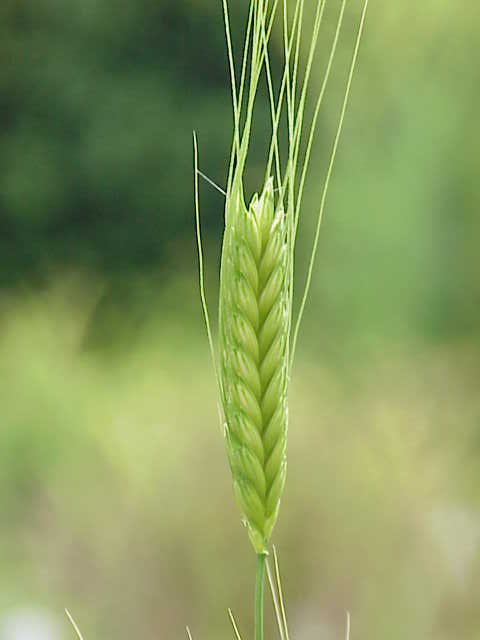
Einkorn (Triticum monococcum L.) is a diploid, non-hybrid wheat with 14 chromosomes and was among the earliest forms of wheat cultivated by humans. Wild Einkorn commonly grows in hill country in the northern Fertile Crescent and Anatolia. Domesticated Einkorn is a hulled wheat with tough glumes that tightly enclose its grains, and its ripe seed head remains intact.
Written 26 November 2026 from the sources listed below. Each statement was checked against the passage it cites; statements that could not be supported were removed.
Similar species
Einkorn is a diploid wheat with 14 chromosomes and is not a hybrid wheat.[1][2]
Appearance
Domesticated Einkorn is a covered wheat with tough glumes that tightly enclose its grains, which remain enclosed after threshing. Its kernels are slightly larger than those of wild Einkorn.[3][4][5]
The cultivated form retains its seed head intact when ripe. Einkorn dough has a bright yellow colour associated with its high carotenoid levels.[6][7]
Wild Einkorn usually grows to less than 70 centimetres in height.[8]
Habitat
Einkorn commonly grows wild in hill country in the northern Fertile Crescent and Anatolia. It can survive in poor, dry and marginal soils that other wheat varieties cannot tolerate.[9][10]
Behaviour
Wild Einkorn typically disperses its seeds when its seed head shatters and releases the kernels onto the ground. Domesticated Einkorn retains its seed head intact rather than naturally scattering its kernels.[11][12]
Reproduction and life cycle
Einkorn is largely self-pollinating. Domesticated Einkorn depends on human planting and harvesting for its continued existence.[13][14]
Uses
Einkorn is commonly consumed as food in northern Provence, France. It is used to make bulgur and as animal feed in mountainous areas of France, India, Italy, Morocco, the former Yugoslavia and Turkey.[15][16]
Historically, Einkorn was primarily consumed boiled as whole grains or as porridge rather than being used for breadmaking. Its dough produces dense loaves because it retains relatively little gas.[17][18]
Einkorn dough requires approximately 10–15 minutes more baking time than comparable bread wheat doughs. Some Einkorn varieties demonstrated favourable baking performance compared with bread wheats during testing in the 1990s.[19][20]
Einkorn contains gluten and is unsuitable for people with gluten-related disorders. It has a higher percentage of protein than modern red wheats.[21][22]
Einkorn is a source of the Sr21 stem rust resistance gene used in hexaploid wheat and the Yr34 yellow rust resistance gene. Its salt-tolerance characteristic has been incorporated into durum wheat through breeding.[23][24][25]
Classification of the Einkorn
| Kingdom | Plantae |
|---|---|
| Subkingdom | Pteridobiotina |
| Phylum | Tracheophyta |
| Class | Liliopsida |
| Order | Poales |
| Family | Poaceae (Turf) |
| Genus | Triticum (Wheat) |
| Species | Triticum monococcum L. |
Where the Einkorn is found
Checklists and occurrence records place Triticum monococcum in 49 countries across Africa, Asia and Europe. GBIF holds 12,545 georeferenced records of it.
Countries where it is native or its origin is not stated
- Afghanistan 750
- Albania 235
- Armenia 649
- Austria 84
- Azerbaijan 118
- Belarus 3
- Belgium 63
- Bosnia and Herzegovina 4
- Bulgaria 168
- China 7
- Czechia 27
- Denmark 29
- Georgia 54
- Greece 201
- Hungary 61
- India 10
- Israel 9
- Italy 88
- Japan 18
- Jordan 6
- Kosovo 23
- Kuwait 3
- Lebanon 111
- Luxembourg 4
- Montenegro 17
- North Macedonia 8
- Poland 31
- Portugal 12
- Serbia 61
- Sweden 40
- Switzerland 128
- Syria 133
- Tajikistan 5
- The Netherlands 6
- United States 535
Countries where it has been introduced
- Algeria 2
- Ethiopia 9
- France 421
- Germany 496
- Iran 543
- Iraq 2,138
- Morocco 91
- Romania 202
- Russia 89
- Spain 271
- Turkey 4,343
- Ukraine 136
- United Kingdom 100
- Zimbabwe 3
Regions and cities with the most records
- Şanlıurfa, Turkey 558
- Erbil, Iraq 524
- Shaqlāwah, Iraq 522
- Pīrmām, Iraq 521
- Baḥarkah, Iraq 330
- California, United States 251
- Bloomington, United States 205
- Colton, United States 205
- Fontana, United States 205
- Glen Avon, United States 205
- Jurupa Valley, United States 205
- Loma Linda, United States 205
- Mead Valley, United States 205
- Moreno Valley, United States 205
- Redlands, United States 205
- Rialto, United States 205
- Riverside, United States 205
- Rubidoux, United States 205
- San Bernardino, United States 205
- Ḩarir, Iraq 191
- Mardin, Turkey 159
- Hauts-de-France, France 157
- Amiens, France 155
- Viranşehir, Turkey 138
- Kermanshah Province, Iran 113
- Dihok, Iraq 95
- Hilvan, Turkey 94
- Simele, Iraq 92
- Sumayl, Iraq 92
- Sīnah, Iraq 90
- Gaziantep, Turkey 89
- Kayseri, Turkey 89
- Abovyan, Armenia 76
- Sulaymaniyah, Iraq 73
- Yerevan, Armenia 72
- Balaklava, Ukraine 71
6 more countries have a few records outside this range
These countries hold a few records of Triticum monococcum but lie outside the range the checklists give for it. Such records are often zoo or garden specimens, museum material or vagrants, so the species is not counted as occurring there.
A number beside a place is its count of GBIF occurrence records. A place without a number comes from a checklist alone. Records show where a species has been observed or collected, which can include escapes and vagrants.
Common names
English
- Einkorn
- Einkorn Wheat
Names in 17 other languages
- Arabic
- قمح وحيد الحبة
- Chinese
- 一粒小麥
- Czech
- pšenice jednozrnka
- Dutch
- Eenkoren
- Finnish
- Yksijyvävehnä
- French
- Engrain
- Hungarian
- Alakor
- Italian
- Farro piccolo, Piccolo farro
- Japanese
- ヒトツブコムギ
- Lithuanian
- Vienagrūdis kvietys
- Norwegian Bokmål
- enkorn
- Polish
- Pszenica samopsza
- Russian
- Пшеница однозернянка
- Slovak
- pšenica jednozrnová
- Spanish
- Escaña Menor
- Swedish
- enkornsvete
- Turkish
- Kaplıca buğdayı, Siyez (Kaplıca) Buğdayı
Synonyms
11 other scientific names have been used for this species and are now treated as synonyms of Triticum monococcum.
- Aegilops monococca (L.) D.L.Fu
- Crithodium monococcum (L.) Á.Löve
- Nivieria monococca (L.) Ser.
- Triticum aestivum var. monococcum (L.) L.H.Bailey
- Triticum monococcum subsp. aegilopoides Asch. & Graebn.
- Triticum monococcum subsp. cereale Asch. & Graebn.
- Triticum monococcum var. vulgare Körn.
- Triticum sativum subsp. monococcum (L.) Voss
- Triticum sativum var. monococcum (L.) Vilm.
- Triticum sativum var. monococcum (L.) Voss
- Triticum spelta subsp. monococcum (L.) Douin
Subspecies and varieties
- Triticum monococcum subsp. aegilopoides (Wild Einkorn) subspecies
- Triticum monococcum subsp. monococcum (Small Spelt) subspecies
Related species
-
 Common WheatTriticum aestivum
-
 Wild EmmerTriticum turgidum
-
 Red Wild Einkorn WheatTriticum urartu
-
 Timopheev's WheatTriticum timopheevii
- Triticum filiforme
- Triticum nigricans
- Triticum poliens
- Triticum × duromedium
Compare
Questions and answers
What is the scientific name of the Einkorn?
The scientific name of the Einkorn is Triticum monococcum. Written with its author, the full name is Triticum monococcum L..
Which family does the Einkorn belong to?
Triticum monococcum belongs to the family Poaceae, in the order Poales and the class Liliopsida.
Where is the Einkorn found?
Checklists and occurrence records place Triticum monococcum in 49 countries, including Afghanistan, Armenia, United States, Albania, Greece and Bulgaria.
What is the conservation status of the Einkorn?
The IUCN Red List category recorded for Triticum monococcum is Least Concern (LC).
What other names does the Einkorn have?
Triticum monococcum is also known in English as Einkorn Wheat.
Sources
Passages the profile rests on
- Einkorn is a diploid wheat with 14 chromosomes. Source passage: “Einkorn is a diploid species (2n = 14 chromosomes)” — English Wikipedia
- Einkorn is not a hybrid wheat. Source passage: “Unlike emmer and bread wheat, which were formed by hybridisation with Aegilops goatgrasses, einkorn is not a hybrid.” — English Wikipedia
- Domesticated einkorn is a hulled wheat with tough glumes that tightly enclose its grains. Source passage: “Einkorn is a diploid species (2n = 14 chromosomes) of hulled wheat, with tough glumes (husks) that tightly enclose the grains.” — English Wikipedia
- The domesticated form has slightly larger kernels than wild einkorn. Source passage: “the human preference for intact seed heads created the domestic variety, which has slightly larger kernels than wild einkorn.” — English Wikipedia
- Einkorn is a covered wheat whose kernels remain enclosed in their glumes after threshing. Source passage: “its kernels do not break free from its seed coat (glume) with threshing.” — English Wikipedia
- The cultivated form retains its seed head intact when ripe. Source passage: “The cultivated form is similar to the wild, except that the ear stays intact when ripe and the seeds are larger.” — English Wikipedia
- Einkorn dough has a bright yellow colour associated with its high carotenoid levels. Source passage: “Einkorn dough has a bright yellow colour due to high levels of carotenoids” — English Wikipedia
- Wild einkorn usually grows to less than 70 centimetres in height. Source passage: “Einkorn is a short variety of wild wheat, usually less than 70 centimetres (28 in) tall” — English Wikipedia
- Einkorn commonly grows wild in hill country in the northern Fertile Crescent and Anatolia. Source passage: “Einkorn wheat commonly grows wild in the hill country in the northern part of the Fertile Crescent and Anatolia” — English Wikipedia
- Einkorn can survive in poor, dry and marginal soils that other wheat varieties cannot tolerate. Source passage: “Einkorn wheat is low-yielding, but can survive on poor, dry, marginal soils where other varieties of wheat will not.” — English Wikipedia
- Wild einkorn typically disperses its seeds when its seed head shatters and releases the kernels onto the ground. Source passage: “In the wild variety, the seed head usually shatters and drops the kernels (seeds) of wheat onto the ground.” — English Wikipedia
- Domesticated einkorn retains its seed head intact rather than naturally scattering its kernels. Source passage: “In the domestic variety, the seed head remains intact.” — English Wikipedia
- Einkorn is largely self-pollinating. Source passage: “the plants are largely self-pollinating.” — English Wikipedia
- Domesticated einkorn depends on human planting and harvesting for its continued existence. Source passage: “Domesticated einkorn thus requires human planting and harvesting for its continuing existence.” — English Wikipedia
- Einkorn is commonly consumed as food in northern Provence, France. Source passage: “Einkorn is a common food in northern Provence, France.” — English Wikipedia
- Einkorn is used to make bulgur and as animal feed in mountainous areas of France, India, Italy, Morocco, the former Yugoslavia and Turkey. Source passage: “It is used for bulgur or as animal feed in mountainous areas of countries including France, India, Italy, Morocco, the former Yugoslavia, and Turkey.” — English Wikipedia
- Historically, einkorn was primarily consumed boiled as whole grains or as porridge rather than being used for breadmaking. Source passage: “Historically, einkorn was not used in breadmaking, having primarily been eaten boiled in whole grains or in porridge” — English Wikipedia
- Einkorn dough produces dense loaves because it retains relatively little gas. Source passage: “due to low gas retention yields loaves with a dense structure.” — English Wikipedia
- Einkorn dough requires approximately 10–15 minutes more baking time than comparable bread wheat doughs. Source passage: “require approximately 10-15 minutes longer baking time than comparable bread wheat doughs.” — English Wikipedia
- Some einkorn varieties demonstrated favourable baking performance compared with bread wheats during testing in the 1990s. Source passage: “Testing during the 1990s demonstrated that some einkorn varieties could perform favourably in comparison to bread wheats” — English Wikipedia
- Einkorn contains gluten and is unsuitable for people with gluten-related disorders. Source passage: “It contains gluten (so is not suitable for people with gluten-related disorders)” — English Wikipedia
- Einkorn has a higher percentage of protein than modern red wheats. Source passage: “and has a higher percentage of protein than modern red wheats.” — English Wikipedia
- Einkorn is a source of the Sr21 stem rust resistance gene used in hexaploid wheat. Source passage: “T. monococcum is the source of Sr21, a stem rust resistance gene which has been introgressed into hexaploid worldwide.” — English Wikipedia
- Einkorn is a source of the Yr34 yellow rust resistance gene. Source passage: “It is also the source of Yr34, a resistance gene for yellow rust.” — English Wikipedia
- The salt-tolerance characteristic of einkorn has been incorporated into durum wheat through breeding. Source passage: “The salt-tolerance feature of T. monococcum has been bred into durum wheat.” — English Wikipedia
Data
- Catalogue of Life, 2026-10-16 XR cc by
- Global Biodiversity Information Facility CC BY 4.0
- Wikidata CC0
- GeoNames CC BY 4.0
- Wikimedia Commons per image; credit shown with each image
- Within the Catalogue of Life, this name comes from The World Checklist of Vascular Plants (WCVP) cc by
References
- Sp. Pl. [Linnaeus] 1: 86. 1753 [1 Mai 1753] Link where the name was published
This species in other databases
- Catalogue of Life 594CW
- Wikidata Q161397
- iNaturalist 363139
- World Flora Online wfo-0000906149
- GRIN 410367
Page built on 28 November 2026. See how the catalog is made and all sources and licences.
Cite this page
ScientificNames.org. (2026). Triticum monococcum (Einkorn). Retrieved November 28, 2026, from https://scientificnames.org/species/triticum-monococcum
“Triticum monococcum (Einkorn).” ScientificNames.org, 2026, scientificnames.org/species/triticum-monococcum. Accessed 28 Nov. 2026.
ScientificNames.org. “Triticum monococcum (Einkorn).” Accessed November 28, 2026. https://scientificnames.org/species/triticum-monococcum.
@misc{scientificnames_triticum_monococcum_einkorn,
  author = {{ScientificNames.org}},
  title = {Triticum monococcum (Einkorn)},
  year = {2026},
  url = {https://scientificnames.org/species/triticum-monococcum},
  note = {Accessed 2026-11-28}
}