Species · Other invertebrates
Sludge Worm Tubifex tubifex
The scientific name of the Sludge Worm is Tubifex tubifex. It is a species of animal in the family Naididae (aquatic oligochaete worm), order Tubificida. The name dates from 1774.
- Scientific name
- Tubifex tubifex (Müller, 1774)
- Common name
- Sludge Worm
- Genus
- Tubifex
- Family
- Naididae (Aquatic Oligochaete Worm)
- Order
- Tubificida
- Class
- Clitellata
- Environment
- freshwater, marine
- Recorded in
- 42 countries
- Name status
- accepted in the Catalogue of Life
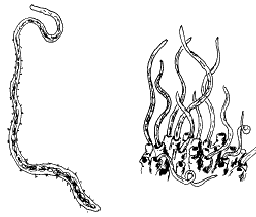
Overview
The species inhabits bottom sediments in lakes and rivers and occasionally occurs in sewer lines and outlets. It can survive in environments heavily polluted with organic matter and obtains oxygen through its thin skin.
Written 24 November 2026 from the sources listed below. Each statement was checked against the passage it cites; statements that could not be supported were removed.
Appearance
The Sludge Worm is a slender, segmented annelid worm that can reach a length of approximately 20 cm.[1][2]
Habitat
The species inhabits bottom sediments in lakes and rivers and occasionally occurs in sewer lines and outlets.[3][4]
It inhabits lake and river sediments on several continents. Its occurrence has also been reported in association with certain riparian land uses and water management practices.[5][6]
Diet
The worms feed on sediment and selectively digest bacteria. They preferentially target silt and clay particles smaller than 63 μm and absorb molecules through their body walls.[7][8][9]
Microplastic ingestion by Tubifex worms presents a risk of transferring and concentrating microplastics through aquatic food chains.[10]
Behaviour
The worms wave their hemoglobin-rich tail ends to obtain oxygen in oxygen-depleted environments. They exchange oxygen and carbon dioxide through their thin skin.[11][12]
The species can survive in environments heavily polluted with organic matter. During drought and food shortages, it can form protective cysts and reduce its metabolic rate.[13][14]
Encystment may contribute to the dispersal of the species.[15]
Reproduction and life cycle
At temperatures between 0.5 and 30°C, the species can produce between 92 and 340 eggs per harvest. Laboratory observations have documented individuals producing as many as 200 embryos over a 72-day reproductive period.[16][17]
In laboratory cultures maintained at 17°C, the worms deposited cocoons approximately every three months. A single individual produces approximately 38 cocoons during one reproductive period, with each cocoon containing an average of approximately 12 embryos.[18][19][20]
Under laboratory conditions, the number of embryos per cocoon increases with the proportion of organic carbon in the substrate.[21]
Similar species
Distinguishing Tubifex tubifex from other Tubifex species is difficult because reproductive organs are reabsorbed after mating. External characteristics of the worm vary with changes in salinity.[22][23]
Classification of the Sludge Worm
| Kingdom | Animalia |
|---|---|
| Phylum | Annelida |
| Class | Clitellata |
| Subclass | Oligochaeta |
| Order | Tubificida |
| Suborder | Tubificina |
| Family | Naididae (Aquatic Oligochaete Worm) |
| Subfamily | Tubificinae |
| Genus | Tubifex (Aquatic Oligochaete Worm) |
| Species | Tubifex tubifex (Müller, 1774) |
Where the Sludge Worm is found
Checklists and occurrence records place Tubifex tubifex in 42 countries. GBIF holds 14,169 georeferenced records of it.
Countries
- Australia 32
- Austria 114
- Belarus 49
- Belgium 61
- Bosnia and Herzegovina 40
- Bulgaria 154
- Canada 309
- Croatia 104
- Czechia 70
- Denmark 231
- Estonia 264
- Finland 1,610
- France 122
- Germany 485
- Greece 5
- Hungary 56
- Iceland 28
- Ireland 10
- Isle of Man 7
- Italy 263
- Latvia 71
- Lithuania 19
- Luxembourg 3
- Moldova 15
- Montenegro 25
- New Zealand 3,226
- North Macedonia 22
- Norway 287
- Poland 294
- Portugal 68
- Romania 136
- Russia 1,148
- Serbia 104
- Slovakia 144
- Slovenia 24
- Spain 313
- Sweden 436
- Switzerland 144
- The Netherlands 2,582
- Ukraine 484
- United Kingdom 256
- United States 354
Regions and cities with the most records
- Hawke's Bay Region, New Zealand 1,585
- Overijssel, The Netherlands 691
- Otago, New Zealand 465
- Hengelo, The Netherlands 449
- Gelderland, The Netherlands 396
- Hastings, New Zealand 382
- Napier, New Zealand 346
- Canterbury, New Zealand 341
- Almelo, The Netherlands 336
- Enschede, The Netherlands 329
- Jyväskylä, Finland 319
- Zeeland, The Netherlands 313
- Gronau, Germany 261
- Schiedam, The Netherlands 256
- Spijkenisse, The Netherlands 248
- Vlaardingen, The Netherlands 248
- Nordhorn, Germany 242
- Southland, New Zealand 233
- North Rhine-Westphalia, Germany 222
- Ontario, Canada 215
- Rotterdam, The Netherlands 214
- Delft, The Netherlands 206
- Odesa, Ukraine 204
- West Coast, New Zealand 173
- England, United Kingdom 171
- Capelle aan den IJssel, The Netherlands 154
- Porvoo, Finland 152
- Rijswijk, The Netherlands 151
- Apeldoorn, The Netherlands 148
- Amersfoort, The Netherlands 147
- Deventer, The Netherlands 145
- Soest, The Netherlands 140
- Middelburg, The Netherlands 139
- Vlissingen, The Netherlands 136
- Zoetermeer, The Netherlands 135
- Basque Country, Spain 133
28 more countries have a few records outside this range
These countries hold a few records of Tubifex tubifex but lie outside the range the checklists give for it. Such records are often zoo or garden specimens, museum material or vagrants, so the species is not counted as occurring there.
A number beside a place is its count of GBIF occurrence records. A place without a number comes from a checklist alone. Records show where a species has been observed or collected, which can include escapes and vagrants.
Common names
English
- Sludge Worm
- Aquatic Oligochaete Worm
- River Worm
- Sewage Worm
Names in 10 other languages
- Chinese
- 正颤蚓
- Czech
- nitěnka obecná
- Dutch
- gewone slingerworm
- German
- Bachwurm, Gemeiner Bachröhrenwurm, Gemeiner Schlammröhrenwurm
- Japanese
- イトミミズ
- Korean
- 참실지렁이
- Polish
- Rurecznik pospolity, rurecznik mułowy
- Russian
- Трубочник обыкновенный
- Slovak
- tubifex bahenný
- Spanish
- Lombriz de aguas negras
Synonyms
10 other scientific names have been used for this species and are now treated as synonyms of Tubifex tubifex.
- Lumbricus tubifex Müller, 1774
- Nais tubifex (Müller, 1774)
- Saenuris tubifex (Müller, 1774)
- Taupodrilus fontaneus (Pointner, 1914)
- Tubifex alpinus Bretscher, 1900
- Tubifex fontaneus Pointner, 1914
- Tubifex rivulorum Lamarck, 1816
- Tubifex tubifex f. tubifex (Müller, 1774)
- Tubifex tubifex heterochaeta Černosvitov, 1926
- Nais filiformis misapplied
Subspecies and varieties
- Tubifex tubifex f. grandiseta form
- Tubifex tubifex tubifex subspecies
Questions and answers
What is the scientific name of the Sludge Worm?
The scientific name of the Sludge Worm is Tubifex tubifex. Written with its author, the full name is Tubifex tubifex (Müller, 1774).
Which family does the Sludge Worm belong to?
Tubifex tubifex belongs to the family Naididae, in the order Tubificida and the class Clitellata.
Where is the Sludge Worm found?
Checklists and occurrence records place Tubifex tubifex in 42 countries, including New Zealand, The Netherlands, Finland, Russia, Germany and Ukraine.
What other names does the Sludge Worm have?
Tubifex tubifex is also known in English as Aquatic Oligochaete Worm, River Worm and Sewage Worm.
What does a sewage worm look like?
The Sludge Worm is a slender, segmented annelid worm that can reach a length of approximately 20 cm.[1][2]
Sources
Passages the profile rests on
- Tubifex tubifex is a slender, segmented annelid worm. Source passage: “Tubifex tubifex is a slender segmented annelid” — English Wikipedia
- The worm can reach a length of approximately 20 cm. Source passage: “can reach lengths of up to about 20 cm.” — English Wikipedia
- The species inhabits bottom sediments in lakes and rivers. Source passage: “They usually inhabit the bottom sediments of lakes, rivers” — English Wikipedia
- The species occasionally occurs in sewer lines and outlets. Source passage: “and occasionally sewer lines and outlets.” — English Wikipedia
- The species inhabits lake and river sediments on several continents. Source passage: “which inhabits the sediments of lakes and rivers on several continents.” — English Wikipedia
- The species has been reported in association with certain riparian land uses and water management practices. Source passage: “Studies have shown that there was a higher abundance of T. tubifex associated with or near some riparian land use and water management practices.” — English Wikipedia
- The worms feed on sediment and selectively digest bacteria. Source passage: “These worms ingest sediments, selectively digest bacteria” — English Wikipedia
- The species absorbs molecules through its body walls. Source passage: “and absorb molecules through their body walls.” — English Wikipedia
- Tubifex tubifex preferentially targets silt and clay particles smaller than 63 μm. Source passage: “Tubifex tubifex tend to target the size range of <63 μm fraction or finer of silt and clay.” — English Wikipedia
- Microplastic ingestion by Tubifex worms presents a risk of transferring and concentrating microplastics through aquatic food chains. Source passage: “Micro-plastic ingestion by Tubifex worms acts as a significant risk for trophic transfer and biomagnification of microplastics up the aquatic food chain.” — English Wikipedia
- The worms wave their hemoglobin-rich tail ends to obtain oxygen in oxygen-depleted environments. Source passage: “by waving hemoglobin-rich tail ends to exploit all available oxygen” — English Wikipedia
- The species exchanges oxygen and carbon dioxide through its thin skin. Source passage: “can exchange carbon dioxide and oxygen through their thin skins” — English Wikipedia
- Tubifex tubifex can survive in environments heavily polluted with organic matter. Source passage: “They can also survive in areas heavily polluted with organic matter” — English Wikipedia
- The species can survive drought and food shortages by forming protective cysts and reducing its metabolic rate. Source passage: “By forming a protective cyst and lowering its metabolic rate, T. tubifex can survive drought and food shortage.” — English Wikipedia
- Encystment may contribute to the dispersal of the species. Source passage: “Encystment may also function in the dispersal of the worm.” — English Wikipedia
- At temperatures between 0.5 and 30°C, the species can produce between 92 and 340 eggs per harvest. Source passage: “Tubifex tubifex can produce a range from 92 to 340 eggs per harvest at a temperature ranging of 0.5-30° Celsius.” — English Wikipedia
- Laboratory observations have documented individuals producing as many as 200 embryos over a 72-day reproductive period. Source passage: “individuals have been documented producing up to 200 embryos over a 72-day reproductive period.” — English Wikipedia
- In laboratory cultures maintained at 17°C, the worms deposited cocoons approximately every three months. Source passage: “These cultures have shown Tubifex tubifex deposited cocoons on a 3-month basis when maintained at a temperature of 17° Celsius.” — English Wikipedia
- A single individual produces approximately 38 cocoons during one reproductive period. Source passage: “A single Tubifex tubifex lays around 38 cocoons during a single reproduction period” — English Wikipedia
- Each cocoon contains an average of approximately 12 embryos. Source passage: “averaging 12 embryos per cocoon.” — English Wikipedia
- The number of embryos per cocoon increases with the proportion of organic carbon in the substrate under laboratory conditions. Source passage: “the number of embryos per cocoon increases with a greater percentage of organic carbon in the given substrate.” — English Wikipedia
- Distinguishing Tubifex tubifex from other Tubifex species is difficult because reproductive organs are reabsorbed after mating. Source passage: “their reproductive organs, commonly used in species identification, are reabsorbed after mating” — English Wikipedia
- External characteristics of the worm vary with changes in salinity. Source passage: “the external characteristics of the worm vary with changes in salinity.” — English Wikipedia
Data
- Catalogue of Life, 2026-10-16 XR cc by
- Global Biodiversity Information Facility CC BY 4.0
- Wikidata CC0
- GeoNames CC BY 4.0
- Wikimedia Commons per image; credit shown with each image
- Within the Catalogue of Life, this name comes from World List of Marine Oligochaeta cc by
References
- Müller, O.F. (1774) Vermium terrestrium et fluviat where the name was published
This species in other databases
- Catalogue of Life 59JSX
- Wikidata Q134912
- iNaturalist 84890
- WoRMS urn:lsid:marinespecies.org:taxname:137569
- ITIS 68623
Page built on 24 November 2026. See how the catalog is made and all sources and licences.
Cite this page
ScientificNames.org. (2026). Tubifex tubifex (Sludge Worm). Retrieved November 24, 2026, from https://scientificnames.org/species/tubifex-tubifex
“Tubifex tubifex (Sludge Worm).” ScientificNames.org, 2026, scientificnames.org/species/tubifex-tubifex. Accessed 24 Nov. 2026.
ScientificNames.org. “Tubifex tubifex (Sludge Worm).” Accessed November 24, 2026. https://scientificnames.org/species/tubifex-tubifex.
@misc{scientificnames_tubifex_tubifex_sludge_worm,
  author = {{ScientificNames.org}},
  title = {Tubifex tubifex (Sludge Worm)},
  year = {2026},
  url = {https://scientificnames.org/species/tubifex-tubifex},
  note = {Accessed 2026-11-24}
}