Species · Molluscs
Thick Shelled River Mussel Unio crassus
The scientific name of the Thick Shelled River Mussel is Unio crassus. It is a species of mollusc, order Unionida. The name dates from 1788.
- Scientific name
- Unio crassus Philipsson, 1788
- Common name
- Thick Shelled River Mussel
- Genus
- Unio
- Order
- Unionida
- Class
- Bivalvia
- Red List category
- EN Endangered
- Environment
- freshwater
- Recorded in
- 33 countries
- Name status
- accepted in the Catalogue of Life
Overview
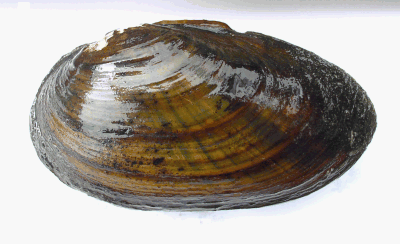
Unio crassus inhabits large streams and rivers across much of Europe and Western Asia. It is characterised by a thick-walled shell and can live for up to 80 years.
Written 26 November 2026 from the sources listed below. Each statement was checked against the passage it cites; statements that could not be supported were removed.
Appearance
The species has a characteristically thick-walled shell. Adults generally measure 3–7 cm in length, although some individuals reach 9–11 cm.[1][2]
Shell size and shape vary between populations and in response to environmental conditions.[3]
Habitat
The species inhabits large streams and rivers with clear water. It prefers slower-flowing water near riverbanks, roots, boulders, and other physical structures.[4][5]
It tolerates higher levels of silt than other threatened mussel species and can also occur in free-flowing river habitats.[6][7]
Diet
The species obtains algae and microorganisms from the water through its siphons.[8]
Behaviour
Individuals bury themselves in the streambed while leaving their siphons exposed. They can move several metres or farther to locate suitable habitat conditions.[9][10]
The species can form colonies in suitable river and stream habitats.[11]
Reproduction and life cycle
The species is a short-term breeder whose reproductive cycle, from fertilization to juvenile development, takes place within one season. Males release spermatozoa into the water during spring, which females take in through siphoning.[12][13]
Females can produce several broods of eggs annually. The eggs develop for several weeks before the larvae are ready to be released.[14][15]
Females release approximately 100,000 glochidia into the water current during spring and summer. The glochidia undergo a parasitic developmental stage during which they attach to fish gills.[16][17]
The species uses fish hosts to complete larval metamorphosis. After metamorphosis, juvenile mussels detach from their fish hosts and bury themselves in the streambed for 1–3 years.[18][19]
Glochidia are released intermittently at approximately 91-second intervals for periods lasting 3–6 hours. Release takes place from mid-morning until mid-afternoon, and a single release period can involve up to 1,127 glochidia.[20][21][22]
Glochidial viability decreases significantly after 12 hours. The minnow (Phoxinus phoxinus) is identified as a dominating host in the studied population, while the gudgeon (Gobio gobio) removes glochidia without supporting their metamorphosis.[23][24][25]
Conservation
The species is classified as endangered globally on the IUCN Red List. European populations declined by as much as 50% during the twentieth century.[26][27]
Major threats include deteriorating water quality, habitat fragmentation, reduced availability of host fish, river canalisation, and introduced muskrats. Habitat destruction, muskrat predation, and insufficient host fish were identified as major causes of population decline in a 2020 study.[28][29]
Artificial breeding methods doubled the population in the Biała Tarnowska River in Poland.[30]
Uses
The species was consumed as food by prehistoric people in Central Europe. Its shells were used as tools at archaeological sites dating to the fifth millennium BC.[31][32]
The species was used in ornamental button production in Central Europe between 4200 and 3800 BC. It was also used as livestock fodder in Central Europe during the nineteenth century.[33][34]
The species is still used as poultry fodder in Romania and for human consumption in some areas.[35]
Classification of the Thick Shelled River Mussel
| Kingdom | Animalia |
|---|---|
| Phylum | Mollusca |
| Class | Bivalvia |
| Subclass | Autobranchia |
| Infraclass | Heteroconchia |
| Subterclass | Palaeoheterodonta |
| Order | Unionida |
| Subfamily | Unioninae |
| Tribe | Unionini |
| Genus | Unio |
| Species | Unio crassus Philipsson, 1788 |
Where the Thick Shelled River Mussel is found
Checklists and occurrence records place Unio crassus in 33 countries. GBIF holds 13,792 georeferenced records of it.
Countries
- Albania 11
- Austria 386
- Belarus 30
- Belgium 2,214
- Bosnia and Herzegovina 28
- Bulgaria 45
- Croatia 43
- Czechia 10
- Denmark 153
- Estonia 407
- Finland 1,037
- France 3,942
- Germany 907
- Greece 106
- Hungary 95
- Italy 15
- Latvia 168
- Liechtenstein 10
- Lithuania 214
- Luxembourg 189
- Montenegro 3
- Poland 224
- Portugal 33
- Romania 103
- Russia 224
- Serbia 15
- Slovakia 57
- Slovenia 76
- Spain 10
- Sweden 1,340
- Switzerland 1,156
- The Netherlands 378
- Ukraine 163
Regions and cities with the most records
- Bourgogne-Franche-Comté, France 634
- Grand Est, France 596
- Skåne, Sweden 471
- Hauts-de-France, France 463
- Poitiers, France 432
- Centre-Val de Loire, France 420
- Bülach, Switzerland 410
- Zurich, Switzerland 392
- Dübendorf, Switzerland 390
- Zürich, Switzerland 382
- Dietikon, Switzerland 366
- Kloten, Switzerland 356
- Opfikon, Switzerland 356
- Stadt Winterthur (Kreis 1), Switzerland 342
- Adliswil, Switzerland 340
- Wettingen, Switzerland 332
- Baden, Switzerland 326
- Winterthur, Switzerland 301
- Arlon, Belgium 272
- Södermanland, Sweden 249
- Tuusula, Finland 214
- Vantaa, Finland 203
- Kerava, Finland 202
- Östergötland, Sweden 201
- Wassenaar, The Netherlands 196
- Scheveningen, The Netherlands 192
- Voorburg, The Netherlands 189
- Oegstgeest, The Netherlands 188
- Katwijk aan Zee, The Netherlands 187
- The Hague, The Netherlands 187
- Noordwijk-Binnen, The Netherlands 186
- Leiderdorp, The Netherlands 185
- Voorschoten, The Netherlands 185
- Leiden, The Netherlands 184
- Sassenheim, The Netherlands 183
- Bavaria, Germany 182
7 more countries have a few records outside this range
These countries hold a few records of Unio crassus but lie outside the range the checklists give for it. Such records are often zoo or garden specimens, museum material or vagrants, so the species is not counted as occurring there.
A number beside a place is its count of GBIF occurrence records. A place without a number comes from a checklist alone. Records show where a species has been observed or collected, which can include escapes and vagrants.
Common names
English
- Thick Shelled River Mussel
- Thick-shelled Mussel
- Common Central European River Mussel
- Common River Mussel
Names in 19 other languages
- Arabic
- بلح البحر النهري سميك الصدفة
- Bulgarian
- Овална речна мида
- Croatian
- Obična lisanka
- Czech
- velevrub tupý
- Danish
- Lille malermusling, Tykskallet malermusling
- Dutch
- Bataafse stroommossel, Dikke stroommossel
- Estonian
- paks jõekarp
- Finnish
- vuollejokisimpukka
- French
- Mulette épaisse
- German
- Bachmuschel, Gemeine Flussmuschel, Kleine Flussmuschel
- Hungarian
- tompa folyamkagyló
- Latvian
- Biezā perlamutrene
- Lithuanian
- Ovalioji geldutė
- Polish
- Skójka gruboskorupowa
- Russian
- Перловица овальная, Толстая перловица
- Slovak
- korýtko riečne
- Slovenian
- potočni škržek
- Swedish
- tjockskalig målarmussla
- Ukrainian
- Перлівниця товста
Synonyms
206 other scientific names have been used for this species and are now treated as synonyms of Unio crassus.
- Crassunio crassus (Philipsson, 1788)
- Mya batava Maton & Rackett, 1807
- Unio (Crassiana) crassus Philipsson, 1788
- Unio (Crassiana) cyprinorum Bourguignat, 1882
- Unio (Crassiana) fusculus Rossmässler, 1835
- Unio (Crassiana) gregorii Kobelt, 1911
- Unio (Crassiana) irenjensis Kobelt, 1911
- Unio (Crassiana) irgizlaicus Lindholm, 1904
- Unio (Crassiana) mengrelicus Drouët, 1881
- Unio (Crassiana) musivus L. Spengler, 1793
- Unio (Crassiana) sobrievskii Rosen, 1925
- Unio (Crassiana) stevenianiformis Zhadin, 1938
- Unio (Eolymnium) araxenus Drouët, 1881
- Unio (Eolymnium) byzantinus Drouët, 1879
- Unio (Eolymnium) colchicus Drouët, 1881
- Unio (Eolymnium) raddei Drouët, 1881
- Unio adonus Locard, 1889
- Unio andegavensis Locard, 1882
- Unio andeliacus Locard, 1889
- Unio arenarum Locard, 1882
- Unio ater irgizlaicus Lindholm, 1904
- Unio ater var. irgizlaicus Lindholm, 1904
- Unio aturicus Locard, 1889
- Unio badiellus Drouët, 1888
- Unio badius Kokeil, 1831
- Unio balbignyanus Locard, 1889
- Unio baroni Servain, 1887
- Unio batavellus Locard, 1885
- Unio batavellus perconvexus Germain, 1904
- Unio batavus Nilsson, 1823
- Unio batavus acutus de Joannis, 1859
- Unio batavus albensis Hazay, 1885
- Unio batavus badensis Haas, 1910
- Unio batavus baraceus de Joannis, 1859
- Unio batavus belgicus Colbeau, 1868
- Unio batavus elongatus Held, 1836
- Unio batavus gibbosus Held, 1836
- Unio batavus longus de Joannis, 1859
- Unio batavus minimus de Joannis, 1859
- Unio batavus ondovensis Hazay, 1885
Showing 40 of 206.
Subspecies and varieties
- Unio crassus jaeckeli subspecies
- Unio crassus klemmi subspecies
Related species
-
 Painter's MusselUnio pictorum
-
 Unio mancus
-
 Swollen River-musselUnio tumidus
-
 Dolphin Freshwater MusselUnio delphinus
-
 Unio tumidiformis
- Unio ravoisieri
- Unio gibbus
-
 Unio elongatulus
Compare
Questions and answers
What is the scientific name of the Thick Shelled River Mussel?
The scientific name of the Thick Shelled River Mussel is Unio crassus. Written with its author, the full name is Unio crassus Philipsson, 1788.
Where is the Thick Shelled River Mussel found?
Checklists and occurrence records place Unio crassus in 33 countries, including France, Belgium, Sweden, Switzerland, Finland and Germany.
What is the conservation status of the Thick Shelled River Mussel?
The IUCN Red List category recorded for Unio crassus is Endangered (EN).
What other names does the Thick Shelled River Mussel have?
Unio crassus is also known in English as Thick-shelled Mussel, Common Central European River Mussel and Common River Mussel.
Can you eat freshwater river mussels?
The Thick shelled river mussel is still used for human consumption in some areas.[35]
How rare are freshwater mussels?
The Thick shelled river mussel is classified as endangered globally on the IUCN Red List. European populations declined by as much as 50% during the twentieth century.[26][27]
What habitat do mussels live in?
The Thick shelled river mussel inhabits large streams and rivers with clear water. It prefers slower-flowing water near riverbanks, roots, boulders, and other physical structures, but can also occur in free-flowing river habitats.[4][5][7]
What food do mussels eat?
The Thick shelled river mussel obtains algae and microorganisms from the water through its siphons.[8]
Sources
Passages the profile rests on
- The species has a characteristically thick-walled shell. Source passage: “Unio crassus is known for its thick-walled shell.” — English Wikipedia
- Adults generally measure 3–7 cm in length, although some individuals reach 9–11 cm. Source passage: “Individuals are generally 3–7 cm in length, though some reach 9–11 cm.” — English Wikipedia
- Shell size and shape can differ between populations and in response to environmental conditions. Source passage: “The size and shape of the shell may vary by population or by environmental factors.” — English Wikipedia
- The species inhabits large streams and rivers with clear water. Source passage: “The species lives in large streams and rivers with clear water” — English Wikipedia
- It prefers slower-flowing water near riverbanks, roots, boulders, and other physical structures. Source passage: “It prefers slower-flowing waters on the banks or near roots, boulders, or other features.” — English Wikipedia
- The species tolerates higher levels of silt than other threatened mussel species. Source passage: “U. crassus was noted to be more tolerant of silt in the water than other threatened species.” — English Wikipedia
- The species can occur in free-flowing river habitats. Source passage: “It often forms colonies in large streams and rivers with clear, free-flowing water.” — English Wikipedia
- The species obtains algae and microorganisms from the water through its siphons. Source passage: “through these it inhales oxygen and food (algae and microorganisms) and expels waste.” — English Wikipedia
- Individuals bury themselves in the streambed while leaving their siphons exposed. Source passage: “It buries itself in the stream bed, leaving only its siphons exposed” — English Wikipedia
- Individuals can move several metres or farther to locate suitable habitat conditions. Source passage: “It can move several meters, sometimes farther, to find suitable habitat conditions.” — English Wikipedia
- The species can form colonies in suitable river and stream habitats. Source passage: “It often forms colonies in large streams and rivers with clear, free-flowing water.” — English Wikipedia
- The species is a short-term breeder whose reproductive cycle from fertilization to juvenile development takes place within one season. Source passage: “They are tachytictic (short-term) breeders, meaning the cycle from fertilization to juvenile takes place in one season.” — English Wikipedia
- Males release spermatozoa into the water during spring, which females take in through siphoning. Source passage: “In the spring, males release their spermatozoa into the water, and females take them in through siphoning.” — English Wikipedia
- Females can produce several broods of eggs annually. Source passage: “Females can have several broods of eggs per year.” — English Wikipedia
- The eggs develop for several weeks before the larvae are ready to be released. Source passage: “The eggs develop for a few weeks until the larvae are ready for release.” — English Wikipedia
- Females release approximately 100,000 glochidia into the water current during spring and summer. Source passage: “In spring and summer, the female releases around 100,000 glochidia into the water current.” — English Wikipedia
- The glochidia undergo a parasitic developmental stage during which they attach to fish gills. Source passage: “The glochidia attach to the gills of a fish and remain for 20–50 days” — English Wikipedia
- After metamorphosis, juvenile mussels detach from their fish hosts and bury themselves in the streambed for 1–3 years. Source passage: “after which they drop off and bury themselves in the stream bed for 1–3 years.” — English Wikipedia
- The species uses fish hosts to complete larval metamorphosis. Source passage: “Glochidia, their parasitic larvae, must attach to the gills or fins of suitable fish species to metamorphose.” — pmc.ncbi.nlm.nih.gov
- Glochidia are released intermittently at approximately 91-second intervals for periods lasting 3–6 hours. Source passage: “Glochidia are released in intermittent spurts—approximately every 91 s—for 3 to 6 h” — pmc.ncbi.nlm.nih.gov
- The release of glochidia takes place from mid-morning until mid-afternoon. Source passage: “from mid-morning to mid-afternoon.” — pmc.ncbi.nlm.nih.gov
- A single release period can involve up to 1,127 glochidia. Source passage: “During this period, the marsupium is emptied, releasing up to 1,127 glochidia” — pmc.ncbi.nlm.nih.gov
- Glochidial viability decreases significantly after 12 hours. Source passage: “their viability decreases significantly after 12 h” — pmc.ncbi.nlm.nih.gov
- The minnow (Phoxinus phoxinus) is identified as a dominating host in the studied population. Source passage: “focusing on the interaction between the dominating host Phoxinus phoxinus and the non-host Gobio gobio.” — pmc.ncbi.nlm.nih.gov
- The gudgeon (Gobio gobio) removes glochidia without supporting their metamorphosis. Source passage: “G. gobio removes a substantial proportion of glochidia without supporting their metamorphosis.” — pmc.ncbi.nlm.nih.gov
- The species is classified as endangered globally on the IUCN Red List. Source passage: “Globally, it is ranked endangered on the IUCN Red List.” — English Wikipedia
- European populations declined by as much as 50% during the twentieth century. Source passage: “During the 20th century, the thick shelled river mussel declined in Europe by as much as 50%” — English Wikipedia
- Major threats include deteriorating water quality, habitat fragmentation, reduced availability of host fish, river canalisation, and introduced muskrats. Source passage: “due to deteriorating water quality, habitat fragmentation, host fish limitation, canalisation of rivers, and introduction of the muskrat” — English Wikipedia
- Habitat destruction, muskrat predation, and insufficient host fish were identified as major causes of population decline in a 2020 study. Source passage: “A 2020 study identified habitat destruction, predation by muskrat, and lack of host fish as the major factors for decline.” — English Wikipedia
- Artificial breeding methods doubled the population in the Biała Tarnowska River in Poland. Source passage: “A project in Poland successfully used artificial breeding methods including release of gravid females, release of glochidia-infested fish, and in vitro-raised juveniles, to double the population of the mussel in the Biała Tarnowska river.” — English Wikipedia
- The species was consumed as food by prehistoric people in Central Europe. Source passage: “Unio crassus appears to have been a preferred species, likely because of its relatively high meat content.” — English Wikipedia
- Shells of this species were used as tools at archaeological sites dating to the fifth millennium BC. Source passage: “Unio shells used as tools, including those of U. crassus, have been found at archaeological sites dating to the 5th millennium BC.” — English Wikipedia
- The species was used in ornamental button production in Central Europe between 4200 and 3800 BC. Source passage: “Unio crassus was also one of several mussels used to make ornamental buttons between 4200 and 3800 BC in central Europe.” — English Wikipedia
- The species was used as livestock fodder in Central Europe during the nineteenth century. Source passage: “The species was used as livestock fodder in Central Europe in the 19th century.” — English Wikipedia
- The species is still used as poultry fodder in Romania and for human consumption in some areas. Source passage: “Today, it is still used as fodder for poultry in Romania, and for human consumption in some areas.” — English Wikipedia
Data
- Catalogue of Life, 2026-10-16 XR cc by
- Global Biodiversity Information Facility CC BY 4.0
- Wikidata CC0
- GeoNames CC BY 4.0
- Wikimedia Commons per image; credit shown with each image
- Within the Catalogue of Life, this name comes from World Register of Marine Species cc by
References
- Retzius, A. J. (1788). Dissertatio historico-naturalis sistens nova testaceorum genera. Quam præside D. M. Andr. J. Retzio (...) ad publicum examen defert Laurentius Münter Philipsson. 4+23 pp. Lund. where the name was published
This species in other databases
Page built on 29 November 2026. See how the catalog is made and all sources and licences.
Cite this page
ScientificNames.org. (2026). Unio crassus (Thick Shelled River Mussel). Retrieved November 29, 2026, from https://scientificnames.org/species/unio-crassus
“Unio crassus (Thick Shelled River Mussel).” ScientificNames.org, 2026, scientificnames.org/species/unio-crassus. Accessed 29 Nov. 2026.
ScientificNames.org. “Unio crassus (Thick Shelled River Mussel).” Accessed November 29, 2026. https://scientificnames.org/species/unio-crassus.
@misc{scientificnames_unio_crassus_thick_shelled_river_mussel,
  author = {{ScientificNames.org}},
  title = {Unio crassus (Thick Shelled River Mussel)},
  year = {2026},
  url = {https://scientificnames.org/species/unio-crassus},
  note = {Accessed 2026-11-29}
}