Species · Flowering plants
Straight Vallisneria Vallisneria spiralis
The scientific name of the Straight Vallisneria is Vallisneria spiralis. It is a species of flowering plant in the family Hydrocharitaceae (frog-bit family), order Alismatales.
- Scientific name
- Vallisneria spiralis L.
- Common name
- Straight Vallisneria
- Genus
- Vallisneria
- Family
- Hydrocharitaceae (Frog-bit Family)
- Order
- Alismatales
- Class
- Liliopsida
- Red List category
- LC Least Concern
- Recorded in
- 76 countries
- Name status
- accepted in the Catalogue of Life
Overview
Vallisneria spiralis occurs in tropical and subtropical regions worldwide. It has narrow, linear leaves and commonly propagates vegetatively through runners.
Written 26 November 2026 from the sources listed below. Each statement was checked against the passage it cites; statements that could not be supported were removed.
Appearance
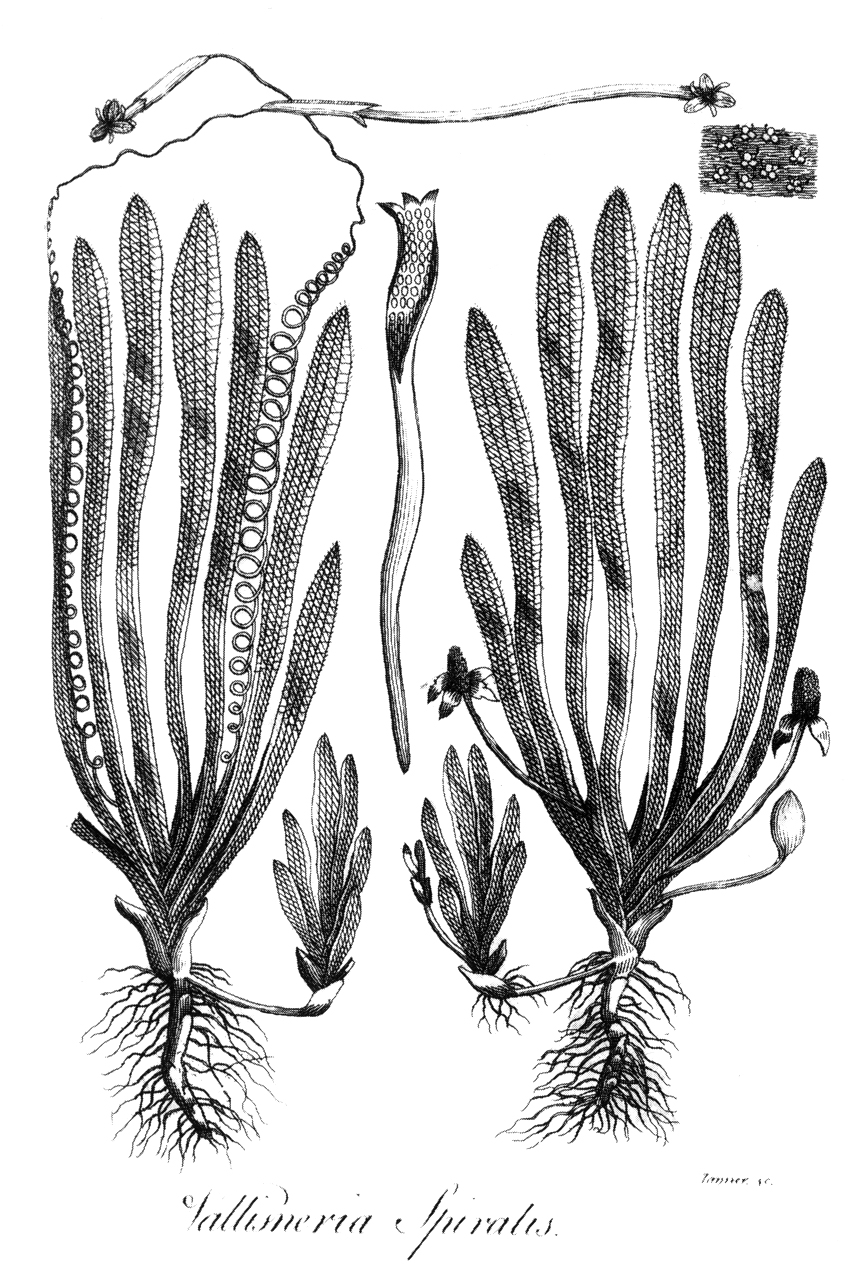
The plant has narrow, linear leaves ranging in colour from pale green to reddish. Its leaves can reach 1 metre in length and 0.75 inches in width.[1][2]
Reproduction and life cycle
Straight vallisneria is monoecious. Male flowers are borne on long spiral stalks that detach from the plant and float on the water surface.[3][4]
In the variety V. spiralis gigantea, female flowers can have stalks reaching 1.85 metres in length. After pollination, the female flower stalk curls up and draws the developing fruit towards the stream or pond bed.[5][6]
The species most commonly propagates vegetatively through runners. Its seeds have not been observed germinating in aquaria.[7][8]
Behaviour
Straight vallisneria can form dense stands through its runner-based propagation.[9]
Uses
Straight vallisneria is commonly used as an aquarium plant. The plant can be eaten after steaming or boiling.[10][11]
Conservation
Straight vallisneria is classified as an unwanted organism in New Zealand. Under the National Pest Plant Accord, it is prohibited from sale and commercial propagation and distribution in New Zealand.[12][13]
The species is described as an effective invader because of its dispersal efficiency, vegetative reproduction, high biomass production and aquarium trade popularity.[14]
Similar species
Vallisneria spiralis f. tortifolia is a described form of the species with tightly twisted leaves. Some taxonomists have elevated Vallisneria spiralis f. tortifolia to species rank under the name Vallisneria tortissima.[15][16]
Classification of the Straight Vallisneria
| Kingdom | Plantae |
|---|---|
| Subkingdom | Pteridobiotina |
| Phylum | Tracheophyta |
| Class | Liliopsida |
| Order | Alismatales |
| Family | Hydrocharitaceae (Frog-bit Family) |
| Genus | Vallisneria (Eelgrass) |
| Species | Vallisneria spiralis L. |
Where the Straight Vallisneria is found
Checklists and occurrence records place Vallisneria spiralis in 76 countries across Africa, Asia and Europe. GBIF holds 8,443 georeferenced records of it.
Countries where it is native or its origin is not stated
- Afghanistan
- Albania 5
- Algeria 6
- Austria 34
- Bangladesh 4
- Botswana 19
- Bulgaria 9
- Burundi 9
- Cameroon
- Central African Republic 1
- Chad 23
- China 100
- Democratic Republic of the Congo 26
- Egypt 7
- Equatorial Guinea
- Ethiopia 5
- France 5,613
- Ghana 22
- Greece 4
- Iceland 3
- India 91
- Iran 10
- Iraq 25
- Israel 12
- Italy 268
- Japan 28
- Kazakhstan 5
- Kenya 3
- Kyrgyzstan 1
- Luxembourg 14
- Malawi 4
- Mali 2
- Montenegro 11
- Mozambique 1
- Myanmar 6
- Namibia
- Nigeria 2
- North Macedonia 4
- Pakistan 1
- Philippines 7
- Portugal 34
- Republic of the Congo
- Romania 77
- Russia 175
- Rwanda 3
- Senegal 2
- Serbia 3
- Sierra Leone 1
- Slovakia 23
- South Africa 7
- South Sudan 6
- Spain 38
- Sri Lanka 2
- Sudan 8
- Switzerland 514
- Syria 8
- Tajikistan
- Tanzania 4
- Thailand 3
- Turkey 9
- Turkmenistan
- Uganda 24
- Ukraine 612
- Uzbekistan 1
- Vietnam 7
- Zambia 7
- Zimbabwe 7
Countries where it has been introduced
- Belgium 52
- Germany 100
- Hungary 14
- Ireland
- Mauritius 2
- Poland 16
- Reunion 6
- The Netherlands 145
- United Kingdom 148
Regions and cities with the most records
- Bourgogne-Franche-Comté, France 1,640
- Île-de-France, France 860
- Occitanie, France 702
- Auvergne-Rhône-Alpes, France 680
- Lugano, Switzerland 554
- Provence-Alpes-Côte d'Azur, France 552
- Ticino, Switzerland 485
- Centre-Val de Loire, France 484
- Dnipropetrovsk, Ukraine 420
- Arles, France 408
- Kamyanske, Ukraine 402
- Alfortville, France 351
- Charenton-le-Pont, France 351
- Maisons-Alfort, France 350
- Nogent-sur-Marne, France 350
- Vitry-sur-Seine, France 350
- Ivry-sur-Seine, France 349
- Champigny-sur-Marne, France 348
- Saint-Mandé, France 348
- Paris 12 Reuilly, France 347
- Gare, France 345
- Joinville-le-Pont, France 344
- Le Kremlin-Bicêtre, France 344
- Quinze-Vingts, France 344
- Croulebarbe, France 343
- Salpêtrière, France 343
- Créteil, France 342
- Paris 13 Gobelins, France 341
- Vincennes, France 341
- Maison Blanche, France 340
- Paris 05 Panthéon, France 340
- Neuilly-Plaisance, France 339
- Villejuif, France 339
- Choisy-le-Roi, France 338
- L'Haÿ-les-Roses, France 338
- Le Perreux-sur-Marne, France 337
9 more countries have a few records outside this range
These countries hold a few records of Vallisneria spiralis but lie outside the range the checklists give for it. Such records are often zoo or garden specimens, museum material or vagrants, so the species is not counted as occurring there.
A number beside a place is its count of GBIF occurrence records. A place without a number comes from a checklist alone. Records show where a species has been observed or collected, which can include escapes and vagrants.
Common names
English
- Straight Vallisneria
- Corkscrew Val
- Tapegrass
- Coiled Vallisneria
- Eelgrass
- Eelweed
- Straight Eelgrass
- Tape-grass
Names in 20 other languages
- Arabic
- فاليسناريا سبيراليس
- Chinese
- 旋葉苦草
- Czech
- zákruticha šroubovitá
- Dutch
- Vallisneria
- Finnish
- kierrevallisneria
- French
- Vallisnérie en Spirale, Vallisnérie spiralée, vallisnérie
- German
- Gewöhnliche Wasserschraube
- Hebrew
- וליסנריה סלולה
- Hungarian
- Közönséges csavarhínár
- Italian
- Vallisneria a spirale
- Japanese
- セイヨウセキショウモ
- Lithuanian
- Spiralinė valisnerija
- Polish
- nurzaniec śrubowy
- Portuguese
- fiteira-de-água
- Russian
- Валлиснерия спиральная
- Slovak
- valisnéria špirálovitá
- Swedish
- vattenskruv
- Ukrainian
- Валіснерія спіральна
- Welsh
- Rhuban y Dŵr, Ruban y Dŵr
- hsb
- Wšědna wódna wjerćawka
Synonyms
13 other scientific names have been used for this species and are now treated as synonyms of Vallisneria spiralis.
- Vallisneria aethiopica Fenzl
- Vallisneria jacquiniana Spreng.
- Vallisneria jacquinii Savi
- Vallisneria linnet Bercht. & J.Presl
- Vallisneria micheliana Spreng.
- Vallisneria michelii Savi
- Vallisneria numidica Pomel
- Vallisneria pusilla Barbieri ex Bertol.
- Vallisneria spiralis f. aethiopica (Fenzl) T.Durand & Schinz
- Vallisneria spiralis subvar. jacquinii (Savi) Nyman
- Vallisneria spiralis subvar. michelii (Savi) Nyman
- Vallisneria spiralis var. numidica (Pomel) Maire & Weiller
- Vallisneria spiralis var. pusilla (Barbieri ex Bertol.) Nyman
Related species
-
 American EelgrassVallisneria americana
- Vallisneria natans
- Vallisneria australis
- Vallisneria nana
- Vallisneria denseserrulata
- Vallisneria rubra
- Vallisneria annua
- Vallisneria caulescens
Compare
Questions and answers
What is the scientific name of the Straight Vallisneria?
The scientific name of the Straight Vallisneria is Vallisneria spiralis. Written with its author, the full name is Vallisneria spiralis L..
Which family does the Straight Vallisneria belong to?
Vallisneria spiralis belongs to the family Hydrocharitaceae, in the order Alismatales and the class Liliopsida.
Where is the Straight Vallisneria found?
Checklists and occurrence records place Vallisneria spiralis in 76 countries, including France, Ukraine, Switzerland, Italy, Russia and China.
What is the conservation status of the Straight Vallisneria?
The IUCN Red List category recorded for Vallisneria spiralis is Least Concern (LC).
What other names does the Straight Vallisneria have?
Vallisneria spiralis is also known in English as Corkscrew Val, Tapegrass, Coiled Vallisneria, Eelgrass, Eelweed and Straight Eelgrass.
Sources
Passages the profile rests on
- The plant has narrow, linear leaves that range in colour from pale green to reddish. Source passage: “It has narrow, linear leaves that range in colour from a pale-green to reddish” — English Wikipedia
- Its leaves can reach 1 metre in length and 0.75 inches in width. Source passage: “up to 3 feet (1 m) long and up to 0.75 inches broad.” — English Wikipedia
- The species is monoecious. Source passage: “V. spiralis is monoecious” — English Wikipedia
- Male flowers are borne on long spiral stalks that detach from the plant and float on the water surface. Source passage: “male flowers carried on long spiral stalks that break away from the plant and float on the water's surface.” — English Wikipedia
- In the variety V. spiralis gigantea, female flowers can have stalks reaching 1.85 metres in length. Source passage: “In the variety V. s. gigantea the female flowers are on stalks (pedicels) up to six feet (1.85 meters) in length.” — English Wikipedia
- After pollination, the female flower stalk curls up and draws the developing fruit towards the stream or pond bed. Source passage: “After the female flowers have been pollinated, the pedicel curls up like a tendril, drawing the young fruit closer to the bed of the stream or pond;” — English Wikipedia
- The species most commonly propagates vegetatively through runners. Source passage: “Instead, it most often propagates by runners which can lead to dense stands..” — English Wikipedia
- Seeds of the species have not been observed germinating in aquaria. Source passage: “Seeds have not been observed germinating in aquaria.” — English Wikipedia
- The species can form dense stands through its runner-based propagation. Source passage: “it most often propagates by runners which can lead to dense stands..” — English Wikipedia
- The species is commonly used as an aquarium plant. Source passage: “is a common aquarium plant” — English Wikipedia
- The plant can be eaten after steaming or boiling. Source passage: “It can be eaten when steamed or boiled.” — English Wikipedia
- The species is classified as an unwanted organism in New Zealand. Source passage: “V. spiralis is an "unwanted organism" in New Zealand.” — English Wikipedia
- In New Zealand, the species is prohibited from sale and commercial propagation and distribution under the National Pest Plant Accord. Source passage: “It is listed on the National Pest Plant Accord prohibiting it from sale and commercial propagation and distribution.” — English Wikipedia
- The species is described as an effective invader because of its dispersal efficiency, vegetative reproduction, high biomass production and aquarium trade popularity. Source passage: “The species is an effective invader due to its efficient dispersal, vegetative reproduction, high biomass production, and popularity in the aquarium trade.” — English Wikipedia
- Vallisneria spiralis f. tortifolia is a described form of the species with tightly twisted leaves. Source passage: “The form has tightly twisted leaves.” — English Wikipedia
- Some taxonomists have elevated Vallisneria spiralis f. tortifolia to species rank under the name Vallisneria tortissima. Source passage: “which has also been elevated to the species level by some taxonomists under the name V. tortissima.” — English Wikipedia
Data
- Catalogue of Life, 2026-10-16 XR cc by
- Global Biodiversity Information Facility CC BY 4.0
- Wikidata CC0
- GeoNames CC BY 4.0
- Wikimedia Commons per image; credit shown with each image
- Within the Catalogue of Life, this name comes from The World Checklist of Vascular Plants (WCVP) cc by
References
- Sp. Pl.: 1015 (1753) where the name was published
This species in other databases
- Catalogue of Life 7FDNP
- Wikidata Q159160
- iNaturalist 355819
- World Flora Online wfo-0000770262
- GRIN 400355
Page built on 29 November 2026. See how the catalog is made and all sources and licences.
Cite this page
ScientificNames.org. (2026). Vallisneria spiralis (Straight Vallisneria). Retrieved November 29, 2026, from https://scientificnames.org/species/vallisneria-spiralis
“Vallisneria spiralis (Straight Vallisneria).” ScientificNames.org, 2026, scientificnames.org/species/vallisneria-spiralis. Accessed 29 Nov. 2026.
ScientificNames.org. “Vallisneria spiralis (Straight Vallisneria).” Accessed November 29, 2026. https://scientificnames.org/species/vallisneria-spiralis.
@misc{scientificnames_vallisneria_spiralis_straight_vallisneria,
  author = {{ScientificNames.org}},
  title = {Vallisneria spiralis (Straight Vallisneria)},
  year = {2026},
  url = {https://scientificnames.org/species/vallisneria-spiralis},
  note = {Accessed 2026-11-29}
}