Species · Molluscs
Lovely Vallonia Vallonia pulchella
The scientific name of the Lovely Vallonia is Vallonia pulchella. It is a species of mollusc in the family Valloniidae (grass snails). The name dates from 1774.
- Scientific name
- Vallonia pulchella (O. F. Müller, 1774)
- Common name
- Lovely Vallonia
- Genus
- Vallonia
- Family
- Valloniidae (Grass Snails)
- Class
- Gastropoda
- Environment
- terrestrial
- Recorded in
- 41 countries
- Name status
- accepted in the Catalogue of Life
Overview
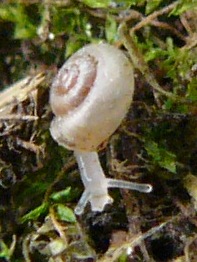
The lovely vallonia is a very small, air-breathing terrestrial pulmonate gastropod mollusc belonging to the family Valloniidae. It has been recorded in British Columbia, Canada, and Illinois, United States of America, and is described as having a wide distribution. It has an ivory-white shell with a circular outline, 3.2–3.3 whorls and a very wide umbilicus.
Written 26 November 2026 from the sources listed below. Each statement was checked against the passage it cites; statements that could not be supported were removed.
Appearance
The shell has a circular outline and consists of 3.2–3.3 whorls. The final whorl is wider immediately before the aperture and descends only slightly.[1][2]
The aperture is relatively non-oblique and has a weaker lip than that of Vallonia costata. Its whorls are slightly more elevated than those of Vallonia costata, and the shell has a very wide umbilicus.[3][4][5]
The shell is ivory-white with very fine, irregular streaks. The soft parts are milky white, the tentacles are short, and the posterior end of the foot is rounded.[6][7][8][9]
Habitat
The lovely vallonia thrives in habitats with relatively moist, conductive soil and large soil aggregates. Its preferred habitat includes low temperatures at soil depths of 0–10 cm and a well-developed litter layer.[10][11][12]
Its preferred habitats have low numbers of plants that change shape in response to humidity or light levels.[13]
In North America, the species is commonly found in woodlands and suburban gardens.[14][15]
Behaviour
Parental care has been observed in the lovely vallonia. The species has been observed cleaning its eggs of fungi.[16][17]
Reproduction and life cycle
The lovely vallonia lays eggs measuring 0.5 mm. Parental care has been documented in the species.[18][19]
Classification of the Lovely Vallonia
| Kingdom | Animalia |
|---|---|
| Phylum | Mollusca |
| Class | Gastropoda (Gastropod) |
| Subclass | Heterobranchia |
| Infraclass | Euthyneura |
| Subterclass | Tectipleura |
| Superorder | Eupulmonata |
| Infraorder | Pupilloidei |
| Family | Valloniidae (Grass Snails) |
| Genus | Vallonia (Grass-snails) |
| Species | Vallonia pulchella (O. F. Müller, 1774) |
Where the Lovely Vallonia is found
Checklists and occurrence records place Vallonia pulchella in 41 countries. GBIF holds 41,957 georeferenced records of it.
Countries
- Aland Islands 47
- Austria 2,214
- Belarus 3
- Belgium 219
- Bermuda 13
- Bulgaria 58
- Canada 539
- Croatia 16
- Czechia 29
- Denmark 84
- Estonia 166
- Finland 1,149
- France 4,033
- Germany 1,051
- Greece 15
- Guernsey 16
- Hungary 68
- Ireland 553
- Isle of Man 11
- Italy 139
- Jersey 18
- Latvia 13
- Liechtenstein 85
- Lithuania 315
- Luxembourg 179
- Mexico 4
- Norway 171
- Poland 593
- Portugal 463
- Romania 34
- Russia 46
- Serbia 10
- Slovakia 20
- Slovenia 6
- Spain 476
- Sweden 6,492
- Switzerland 13,470
- The Netherlands 1,420
- Ukraine 176
- United Kingdom 4,724
- United States 2,819
Regions and cities with the most records
- England, United Kingdom 3,524
- Aargau, Switzerland 2,818
- Aarau, Switzerland 2,151
- Baden, Switzerland 1,902
- Wettingen, Switzerland 1,841
- Olten, Switzerland 1,652
- Dietikon, Switzerland 1,582
- Reinach, Switzerland 1,555
- Bad Säckingen, Germany 1,537
- Bern, Switzerland 1,420
- Muttenz, Switzerland 1,304
- Rheinfelden, Germany 1,298
- Skåne, Sweden 1,293
- Adliswil, Switzerland 1,135
- Basel, Switzerland 1,132
- Allschwil, Switzerland 1,100
- Neuchâtel, Switzerland 1,091
- Riehen, Switzerland 1,063
- Valais, Switzerland 1,036
- Weil am Rhein, Germany 1,029
- Zürich, Switzerland 1,029
- Waldshut-Tiengen, Germany 1,017
- Lörrach, Germany 966
- Opfikon, Switzerland 936
- Kloten, Switzerland 921
- Saint-Louis, France 868
- Zurich, Switzerland 832
- Vaud, Switzerland 814
- Bülach, Switzerland 812
- Cham, Switzerland 785
- Neuchâtel, Switzerland 784
- Västra Götaland, Sweden 779
- Östergötland, Sweden 773
- Gotland, Sweden 751
- Yverdon-les-Bains, Switzerland 748
- Schopfheim, Germany 737
20 more countries have a few records outside this range
These countries hold a few records of Vallonia pulchella but lie outside the range the checklists give for it. Such records are often zoo or garden specimens, museum material or vagrants, so the species is not counted as occurring there.
A number beside a place is its count of GBIF occurrence records. A place without a number comes from a checklist alone. Records show where a species has been observed or collected, which can include escapes and vagrants.
Common names
English
- Lovely Vallonia
- Eccentric Grass Snail
- Iroquois Vallonia
- Beautiful Grass Snail
- Smooth Grass Snail
Names in 20 other languages
- Croatian
- Glatki travaš, Gustorebrasti travaš, Ovalni travaš
- Czech
- údolníček drobný, údolníček rýhovaný, údolníček šikmý, údolníček švábský
- Danish
- Glat græssnegl, Jordsnegl
- Dutch
- Fraaie jachthorenslak, Scheve jachthorenslak
- Finnish
- sirokotilo, soikeasirokotilo
- French
- Escargot nain blanc, Vallonie des marais, Vallonie des pelouses, Vallonie mignonne, Vallonie orientale, Vallonie trompette
- German
- Feingerippte Grasschnecke, Glatte Grasschnecke, Große Grasschnecke, Schiefe Grasschnecke
- Hebrew
- ואלוניה חלקה
- Hungarian
- sima gyepcsigácska
- Japanese
- ソウジマミジンマイマイ, ミジンマイマイ
- Latvian
- Gludais zāļgliemezis, Slīpais zāļgliemezis, Улитка дерновая овальная
- Lithuanian
- Glotnioji lūpenė, Kreivoji lūpenė
- Norwegian Bokmål
- Eksenteralabastsnegl, senteralabastsnegl
- Norwegian Nynorsk
- senteralabastsnigel
- Polish
- Ślimaczek gładki, Ślimaczek owalny, Ślimaczek zapoznany
- Russian
- Дерновка овальная, Дерновка тирольская, Дерновка хорошая, улитка дерновая гладкая
- Slovak
- valónia hladká, valónia hodvábna, valónia mokraďová, valónia šikmá
- Spanish
- Caracol de pasto
- Swedish
- hedgrässnäcka, kärrgrässnäcka, ängsgrässnäcka
- Ukrainian
- Дернівка овальна, Дернівка тірольська, Дернівка хороша
Synonyms
30 other scientific names have been used for this species and are now treated as synonyms of Vallonia pulchella.
- Helix (Glaphyra) pulchella (O. F. Müller, 1774)
- Helix (Lucena) pulchella (Risso, 1826)
- Helix (Vallonia) adela Westerlund, 1874
- Helix (Vallonia) petricola Clessin, 1908
- Helix (Vallonia) pulchella O. F. Müller, 1774
- Helix (Vallonia) pulchella var. intermedia Wattebled, 1889
- Helix (Vallonia) pulchella var. laevigata Moquin-Tandon, 1855
- Helix (Vallonia) subpulchella var. oenotria De Stefani, 1880
- Helix csorensis Kormos, 1909
- Helix excentricoides Weiss, 1894
- Helix extrema Westerlund, 1898
- Helix globulosa Bourguignat, 1864
- Helix inornata Stabile, 1859
- Helix potua Nardo, 1847
- Helix pulchella O. F. Müller, 1774
- Helix pulchella var. enniensis Gredler, 1856
- Helix pulchella var. laevigata Moquin-Tandon, 1856
- Vallonia (Vallonia) excentrica Sterki, 1893
- Vallonia (Vallonia) pulchella (O. F. Müller, 1774)
- Vallonia adela (Westerlund, 1874)
- Vallonia altilis Sterki, 1893
- Vallonia declivis Sterki, 1893
- Vallonia enniensis (Gredler, 1856)
- Vallonia excentrica Sterki, 1893
- Vallonia pulchella excentrica Sterki, 1893
- Vallonia pulchella var. hispanica Sterki, 1893
- Vallonia subpulchella oenotria (De Stefani, 1880)
- Helix adela Westerlund, 1874 ambiguous synonym
- Helix minuta Say, 1817 ambiguous synonym
- Helix paludosa da Costa, 1778 ambiguous synonym
Related species
-
 Ribbed ValloniaVallonia costata
- Vallonia tenuilabris
- Thin-lip ValloniaVallonia perspectiva
- Newfoundland ValloniaVallonia terraenovae
- Vallonia eiapopeia
- Multirib ValloniaVallonia gracilicosta
- Trumpet ValloniaVallonia parvula
- Silky ValloniaVallonia cyclophorella
Compare
Questions and answers
What is the scientific name of the Lovely Vallonia?
The scientific name of the Lovely Vallonia is Vallonia pulchella. Written with its author, the full name is Vallonia pulchella (O. F. Müller, 1774).
Which family does the Lovely Vallonia belong to?
Vallonia pulchella belongs to the family Valloniidae and the class Gastropoda.
Where is the Lovely Vallonia found?
Checklists and occurrence records place Vallonia pulchella in 41 countries, including Switzerland, Sweden, United Kingdom, France, United States and Austria.
What other names does the Lovely Vallonia have?
Vallonia pulchella is also known in English as Eccentric Grass Snail, Iroquois Vallonia, Beautiful Grass Snail and Smooth Grass Snail.
Sources
Passages the profile rests on
- The shell has a circular outline and consists of 3.2–3.3 whorls. Source passage: “The shell is circular in outline, with 3.2 - 3.3 whorls.” — English Wikipedia
- The final whorl is wider immediately before the aperture and descends only slightly. Source passage: “The last whorl is wider immediately before the aperture, and is not much descending.” — English Wikipedia
- The aperture is relatively non-oblique and has a weaker lip than that of Vallonia costata. Source passage: “Compared to Vallonia costata, the aperture is not very oblique, and the lip is weaker than in that species.” — English Wikipedia
- Its whorls are slightly more elevated than those of Vallonia costata. Source passage: “Vallonia pulchella also has slightly more elevated whorls than Vallonia costata.” — English Wikipedia
- The species has a very wide umbilicus. Source passage: “Like other Vallonia species, the umbilicus is very wide.” — English Wikipedia
- Its shell is ivory-white with very fine, irregular streaks. Source passage: “The shell is ivory-white with very fine and irregular streaks.” — English Wikipedia
- The soft parts of the snail are milky white. Source passage: “The soft parts are milky white.” — English Wikipedia
- Its tentacles are short. Source passage: “The tentacles are short” — English Wikipedia
- The posterior end of its foot is rounded. Source passage: “the posterior end of the foot is round.” — English Wikipedia
- The species thrives in habitats with relatively moist, conductive soil and large soil aggregates. Source passage: “relatively moist and conductive soil, large soil aggregates” — English Wikipedia
- Its preferred habitat includes low temperatures at soil depths of 0–10 cm. Source passage: “low temperatures at 0-10 cm depth” — English Wikipedia
- Its preferred habitat includes a well-developed litter layer. Source passage: “a well-developed litter layer” — English Wikipedia
- Its preferred habitats have low numbers of plants that change shape in response to humidity or light levels. Source passage: “low numbers of plants which change shape in response to humidity and/or light levels.” — English Wikipedia
- In North America, the species is commonly found in woodlands. Source passage: “In North America it is commonly found in woodlands” — English Wikipedia
- In North America, the species is commonly found in suburban gardens. Source passage: “and suburban gardens.” — English Wikipedia
- Parental care has been observed in this species. Source passage: “In this species some parental care was observed” — English Wikipedia
- The species has been observed cleaning its eggs of fungi. Source passage: “apparently the eggs were cleaned of fungi.” — English Wikipedia
- The species lays eggs measuring 0.5 mm. Source passage: “The size of the egg is 0.5 mm.” — English Wikipedia
- Parental care has been documented in this species. Source passage: “In this species some parental care was observed” — English Wikipedia
Data
- Catalogue of Life, 2026-10-16 XR cc by
- Global Biodiversity Information Facility CC BY 4.0
- Wikidata CC0
- GeoNames CC BY 4.0
- Wikimedia Commons per image; credit shown with each image
- Within the Catalogue of Life, this name comes from World Register of Marine Species cc by
References
- Müller, O.F., 1774, Müller, O.F. 1774. Vermivm terrestrium et fluviati where the name was published
This species in other databases
Page built on 29 November 2026. See how the catalog is made and all sources and licences.
Cite this page
ScientificNames.org. (2026). Vallonia pulchella (Lovely Vallonia). Retrieved November 29, 2026, from https://scientificnames.org/species/vallonia-pulchella
“Vallonia pulchella (Lovely Vallonia).” ScientificNames.org, 2026, scientificnames.org/species/vallonia-pulchella. Accessed 29 Nov. 2026.
ScientificNames.org. “Vallonia pulchella (Lovely Vallonia).” Accessed November 29, 2026. https://scientificnames.org/species/vallonia-pulchella.
@misc{scientificnames_vallonia_pulchella_lovely_vallonia,
  author = {{ScientificNames.org}},
  title = {Vallonia pulchella (Lovely Vallonia)},
  year = {2026},
  url = {https://scientificnames.org/species/vallonia-pulchella},
  note = {Accessed 2026-11-29}
}