Species · Flowering plants
Arkansas Ironweed Vernonia arkansana
The scientific name of the Arkansas Ironweed is Vernonia arkansana. It is a species of flowering plant in the family Asteraceae (composite), order Asterales.
- Scientific name
- Vernonia arkansana DC.
- Common name
- Arkansas Ironweed
- Genus
- Vernonia
- Family
- Asteraceae (Composite)
- Order
- Asterales
- Class
- Magnoliopsida
- Recorded in
- 1 country
- Name status
- accepted in the Catalogue of Life

Overview
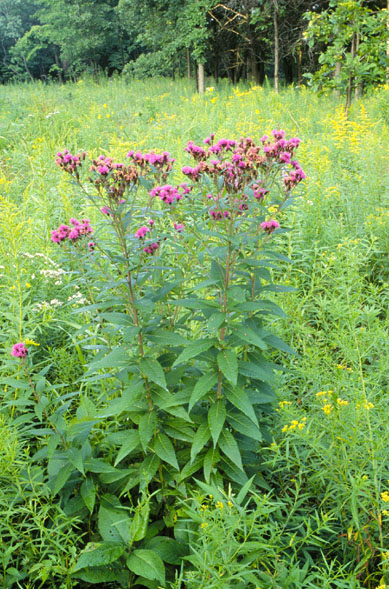
Arkansas ironweed is a flowering plant with pink-purple flowers. The species occurs in the south-central United States. It is recognizable by its long, thin, curling involucral bracts.
Written 27 November 2026 from the sources listed below. Each statement was checked against the passage it cites; statements that could not be supported were removed.
Appearance
Arkansas ironweed has pink-purple flowers and is usually smooth and hairless. It is recognizable by its long, thin, curling involucral bracts.[1][2][3]
The plant typically reaches 4–6 feet (1.2–1.8 m) in height and grows 3–4 feet (0.91–1.22 m) wide.[4][5]
Habitat
Arkansas ironweed occurs in the south-central United States.[6]
Reproduction and life cycle
Arkansas ironweed flowers from August through September. It is pollinated by insects, including bees, butterflies, and skippers.[7][8]
Diet
The aphid Aphis vernoniae feeds on the plant's juices, and various moth caterpillars feed on the species.[9][10]
Birds do not feed on the plant because its seeds are hard and little pollen remains available for hummingbirds. Herbivorous mammals avoid the plant because its foliage is bitter.[11][12]
Behaviour
Bees, butterflies, and skippers collect nectar from Arkansas ironweed. The bee species Melissodes vernoniae frequently visits plants in the genus Vernonia.[13][14]
Conservation
The New York Flora Atlas records Arkansas ironweed as not native and not persisting in New York.[15]
Uses
The cultivar 'Mammuth' has received the Royal Horticultural Society's Award of Garden Merit.[16]
Classification of the Arkansas Ironweed
| Kingdom | Plantae |
|---|---|
| Subkingdom | Pteridobiotina |
| Phylum | Tracheophyta |
| Class | Magnoliopsida |
| Order | Asterales |
| Family | Asteraceae (Composite) |
| Subfamily | Vernonioideae |
| Tribe | Vernonieae |
| Subtribe | Vernoniinae |
| Genus | Vernonia (Ironweed) |
| Species | Vernonia arkansana DC. |
Where the Arkansas Ironweed is found
Checklists and occurrence records place Vernonia arkansana in 1 country across North America. GBIF holds 1,592 georeferenced records of it.
Countries
Regions and cities with the most records
- Missouri, United States 412
- Arkansas, United States 342
- Kansas, United States 119
- Bentonville, United States 55
- Rogers, United States 55
- Oklahoma, United States 53
- Bella Vista, United States 50
- Kirkwood, United States 48
- Concord, United States 44
- Webster Groves, United States 43
- Affton, United States 41
- Lemay, United States 40
- Wildwood, United States 39
- Mehlville, United States 37
- Creve Coeur, United States 32
- Manchester, United States 32
- Oakville, United States 31
- Siloam Springs, United States 30
- St. Louis, United States 30
- Clayton, United States 29
- Overland, United States 29
- University City, United States 29
- Illinois, United States 28
- Ferguson, United States 26
- Maryland Heights, United States 26
- Sedalia, United States 25
- Arnold, United States 24
- Ballwin, United States 24
- Champaign, United States 22
- Urbana, United States 22
- Chesterfield, United States 21
- East Saint Louis, United States 21
- Florissant, United States 21
- Granite City, United States 21
- Hazelwood, United States 21
- Spanish Lake, United States 19
Range as the checklists state it
USA (Arkansas, Kansas, Missouri, Oklahoma)
A number beside a place is its count of GBIF occurrence records. A place without a number comes from a checklist alone. Records show where a species has been observed or collected, which can include escapes and vagrants.
Common names
English
- Arkansas Ironweed
- Ozark Ironweed
Names in 6 other languages
- Finnish
- purppuravernonia
- French
- vernonie de l'Arkansas, vernonie des Ozarks
- German
- Arkansas-Scheinaster
- Russian
- Вернония арканзасская
- Slovak
- vernónia arkansaská
- Swedish
- prärievernonia
Synonyms
2 other scientific names have been used for this species and are now treated as synonyms of Vernonia arkansana.
- Cacalia arkansana (DC.) Kuntze
- Vernonia crinita Raf.
Related species
-
 Giant IronweedVernonia gigantea
-
 New York IronweedVernonia noveboracensis
-
 Western IronweedVernonia baldwinii
-
 Prairie IronweedVernonia fasciculata
-
 Missouri IronweedVernonia missurica
-
 IronweedVernonia galamensis
-
 Narrow Leaf IronweedVernonia angustifolia
-
 Star-flowered VernoniaVernonia colorata
Compare
Questions and answers
What is the scientific name of the Arkansas Ironweed?
The scientific name of the Arkansas Ironweed is Vernonia arkansana. Written with its author, the full name is Vernonia arkansana DC..
Which family does the Arkansas Ironweed belong to?
Vernonia arkansana belongs to the family Asteraceae, in the order Asterales and the class Magnoliopsida.
Where is the Arkansas Ironweed found?
Checklists and occurrence records place Vernonia arkansana in 1 country: United States.
What other names does the Arkansas Ironweed have?
Vernonia arkansana is also known in English as Ozark Ironweed.
Sources
Passages the profile rests on
- The species has pink-purple flowers. Source passage: “The flowers bloom from August to September and are pink-purple coloured.” — English Wikipedia
- The species is recognizable by its long, thin, curling involucral bracts. Source passage: “easily recognized by its long, thin, curling involucral bracts.” — mdc.mo.gov
- The plant is usually smooth and hairless. Source passage: “It is also usually a smooth, hairless” — mdc.mo.gov
- The plant typically reaches 4–6 feet (1.2–1.8 m) in height. Source passage: “The plant is 4–6 feet (1.2–1.8 m) high” — English Wikipedia
- The plant typically grows 3–4 feet (0.91–1.22 m) wide. Source passage: “3–4 feet (0.91–1.22 m) wide.” — English Wikipedia
- The species occurs in the south-central United States. Source passage: “found in south-central United States.” — English Wikipedia
- The species is pollinated by insects including bees, butterflies, and skippers. Source passage: “The plant is pollinated by various insects such as bees, butterflies, and skippers.” — English Wikipedia
- The species flowers from August through September. Source passage: “The flowers bloom from August to September” — English Wikipedia
- The aphid Aphis vernoniae feeds on the plant's juices. Source passage: “Aphis vernoniae, an aphid that prefers to suck on juice of the species.” — English Wikipedia
- Various moth caterpillars feed on the species. Source passage: “Various caterpillars of moths also enjoy the feeding.” — English Wikipedia
- Birds do not feed on the plant because its seeds are hard and little pollen remains available for hummingbirds. Source passage: “Birds on the other hand, don't feed on it, due to hard seeds, and small amount of pollen left (for hummingbirds).” — English Wikipedia
- Herbivorous mammals avoid the plant because its foliage is bitter. Source passage: “Herbevorian mammals also avoid the plant due to the bitterness of its foliage.” — English Wikipedia
- Bees, butterflies, and skippers also collect nectar from the species. Source passage: “The same fauna representatives also collect nectar.” — English Wikipedia
- The bee species Melissodes vernoniae frequently visits plants in the genus Vernonia. Source passage: “Bees like Melissodes vernoniae are frequent visitors to Vernonia plants in general.” — English Wikipedia
- The New York Flora Atlas records the species as not native and not persisting in New York. Source passage: “Vernonia arkansana, Ozark ironweed, Not Native, Not Persisting” — newyork.plantatlas.usf.edu
- The cultivar 'Mammuth' has received the Royal Horticultural Society's Award of Garden Merit. Source passage: “The cultivar 'Mammuth' is a recipient of the Royal Horticultural Society's Award of Garden Merit.” — English Wikipedia
Data
- Catalogue of Life, 2026-10-16 XR cc by
- Global Biodiversity Information Facility CC BY 4.0
- Wikidata CC0
- GeoNames CC BY 4.0
- Wikimedia Commons per image; credit shown with each image
- Within the Catalogue of Life, this name comes from Synonymic Checklists of the Vascular Plants of the World cc by
References
- DC. (1838). Prodr. [A.P. de Candolle] 7: 264 (1838). where the name was published
This species in other databases
- Catalogue of Life 5B4GD
- Wikidata Q672677
- iNaturalist 170173
- World Flora Online wfo-0000042710
- GRIN 312698
Page built on 29 November 2026. See how the catalog is made and all sources and licences.
Cite this page
ScientificNames.org. (2026). Vernonia arkansana (Arkansas Ironweed). Retrieved November 29, 2026, from https://scientificnames.org/species/vernonia-arkansana
“Vernonia arkansana (Arkansas Ironweed).” ScientificNames.org, 2026, scientificnames.org/species/vernonia-arkansana. Accessed 29 Nov. 2026.
ScientificNames.org. “Vernonia arkansana (Arkansas Ironweed).” Accessed November 29, 2026. https://scientificnames.org/species/vernonia-arkansana.
@misc{scientificnames_vernonia_arkansana_arkansas_ironweed,
  author = {{ScientificNames.org}},
  title = {Vernonia arkansana (Arkansas Ironweed)},
  year = {2026},
  url = {https://scientificnames.org/species/vernonia-arkansana},
  note = {Accessed 2026-11-29}
}