Species · Insects
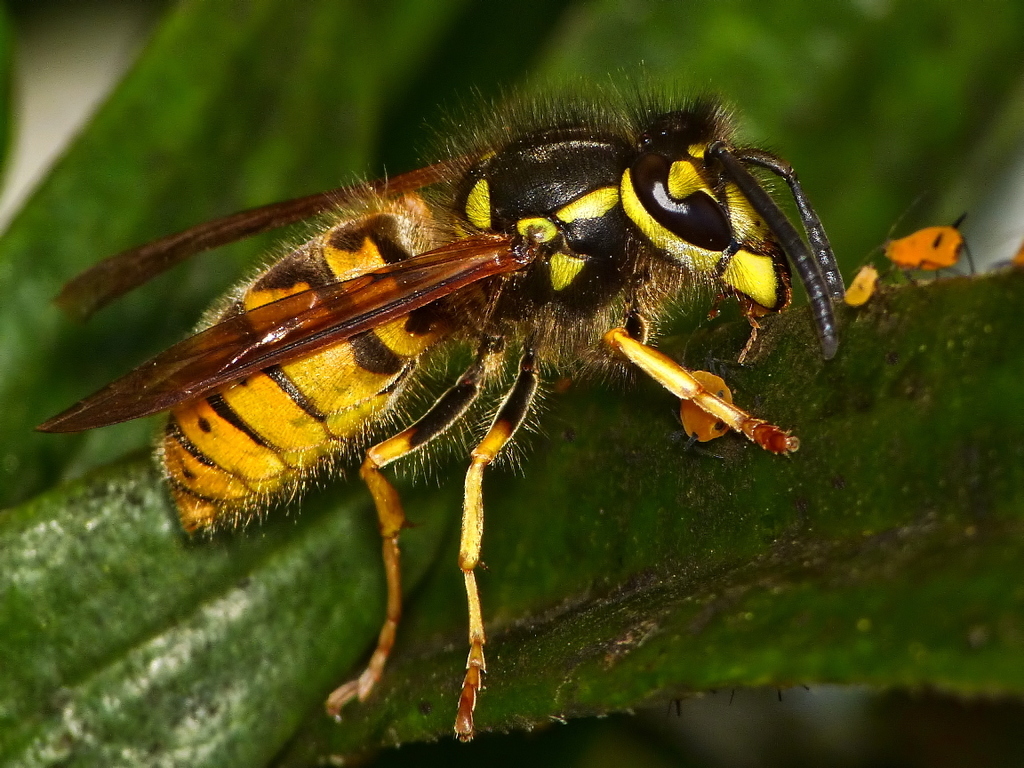
German Yellowjacket Vespula germanica
The scientific name of the German Yellowjacket is Vespula germanica. It is a species of insect in the family Vespidae (hornets), order Hymenoptera. The name dates from 1793.
- Scientific name
- Vespula germanica (Fabricius, 1793)
- Common name
- German Yellowjacket
- Genus
- Vespula
- Family
- Vespidae (Hornets)
- Order
- Hymenoptera
- Class
- Insecta
- Recorded in
- 52 countries
- Name status
- accepted in the Catalogue of Life
Overview
The species is native to Europe, northern Africa and temperate Asia and has established invasive populations in Argentina and Australia.
Written 26 November 2026 from the sources listed below. Each statement was checked against the passage it cites; statements that could not be supported were removed.
Similar species
The common wasp (Vespula vulgaris) is a close morphological lookalike of the German Yellowjacket.[1]
Appearance
Workers are approximately 13 mm long, while queens are approximately 18 mm long. The reported average mass of an individual wasp is 74.1 ± 9.6 mg.[2][3][4]
Habitat
In its native range, the species usually builds nests underground. Some nests are constructed above ground in artificial structures.[5][6]
In North America, the species commonly nests in attics, wall cavities and other open spaces within buildings.[7]
Its nest consists of horizontal combs enclosed within a paper envelope that is typically grey to brown. Nests are constructed from chewed plant fibres mixed with saliva.[8][9]
Diet
The German Yellowjacket consumes carrion, live arthropods, fruit, honeydew, nectar, small prey, processed human food and garbage.[10][11]
The species frequently scavenges dead honey bees near beehives and can prey on adult honey bees and honey bee brood.[12][13]
The species frequently preys on native insects and scavenges dead animal carcasses and discarded human food.[14]
Behaviour
Foragers associate local visual, spatial and odour cues with particular food sources. They are attracted to food sources where other members of their species are already present.[15][16]
Rain, temperature extremes and low-light conditions such as fog reduce daily foraging activity. Competition between individuals during feeding becomes more frequent when the food resource is fresh.[17][18]
When two wasps compete for food, the individual that reaches the resource first frequently wins. Workers may defend food resources aggressively against other members of their species.[19][20]
Workers typically perform nest work, pulp collection, carbohydrate collection and protein collection in that sequence. Approximately 61 percent of observed workers perform more than two different tasks during their lifetimes.[21][22]
Reproduction and life cycle
A single queen usually initiates a new nest in spring. Queens typically mate with between one and seven males.[23][24]
New queens and males leave the nest to mate in autumn. New queens overwinter in dry, protected locations.[25][26]
An overwintering queen establishes a new nest independently in spring. The first generation of workers assumes nest construction and foraging duties after emerging.[27][28]
Old queens die in autumn as the colony collapses. Male wasps die soon after mating, while workers and remaining brood usually die as food availability declines and cold weather begins.[29][30][31]
Conservation
In New Zealand, the species reduces the honeydew available to native birds in beech forests.[32]
The species can cause economic losses to beekeeping through damaged hives and reduced productivity.[33]
Classification of the German Yellowjacket
| Kingdom | Animalia |
|---|---|
| Phylum | Arthropoda |
| Subphylum | Hexapoda |
| Class | Insecta (Insect) |
| Order | Hymenoptera (Ants) |
| Suborder | Apocrita (Ants) |
| Infraorder | Aculeata |
| Superfamily | Vespoidea (Vespoid Wasps) |
| Family | Vespidae (Hornets) |
| Subfamily | Vespinae |
| Genus | Vespula (Yellow Jackets) |
| Species | Vespula germanica (Fabricius, 1793) |
Where the German Yellowjacket is found
Checklists and occurrence records place Vespula germanica in 52 countries. GBIF holds 69,580 georeferenced records of it.
Countries
- Aland Islands 21
- Albania 31
- Australia 4,370
- Austria 2,416
- Belarus 62
- Belgium 1,845
- Bosnia and Herzegovina 12
- Bulgaria 136
- Canada 4,884
- Chile 655
- Croatia 165
- Cyprus 23
- Czechia 301
- Denmark 324
- Estonia 321
- Finland 692
- France 2,853
- Germany 9,643
- Gibraltar 5
- Greece 813
- Hungary 371
- Ireland 278
- Italy 1,464
- Jersey 16
- Kosovo 4
- Latvia 19
- Liechtenstein 20
- Lithuania 40
- Luxembourg 644
- Malta 20
- Mexico 3
- Moldova 12
- Montenegro 34
- New Zealand 2,219
- North Macedonia 52
- Norway 837
- Poland 1,089
- Portugal 914
- Romania 146
- Russia 1,029
- Serbia 422
- Slovakia 65
- Slovenia 18
- South Africa 627
- Spain 4,234
- Sweden 3,087
- Switzerland 3,093
- The Netherlands 3,201
- Turkey 539
- Ukraine 479
- United Kingdom 7,304
- United States 7,728
Regions and cities with the most records
- England, United Kingdom 5,805
- Ontario, Canada 3,357
- North Rhine-Westphalia, Germany 2,185
- New York, United States 1,791
- Victoria, Australia 1,762
- Hesse, Germany 1,621
- Willowdale, Canada 1,306
- Thornhill, Canada 1,291
- Lower Saxony, Germany 1,035
- Baden-Wurttemberg, Germany 1,027
- Vaughan, Canada 1,011
- Richmond Hill, Canada 947
- New South Wales, Australia 937
- Markham, Canada 908
- Pennsylvania, United States 814
- Bavaria, Germany 807
- Manhattan, United States 768
- Ohio, United States 758
- Hoboken, United States 747
- Union City, United States 747
- West New York, United States 747
- North Bergen, United States 739
- New York City, United States 738
- Secaucus, United States 727
- Cliffside Park, United States 725
- Stouffville, Canada 710
- Jersey City, United States 699
- Queens, United States 695
- Aurora, Canada 694
- Whitchurch-Stouffville, Canada 694
- Catalonia, Spain 690
- Brooklyn, United States 675
- Toronto, Canada 666
- Newmarket, Canada 646
- Rheinland-Pfalz, Germany 636
- East Gwillimbury, Canada 633
23 more countries have a few records outside this range
These countries hold a few records of Vespula germanica but lie outside the range the checklists give for it. Such records are often zoo or garden specimens, museum material or vagrants, so the species is not counted as occurring there.
A number beside a place is its count of GBIF occurrence records. A place without a number comes from a checklist alone. Records show where a species has been observed or collected, which can include escapes and vagrants.
Common names
English
- German Yellowjacket
- European Wasp
- German Wasp
Names in 33 other languages
- Arabic
- دبور أوربي
- Asturian
- viéspora alemana
- Catalan
- Vespa Carnissera
- Chinese
- 德国黄胡蜂, 德國黃胡蜂
- Czech
- vosa útočná
- Danish
- Tysk gedehams
- Dutch
- Duitse wesp
- Estonian
- Täpik-maaherilane
- Finnish
- saksanampiainen
- French
- Guêpe européenne, Guêpe germanique
- German
- Deutsche Wespe
- Greek
- Σφήκα η γερμανική
- Hebrew
- צרעה גרמנית
- Hungarian
- Német darázs
- Icelandic
- Húsageitungur
- Italian
- Vespa di terra
- Japanese
- ヨーロッパクロスズメバチ
- Korean
- 독일땅벌
- Lithuanian
- Germaninė vapsva
- Māori
- Pi Waikato
- Norwegian Bokmål
- Tysk veps
- Polish
- Osa dachowa
- Portuguese
- Vespa germânica, Vespa-alemã, Vespa-europeia
- Russian
- Германская оса, Оса германская
- Serbian
- Немачка оса
- Slovak
- osa útočná
- Slovenian
- nemška osa
- Spanish
- Avispa chaqueta amarilla germánica, Avispa germánica, Chaqueta Amarilla
- Swedish
- husgeting, tyskgeting
- Thai
- ต่อเยอรมัน
- Turkish
- Alman Sarı Ceketli
- Ukrainian
- Оса німецька
- bar
- Daitscher Wapps, Deitsche Weschpm, Wappsen, Waspm
Synonyms
2 other scientific names have been used for this species and are now treated as synonyms of Vespula germanica.
- Vespa germanica Fabricius, 1793
- Vespa macularis Olivier, 1792
Related species
-
 Common WaspVespula vulgaris
-
 Eastern YellowjacketVespula maculifrons
-
 Southern YellowjacketVespula squamosa
-
 Western YellowjacketVespula pensylvanica
-
 BlackjacketVespula consobrina
-
 Alaska YellowjacketVespula alascensis
-
 Common Asian YellowjacketVespula flaviceps
-
 Red WaspVespula rufa
Compare
Questions and answers
What is the scientific name of the German Yellowjacket?
The scientific name of the German Yellowjacket is Vespula germanica. Written with its author, the full name is Vespula germanica (Fabricius, 1793).
Which family does the German Yellowjacket belong to?
Vespula germanica belongs to the family Vespidae, in the order Hymenoptera and the class Insecta.
Where is the German Yellowjacket found?
Checklists and occurrence records place Vespula germanica in 52 countries, including Germany, United States, United Kingdom, Canada, Australia and Spain.
What other names does the German Yellowjacket have?
Vespula germanica is also known in English as European Wasp and German Wasp.
How aggressive are German yellow jackets?
Workers may defend food resources aggressively against other members of their species.[20]
What do German yellow jackets eat?
They consume carrion, live arthropods, fruit, honeydew, nectar, small prey, processed human food and garbage. They also scavenge dead honey bees and can prey on adult honey bees and honey bee brood.[10][11][12][13]
What kind of food do yellow jackets eat?
Their diet includes nectar, fruits, honeydew, small prey, animal carrion and human food waste.[11]
What does a yellow jacket live in?
The German Yellowjacket builds nests consisting of horizontal combs enclosed within a paper envelope that is typically grey to brown. Nests are usually underground in its native range, but in North America they commonly occur in attics, wall cavities and other open spaces within buildings.[8][5][7]
Sources
Passages the profile rests on
- The common wasp (Vespula vulgaris) is a close morphological lookalike of the German yellowjacket. Source passage: “It is very similar to the common wasp (V. vulgaris)” — English Wikipedia
- Workers are approximately 13 mm long. Source passage: “Workers are approximately ½ inch (13 mm) in length” — extension.psu.edu
- Queens are approximately 18 mm long. Source passage: “queens are approximately ¾ inch (18 mm) in length.” — extension.psu.edu
- The reported average mass of an individual wasp is 74.1 ± 9.6 mg. Source passage: “has a mass of 74.1 ± 9.6 mg” — English Wikipedia
- In its native range, the species usually builds nests underground. Source passage: “In their native range, German yellowjackets usually build underground nests.” — extension.psu.edu
- Some nests are constructed above ground in artificial structures. Source passage: “A significant portion of nests are found in artificial structures such as attics, and a small portion are found above ground.” — English Wikipedia
- In North America, the species commonly nests in attics, wall cavities and other open spaces within buildings. Source passage: “In North America, nests are usually in attics, wall voids, and other open areas of structures but may be found underground as well.” — extension.psu.edu
- Its nest consists of horizontal combs enclosed within a paper envelope that is typically grey to brown. Source passage: “German yellowjacket nests consist of a series of horizontal combs encased in a paper envelope. The paper is typically grey to brown in color” — extension.psu.edu
- The species constructs nests from chewed plant fibres mixed with saliva. Source passage: “The nest is made from chewed plant fibres, mixed with saliva.” — English Wikipedia
- The species consumes carrion, live arthropods, fruit, honeydew, and processed human food and garbage. Source passage: “They are known to eat carrion, live arthropods (including spiders), fruit, honeydew, and processed human food and garbage.” — English Wikipedia
- Its diet includes nectar, fruits, honeydew, small prey, animal carrion, and human food waste. Source passage: “its eclectic diet includes small prey, vertebrate and invertebrate carrions, food and garbage from humans, and also carbohydrates from nectar, fruits and honeydew” — pmc.ncbi.nlm.nih.gov
- The species frequently scavenges dead honey bees near beehives. Source passage: “Our results confirm the major role of the German yellowjacket as a scavenger, because its diet is based mostly on bee carrions.” — pmc.ncbi.nlm.nih.gov
- German yellowjackets can prey on adult honey bees and honey bee brood. Source passage: “They also steal honey or prey on adult bees and brood” — pmc.ncbi.nlm.nih.gov
- The species frequently preys on native insects and scavenges dead animal carcasses and discarded human food. Source passage: “They frequently prey on native insects and scavenge from dead animal carcasses and discarded human food” — extension.psu.edu
- Foragers associate local visual, spatial and odour cues with particular food sources. Source passage: “show an associative learning between local landmarks (visual, spatial and odor cues) and a certain food source” — pmc.ncbi.nlm.nih.gov
- Foragers are attracted to food sources where other members of their species are already present. Source passage: “V. germanica foragers are attracted by the presence of conspecifics at food sources by local enhancement processes” — pmc.ncbi.nlm.nih.gov
- Rain, temperature extremes and low-light conditions such as fog reduce daily foraging activity. Source passage: “rain, low and high temperatures and low light (e.g. fog) which reduce foraging” — pmc.ncbi.nlm.nih.gov
- Competition between individuals during feeding becomes more frequent when the food resource is fresh. Source passage: “our study also revealed that intraspecific competition events increase when the resource is fresh (predation vs necrophagy)” — pmc.ncbi.nlm.nih.gov
- When two wasps compete for food, the individual that reaches the resource first frequently wins. Source passage: “the winner was frequently the first wasp to reach the resource in both predation and necrophagy events.” — pmc.ncbi.nlm.nih.gov
- Workers may defend food resources aggressively against other members of their species. Source passage: “Intraspecific competition for food as an aggressive interaction between two or more German yellowjackets has also been reported” — pmc.ncbi.nlm.nih.gov
- Workers typically perform nest work, pulp collection, carbohydrate collection and protein collection in that sequence. Source passage: “The typical order of tasks in V. germanica is nest work, pulp foraging, carbohydrate foraging and protein foraging.” — English Wikipedia
- Approximately 61 percent of observed workers perform more than two different tasks during their lifetimes. Source passage: “Approximately 61 percent of the wasps observed perform more than two of these tasks during their lifetimes.” — English Wikipedia
- A single queen usually initiates a new nest in spring. Source passage: “A single queen initiates a nest in the spring by constructing an embryonic nest” — English Wikipedia
- Queens typically mate with between one and seven males. Source passage: “The queens mate with a moderate number of males, usually between one and seven” — English Wikipedia
- New queens and males leave the nest to mate in autumn. Source passage: “New queens and males then leave the nest to mate.” — extension.psu.edu
- New queens overwinter in dry, protected locations. Source passage: “the new queens find a dry, protected place to hibernate through the winter.” — extension.psu.edu
- An overwintering queen establishes a new nest independently in spring. Source passage: “an overwintering queen emerges in the spring to start a new nest by herself.” — extension.psu.edu
- The first generation of workers assumes nest construction and foraging duties after emerging. Source passage: “Once the first generation of workers emerge, they take over nest-building and foraging duties.” — extension.psu.edu
- The old queens die in autumn as the colony collapses. Source passage: “In the fall, the new queens begin hibernation, while the old queens die off and the colony collapses.” — English Wikipedia
- Male wasps die soon after mating. Source passage: “The males die soon after mating” — extension.psu.edu
- Workers and remaining brood usually die as food availability declines and cold weather begins. Source passage: “the workers and remaining brood die off due to the declining availability of food and the onset of cold weather.” — extension.psu.edu
- In New Zealand, the species reduces the honeydew available to native birds in beech forests. Source passage: “This has a serious effect on forest ecology, as less honeydew remains available for native birds.” — English Wikipedia
- The species can cause economic losses to beekeeping through damaged hives and reduced productivity. Source passage: “the economic damage caused by this wasp on beekeeping is due to the costs incurred for destroyed or damaged hives (approx. 9% of the total number of hives) and to productivity losses” — pmc.ncbi.nlm.nih.gov
Data
- Catalogue of Life, 2026-10-16 XR cc by
- Global Biodiversity Information Facility CC BY 4.0
- Wikidata CC0
- GeoNames CC BY 4.0
- iNaturalist per image; credit shown with each image
- Within the Catalogue of Life, this name comes from Vespidae based on Zoological-Botanical Database cc by
References
- Soika, A. G. (1962). The 3rd Danish Expedition to central Asia. Zoological Results 29. Diploptera (Insecta) from Afghanistan. Vidensk.Meddr.dansk.naturh.Foren. 124: (1962): Vidensk. Meddel., Dansk Naturh. Foren. Copenhagen. where the name was published
This species in other databases
Page built on 28 November 2026. See how the catalog is made and all sources and licences.
Cite this page
ScientificNames.org. (2026). Vespula germanica (German Yellowjacket). Retrieved November 28, 2026, from https://scientificnames.org/species/vespula-germanica
“Vespula germanica (German Yellowjacket).” ScientificNames.org, 2026, scientificnames.org/species/vespula-germanica. Accessed 28 Nov. 2026.
ScientificNames.org. “Vespula germanica (German Yellowjacket).” Accessed November 28, 2026. https://scientificnames.org/species/vespula-germanica.
@misc{scientificnames_vespula_germanica_german_yellowjacket,
  author = {{ScientificNames.org}},
  title = {Vespula germanica (German Yellowjacket)},
  year = {2026},
  url = {https://scientificnames.org/species/vespula-germanica},
  note = {Accessed 2026-11-28}
}