Species · Flowering plants
North California Grape Vitis californica
The scientific name of the North California Grape is Vitis californica. It is a species of flowering plant in the family Vitaceae (grape family), order Vitales.
- Scientific name
- Vitis californica Benth.
- Common name
- North California Grape
- Genus
- Vitis
- Family
- Vitaceae (Grape Family)
- Order
- Vitales
- Class
- Magnoliopsida
- Recorded in
- 1 country
- Name status
- accepted in the Catalogue of Life

Overview
The species occurs across much of California and southwestern Oregon. The vine produces small, often sour but edible purple grapes in autumn.
Written 26 November 2026 from the sources listed below. Each statement was checked against the passage it cites; statements that could not be supported were removed.
Appearance
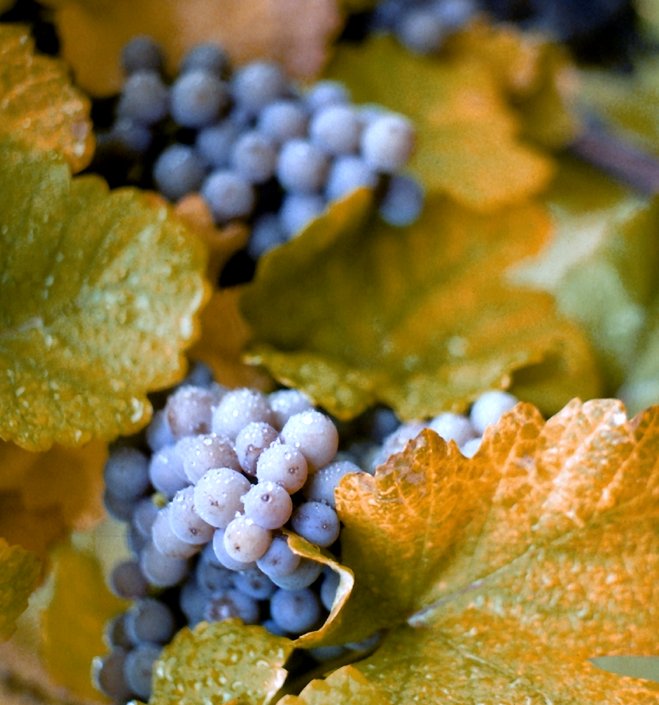
The leaves turn orange and yellow in autumn before falling. The plant produces small, often sour but edible purple grapes in autumn.[1][2]
Habitat
The species grows in canyons, near springs, and alongside streams. It commonly occurs in riparian areas because it thrives in damp conditions.[3][4]
It occurs on both slopes and flat ground in wetland and forested habitats. It prefers heavier soils.[5][6]
Behaviour
The vine climbs other plants or spreads across the ground. It can grow to more than 10 metres in length and is described as strong and robust.[7][8][9]
Mature plants can withstand periods of dry conditions.[10]
Reproduction and life cycle
The species typically flowers during May and June.[11]
Diet
The grapes provide an important food source for various wild animals, particularly birds.[12]
Uses
The edible grapes can be used to make wine or jelly. The species is also used as rootstock for wine grapes by viticulturists worldwide.[2][13][14]
The species is cultivated as an ornamental garden plant and is commonly planted in native plant gardens. Once established in native plant gardens, the vine thrives without summer watering.[15][16][17]
The foliage provides thick cover for wildlife.[18]
Similar species
Roger's Red is a hybrid of a wine grape and Vitis californica. It develops brilliant red coloration in autumn.[19][20]
The cultivar Walker Ridge develops yellow leaves in autumn.[21]
Conservation
The species can become a noxious weed in areas outside its native range.[22]
Classification of the North California Grape
| Kingdom | Plantae |
|---|---|
| Subkingdom | Pteridobiotina |
| Phylum | Tracheophyta |
| Class | Magnoliopsida |
| Order | Vitales |
| Family | Vitaceae (Grape Family) |
| Subfamily | Vitoideae |
| Tribe | Viteae |
| Genus | Vitis (Grape) |
| Species | Vitis californica Benth. |
Where the North California Grape is found
Checklists and occurrence records place Vitis californica in 1 country across North America. GBIF holds 3,625 georeferenced records of it.
Countries
Regions and cities with the most records
- California, United States 2,475
- Rancho Cordova, United States 270
- Carmichael, United States 269
- Antelope, United States 266
- Arden-Arcade, United States 266
- Foothill Farms, United States 266
- North Highlands, United States 262
- Rosemont, United States 255
- Fair Oaks, United States 251
- Danville, United States 246
- Lafayette, United States 244
- Walnut Creek, United States 244
- Pleasant Hill, United States 243
- Concord, United States 241
- San Ramon, United States 239
- Bay Point, United States 236
- Pittsburg, United States 229
- Citrus Heights, United States 222
- Orangevale, United States 221
- Moraga, United States 217
- Rio Linda, United States 217
- Folsom, United States 206
- Sacramento, United States 206
- Oregon, United States 205
- Chico, United States 202
- Florin, United States 202
- West Sacramento, United States 198
- Antioch, United States 196
- Paradise, United States 195
- Roseville, United States 186
- Vineyard, United States 172
- Granite Bay, United States 148
- El Dorado Hills, United States 137
- Rocklin, United States 137
- Redding, United States 116
- Cameron Park, United States 113
1 more country has a few records outside this range
These countries hold a few records of Vitis californica but lie outside the range the checklists give for it. Such records are often zoo or garden specimens, museum material or vagrants, so the species is not counted as occurring there.
Range as the checklists state it
USA (California, Oregon)
A number beside a place is its count of GBIF occurrence records. A place without a number comes from a checklist alone. Records show where a species has been observed or collected, which can include escapes and vagrants.
Common names
English
- North California Grape
- Pacific Grape
Related species
-
 European GrapeVitis vinifera
-
 Muscadine GrapeVitis rotundifolia
-
 Fox GrapeVitis labrusca
-
 Riverbank GrapeVitis riparia
-
 Crimson-glory-vineVitis coignetiae
-
 Frost GrapeVitis vulpina
-
 Bunch GrapeVitis aestivalis
-
 Amur GrapeVitis amurensis
Compare
Questions and answers
What is the scientific name of the North California Grape?
The scientific name of the North California Grape is Vitis californica. Written with its author, the full name is Vitis californica Benth..
Which family does the North California Grape belong to?
Vitis californica belongs to the family Vitaceae, in the order Vitales and the class Magnoliopsida.
Where is the North California Grape found?
Checklists and occurrence records place Vitis californica in 1 country: United States.
What other names does the North California Grape have?
Vitis californica is also known in English as Pacific Grape.
Can you eat California wild grapes?
The North California grape produces small, often sour but edible purple grapes in autumn.[2]
What grapes are native to California?
The North California grape (Vitis californica Benth.) occurs across much of California, including the Coast Ranges, Klamath Mountains, Cascade Range, Sierra Nevada, and Central Valley.[23][24][25][26]
What animals in the wild eat grapes?
Various wild animals eat the grapes of the North California grape, particularly birds.[12]
Sources
Passages the profile rests on
- Its leaves turn orange and yellow in autumn before falling. Source passage: “In autumn, the leaves turn orange and yellow before falling.” — English Wikipedia
- The plant produces small, often sour but edible purple grapes in autumn. Source passage: “Bunches of small and often sour but edible purple grapes hang from the vines in autumn” — English Wikipedia
- The species grows in canyons, near springs, and alongside streams. Source passage: “The plant grows in canyons, alongside springs, and streams.” — English Wikipedia
- The species commonly occurs in riparian areas because it thrives in damp conditions. Source passage: “It tends to thrive in damp conditions and so it is common in riparian areas.” — English Wikipedia
- The species occurs on both slopes and flat ground in wetland and forested habitats. Source passage: “It can be found on slopes as well as flat ground in wetland and forested habitats.” — English Wikipedia
- The species prefers heavier soils. Source passage: “It prefers heavier soils.” — English Wikipedia
- The vine can grow to more than 10 metres in length. Source passage: “can grow to over 10 metres (33 ft) in length.” — English Wikipedia
- The vine climbs other plants or spreads across the ground. Source passage: “It climbs on other plants or covers the ground” — English Wikipedia
- The species is described as strong and robust. Source passage: “The wild grape is strong and robust” — English Wikipedia
- Mature plants can withstand periods of dry conditions. Source passage: “Once matured like most other native California plants it can withstand periods of dry conditions.” — English Wikipedia
- The species typically flowers during May and June. Source passage: “It typically flowers in May and June.” — English Wikipedia
- The grapes provide an important food source for various wild animals, particularly birds. Source passage: “The grapes provide an important food source for a variety of wild animals, especially birds” — English Wikipedia
- The edible grapes can be used to make wine or jelly. Source passage: “which can be made into wine or jelly.” — English Wikipedia
- The species is used as rootstock for wine grapes by viticulturists worldwide. Source passage: “viticulturists worldwide often use it as rootstock for their wine grapes.” — English Wikipedia
- The species is cultivated as an ornamental garden plant. Source passage: “Vitis californica is cultivated as an ornamental plant.” — English Wikipedia
- The species is commonly planted in native plant gardens. Source passage: “This vine is commonly used in native plant gardens” — English Wikipedia
- Once established in native plant gardens, the vine thrives without summer watering. Source passage: “where once established it thrives without summer water.” — English Wikipedia
- The foliage provides thick cover for wildlife. Source passage: “and the foliage provides thick cover.” — English Wikipedia
- The cultivar Roger's Red is a hybrid of a wine grape and Vitis californica. Source passage: “It is a hybrid with a wine grape, × Vitis vinifera cv. Alicante Bouschet.” — English Wikipedia
- The cultivar Roger's Red develops brilliant red coloration in autumn. Source passage: “The cultivar 'Roger's Red' (named for noted horticulturist Roger Raiche) turns brilliant red in fall.” — English Wikipedia
- The cultivar Walker Ridge develops yellow leaves in autumn. Source passage: “The cultivar 'Walker Ridge' turns yellow in the autumn.” — English Wikipedia
- The species can become a noxious weed in areas outside its native range. Source passage: “In some areas where the plant is not native it has the capacity to become a noxious weed.” — English Wikipedia
- The species is distributed across much of California and southwestern Oregon. Source passage: “The species is widespread across much of California as well as southwestern Oregon.” — English Wikipedia
- The species occurs along the Coast Ranges from Douglas County, Oregon, to San Luis Obispo County, California. Source passage: “along the Coast Ranges from Douglas County, Oregon, south to San Luis Obispo County, California;” — English Wikipedia
- The species occurs in the Klamath Mountains, Cascade Range, and Sierra Nevada from Siskiyou to Kern counties in California. Source passage: “in the Klamath Mountains, the Cascade Range, and the Sierra Nevada from Siskiyou to Kern counties, California;” — English Wikipedia
- The species also occurs in California's Central Valley. Source passage: “and in the Central Valley.” — English Wikipedia
Data
- Catalogue of Life, 2026-10-16 XR cc by
- Global Biodiversity Information Facility CC BY 4.0
- Wikidata CC0
- GeoNames CC BY 4.0
- Wikimedia Commons per image; credit shown with each image
- Within the Catalogue of Life, this name comes from Synonymic Checklists of the Vascular Plants of the World cc by
References
- Benth. Bot. Voy. Sulphur [Bentham] 10 (1844). where the name was published
This species in other databases
Page built on 29 November 2026. See how the catalog is made and all sources and licences.
Cite this page
ScientificNames.org. (2026). Vitis californica (North California Grape). Retrieved November 29, 2026, from https://scientificnames.org/species/vitis-californica
“Vitis californica (North California Grape).” ScientificNames.org, 2026, scientificnames.org/species/vitis-californica. Accessed 29 Nov. 2026.
ScientificNames.org. “Vitis californica (North California Grape).” Accessed November 29, 2026. https://scientificnames.org/species/vitis-californica.
@misc{scientificnames_vitis_californica_north_california_grape,
  author = {{ScientificNames.org}},
  title = {Vitis californica (North California Grape)},
  year = {2026},
  url = {https://scientificnames.org/species/vitis-californica},
  note = {Accessed 2026-11-29}
}