Species · Mammals
Common Wombat Vombatus ursinus
The scientific name of the Common Wombat is Vombatus ursinus. It is a species of mammal in the family Vombatidae (wombat), order Diprotodontia. The name dates from 1800.
- Scientific name
- Vombatus ursinus (Shaw, 1800)
- Common name
- Common Wombat
- Genus
- Vombatus
- Family
- Vombatidae (Wombat)
- Order
- Diprotodontia
- Class
- Mammalia
- Red List category
- LC Least Concern
- Recorded in
- 1 country
- Name status
- accepted in the Catalogue of Life

Overview
Vombatus ursinus occurs in Queensland, New South Wales, Victoria, South Australia, Tasmania and Flinders Island. It has a short, stocky, barrel-shaped body, a large hairless nose and powerful limbs adapted to burrowing.
Written 26 November 2026 from the sources listed below. Each statement was checked against the passage it cites; statements that could not be supported were removed.
Appearance
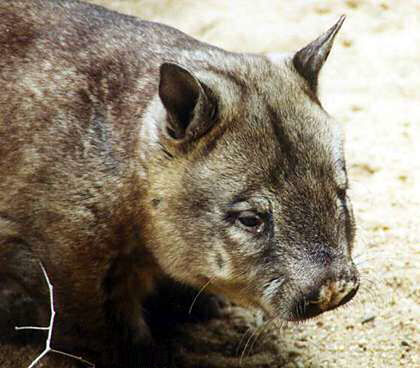
The Common Wombat has a short, stocky, barrel-shaped body and a large, hairless nose with grainy skin. Its thick, coarse coat ranges in colour from glossy black and grey to brown, sandy and cream.[1][2][3]
Its ears are short and slightly rounded. Its tail is approximately 25 mm long and concealed by its fur.[4][5]
Mainland individuals average 985 mm in head-and-body length, with a recorded range of 840–1150 mm. Their average weight is 26 kg, with a recorded range of 22–39 kg.[6][7]
Tasmanian and island populations are generally smaller than mainland populations. Females tend to be slightly larger than males of the same age.[8][9]
Habitat
The Common Wombat inhabits grasslands, low open shrublands, open forests and open heathlands. Its main habitat consists of temperate forest-covered areas in southeastern Australia.[10][11]
In South Australia and Tasmania, it also inhabits woodland, coastal scrub and heathland at lower elevations. It generally avoids rainforests and frequently occurs in mountainous areas.[12][13]
In southern Queensland and northern New South Wales, it occurs only in sclerophyll forest above 600 m. In New South Wales, it mainly inhabits wet, partly forested coastal areas, ranges and western slopes.[14][15]
It prefers digging its main shelters on slopes above creeks and gullies.[16]
Diet
The Common Wombat primarily feeds on fibrous native grasses, sedges and rushes. It favours tussock grass in forest habitats and kangaroo grass and wallaby grass in open pastoral habitats.[17][18]
Its dietary preferences vary with season and habitat.[19]
Behaviour
The Common Wombat is primarily nocturnal and emerges from its burrow to graze during cooler nighttime temperatures. During colder seasons, individuals may sunbathe during daylight hours.[20][21]
Individuals use scent marking to maintain territorial boundaries. They may travel several kilometres while searching for food and repeatedly visit the same feeding locations.[22][23]
Common Wombat burrows can provide shelter and habitat for other animal species. Individuals defend themselves inside burrows by crushing an attacking predator's head against the burrow roof or wall with their rump.[24][25]
Reproduction and life cycle
Females generally produce one offspring approximately every two years. Gestation lasts approximately one month.[26][27]
Young individuals generally become independent at approximately 18–20 months of age. Individuals reach sexual maturity at approximately two years of age.[28][29]
Conservation
Habitat reduction, road mortality and sarcoptic mange are identified as major threats. Sarcoptic mange is caused by the mite Sarcoptes scabiei.[30][31]
The species is protected under the New South Wales Biodiversity Conservation Act 2016.[32]
Similar species
The northern and southern hairy-nosed wombats have longer, more square-shaped muzzles than the Common Wombat.[33]
Classification of the Common Wombat
| Kingdom | Animalia |
|---|---|
| Phylum | Chordata |
| Subphylum | Vertebrata |
| Infraphylum | Gnathostomata |
| Parvphylum | Osteichthyes |
| Megaclass | Tetrapoda |
| Class | Mammalia (Mammal) |
| Subclass | Theria |
| Infraclass | Metatheria |
| Order | Diprotodontia |
| Suborder | Vombatiformes |
| Family | Vombatidae (Wombat) |
| Genus | Vombatus (Common Wombat) |
| Species | Vombatus ursinus (Shaw, 1800) |
Where the Common Wombat is found
Checklists and occurrence records place Vombatus ursinus in 1 country across Oceania. GBIF holds 143,682 georeferenced records of it.
Countries
Regions and cities with the most records
- New South Wales, Australia 109,532
- Victoria, Australia 26,805
- Tasmania, Australia 4,937
- Frankston East, Australia 1,770
- Tuggeranong, Australia 1,249
- Batemans Bay, Australia 1,049
- Australian Capital Territory, Australia 991
- Canberra, Australia 968
- Cessnock, Australia 798
- Wollongong, Australia 761
- South Australia, Australia 636
- Goulburn, Australia 460
- Bathurst, Australia 421
- Central Coast, Australia 419
- Balwyn North, Australia 408
- Burwood, Australia 302
- Warragul, Australia 283
- Maitland, Australia 240
- Traralgon, Australia 237
- Wallan, Australia 213
- Queensland, Australia 189
- Hornsby, Australia 158
- Orange, Australia 150
- Wodonga, Australia 148
- Bairnsdale, Australia 147
- Bacchus Marsh, Australia 146
- Muswellbrook, Australia 143
- Liverpool, Australia 139
- Melbourne, Australia 136
- Parramatta, Australia 121
- Newcastle, Australia 71
- Launceston, Australia 66
- Sydney, Australia 66
- Mount Gambier, Australia 52
- Northern Territory, Australia 30
- Dubbo, Australia 29
2 more countries have a few records outside this range
These countries hold a few records of Vombatus ursinus but lie outside the range the checklists give for it. Such records are often zoo or garden specimens, museum material or vagrants, so the species is not counted as occurring there.
Range as the checklists state it
Australia
A number beside a place is its count of GBIF occurrence records. A place without a number comes from a checklist alone. Records show where a species has been observed or collected, which can include escapes and vagrants.
Common names
English
- Common Wombat
- Bare-nosed Wombat
- Coarse-haired Wombat
Names in 21 other languages
- Arabic
- ومبت شائع
- Chinese
- 袋熊
- Czech
- vombat obecný
- Danish
- Almindelig wombat
- Dutch
- Wombat
- Finnish
- vompatti
- French
- Wombat Commun
- German
- Nacktnasenwombat
- Greek
- Φασκωλόμυς
- Italian
- Vombato comune, Vombato dal pelo ruvido
- Japanese
- ウォンバット
- Korean
- 애기웜뱃
- Norwegian Bokmål
- Nakensnutevombat, Slettevombat, Vanlig Vombat
- Polish
- Wombat tasmański
- Portuguese
- Vombate, Vombate comum
- Russian
- Короткошёрстный вомбат
- Spanish
- Uómbat Común, Uómbat de Pelo Áspero
- Swedish
- nakennosvombat
- Turkish
- Vombat
- Ukrainian
- Вомбат короткошерстий
- arg
- Vombat común
Synonyms
2 other scientific names have been used for this species and are now treated as synonyms of Vombatus ursinus.
- Didelphis ursina Shaw, 1800
- Phascolomis wombat Lesueur & Petit, 1807
Subspecies and varieties
- Vombatus ursinus hirsutus (Hirsute Wombat) subspecies
- Vombatus ursinus tasmaniensis (Tasmanian Wombat) subspecies
- Vombatus ursinus ursinus (Flinders Wombat) subspecies
Related species
Compare
Questions and answers
What is the scientific name of the Common Wombat?
The scientific name of the Common Wombat is Vombatus ursinus. Written with its author, the full name is Vombatus ursinus (Shaw, 1800).
Which family does the Common Wombat belong to?
Vombatus ursinus belongs to the family Vombatidae, in the order Diprotodontia and the class Mammalia.
Where is the Common Wombat found?
Checklists and occurrence records place Vombatus ursinus in 1 country: Australia.
What is the conservation status of the Common Wombat?
The IUCN Red List category recorded for Vombatus ursinus is Least Concern (LC).
What other names does the Common Wombat have?
Vombatus ursinus is also known in English as Bare-nosed Wombat and Coarse-haired Wombat.
Sources
Passages the profile rests on
- The species has a short, stocky, barrel-shaped body adapted to burrowing. Source passage: “A short, stocky, barrel-shaped animal with physical characteristics that reflect its burrowing nature.” — australian.museum
- Its nose is large and hairless, with grainy skin. Source passage: “has a large, naked snout covered in grainy skin.” — environment.nsw.gov.au
- Its coat is thick and coarse, with colours ranging from glossy black and grey to brown, sandy and cream. Source passage: “Colour of the wombat’s coarse coat varies from glossy black, dark grey, silver-grey, chocolate brown, grey-brown, sandy and cream.” — australian.museum
- Its ears are short and slightly rounded. Source passage: “short, slightly rounded ears.” — australian.museum
- Its tail is approximately 25 mm long and concealed by its fur. Source passage: “a very small tail (~25 mm) hidden by fur.” — australian.museum
- Mainland individuals average 985 mm in head-and-body length, with a recorded range of 840–1150 mm. Source passage: “Average head and body length of mainland wombat is 985 mm (840-1150 mm).” — australian.museum
- Mainland individuals average 26 kg in weight, with a recorded range of 22–39 kg. Source passage: “Weight is 26 kg (22-39 kg).” — australian.museum
- Tasmanian and island populations are generally smaller than mainland populations. Source passage: “Tasmanian and island species are generally smaller.” — australian.museum
- Females tend to be slightly larger than males of the same age. Source passage: “Females tend to be slightly larger than males of the same age” — australian.museum
- The species inhabits grasslands, low open shrublands, open forests and open heathlands. Source passage: “Habitats grassland, low open shrubland, open forest, open heath” — australian.museum
- Its main habitat consists of temperate forest-covered areas in southeastern Australia. Source passage: “The main habitat for the Bare-nosed Wombat is the temperate forest-covered areas of southeastern Australia.” — australian.museum
- In South Australia and Tasmania, it also inhabits woodland, coastal scrub and heathland at lower elevations. Source passage: “In South Australia and Tasmania it also occurs at lower altitudes in more open vegetation – woodland, coastal scrub and heathland.” — australian.museum
- It generally avoids rainforests and frequently occurs in mountainous areas. Source passage: “The species tends to avoid rainforests and is often found in the mountainous areas.” — australian.museum
- In southern Queensland and northern New South Wales, it occurs only in sclerophyll forest above 600 m. Source passage: “In southern Queensland and northern New South Wales it is found only in sclerophyll forest above 600 m.” — australian.museum
- In New South Wales, it mainly inhabits wet, partly forested coastal areas, ranges and western slopes. Source passage: “The bare-nosed wombat lives mainly in wet, partly forested areas on the coast and on the ranges and western slopes.” — environment.nsw.gov.au
- It prefers digging its main shelters on slopes above creeks and gullies. Source passage: “Wombats prefer to dig their main shelters on slopes above creeks and gullies” — australian.museum
- The species primarily feeds on fibrous native grasses, sedges and rushes. Source passage: “The main food for wombats is fibrous native grasses, sedges and rushes” — australian.museum
- It favours tussock grass in forest habitats and kangaroo grass and wallaby grass in open pastoral habitats. Source passage: “Wombats seem to prefer Tussock Grass in the forest areas, and Kangaroo Grass and Wallaby Grass are favoured in open, more pastoral areas.” — australian.museum
- Its dietary preferences vary with season and habitat. Source passage: “dietary preferences are significant across season and are habitat specific.” — pmc.ncbi.nlm.nih.gov
- The species is primarily nocturnal and emerges from its burrow to graze during cooler nighttime temperatures. Source passage: “Wombats are mainly nocturnal and crepuscular, emerging from their burrows at dusk to graze in the cooler night temperatures.” — animaldiversity.org
- During colder seasons, individuals may sunbathe during daylight hours. Source passage: “However during colder seasons they may be seen sunbathing in the day.” — animaldiversity.org
- Individuals use scent marking to maintain territorial boundaries. Source passage: “The common wombat communicates to conspecifics in a number of ways, mainly through scent marking to maintain territories.” — animaldiversity.org
- Individuals may travel several kilometres while searching for food and repeatedly visit the same feeding locations. Source passage: “When foraging, coarse-haired wombats might travel several kilometers in search of food, often visiting the same sites repeatedly” — animaldiversity.org
- Its burrows can provide shelter and habitat for other animal species. Source passage: “with their burrows providing habitat and refuge for other animals” — pmc.ncbi.nlm.nih.gov
- Individuals defend themselves inside burrows by crushing an attacking predator's head against the burrow roof or wall with their rump. Source passage: “where it can defend itself by crushing a predator’s head with its rump against the roof or wall of the burrow.” — australian.museum
- Females generally produce one offspring approximately every two years. Source passage: “Coarse-haired wombats typically breed and produce one offspring about every two years.” — animaldiversity.org
- Gestation lasts approximately one month. Source passage: “Gestation lasts approximately one month” — animaldiversity.org
- Young individuals generally become independent at approximately 18–20 months of age. Source passage: “The wombat will remain with its mother until about 18 to 20 months of age, until it gains its independence.” — animaldiversity.org
- Individuals reach sexual maturity at approximately two years of age. Source passage: “Both male and female wombats are sexually mature after about 2 years.” — animaldiversity.org
- Habitat reduction, road mortality and sarcoptic mange are identified as major threats to the species. Source passage: “they remain threatened largely due to anthropomorphic factors including habitat reduction, roadkill and sarcoptic mange.” — English Wikipedia
- Sarcoptic mange is caused by the mite Sarcoptes scabiei. Source passage: “It is caused by a mite (Sarcoptes scabiei).” — environment.nsw.gov.au
- The species is protected under the New South Wales Biodiversity Conservation Act 2016. Source passage: “Wombats are protected under the NSW Biodiversity Conservation Act 2016.” — environment.nsw.gov.au
- The northern and southern hairy-nosed wombats have longer, more square-shaped muzzles than this species. Source passage: “The northern and southern hairy nosed wombats tend toward longer muzzles that are more square-like in shape.” — animaldiversity.org
- Its diet can also include dry leaves, stalks and small quantities of tree bark. Source passage: “At times when it is eating grass, a wombat will also eat dry leaves and stalks, and occasionally tear a strip of bark from a tree trunk” — australian.museum
Data
- Catalogue of Life, 2026-10-16 XR cc by
- Global Biodiversity Information Facility CC BY 4.0
- Wikidata CC0
- GeoNames CC BY 4.0
- Wikimedia Commons per image; credit shown with each image
- Within the Catalogue of Life, this name comes from The Integrated Taxonomic Information System cc0
References
- Gen. Zool. Syst. Nat. Hist. vol.1 2, Mammalia p.504 where the name was published
- Nowak, Ronald M. (1991). Walker’s Mammals of the World, Vol. 1, 5th Ed.
- Wilson, Don E., and DeeAnn M. Reeder, eds. (1993). Mammal Species of the World: A Taxonomic and Geographic Reference, 2nd Ed., 3rd Printing.
- Wilson, Don E., and DeeAnn M. Reeder, eds. (2005). Mammal Species of the World: A Taxonomic and Geographic Reference, 3rd Ed., Vols. 1 & 2.
- Wilson, Don E., and Russell A. Mittermeier, eds. (2015). Handbook of the Mammals of the World, Vol. 5. Monotremes and Marsupials.
- Burgin, Connor J., Don E. Wilson, Russell A. Mittermeier, Anthony B. Rylands, et al. (2020). Illustrated Checklist of the Mammals of the World. Vol. 1. Monotremata to Rodentia.
This species in other databases
Page built on 27 November 2026. See how the catalog is made and all sources and licences.
Cite this page
ScientificNames.org. (2026). Vombatus ursinus (Common Wombat). Retrieved November 27, 2026, from https://scientificnames.org/species/vombatus-ursinus
“Vombatus ursinus (Common Wombat).” ScientificNames.org, 2026, scientificnames.org/species/vombatus-ursinus. Accessed 27 Nov. 2026.
ScientificNames.org. “Vombatus ursinus (Common Wombat).” Accessed November 27, 2026. https://scientificnames.org/species/vombatus-ursinus.
@misc{scientificnames_vombatus_ursinus_common_wombat,
  author = {{ScientificNames.org}},
  title = {Vombatus ursinus (Common Wombat)},
  year = {2026},
  url = {https://scientificnames.org/species/vombatus-ursinus},
  note = {Accessed 2026-11-27}
}