Species · Flowering plants
Yellowroot Xanthorhiza simplicissima
The scientific name of the Yellowroot is Xanthorhiza simplicissima. It is a species of flowering plant in the family Ranunculaceae (crowfoot family), order Ranunculales.
- Scientific name
- Xanthorhiza simplicissima Marshall
- Common name
- Yellowroot
- Genus
- Xanthorhiza
- Family
- Ranunculaceae (Crowfoot Family)
- Order
- Ranunculales
- Class
- Magnoliopsida
- Recorded in
- 2 countries
- Name status
- accepted in the Catalogue of Life

Overview
In the wild, yellowroot grows along shaded, moist stream edges in sandy soil under dappled sunlight. Yellowroot has yellow roots and is one of very few genera in Ranunculaceae with woody stems.
Written 27 November 2026 from the sources listed below. Each statement was checked against the passage it cites; statements that could not be supported were removed.
Appearance
Yellowroot has spirally arranged compound leaves divided into five toothed leaflets. The leaves resemble celery leaves and cluster at branch ends.[1][2]
Its flowers are small, star-shaped, and reddish brown to purple brown, with five petals. They grow in broad panicles measuring 6–20 centimetres long.[3][4]
The plant has gray, smooth stems marked by prominent leaf scars. Its new spring growth is maroon and changes to bright green during summer.[5][6]
Autumn foliage can become yellowish, orangish, and brownish, particularly in brighter locations. Although deciduous, its leaves can persist until December.[7][8]
Yellowroot typically reaches 20–70 centimetres in height and rarely reaches 90 centimetres. Its stems can reach 6 millimetres in diameter, and its leaves measure 10–18 centimetres long.[9][10][11]
Its leaflets are approximately two inches long, and its flowers measure up to a quarter-inch across.[12][13]
Habitat
In the wild, yellowroot grows along stream edges in sandy soil under dappled sunlight. Its preferred natural habitat includes shaded, moist streams.[14][15]
Behaviour
Its flowers emerge in early spring before the leaves develop.[16]
Reproduction and life cycle
Yellowroot reproduces asexually by producing numerous underground runners. It also reproduces sexually through seeds.[17][18]
Conservation
Yellowroot is considered endangered in Florida.[19]
Uses
Yellowroot roots and stems are used to produce yellow dye. The dye can change to olive drab when exposed to sunlight.[20][21]
The plant contains berberine, a compound used in traditional and contemporary dyeing and medicinal applications.[22]
Native American cultures traditionally prepared root tea for stomach ulcers, colds, jaundice, and sore mouth or throat. The tea was also traditionally used as an astringent.[23][24]
A Southern folk remedy made from yellowroot has been used for diabetes and hypertension.[25]
Yellowroot is cultivated as an ornamental throughout Arkansas. It makes an effective deciduous groundcover.[26][27]
Classification of the Yellowroot
| Kingdom | Plantae |
|---|---|
| Subkingdom | Pteridobiotina |
| Phylum | Tracheophyta |
| Class | Magnoliopsida |
| Order | Ranunculales |
| Family | Ranunculaceae (Crowfoot Family) |
| Subfamily | Coptidoideae |
| Tribe | Xanthorhizeae |
| Genus | Xanthorhiza (Yellowroot) |
| Species | Xanthorhiza simplicissima Marshall |
Where the Yellowroot is found
Checklists and occurrence records place Xanthorhiza simplicissima in 2 countries across Europe and North America. GBIF holds 5,417 georeferenced records of it.
Countries where it is native or its origin is not stated
Countries where it has been introduced
Regions and cities with the most records
- North Carolina, United States 1,210
- Tennessee, United States 512
- Georgia, United States 457
- Alabama, United States 347
- South Carolina, United States 234
- Kentucky, United States 120
- Asheville, United States 96
- New York, United States 89
- Raleigh, United States 87
- Virginia, United States 84
- Morrisville, United States 79
- Cary, United States 76
- Manhattan, United States 76
- Carrboro, United States 75
- Apex, United States 74
- Cliffside Park, United States 72
- Hoboken, United States 72
- New York City, United States 72
- North Bergen, United States 72
- Secaucus, United States 72
- Union City, United States 72
- West New York, United States 72
- Garner, United States 71
- Chapel Hill, United States 70
- Queens, United States 68
- Jersey City, United States 67
- The Bronx, United States 67
- Kearny, United States 65
- Bayonne, United States 64
- Brooklyn, United States 64
- Fort Lee, United States 64
- Harrison, United States 64
- Newark, United States 64
- Palisades Park, United States 64
- Chamblee, United States 63
- Rutherford, United States 63
1 more country has a few records outside this range
These countries hold a few records of Xanthorhiza simplicissima but lie outside the range the checklists give for it. Such records are often zoo or garden specimens, museum material or vagrants, so the species is not counted as occurring there.
Range as the checklists state it
Germany [I]; USA (Alabama, Connecticut, Florida, Georgia, Kentucky, Louisiana, Massachusetts, Maryland, Maine, Mississippi, North Carolina, New Jersey, New York, Ohio, Pennsylvania, South Carolina, Tennessee, Texas, Virginia, West Virginia)
A number beside a place is its count of GBIF occurrence records. A place without a number comes from a checklist alone. Records show where a species has been observed or collected, which can include escapes and vagrants.
Common names
English
- Yellowroot
- Shrub Yellowroot
- Shrubby Yellow-root
- Brook-feather
Names in 8 other languages
- Chinese
- 黃根木
- Czech
- žlutokořen jednoduchý
- Finnish
- keltajuuri
- German
- Gelbwurz
- Japanese
- クサントリザ
- Russian
- Ксанториза простейшая
- Slovak
- žltokoreň najjednoduchší
- Swedish
- gulrot
Synonyms
7 other scientific names have been used for this species and are now treated as synonyms of Xanthorhiza simplicissima.
- Actaea xanthorrhiza E.H.L.Krause
- Xanthorhiza apiifolia L'Hér.
- Xanthorhiza apiifolia var. ternata Huth
- Xanthorhiza tinctoria Woodhead
- Zanthorhiza apiifolia L'Hér.
- Zanthorhiza simplicissima Marshall
- Zanthorhiza tinctoria Woodf.
Related species
-
 LiverleafHepatica nobilis
-
 Black CuminNigella sativa
-
 Poppy AnemoneAnemone coronaria
-
 Christmas RoseHelleborus niger
-
 Hubei AnemoneEriocapitella hupehensis
-
 GoldensealHydrastis canadensis
-
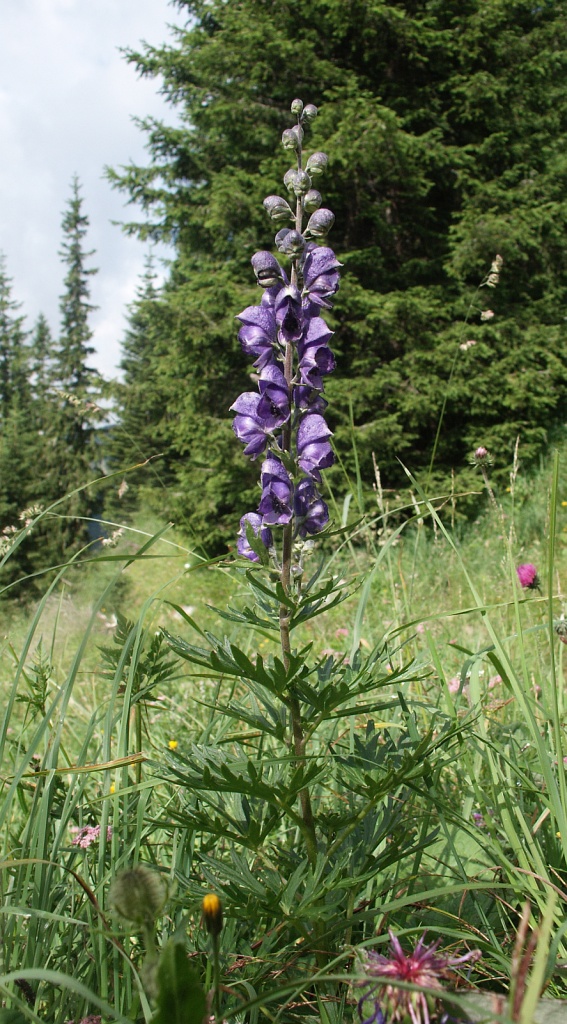 MonkshoodAconitum napellus
-
 Love-in-a-mistNigella damascena
Compare
Questions and answers
What is the scientific name of the Yellowroot?
The scientific name of the Yellowroot is Xanthorhiza simplicissima. Written with its author, the full name is Xanthorhiza simplicissima Marshall.
Which family does the Yellowroot belong to?
Xanthorhiza simplicissima belongs to the family Ranunculaceae, in the order Ranunculales and the class Magnoliopsida.
Where is the Yellowroot found?
Checklists and occurrence records place Xanthorhiza simplicissima in 2 countries, including United States.
What other names does the Yellowroot have?
Xanthorhiza simplicissima is also known in English as Shrub Yellowroot, Shrubby Yellow-root and Brook-feather.
What is the herb Yellowroot good for?
Yellowroot roots and stems are used to produce yellow dye. Traditionally, Native American cultures prepared root tea for stomach ulcers, colds, jaundice, and sore mouth or throat, and also used it as an astringent. A Southern folk remedy made from the plant has been used for diabetes and hypertension.[20][23][24][25]
Sources
Passages the profile rests on
- The plant has spirally arranged leaves divided into five toothed leaflets. Source passage: “The leaves are spirally arranged, 10–18 centimetres (4–7 in) long, each divided into 5 toothed leaflets” — English Wikipedia
- Its compound leaves resemble celery leaves and are clustered at branch ends. Source passage: “The leaves are compound, celery-like and clustered at the ends of branches” — uaex.uada.edu
- Its flowers are small, star-shaped, and reddish brown to purple brown, with five petals. Source passage: “each flower small, star-shaped, reddish brown to purple brown, with five petals.” — English Wikipedia
- The flowers grow in broad panicles measuring 6–20 centimetres long. Source passage: “The flowers are produced in broad panicles 6–20 centimetres (2–8 in) long” — English Wikipedia
- The plant has gray, smooth stems marked by prominent leaf scars. Source passage: “The gray stems are smooth on the surface, to pencil size in diameter and marked with prominent leaf scars that give them a segmented look.” — uaex.uada.edu
- New spring growth has a maroon coloration that changes to bright green during summer. Source passage: “New growth in the spring begins with a maroon cast that changes to a bright green during the summer.” — uaex.uada.edu
- Its autumn foliage can become yellowish, orangish, and brownish, particularly in brighter locations. Source passage: “In the fall a yellowish – orangish – brownish fall color can develop, especially in brighter landscape locations.” — uaex.uada.edu
- Its leaves can persist until December despite the plant being deciduous. Source passage: “Though deciduous, the leaves persist into December.” — uaex.uada.edu
- The plant typically reaches 20–70 centimetres in height and rarely reaches 90 centimetres. Source passage: “reaching 20–70 centimetres (8–28 in) (rarely 90 centimetres (35 in)) in height” — English Wikipedia
- Its stems can reach 6 millimetres in diameter. Source passage: “with stems up to 6 millimetres (0.24 in) diameter.” — English Wikipedia
- Its leaves measure 10–18 centimetres long. Source passage: “10–18 centimetres (4–7 in) long” — English Wikipedia
- Its leaflets are approximately two inches long. Source passage: “with 3 to 5 two inch long leaflets.” — uaex.uada.edu
- Its flowers measure up to a quarter-inch across. Source passage: “The star-shaped maroonish colored flowers to a quarter-inch across” — uaex.uada.edu
- In the wild, the plant grows along stream edges in sandy soil under dappled sunlight. Source passage: “In the wild, it grows on the edges of streams in sandy soil under a canopy of dappled sunlight.” — English Wikipedia
- Its preferred natural habitat includes shaded, moist streams. Source passage: “found it growing along a shaded, moist stream, its preferred natural habitat.” — uaex.uada.edu
- Its flowers emerge in early spring before the leaves develop. Source passage: “The star-shaped maroonish colored flowers to a quarter-inch across are produced at the ends of branches in open panicles in early spring before the leaves emerge.” — uaex.uada.edu
- The plant reproduces asexually by producing numerous underground runners. Source passage: “Yellowroot propagates asexually by sending out many underground runners” — English Wikipedia
- The species also reproduces sexually through seeds. Source passage: “it reproduces sexually with seeds.” — English Wikipedia
- Yellowroot is considered endangered in Florida. Source passage: “Yellowroot is considered an endangered species in Florida.” — English Wikipedia
- The plant's roots and stems are used to produce yellow dye. Source passage: “The roots and stems can be used in dye making.” — plants.ces.ncsu.edu
- The plant's yellow dye can change to olive drab when exposed to sunlight. Source passage: “The yellow dye has the unfortunate tendency of changing to olive drab when exposed to sunlight.” — uaex.uada.edu
- The plant contains berberine, a compound used in traditional and contemporary dyeing and medicinal applications. Source passage: “It contains the alkaloid berberine, which has a number of traditional and contemporary uses for dyeing and medicine.” — English Wikipedia
- Native American cultures traditionally prepared root tea for stomach ulcers, colds, jaundice, and sore mouth or throat. Source passage: “Native American cultures used the root tea for stomach ulcers, colds, jaundice, sore mouth or throat” — English Wikipedia
- The root tea was also traditionally used as an astringent. Source passage: “and as an astringent.” — English Wikipedia
- A Southern folk remedy made from the plant has been used for diabetes and hypertension. Source passage: “A folk remedy used in the South for diabetes and hypertension.” — English Wikipedia
- The plant is cultivated as an ornamental throughout Arkansas. Source passage: “but grows well as an ornamental throughout the state.” — uaex.uada.edu
- Yellowroot makes an effective deciduous groundcover. Source passage: “It makes an excellent deciduous groundcover” — uaex.uada.edu
Data
- Catalogue of Life, 2026-10-16 XR cc by
- Global Biodiversity Information Facility CC BY 4.0
- Wikidata CC0
- GeoNames CC BY 4.0
- Wikimedia Commons per image; credit shown with each image
- Within the Catalogue of Life, this name comes from Synonymic Checklists of the Vascular Plants of the World cc by
References
- Marshall. Arbust. Amer. 168 (1785). where the name was published
This species in other databases
- Catalogue of Life 7FX36
- Wikidata Q1499457
- iNaturalist 170344
- World Flora Online wfo-0001129483
- GRIN 404013
Page built on 29 November 2026. See how the catalog is made and all sources and licences.
Cite this page
ScientificNames.org. (2026). Xanthorhiza simplicissima (Yellowroot). Retrieved November 29, 2026, from https://scientificnames.org/species/xanthorhiza-simplicissima
“Xanthorhiza simplicissima (Yellowroot).” ScientificNames.org, 2026, scientificnames.org/species/xanthorhiza-simplicissima. Accessed 29 Nov. 2026.
ScientificNames.org. “Xanthorhiza simplicissima (Yellowroot).” Accessed November 29, 2026. https://scientificnames.org/species/xanthorhiza-simplicissima.
@misc{scientificnames_xanthorhiza_simplicissima_yellowroot,
  author = {{ScientificNames.org}},
  title = {Xanthorhiza simplicissima (Yellowroot)},
  year = {2026},
  url = {https://scientificnames.org/species/xanthorhiza-simplicissima},
  note = {Accessed 2026-11-29}
}