Species · Reptiles
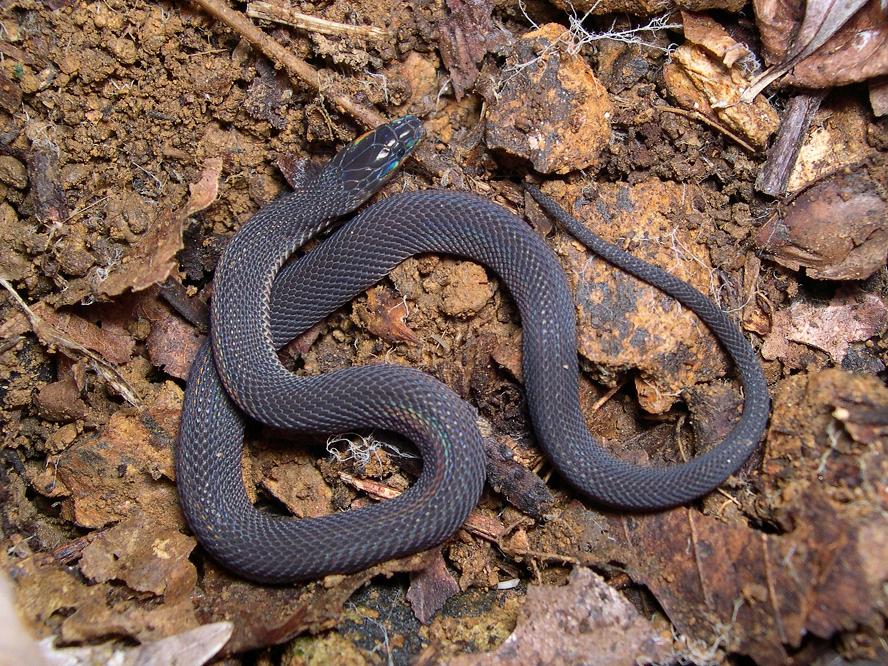
Javan Tubercle Snake Xenodermus javanicus
The scientific name of the Javan Tubercle Snake is Xenodermus javanicus. It is a species of reptile in the family Xenodermidae (xenodermid snakes), order Squamata. The name dates from 1836.
- Scientific name
- Xenodermus javanicus Reinhardt, 1836
- Common name
- Javan Tubercle Snake
- Genus
- Xenodermus
- Family
- Xenodermidae (Xenodermid Snakes)
- Order
- Squamata
- Class
- Reptilia
- Red List category
- LC Least Concern
- Recorded in
- 4 countries
- Name status
- accepted in the Catalogue of Life

Overview
Xenodermus javanicus, also known as the dragon snake, Javan tubercle snake, Javan mudsnake, or rough-backed litter snake, is a small, non-venomous, semi-fossorial snake species belonging to the monotypic genus Xenodermus. This species is best known for their characteristic dorsal scales and interesting defense mechanism in which they stiffen their entire bodies when threatened. X.
Classification of the Javan Tubercle Snake
| Kingdom | Animalia |
|---|---|
| Phylum | Chordata |
| Subphylum | Vertebrata |
| Infraphylum | Gnathostomata |
| Parvphylum | Osteichthyes |
| Megaclass | Tetrapoda |
| Class | Reptilia (Reptile) |
| Order | Squamata (Snakes) |
| Suborder | Serpentes (Snakes) |
| Infraorder | Alethinophidia |
| Family | Xenodermidae (Xenodermid Snakes) |
| Genus | Xenodermus (Dragon Snake) |
| Species | Xenodermus javanicus Reinhardt, 1836 |
Where the Javan Tubercle Snake is found
Checklists and occurrence records place Xenodermus javanicus in 4 countries across Asia. GBIF holds 213 georeferenced records of it.
Countries
Regions and cities with the most records
- Caringin, Indonesia 42
- Ciampea, Indonesia 39
- Cicurug, Indonesia 39
- Bogor, Indonesia 38
- Purwokerto, Indonesia 19
- Sabah, Malaysia 19
- Purbalingga, Indonesia 10
- Sarawak, Malaysia 9
- Sokaraja, Indonesia 9
- Cibinong, Indonesia 6
- Ungaran, Indonesia 5
- Ambarawa, Indonesia 4
- Citeureup, Indonesia 4
- Semarang, Indonesia 4
- Banyumas, Indonesia 3
- Cianjur, Indonesia 3
- Kuching, Malaysia 3
Range as the checklists state it
Burma (Myanmar),
A number beside a place is its count of GBIF occurrence records. A place without a number comes from a checklist alone. Records show where a species has been observed or collected, which can include escapes and vagrants.
Common names
English
- Javan Tubercle Snake
- Dragon Snake
- Java Tubercle Snake
- Javan Mudsnake
- Rough-backed Litter Snake
- Xenodermine Snake
Names in 7 other languages
- Chinese
- 爪哇閃皮蛇
- Dutch
- Javaanse knobbelslang
- French
- Serpent Dragon, Serpent javanais, Xenoderme de Java
- German
- Java Höckernatter, Java-Höckernatter
- Russian
- Яванская ксенодерма
- Spanish
- Serpiente Dragón
- Thai
- งูขอนท้องขาว
Synonyms
One other scientific name has been used for this species and is now treated as a synonym of Xenodermus javanicus.
- Gonionotus plumbeus Gray, 1846
Related species
-
 Peters' Odd-scaled SnakeAchalinus spinalis
-
 Formosa Odd-scaled SnakeAchalinus formosanus
-
 Amami Odd-scaled SnakeAchalinus werneri
- Borneo Red SnakeParaxenodermus borneensis
- Bourret's Odd-scaled SnakeAchalinus ater
- Black Odd-scaled SnakeAchalinus niger
-
 Zong's Odd-scaled SnakeAchalinus jinggangensis
- Hainan Odd-scaled SnakeAchalinus hainanus
Compare
Questions and answers
What is the scientific name of the Javan Tubercle Snake?
The scientific name of the Javan Tubercle Snake is Xenodermus javanicus. Written with its author, the full name is Xenodermus javanicus Reinhardt, 1836.
Which family does the Javan Tubercle Snake belong to?
Xenodermus javanicus belongs to the family Xenodermidae, in the order Squamata and the class Reptilia.
Where is the Javan Tubercle Snake found?
Checklists and occurrence records place Xenodermus javanicus in 4 countries: Indonesia, Malaysia, Thailand and Myanmar.
What is the conservation status of the Javan Tubercle Snake?
The IUCN Red List category recorded for Xenodermus javanicus is Least Concern (LC).
What other names does the Javan Tubercle Snake have?
Xenodermus javanicus is also known in English as Dragon Snake, Java Tubercle Snake, Javan Mudsnake, Rough-backed Litter Snake and Xenodermine Snake.
Sources
Data
- Catalogue of Life, 2026-10-16 XR cc by
- Global Biodiversity Information Facility CC BY 4.0
- Wikidata CC0
- English Wikipedia CC BY-SA 4.0
- GeoNames CC BY 4.0
- Wikimedia Commons per image; credit shown with each image
- Within the Catalogue of Life, this name comes from The Reptile Database cc by
References
- Reinhardt, J. T. (1836). Afhandling om Xenodermus javanicus. Oversigt over Det Kongelige Danske Videnskabernes Selskabs Forhandlinger. Kjobenhavn 3: 6-7.
- Boulenger, G. A. (1893). Catalogue of the snakes in the British Museum (Nat. Hist.) I. London (Taylor & Francis), 448 Pp.
- de Rooij, & DE, N. (1917). The Reptiles of the Indo-Australian Archipelago. Il. Ophidia. Leiden (E. J. Brill), Xiv + 334 S.
- Kopstein, F. (1938). Ein Beitrag zur Eierkunde und zur Fortpflanzung der Malaiischen Reptilien. Bull. Raffles Mus. No 14: 81-167.
- Kopstein, F. (1938). Ein Beitrag zur Morphologie, Biologie und Okologie von Xenodermus javanicus Reinhardt. Bull. Raffles Mus. No 14: 168-174.
- Smith, M. A. (1943). The Fauna of British India, Ceylon and Burma, Including the Whole of the Indo-Chinese Sub-Region. Reptilia and Amphibia. 3 (Serpentes). Taylor and Francis, London. 583 Pp.
- Taylor, E. H. (1965). The serpents of Thailand and adjacent waters. Univ. Kansas Sci. Bull. 45 (9): 609-1096.
- Tinkle, Donald W.;Gibbons, J. Whitfield. (1977). The distribution and evolution of viviparity in reptiles. Miscellaneous Publications, Museum of Zoology, University of Michigan (154): 1-55.
- Grandison, A. G. C. (1978). Snakes of West Malaysia and Singapore. Annalen Des Naturhistorischen Museums in Wien 81 [1977]: 283-303.
- Blackburn, D. G. (1993). STANDARDIZED CRITERIA FOR THE RECOGNITION OF REPRODUCTIVE MODES IN SQUAMATE REPTILES. Herpetologica 49 (1): 118-132.
- Murphy, J. C., Voris, H. K., & Karns, D. R. (1994). A field guide and key to the snakes of the Danum Valley, A bornean tropical rainforest ecosystem. Bull. Chicago Herp. Soc. 29: 133-151.
- David, P., & Vogel, G. (1996). The snakes of Sumatra. An annotated checklist and key with natural history notes. Bücher Kreth, Frankfurt/M.
- Manthey, U., & Grossmann, W. (1997). Amphibien & Reptilien Südostasiens. Natur Und Tier Verlag (Münster), 512 Pp. (ISBN 3-931587-12-6).
- Stuebing, R. B., & INGER, R. F. (1999). A field guide to the snakes of Borneo. Natural History Publications (Borneo), Kota Kinabalu, 254 Pp. [Corrections in HR 31: 124].
- TEYNIÉ, ALEXANDRE; PATRICK DAVID, & ANNEMARIE OHLER. (2010). Note on a collection of Amphibians and Reptiles from Western Sumatra (Indonesia), with the description of a new species of the genus Bufo. Zootaxa 2416: 1–43.
- Das, I. (2012). A Naturalist’s Guide to the Snakes of South-East Asia: Malaysia, Singapore, Thailand, Myanmar, Borneo, Sumatra, Java and Bali. Oxford J, Ohn Beaufoy Publishing.
- Gower, D.; Garrett, K. & Stafford, P. (2012). Snakes. Firefly Books, Buffalo, NY,144 P..
- Stuebing, R. B., Inger, R. F., & Lardner, B. (2014). A field guide to the snakes of Borneo, second edition. Natural History Publications (Borneo).
- Wallach, Van; Kenneth L. Williams, Jeff Boundy. (2014). Snakes of the World: A Catalogue of Living and Extinct Species. [type catalogue]. Taylor and Francis, CRC Press, 1237 Pp.
- Rovatsos, P. M., Martina Johnson, & Lukáš Kratochvíl. (2015). Differentiation of Sex Chromosomes and Karyotype Characterisation in the Dragonsnake Xenodermus javanicus (Squamata: Xenodermatidae). Cytogenet Genome Res., DOI: 10.1159/000441646.
- Kudryavtsev, Sergey V.; Vasyliy A. Latyshev. (2015). Xenodermus javanicus Reinhardt, 1836: Captive Husbandry and Breeding. . Russ. J. Herpetol. 22 (1): 75-78.
- Chan-ard, T., Parr, J. W. K., & Nabhitabhata, J. (2015). A field guide to the reptiles of Thailand. Oxford University Press, NY, 352 Pp. [See Book Reviews by Pauwels & Grismer 2015 and Hikida 2015 for Corrections].
- Savage, Jay M. (2015). What are the correct family names for the taxa that include the snake general Xenodermus, Pareas, and Calamaria? Herpetological Review 46 (4): 664-665.
- Lang, & Ruud de. (2017). The Snakes of Java, Bali and Surrounding Islands. Edition Chimaira, Frankfurt Am Main, Germany, 435 Pp.
- O’Shea, M. (2018). The Book of Snakes. Ivy Press / Quarto Publishing, London,.
This species in other databases
Page built on 25 November 2026. See how the catalog is made and all sources and licences.
Cite this page
ScientificNames.org. (2026). Xenodermus javanicus (Javan Tubercle Snake). Retrieved November 25, 2026, from https://scientificnames.org/species/xenodermus-javanicus
“Xenodermus javanicus (Javan Tubercle Snake).” ScientificNames.org, 2026, scientificnames.org/species/xenodermus-javanicus. Accessed 25 Nov. 2026.
ScientificNames.org. “Xenodermus javanicus (Javan Tubercle Snake).” Accessed November 25, 2026. https://scientificnames.org/species/xenodermus-javanicus.
@misc{scientificnames_xenodermus_javanicus_javan_tubercle_snake,
  author = {{ScientificNames.org}},
  title = {Xenodermus javanicus (Javan Tubercle Snake)},
  year = {2026},
  url = {https://scientificnames.org/species/xenodermus-javanicus},
  note = {Accessed 2026-11-25}
}