Species · Fishes
Swordfish Xiphias gladius
The scientific name of the Swordfish is Xiphias gladius. It is a species of fish in the family Xiphiidae (swordfish), order Carangiformes. The name dates from 1758.
- Scientific name
- Xiphias gladius Linnaeus, 1758
- Common name
- Swordfish
- Genus
- Xiphias
- Family
- Xiphiidae (Swordfish)
- Order
- Carangiformes
- Class
- Teleostei
- Red List category
- NT Near Threatened
- Environment
- marine
- Recorded in
- 49 countries
- Name status
- accepted in the Catalogue of Life
Overview
Swordfish occur throughout the Atlantic, Pacific and Indian Oceans, inhabiting tropical, subtropical and temperate marine waters. The Swordfish has a long, flattened, pointed bill resembling a sword and specialized organs near its eyes that heat its eyes and brain.
Written 24 November 2026 from the sources listed below. Each statement was checked against the passage it cites; statements that could not be supported were removed.
Appearance
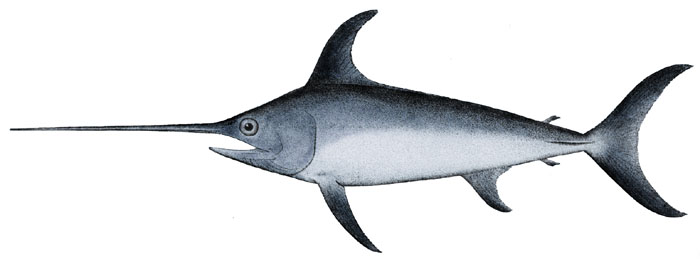
The Swordfish has a long, flattened, pointed bill resembling a sword. Adults have an elongated, cylindrical body and lose their teeth and scales.[1][2]
Adult Swordfish have dark brown to black upper coloration that fades to a lighter shade underneath. They have two dorsal fins, with the second considerably smaller than the first, lack pelvic fins and have a crescent-shaped caudal fin.[3][4][5][6]
Juvenile Swordfish possess scales that disappear when their body length reaches approximately one metre. Swordfish commonly reach approximately three metres in length, with a maximum reported length of 4.55 metres and a maximum reported weight of 682 kilograms.[7][8][9][10]
Female Swordfish grow larger than males. Pacific Swordfish attain greater sizes than northwest Atlantic and Mediterranean Swordfish.[11][12]
Swordfish possess specialized organs near their eyes that heat their eyes and brains. Their eye temperatures can be maintained 10–15°C above the surrounding water temperature.[13][14]
Habitat
Swordfish inhabit tropical, subtropical and temperate marine waters throughout the Atlantic, Pacific and Indian Oceans. Their worldwide distribution extends approximately from 50°N to 50°S.[15][16][17]
Swordfish generally inhabit waters with sea surface temperatures above 13°C but tolerate water temperatures ranging from 5°C to 27°C. They occur at depths of up to 1,136 metres during dives.[18][19][20]
Swordfish frequently concentrate around seamounts, underwater banks and oceanographic boundaries. They aggregate along thermal boundaries between cold upwelled water and warmer water masses to forage.[21][22]
Swordfish occur in the California Current Large Marine Ecosystem, where individuals from different eastern and central North Pacific regions aggregate.[23]
Diet
Swordfish feed primarily on cephalopods and also consume epipelagic and mesopelagic bony fishes. They also consume demersal fishes, squid and crustaceans.[24][25]
Swordfish consume mackerel, barracudinas, silver hake, rockfish, herring and lanternfishes. Jumbo squid and Gonatopsis borealis were the most important prey species in a California Current feeding study.[26][27]
In a northwestern Atlantic stomach-content survey, squid occurred in 82% of sampled Swordfish and fish occurred in 53%.[28]
Swordfish use their bills to incapacitate and kill prey. They swallow their food whole rather than chewing it.[29][30]
Behaviour
Swordfish are solitary swimmers or form very loose aggregations rather than schools. They frequently bask at the ocean surface during daylight and perform powerful jumps above the water surface, a behaviour also known as breaching.[31][32][33]
Swordfish undertake daily vertical migrations, diving deeper during daylight and returning to shallower waters at night. They feed daily, most frequently at night when they move into surface and near-surface waters.[34][35]
Swordfish generally migrate toward colder regions during summer to feed.[36]
Reproduction and life cycle
Swordfish reach sexual maturity at approximately four to five years of age. North Atlantic Swordfish spawning occurs in the Sargasso Sea, in water warmer than 23°C and shallower than 75 metres.[37][38][39]
Swordfish spawning occurs throughout the year in the equatorial Pacific. Female Swordfish have been recorded carrying between one million and 29 million eggs.[40][41]
Swordfish eggs are pelagic and measure approximately 1.6–1.8 millimetres in diameter. Swordfish larvae measure approximately four millimetres at hatching.[42][43]
Uses
Swordfish meat is also used as an ingredient in sashimi and sushi.[44]
Conservation
The North Atlantic Swordfish stock is considered fully rebuilt, with estimated biomass approximately five percent above its target level.[45]
Swordfish stocks in the Indian Ocean are considered of high conservation concern because overfishing is likely occurring. The Mediterranean Swordfish stock is also considered of high conservation concern because fishing mortality exceeds the recommended maximum.[46][47]
Greenpeace International added Swordfish to its seafood red list in 2010.[48]
Classification of the Swordfish
| Kingdom | Animalia |
|---|---|
| Phylum | Chordata |
| Subphylum | Vertebrata |
| Infraphylum | Gnathostomata |
| Parvphylum | Osteichthyes |
| Gigaclass | Actinopterygii |
| Superclass | Actinopteri |
| Class | Teleostei (Teleost) |
| Order | Carangiformes |
| Family | Xiphiidae (Swordfish) |
| Genus | Xiphias (Swordfishes) |
| Species | Xiphias gladius Linnaeus, 1758 |
Where the Swordfish is found
Checklists and occurrence records place Xiphias gladius in 49 countries. GBIF holds 404,216 georeferenced records of it.
Countries
- Anguilla 120
- Antigua and Barbuda 116
- Aruba 31
- Australia 12,470
- Bahamas 2,737
- Barbados 6
- Belize 15
- Bermuda 62
- Bonaire, Saint Eustatius and Saba 34
- Brazil 98
- British Virgin Islands 43
- Canada 187
- Cayman Islands 22
- Chile 277,201
- Colombia 104
- Cook Islands 1,021
- Costa Rica 35
- Cuba 6,309
- Curacao 11
- Dominica 63
- Dominican Republic 293
- Ecuador 29
- French Guiana 12
- French Polynesia 497
- Greenland 7
- Grenada 6
- Guadeloupe 49
- Guyana 45
- Haiti 623
- Honduras 9
- Jamaica 22
- Martinique 29
- Mexico 2,368
- Montserrat 9
- New Caledonia 1,167
- New Zealand 725
- Peru 23
- Puerto Rico 832
- Saint Lucia 3
- Saint Pierre and Miquelon 3
- Saint Vincent and the Grenadines 10
- Spain 510
- Suriname 83
- Trinidad and Tobago 12
- Turks and Caicos Islands 12
- U.S. Virgin Islands 1,186
- United Kingdom 312
- United States 94,244
- Venezuela 411
Regions and cities with the most records
- Sunrise, United States 1,323
- Hollywood, United States 1,162
- Fort Lauderdale, United States 1,138
- Florida, United States 1,085
- Miami Beach, United States 862
- Boca Raton, United States 402
- Delray Beach, United States 372
- West Palm Beach, United States 365
- Pompano Beach, United States 361
- Boynton Beach, United States 358
- Deerfield Beach, United States 358
- North Miami, United States 240
- Jupiter, United States 237
- Miami, United States 214
- Catalonia, Spain 171
- Antofagasta, Chile 102
- Nord-Ouest, Haiti 93
- Coconut Creek, United States 84
- Queensland, Australia 75
- Allapattah, United States 69
- Little Havana, United States 53
- Bimini, Bahamas 47
- Pembroke Pines, United States 41
- Margate, United States 39
- Scotland, United Kingdom 39
- New South Wales, Australia 38
- Lauderhill, United States 33
- Miramar, United States 32
- Cartagena, Spain 31
- Palm Beach Gardens, United States 30
- Davie, United States 26
- England, United Kingdom 26
- Carol City, United States 23
- Miami Gardens, United States 23
- Port-de-Paix, Haiti 23
- Coral Gables, United States 21
47 more countries have a few records outside this range
These countries hold a few records of Xiphias gladius but lie outside the range the checklists give for it. Such records are often zoo or garden specimens, museum material or vagrants, so the species is not counted as occurring there.
- Albania 15
- Algeria 8
- American Samoa 207
- Austria 5
- Belgium 8
- Benin 10
- Cabo Verde 18
- China 8
- Croatia 155
- Denmark 17
- Estonia 3
- Faroe Islands 25
- Fiji 3
- France 109
- French Southern Territories 20
- Germany 17
- Greece 14
- Iceland 7
- India 13
- Indonesia 26
- Ireland 20
- Israel 4
- Italy 115
- Ivory Coast 4
- Japan 17
- Mauritius 3
- Mayotte 7
- Montenegro 4
- Morocco 11
- Norfolk Island 205
- Norway 73
- Papua New Guinea 33
- Philippines 11
- Portugal 85
- Reunion 5
- Senegal 3
- Seychelles 6
- Singapore 7
- South Africa 44
- Sri Lanka 5
- Svalbard and Jan Mayen 17
- Sweden 30
- Taiwan 8
- The Netherlands 41
- Tonga 243
- Turkey 100
- Western Sahara 9
A number beside a place is its count of GBIF occurrence records. A place without a number comes from a checklist alone. Records show where a species has been observed or collected, which can include escapes and vagrants.
Common names
English
- Swordfish
- Atlantic Swordfish
- Broadbill Swordfish
- Pirapucu
- Shutome
- Broadbill
- Swordfish Sucker
Names in 55 other languages
- Afrikaans
- Swaardvis
- Arabic
- Sangusu, أبو سيف, ﻒﻴﺳﻮﺑﺃ
- Asturian
- pexe espada
- Basque
- ezpata-arrain
- Catalan
- emperador, peix espasa
- Chinese
- 劍旗魚
- Croatian
- Iglun
- Czech
- mečoun obecný
- Danish
- Sværdfisk, svaerdfisk
- Dutch
- Zwaardvfisch, zwaardvis
- Estonian
- mõõkkala
- Faroese
- Svørðfiskur
- Fijian
- saku vorowaqa
- Finnish
- miekkakala
- French
- Espadron, Poisson Porte-épée, Poisson épée, espadon
- Galician
- peixe espada
- German
- Schwertfisch
- Greek
- Ξιφίας, Ξιφιός
- Hawaiian
- A'u, A'u ku
- Hebrew
- דג החרב
- Hungarian
- Kardhal
- Icelandic
- sverðfiskur
- Italian
- Pegador, Pesce sorzo, Pesse petene, Pisci signuri, Pisci spata, Spada rossa, Spadopsaro, Sparaganaci
- Japanese
- Dakuda, Medara, Meka, Mekajiki, メカジキ
- Korean
- 황새치
- Latvian
- Zobenzivs
- Lithuanian
- durklažuvė
- Maltese
- Sovento
- Marathi
- तदमासा
- Māori
- Paea
- Norwegian
- sverdfisk
- Norwegian Bokmål
- sverdfisk
- Norwegian Nynorsk
- sverdfisk
- Papiamento
- Balao, Balau tonini
- Polish
- miecznik, ryba miecz, wlócznik, włócznik
- Portuguese
- Aguilhão, Agulhao, Agulhão, Espadarte-maca, Espadarte-meca, Espadão, Pirapicu, agulha
- Romanian
- Pește spadă
- Russian
- mech-ryba, Меч-рыба, сабленка, саблянка
- Scottish Gaelic
- colgán
- Slovenian
- Meèarica, mečarica
- Spanish
- Aja para, Albacora, Chichi spada, Espada, Espardarte, pez espada
- Swedish
- svärdfisk
- Telugu
- కట్టిచెపుా
- Thai
- ปลากระโทงแทงดาบ
- Turkish
- kilic baligi, kılıç balığı
- Ukrainian
- Риба-меч, Риба-меч звичайна, меч-риба
- Welsh
- Pysgod Cleddyf, pysgodyn cleddyf
- bik
- Dugso
- cos
- Pesciu spada
- ewe
- Hatalikofi
- hil
- Malasugi, Sibingan
- mah
- Lokjan
- mic
- kinisku'nej
- pau
- Meluis
- tvl
- Te sakula
Synonyms
12 other scientific names have been used for this species and are now treated as synonyms of Xiphias gladius.
- Phaethonichthys tuberculatus Nichols, 1923
- Tetrapterus imperator (Bloch & Schneider, 1801)
- Tetrapturus imperator (Bloch & Schneider, 1801)
- Xiphasia gladius (Linnaeus, 1758)
- Xiphias estara Phillipps, 1932
- Xiphias gladius estara Phillipps, 1932
- Xiphias imperator Bloch & Schneider, 1801
- Xiphias kleinii Suckow, 1799
- Xiphias rondeletii Leach, 1814
- Xiphias rondeletti Leach, 1814
- Xiphias thermaicus Serbetis, 1951
- Xyphias gladius Linnaeus, 1758
Questions and answers
What is the scientific name of the Swordfish?
The scientific name of the Swordfish is Xiphias gladius. Written with its author, the full name is Xiphias gladius Linnaeus, 1758.
Which family does the Swordfish belong to?
Xiphias gladius belongs to the family Xiphiidae, in the order Carangiformes and the class Teleostei.
Where is the Swordfish found?
Checklists and occurrence records place Xiphias gladius in 49 countries, including Chile, United States, Australia, Cuba, Bahamas and Mexico.
What is the conservation status of the Swordfish?
The IUCN Red List category recorded for Xiphias gladius is Near Threatened (NT).
What other names does the Swordfish have?
Xiphias gladius is also known in English as Atlantic Swordfish, Broadbill Swordfish, Pirapucu, Shutome, Broadbill and Swordfish Sucker.
What habitat do swordfish live in?
Swordfish inhabit tropical, subtropical and temperate marine waters throughout the Atlantic, Pacific and Indian Oceans. They generally inhabit waters with sea surface temperatures above 13°C, tolerate temperatures ranging from 5°C to 27°C and occur at depths of up to 1,136 metres during dives.[15][18][19][20][16]
Sources
Passages the profile rests on
- The swordfish has a long, flattened, pointed bill resembling a sword. Source passage: “characterized by a long, flat, sword-like, pointed bill.” — English Wikipedia
- The adult swordfish has an elongated, cylindrical body and loses its teeth and scales. Source passage: “Swordfish are elongated, round-bodied, and lose all teeth and scales by adulthood.” — English Wikipedia
- Adult swordfish have dark brown to black upper coloration that fades to a lighter shade underneath. Source passage: “It is a dark brown black above, fading to a lighter shade underneath” — floridamuseum.ufl.edu
- The swordfish has two dorsal fins, with the second considerably smaller than the first. Source passage: “Two dorsal fins are present, although the second is quite small, separated from the first, and set far back on the body.” — floridamuseum.ufl.edu
- The swordfish lacks pelvic fins. Source passage: “Pelvic fins are absent.” — floridamuseum.ufl.edu
- The swordfish has a crescent-shaped caudal fin. Source passage: “The caudal fin is lunate” — floridamuseum.ufl.edu
- Juvenile swordfish possess scales that disappear when their body length reaches approximately one metre. Source passage: “While the young have scales, these are lost by the time the fish attain a body length of about 3 feet (1 m).” — floridamuseum.ufl.edu
- Swordfish commonly reach approximately three metres in length. Source passage: “They commonly reach 3 m (10 ft) in length” — English Wikipedia
- The maximum reported swordfish length is 4.55 metres. Source passage: “the maximum reported is 4.55 m (14 ft 11 in) in length” — English Wikipedia
- A maximum reported swordfish weight is 682 kilograms. Source passage: “682 kg (1,500 lb) in weight.” — English Wikipedia
- Female swordfish grow larger than males. Source passage: “Females are larger than males” — English Wikipedia
- Pacific swordfish attain greater sizes than northwest Atlantic and Mediterranean swordfish. Source passage: “Pacific swordfish reach a greater size than northwest Atlantic and Mediterranean swordfish.” — English Wikipedia
- Swordfish possess specialized organs near their eyes that heat their eyes and brains. Source passage: “they have special organs next to their eyes called heater cells which function to heat their eyes and brains.” — English Wikipedia
- Swordfish eye temperatures can be maintained 10–15°C above the surrounding water temperature. Source passage: “Their eyes are heated to temperatures measured between 10 and 15 °C above the surrounding water temperature” — English Wikipedia
- Swordfish inhabit tropical, subtropical and temperate marine waters. Source passage: “occur worldwide in tropical, subtropical and temperate waters from around 50°N to 50°S” — pmc.ncbi.nlm.nih.gov
- Swordfish occur throughout the Atlantic, Pacific and Indian Oceans. Source passage: “These fish are found widely in tropical and temperate parts of the Atlantic, Pacific, and Indian Oceans” — English Wikipedia
- Swordfish have a worldwide distribution extending approximately from 50°N to 50°S. Source passage: “occur worldwide in tropical, subtropical and temperate waters from around 50°N to 50°S” — pmc.ncbi.nlm.nih.gov
- Swordfish generally inhabit waters with sea surface temperatures above 13°C. Source passage: “they are generally found in areas with sea surface temperatures (SST) above 13°C.” — pmc.ncbi.nlm.nih.gov
- Swordfish tolerate water temperatures ranging from 5°C to 27°C. Source passage: “Swordfish are well adapted for survival in a wide range of water temperatures from 5°C to 27°C” — pmc.ncbi.nlm.nih.gov
- Swordfish occur at depths of up to 1,136 metres during dives. Source passage: “During dives, swordfish can reach depths of up to 1136 m” — pmc.ncbi.nlm.nih.gov
- Swordfish frequently concentrate around seamounts, underwater banks and oceanographic boundaries. Source passage: “Swordfish tend to concentrate near underwater features, like seamounts and banks, and near oceanographic boundaries” — pmc.ncbi.nlm.nih.gov
- Swordfish aggregate along thermal boundaries between cold upwelled water and warmer water masses to forage. Source passage: “Swordfish aggregate along these productive thermal boundaries between cold upwelled water and warmer water masses to forage” — pmc.ncbi.nlm.nih.gov
- Swordfish occur in the California Current Large Marine Ecosystem, where individuals from different eastern and central North Pacific regions aggregate. Source passage: “Southern California is a foraging ground within the CCLME where swordfish from various regions of the eastern and central north Pacific aggregate.” — pmc.ncbi.nlm.nih.gov
- Swordfish feed primarily on cephalopods and also consume epipelagic and mesopelagic bony fishes. Source passage: “Diet consisted mainly of cephalopods but also included epipelagic and mesopelagic teleosts.” — pmc.ncbi.nlm.nih.gov
- Swordfish also consume demersal fishes, squid and crustaceans. Source passage: “They also take demersal fish, squid, and crustaceans.” — English Wikipedia
- Jumbo squid and Gonatopsis borealis were the most important prey species in a California Current feeding study. Source passage: “Jumbo squid (Dosidicus gigas) and Gonatopsis borealis were the most important prey based on the geometric index of importance.” — pmc.ncbi.nlm.nih.gov
- Swordfish consume mackerel, barracudinas, silver hake, rockfish, herring and lanternfishes. Source passage: “such as mackerel, barracudinas, silver hake, rockfish, herring, and lanternfishes.” — English Wikipedia
- In a northwestern Atlantic stomach-content survey, squid occurred in 82% of sampled swordfish and fish occurred in 53%. Source passage: “82% had eaten squid and 53% had eaten fish” — English Wikipedia
- Swordfish use their bills to incapacitate and kill prey. Source passage: “They use their large bill to incapacitate and kill prey” — pmc.ncbi.nlm.nih.gov
- Swordfish swallow their food whole rather than chewing it. Source passage: “swordfish lack teeth and ingest their food whole” — pmc.ncbi.nlm.nih.gov
- Swordfish are solitary swimmers or form very loose aggregations rather than schools. Source passage: “Swordfish are not schooling fish. They swim alone or in very loose aggregations” — English Wikipedia
- Swordfish frequently bask at the ocean surface during daylight. Source passage: “They are frequently found basking at the surface, airing their first dorsal fin.” — English Wikipedia
- Swordfish perform powerful jumps above the water surface, a behaviour also known as breaching. Source passage: “This jumping, also called breaching” — English Wikipedia
- Swordfish undertake daily vertical migrations, diving deeper during daylight and returning to shallower waters at night. Source passage: “Swordfish display diurnal vertical migration, diving below the deep scattering layer by day and returning to shallower depths by night.” — pmc.ncbi.nlm.nih.gov
- Swordfish feed daily, most frequently at night when they move into surface and near-surface waters. Source passage: “Swordfish feed daily, most often at night, when they rise to surface and near-surface waters in search of smaller fish.” — English Wikipedia
- Swordfish generally migrate toward colder regions during summer to feed. Source passage: “This highly migratory species typically moves towards colder regions to feed during the summer.” — English Wikipedia
- Swordfish reach sexual maturity at approximately four to five years of age. Source passage: “They reach maturity at 4–5 years of age” — English Wikipedia
- North Atlantic swordfish spawning occurs in the Sargasso Sea. Source passage: “In the North Atlantic, spawning is known from the Sargasso Sea” — English Wikipedia
- Swordfish spawning in the North Atlantic occurs in water warmer than 23°C and shallower than 75 metres. Source passage: “in water warmer than 23 °C (73 °F) and less than 75 m (246 ft; 41 fathoms) deep.” — English Wikipedia
- Swordfish spawning occurs throughout the year in the equatorial Pacific. Source passage: “year-round in the equatorial Pacific.” — English Wikipedia
- Female swordfish have been recorded carrying between one million and 29 million eggs. Source passage: “between 1 million and 29 million eggs have been recorded.” — English Wikipedia
- Swordfish eggs are pelagic and measure approximately 1.6–1.8 millimetres in diameter. Source passage: “The pelagic eggs measure 1.6–1.8 mm (1⁄16–5⁄64 in) in diameter” — English Wikipedia
- Swordfish larvae measure approximately four millimetres at hatching. Source passage: “The surface-living and unique-looking larvae are 4 mm (5⁄32 in) long at hatching.” — English Wikipedia
- Swordfish meat is used as an ingredient in sashimi and sushi. Source passage: “high-quality swordfish is valued as an ingredient in sashimi or sushi.” — floridamuseum.ufl.edu
- The North Atlantic swordfish stock is considered fully rebuilt, with estimated biomass approximately five percent above its target level. Source passage: “In the North Atlantic, the swordfish stock is fully rebuilt, with biomass estimates currently 5% above the target level.” — English Wikipedia
- Swordfish stocks in the Indian Ocean are considered of high conservation concern because overfishing is likely occurring. Source passage: “Overfishing is likely occurring in the Indian Ocean” — English Wikipedia
- The Mediterranean swordfish stock is considered of high conservation concern because fishing mortality exceeds the recommended maximum. Source passage: “fishing mortality exceeds the maximum recommended level in the Mediterranean, thus these stocks are considered of high conservation concern.” — English Wikipedia
- Greenpeace International added swordfish to its seafood red list in 2010. Source passage: “In 2010, Greenpeace International added the swordfish to its seafood red list.” — English Wikipedia
Data
- Catalogue of Life, 2026-10-16 XR cc by
- Global Biodiversity Information Facility CC BY 4.0
- Wikidata CC0
- GeoNames CC BY 4.0
- Wikimedia Commons per image; credit shown with each image
- Within the Catalogue of Life, this name comes from World Register of Marine Species cc by
References
- Linnaeus, C. (1758). Systema Naturae per regna tria naturae, secundum classes, ordines, genera, species, cum characteribus, differentiis, synonymis, locis. Tomus I. Editio decima, reformata. Laurentii Salvii. Holmiae [Stockholm]. [iii] + 824 pp. https://doi.org/10.5962/bhl.title.542 Link where the name was published
This species in other databases
- Catalogue of Life 7G9C4
- Wikidata Q164327
- iNaturalist 115167
- WoRMS urn:lsid:marinespecies.org:taxname:127094
- ITIS 172482
Page built on 24 November 2026. See how the catalog is made and all sources and licences.
Cite this page
ScientificNames.org. (2026). Xiphias gladius (Swordfish). Retrieved November 24, 2026, from https://scientificnames.org/species/xiphias-gladius
“Xiphias gladius (Swordfish).” ScientificNames.org, 2026, scientificnames.org/species/xiphias-gladius. Accessed 24 Nov. 2026.
ScientificNames.org. “Xiphias gladius (Swordfish).” Accessed November 24, 2026. https://scientificnames.org/species/xiphias-gladius.
@misc{scientificnames_xiphias_gladius_swordfish,
  author = {{ScientificNames.org}},
  title = {Xiphias gladius (Swordfish)},
  year = {2026},
  url = {https://scientificnames.org/species/xiphias-gladius},
  note = {Accessed 2026-11-24}
}