Species · Birds
Cuban Green Woodpecker Xiphidiopicus percussus
The scientific name of the Cuban Green Woodpecker is Xiphidiopicus percussus. It is a species of bird in the family Picidae (woodpecker), order Piciformes. The name dates from 1826.
- Scientific name
- Xiphidiopicus percussus (Temminck, 1826)
- Common name
- Cuban Green Woodpecker
- Genus
- Xiphidiopicus
- Family
- Picidae (Woodpecker)
- Order
- Piciformes
- Class
- Aves
- Red List category
- LC Least Concern
- Recorded in
- 1 country
- Name status
- accepted in the Catalogue of Life

Overview
The species is endemic to Cuba. It is the only species in the genus Xiphidiopicus and one of two woodpeckers endemic to Cuba.
Written 26 November 2026 from the sources listed below. Each statement was checked against the passage it cites; statements that could not be supported were removed.
Appearance
The Cuban Green Woodpecker has olive-green upperparts and yellow, streaked underparts. It usually has a crest, a bright red upper breast, and a black chin contrasting with its white face and supercilium.[1][2]
Adult males have a red crown, whereas females have black crowns with white stripes. Its yellow crissum has black barring.[3][4]
Its bill is short, straight, and darkens from blue to black toward the tip. The species has brown irises and grayish-green tarsi and toes.[5][6]
Females have shorter bills and are significantly smaller than males. Juveniles have more breast barring and streaking and less intense plumage coloration than adults.[7][8]
The Cuban Green Woodpecker measures 21–25 cm in length and weighs approximately 48–97 g.[9][10]
Habitat
The Cuban Green Woodpecker inhabits wet and dry forests, mangroves, open woodlands with palms, and pine forests. It also occurs in lowland moist forests and heavily degraded former forests.[11][12]
Diet
The Cuban Green Woodpecker primarily eats large insects. It occasionally consumes fruits and small frogs.[13][14]
The species has been documented eating eggs of other birds, including herons nesting in mangroves. It also feeds on flower nectar, particularly from Cordia sebestena.[15][16]
Behaviour
The Cuban Green Woodpecker is most frequently observed in pairs and less frequently in small groups. It can remain completely still for extended periods.[17][18]
The species searches for dead insects on dead branches at any height within its habitat. It is particularly territorial during the breeding season.[19][20]
The species defends its nest against intruders through drumming, vocal signals, and active pursuit. During pursuit of threats, it flicks its wings.[21][22]
The species has an undulating flight pattern. It produces a short, harsh call described as jhhhorr, jhhhorr, jhhhorr, and a higher-pitched call described as yeh-yeh-yeh.[23][24][25]
The species sometimes produces a slurred two-note call resembling that of the yellow-bellied sapsucker. It primarily uses its calls to protect its nest and chicks from intruders.[26][27]
Reproduction and life cycle
The Cuban Green Woodpecker nests in cavities excavated in living or dead trees. Nest cavities are often located 4–5 metres above the ground, and males usually perform most of the nest-hole excavation.[28][29][30]
The breeding season extends from February through August, with peak activity in May and June. Females lay three to four white eggs per clutch.[31][32]
Both parents participate in incubating the eggs, and the incubation period is presumed to last 9–14 days. Both parents feed the chicks, with females feeding nestlings more frequently.[33][34][35]
The chicks hatch completely naked and remain in the nest for approximately three to four weeks. The species reaches sexual maturity during its first year of life.[36][37][38]
Conservation
The Cuban Green Woodpecker has a stable population and is classified as Least Concern.[39][40]
Classification of the Cuban Green Woodpecker
| Kingdom | Animalia |
|---|---|
| Phylum | Chordata |
| Subphylum | Vertebrata |
| Infraphylum | Gnathostomata |
| Parvphylum | Osteichthyes |
| Megaclass | Tetrapoda |
| Class | Aves (Bird) |
| Order | Piciformes (Woodpeckers) |
| Family | Picidae (Woodpecker) |
| Subfamily | Picinae |
| Genus | Xiphidiopicus (Cuban Green Woodpecker) |
| Species | Xiphidiopicus percussus (Temminck, 1826) |
Where the Cuban Green Woodpecker is found
Checklists and occurrence records place Xiphidiopicus percussus in 1 country across North America. GBIF holds 11,993 georeferenced records of it.
Countries
Regions and cities with the most records
- Matanzas Province, Cuba 2,688
- Pinar del Río, Cuba 2,612
- Ciego de Ávila Province, Cuba 1,384
- San Cristobal, Cuba 880
- Artemisa, Cuba 840
- Villa Clara Province, Cuba 686
- Guanabacoa, Cuba 668
- Fontanar, Cuba 647
- Arroyo Naranjo, Cuba 645
- Santiago de las Vegas, Cuba 641
- Viñales, Cuba 638
- San Miguel del Padrón, Cuba 634
- Regla, Cuba 633
- Havana, Cuba 625
- Cojímar, Cuba 615
- Bejucal, Cuba 567
- Holguín Province, Cuba 564
- La Salud, Cuba 474
- Cienfuegos Province, Cuba 466
- Guantánamo Province, Cuba 462
- Camagüey, Cuba 438
- San José de las Lajas, Cuba 436
- Consolación del Sur, Cuba 406
- Los Palacios, Cuba 394
- Jagüey Grande, Cuba 356
- Sancti Spíritus Province, Cuba 333
- Trinidad, Cuba 323
- Las Tunas Province, Cuba 314
- Santiago de Cuba Province, Cuba 304
- Cienfuegos, Cuba 296
- Bauta, Cuba 291
- Bahía Honda, Cuba 273
- Granma Province, Cuba 259
- Palmira, Cuba 242
- Minas de Matahambre, Cuba 231
- Jobabo, Cuba 221
Range as the checklists state it
Caribbean
A number beside a place is its count of GBIF occurrence records. A place without a number comes from a checklist alone. Records show where a species has been observed or collected, which can include escapes and vagrants.
Common names
English
- Cuban Green Woodpecker
Names in 26 other languages
- Arabic
- نقار الخشب الكوبي الأخضر
- Catalan
- picot arlequí
- Chinese
- 古巴綠啄木, 古巴绿啄木鸟
- Croatian
- kubanski djetlić
- Czech
- datel kubánský
- Danish
- Cubagrønspætte
- Dutch
- Cubaanse Groene Specht
- Esperanto
- kuba pego
- Estonian
- viherrähn
- Finnish
- kuubanvihertikka
- French
- Pic poignardé
- German
- Blutfleckspecht, Gelbspecht
- Italian
- Picchio di Cuba, Picchio verde di Cuba
- Japanese
- キューバアオゲラ
- Lithuanian
- žalsvasis genys
- Norwegian
- kubaspett
- Polish
- kubańczyk, oskomik zielony
- Portuguese
- pica-pau-verde-cubano
- Russian
- Кубинский дятел, Кубинский зелёный дятел
- Serbian
- Kubanski zeleni detlić
- Slovak
- tesárik zelený
- Spanish
- Carpintero Verde, Carpintero tajá
- Swedish
- Kubansk grönspett
- Turkish
- Küba Ağaçkakanı
- Ukrainian
- дятел кубинський
- Welsh
- cnocell werdd Ciwba
Synonyms
2 other scientific names have been used for this species and are now treated as synonyms of Xiphidiopicus percussus.
- Picus percussus Temminck, CJ, 1826
- Xyphidiopicus percussus Temminck, CJ, 1826
Subspecies and varieties
- Xiphidiopicus percussus insulaepinorum subspecies
- Xiphidiopicus percussus percussus subspecies
Related species
- Northern FlickerColaptes auratus
-
 Pileated WoodpeckerDryocopus pileatus
-
 Ivory-billed WoodpeckerCampephilus principalis
-
 Downy WoodpeckerDryobates pubescens
-
 Red-bellied WoodpeckerMelanerpes carolinus
-
 Great Spotted WoodpeckerDendrocopos major
-
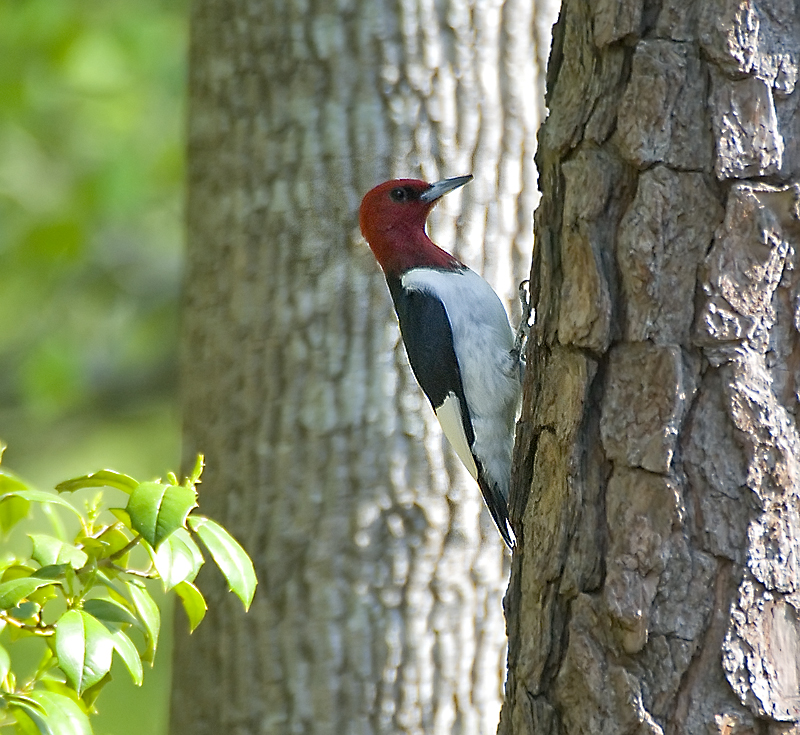 Red-headed WoodpeckerMelanerpes erythrocephalus
-
 Hairy WoodpeckerLeuconotopicus villosus
Compare
Questions and answers
What is the scientific name of the Cuban Green Woodpecker?
The scientific name of the Cuban Green Woodpecker is Xiphidiopicus percussus. Written with its author, the full name is Xiphidiopicus percussus (Temminck, 1826).
Which family does the Cuban Green Woodpecker belong to?
Xiphidiopicus percussus belongs to the family Picidae, in the order Piciformes and the class Aves.
Where is the Cuban Green Woodpecker found?
Checklists and occurrence records place Xiphidiopicus percussus in 1 country: Cuba.
What is the conservation status of the Cuban Green Woodpecker?
The IUCN Red List category recorded for Xiphidiopicus percussus is Least Concern (LC).
What type of diet does a woodpecker have?
The Cuban Green Woodpecker primarily eats large insects. It occasionally consumes fruits and small frogs, bird eggs, and flower nectar, particularly from Cordia sebestena.[13][14][15][16]
What type of habitat do woodpeckers live in?
The Cuban Green Woodpecker inhabits wet and dry forests, mangroves, open woodlands with palms, pine forests, lowland moist forests, and heavily degraded former forests.[11][12]
Where does the green woodpecker live?
The Cuban Green Woodpecker is endemic to Cuba. The subspecies X. p. insulaepinorum occurs in the Cantiles Keys, Isla de la Juventud, and Cayo Caballones in the Archipiélago Jardines de la Reina, while X. p. percussus occurs in the Sabana and Camagüey archipelagos.[41][42][43]
Sources
Passages the profile rests on
- The Cuban green woodpecker has olive-green upperparts and yellow, streaked underparts. Source passage: “Featuring olive green overparts and yellow, streaked underparts” — English Wikipedia
- The species usually has a crest, a bright red upper breast, and a black chin contrasting with its white face and supercilium. Source passage: “usually appears crested, and features a bright red upper breast, as well as a black chin contrasting a white face and supercilium.” — English Wikipedia
- Adult males have a red crown, whereas females have black crowns with white stripes. Source passage: “In males, a red crown is present, while females possess black crowns with white stripes.” — English Wikipedia
- Its yellow crissum has black barring. Source passage: “The area around the cloaca, or the crissum, is yellow with black barring.” — English Wikipedia
- Its bill is short, straight, and darkens from blue to black toward the tip. Source passage: “Its beak is short and straight with a progressively darkening coloration, from dark blue to black from base to tip” — English Wikipedia
- The species has brown irises and grayish-green tarsi and toes. Source passage: “They have been shown to have brown irises and grayish green tarsi and toes” — English Wikipedia
- Females have shorter bills and are significantly smaller than males. Source passage: “females have shorter bills and are generally significantly smaller than their male counterparts.” — English Wikipedia
- Juveniles have more breast barring and streaking and less intense plumage coloration than adults. Source passage: “Juveniles will show more barring and streaking on their breasts and lack the depth of color adults have in their plumage.” — English Wikipedia
- The Cuban green woodpecker measures 21–25 cm in length. Source passage: “They typically measure between 21 and 25 cm (8.3 and 9.8 in) in length” — English Wikipedia
- The species weighs approximately 48–97 g. Source passage: “weigh approximately 48 to 97 g (1.7 to 3.4 oz).” — English Wikipedia
- The species inhabits wet and dry forests, mangroves, open woodlands with palms, and pine forests. Source passage: “Its natural habitats are wet and dry forests, mangroves, open woodland with palms, and pine forests” — English Wikipedia
- The species also occurs in lowland moist forests and heavily degraded former forests. Source passage: “lowland moist forests, and heavily degraded former forest.” — English Wikipedia
- The Cuban green woodpecker primarily eats large insects. Source passage: “is primarily an insectivore, focusing on large insects” — English Wikipedia
- The species occasionally consumes fruits and small frogs. Source passage: “but will also consume fruits and small frogs occasionally.” — English Wikipedia
- The species has been documented eating eggs of other birds, including herons nesting in mangroves. Source passage: “It has also been documented taking eggs of other birds such as herons nesting in mangroves.” — English Wikipedia
- The species feeds on flower nectar, particularly from Cordia sebestena. Source passage: “It will also feed on flower nectar, especially Cordia sebestena.” — English Wikipedia
- The Cuban green woodpecker is most frequently observed in pairs and less frequently in small groups. Source passage: “The Cuban green woodpecker is found most frequently in pairs, and less frequently in small groups.” — English Wikipedia
- The species can remain completely still for extended periods. Source passage: “It is able to remain completely still for long periods” — English Wikipedia
- The species searches for dead insects on dead branches at any height within its habitat. Source passage: “will forage for dead insects on dead limbs at any height within its habitat.” — English Wikipedia
- The species is particularly territorial during the breeding season. Source passage: “They are very territorial, especially during breeding season” — English Wikipedia
- The species defends its nest against intruders through drumming, vocal signals, and active pursuit. Source passage: “use active vocalization, utilizing both drumming and vocal signals, and active pursuit” — English Wikipedia
- During pursuit of threats, the species flicks its wings. Source passage: “pursuing threats while flicking their wings” — English Wikipedia
- The species has an undulating flight pattern. Source passage: “Similarly to all other woodpeckers, its flight is undulating.” — English Wikipedia
- The species produces a short, harsh call described as jhhhorr, jhhhorr, jhhhorr. Source passage: “The Cuban green woodpecker's call is a short, harsh "jhhhorr, jhhhorr, jhhhorr,"” — English Wikipedia
- The species also produces a higher-pitched call described as yeh-yeh-yeh. Source passage: “as well as a higher pitched "yeh-yeh-yeh."” — English Wikipedia
- The species sometimes produces a slurred two-note call resembling that of the yellow-bellied sapsucker. Source passage: “It may sometimes produce a slurred, two-note call "ta-ha", which is similar to the Yellow-bellied Sapsucker” — English Wikipedia
- The species primarily uses its calls to protect its nest and chicks from intruders. Source passage: “It will use its call mostly while protecting nest and chicks from intruder.” — English Wikipedia
- The species nests in cavities excavated in living or dead trees. Source passage: “Cuban green woodpeckers will nest in the cavities of tree, alive or dead” — English Wikipedia
- Its nest cavities are often located 4–5 metres above the ground. Source passage: “often 4–5 metres above the ground.” — English Wikipedia
- Males usually perform most of the nest-hole excavation. Source passage: “The male will usually do most of the excavation for the nest-hole” — English Wikipedia
- The breeding season extends from February through August, with peak activity in May and June. Source passage: “The breeding season takes place between February and August, with peak in May–June” — English Wikipedia
- Females lay three to four white eggs per clutch. Source passage: “The female will lay 3–4 white eggs” — English Wikipedia
- Both parents participate in incubating the eggs. Source passage: “both adults share the incubation” — English Wikipedia
- The incubation period is presumed to last 9–14 days. Source passage: “which is presumed to be between 9 and 14 days” — English Wikipedia
- Both parents feed the chicks, with females feeding nestlings more frequently. Source passage: “and feed the chicks, with the females feeding the nestlings at a higher rate.” — English Wikipedia
- The chicks hatch completely naked. Source passage: “The chicks are hatched completely naked” — English Wikipedia
- The chicks remain in the nest for approximately three to four weeks. Source passage: “stay in the nest for about 3–4 weeks.” — English Wikipedia
- The species reaches sexual maturity during its first year of life. Source passage: “They are sexually mature in the first year of life.” — English Wikipedia
- The Cuban green woodpecker has a stable population. Source passage: “The population of the Cuban green woodpecker is stable” — English Wikipedia
- The species is classified as Least Concern. Source passage: “its status is listed as "Least Concern".” — English Wikipedia
- The Cuban green woodpecker is endemic to Cuba. Source passage: “The Cuban green woodpecker is only found in Cuba” — English Wikipedia
- The subspecies X. p. insulaepinorum occurs in the Cantiles Keys, Isla de la Juventud, and Cayo Caballones in the Archipiélago Jardines de la Reina. Source passage: “X. p. insulaepinorum - found in the Cantiles Keys, Isla de la Juventud and Archipiélago Jardines de la Reina (Cayo Caballones)” — English Wikipedia
- The subspecies X. p. percussus occurs in the Sabana and Camagüey archipelagos. Source passage: “X. p. percussus - found on the archipelagos of Sabana and Camagüey” — English Wikipedia
Data
- Catalogue of Life, 2026-10-16 XR cc by
- Global Biodiversity Information Facility CC BY 4.0
- Wikidata CC0
- GeoNames CC BY 4.0
- Wikimedia Commons per image; credit shown with each image
- Within the Catalogue of Life, this name comes from The Integrated Taxonomic Information System cc0
References
- Gill, Frank, & and Minturn Wright. (2006). Birds of the World: Recommended English Names.
This species in other databases
Page built on 28 November 2026. See how the catalog is made and all sources and licences.
Cite this page
ScientificNames.org. (2026). Xiphidiopicus percussus (Cuban Green Woodpecker). Retrieved November 28, 2026, from https://scientificnames.org/species/xiphidiopicus-percussus
“Xiphidiopicus percussus (Cuban Green Woodpecker).” ScientificNames.org, 2026, scientificnames.org/species/xiphidiopicus-percussus. Accessed 28 Nov. 2026.
ScientificNames.org. “Xiphidiopicus percussus (Cuban Green Woodpecker).” Accessed November 28, 2026. https://scientificnames.org/species/xiphidiopicus-percussus.
@misc{scientificnames_xiphidiopicus_percussus_cuban_green_woodpecker,
  author = {{ScientificNames.org}},
  title = {Xiphidiopicus percussus (Cuban Green Woodpecker)},
  year = {2026},
  url = {https://scientificnames.org/species/xiphidiopicus-percussus},
  note = {Accessed 2026-11-28}
}