Species · Flowering plants
Xylopia quintasii
Xylopia quintasii has no English name on record in the checklists used here. It is a species of flowering plant in the family Annonaceae (pawpaw family), order Magnoliales.
- Scientific name
- Xylopia quintasii Pierre ex Engl. & Diels
- Genus
- Xylopia
- Family
- Annonaceae (Pawpaw Family)
- Order
- Magnoliales
- Class
- Magnoliopsida
- Red List category
- LC Least Concern
- Recorded in
- 15 countries
- Name status
- accepted in the Catalogue of Life
Overview
Xylopia quintasii Pierre ex Engl. & Diels is an evergreen flowering tree in the family Annonaceae, order Magnoliales, and class Magnoliopsida. It occurs in evergreen forests, deciduous forests, and coastal thickets. It produces six star-shaped flowers and grows to a height of 20–25 metres.
Written 27 November 2026 from the sources listed below. Each statement was checked against the passage it cites; statements that could not be supported were removed.
Appearance
Xylopia quintasii is an evergreen tree with oblanceolate, petiolate leaves. It produces six star-shaped flowers.[1][2]
The tree grows to a height of 20–25 metres.[3]
Habitat
Xylopia quintasii occurs in evergreen forests, deciduous forests, and coastal thickets.[4]
It is native to west and west-central tropical Africa, with a range extending from Senegal to the Democratic Republic of the Congo.[5]
Uses
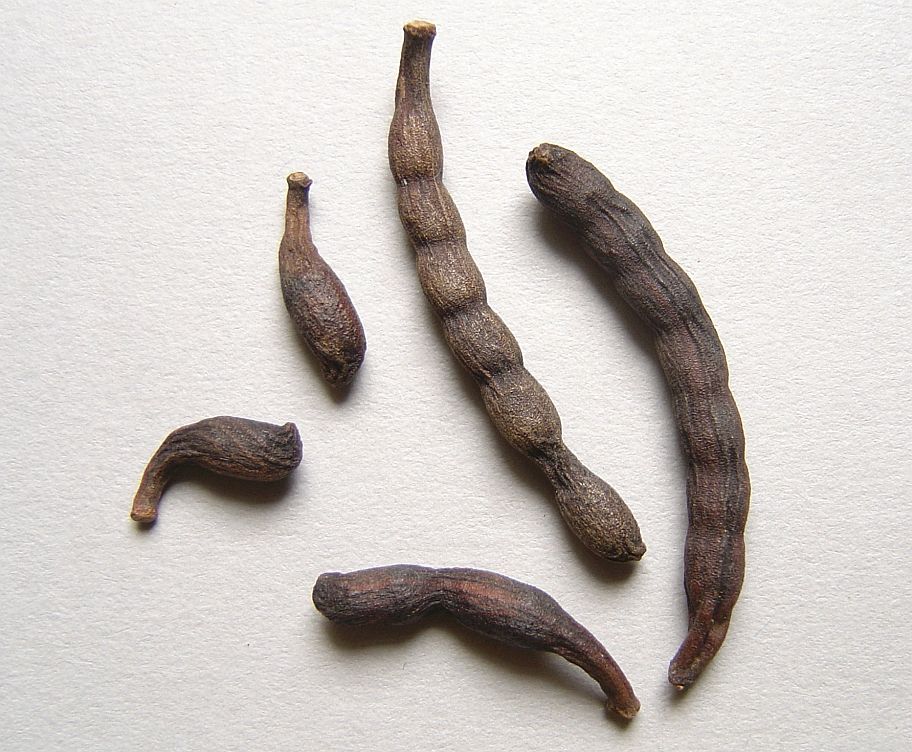
Xylopia quintasii is generally used locally rather than being widely traded internationally. It is sometimes used as an ingredient in Grains of Selim and is also used for smoking.[6][7][8]
Its wood is used to construct house posts, poles, and planks. It is also used to make bowls, plates, weapons, tools, and toys.[9][10]
Various parts of Xylopia quintasii are used in traditional medicine. The bark is used to treat bronchitis and pneumonia, while the inner bark is used to treat swellings. A lotion made from the bark is used to treat headaches.[11][12][13][14]
Classification of Xylopia quintasii
| Kingdom | Plantae |
|---|---|
| Subkingdom | Pteridobiotina |
| Phylum | Tracheophyta |
| Class | Magnoliopsida |
| Order | Magnoliales |
| Family | Annonaceae (Pawpaw Family) |
| Subfamily | Annonoideae |
| Tribe | Xylopieae |
| Genus | Xylopia |
| Species | Xylopia quintasii Pierre ex Engl. & Diels |
Where Xylopia quintasii is found
Checklists and occurrence records place Xylopia quintasii in 15 countries across Africa. GBIF holds 1,500 georeferenced records of it.
Countries
- Angola 28
- Cameroon 250
- Central African Republic 6
- Democratic Republic of the Congo 10
- Equatorial Guinea 13
- Gabon 608
- Gambia
- Ghana 74
- Guinea 59
- Ivory Coast 154
- Liberia 80
- Nigeria 64
- Sao Tome and Principe 124
- Senegal 5
- Sierra Leone 25
Regions and cities with the most records
- Estuaire, Gabon 133
- Príncipe, Sao Tome and Principe 113
- South, Cameroon 85
- Ogooué-Ivindo, Gabon 78
- Woleu-Ntem, Gabon 66
- Moyen-Ogooué, Gabon 61
- Nzérékoré Region, Guinea 55
- Abidjan, Ivory Coast 44
- Abobo, Ivory Coast 44
- Eastern, Ghana 44
- Koumassi, Ivory Coast 44
- Marcory, Ivory Coast 44
- Ogooué-Maritime, Gabon 44
- Bingerville, Ivory Coast 43
- Anyama, Ivory Coast 42
- Ébolowa, Cameroon 40
- Montagnes, Ivory Coast 37
- East, Cameroon 28
- Bas-Sassandra District, Ivory Coast 27
- Centre, Cameroon 27
- Akwatia, Ghana 23
- Asamankese, Ghana 16
- Kribi, Cameroon 15
- Para, Ivory Coast 15
- Petit Grabo, Ivory Coast 15
- Haut-Ogooué, Gabon 14
- Lofa County, Liberia 14
- Nyanga, Gabon 14
- Littoral, Cameroon 13
- Lola, Guinea 13
- Oyam, Gabon 13
- South-West, Cameroon 12
- Mouila, Gabon 11
- New Yekepa, Liberia 11
- Loum, Cameroon 8
- Manjo, Cameroon 8
Range as the checklists state it
Gambia; Sierra Leone; Liberia; Ivory Coast; Ghana; Nigeria; Cameroon; Bioko Isl. [Fernando Poo]; São Tomé; Equatorial Guinea; Gabon; Congo [Brazzaville]; SW-Central African Republic; Cabinda; D. R. Congo [Zaire]
A number beside a place is its count of GBIF occurrence records. A place without a number comes from a checklist alone. Records show where a species has been observed or collected, which can include escapes and vagrants.
Synonyms
3 other scientific names have been used for this species and are now treated as synonyms of Xylopia quintasii.
- Polyalthia mayumbensis Exell
- Xylopia lane-poolei Sprague & Hutch.
- Xylopia striata Engl.
Related species
-
 Ethiopian PepperXylopia aethiopica
-
 Xylopia aromatica
-
 Xylopia polyantha
-
 PimientilloXylopia frutescens
-
 Xylopia emarginata
-
 Xylopia brasiliensis
-
 Xylopia discreta
-
 Xylopia africana
Compare
Sources
Passages the profile rests on
- Xylopia quintasii is an evergreen tree with oblanceolate, petiolate leaves. Source passage: “Xylopia quintasii, commonly known as Elo, is a species of evergreen tree, in the family Annonaceae that grows 20-25 metres tall. Xylopia quintasii can tolerate temperatures above at least 1°C. Its leaves are oblanceolate and petiolate.” — English Wikipedia
- Xylopia quintasii produces six star-shaped flowers. Source passage: “Xylopia quintasii produces six star-shaped flowers.” — English Wikipedia
- Xylopia quintasii grows to a height of 20–25 metres. Source passage: “grows 20-25 metres tall.” — English Wikipedia
- Xylopia quintasii occurs in evergreen forests, deciduous forests, and coastal thickets. Source passage: “Xylopia quintasii is commonly found in evergreen and deciduous forests and coastal thickets.” — English Wikipedia
- Xylopia quintasii is native to west and west-central tropical Africa, with a range extending from Senegal to the Democratic Republic of the Congo. Source passage: “Xylopia quintasii is native to west and west-central tropical Africa, ranging from Senegal to Democratic Republic of the Congo.” — English Wikipedia
- Xylopia quintasii is generally used locally rather than being widely traded internationally. Source passage: “Xylopia quintasii is not commonly sold on the international market and is usually only used for local purposes.” — English Wikipedia
- Xylopia quintasii is sometimes used as an ingredient in Grains of Selim. Source passage: “It is sometimes used in Grains of Selim and is smoked.” — English Wikipedia
- Xylopia quintasii is used for smoking. Source passage: “It is sometimes used in Grains of Selim and is smoked.” — English Wikipedia
- The wood of Xylopia quintasii is used to construct house posts, poles, and planks. Source passage: “The wood of Xylopia quintasii is used for house building in posts, poles, and planks.” — English Wikipedia
- The wood of Xylopia quintasii is also used to make bowls, plates, weapons, tools, and toys. Source passage: “It can also have other uses like bowls, plates, weapons, tools, toys, etc.” — English Wikipedia
- Various parts of Xylopia quintasii are used in traditional medicine. Source passage: “Many parts of Xylopia quintasii are used in traditional medicine.” — English Wikipedia
- The bark of Xylopia quintasii is used traditionally to treat bronchitis and pneumonia. Source passage: “The bark is used to treat illnesses like bronchitis and pneumonia.” — English Wikipedia
- The inner bark of Xylopia quintasii is used traditionally to treat swellings. Source passage: “The inner bark is used to treat swellings.” — English Wikipedia
- A lotion made from the bark of Xylopia quintasii is used traditionally to treat headaches. Source passage: “A lotion can be prepared from the bark to treat headaches.” — English Wikipedia
Data
- Catalogue of Life, 2026-10-16 XR cc by
- Global Biodiversity Information Facility CC BY 4.0
- Wikidata CC0
- GeoNames CC BY 4.0
- Within the Catalogue of Life, this name comes from Synonymic Checklists of the Vascular Plants of the World cc by
References
- Pierre ex Engl. & Diels. (1901). Monogr. Afrik. Pflanzen-Fam. 6: 62 (1901). where the name was published
This species in other databases
- Catalogue of Life 5CM73
- Wikidata Q15367478
- iNaturalist 1119107
- World Flora Online wfo-0000428692
- GRIN 463431
Page built on 28 November 2026. See how the catalog is made and all sources and licences.
Cite this page
ScientificNames.org. (2026). Xylopia quintasii. Retrieved November 28, 2026, from https://scientificnames.org/species/xylopia-quintasii
“Xylopia quintasii.” ScientificNames.org, 2026, scientificnames.org/species/xylopia-quintasii. Accessed 28 Nov. 2026.
ScientificNames.org. “Xylopia quintasii.” Accessed November 28, 2026. https://scientificnames.org/species/xylopia-quintasii.
@misc{scientificnames_xylopia_quintasii,
  author = {{ScientificNames.org}},
  title = {Xylopia quintasii},
  year = {2026},
  url = {https://scientificnames.org/species/xylopia-quintasii},
  note = {Accessed 2026-11-28}
}