Species · Spiders and other arachnids
Swamp Crab Spider Xysticus ulmi
The scientific name of the Swamp Crab Spider is Xysticus ulmi. It is a species of arachnid in the family Thomisidae (crab spiders), order Araneae. The name dates from 1831.
- Scientific name
- Xysticus ulmi (Hahn, 1831)
- Common name
- Swamp Crab Spider
- Genus
- Xysticus
- Family
- Thomisidae (Crab Spiders)
- Order
- Araneae
- Class
- Arachnida
- Recorded in
- 29 countries
- Name status
- accepted in the Catalogue of Life
Overview
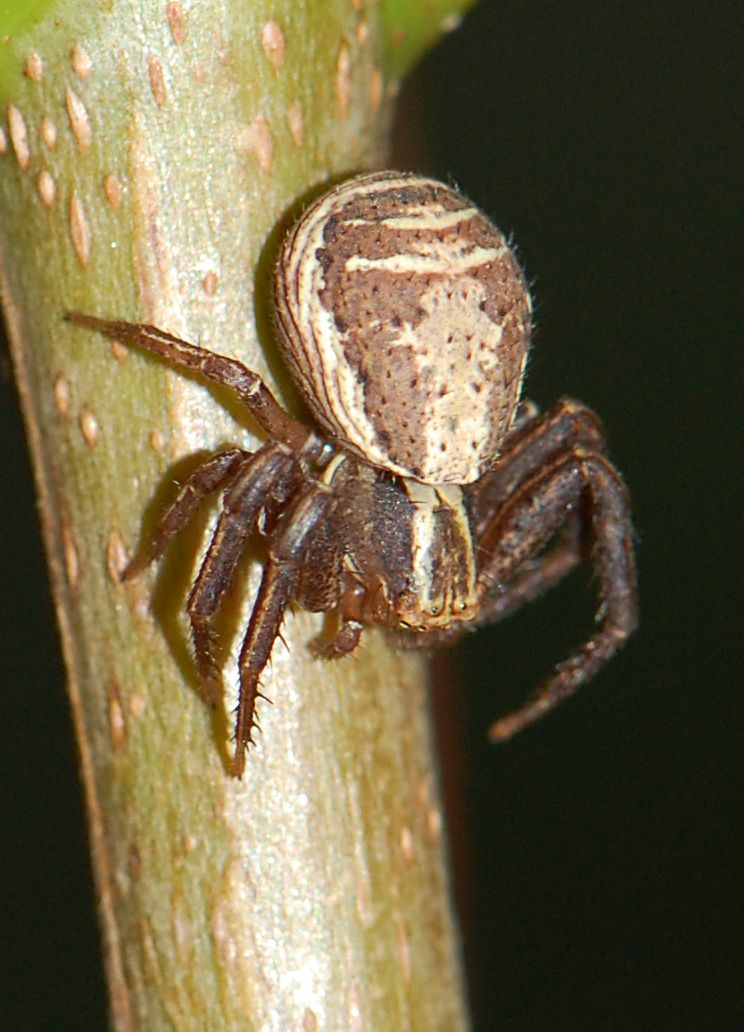
Xysticus ulmi has a Palearctic distribution and occurs throughout Europe but is absent from Iceland. It has a more elongated carapace triangle and abdomen than other spiders in the genus Xysticus, with a brownish dorsal folium pattern and whitish transverse lines near the posterior.
Written 26 November 2026 from the sources listed below. Each statement was checked against the passage it cites; statements that could not be supported were removed.
Appearance
The Swamp Crab Spider has a more elongated carapace triangle and abdomen than other spiders in the genus Xysticus. Its dorsal folium pattern is brownish, with whitish transverse lines near the posterior, and its legs have fine spots.[1][2][3]
Males are darker than females and have black patellae and femora on their first and second pairs of legs. Male body length ranges from 3 to 4 mm.[4][5]
Habitat
The Swamp Crab Spider prefers damp habitats and is usually found on low vegetation and at ground level in damp places, particularly wetlands and rough grassland. It can also inhabit ditches beside arable fields, hedges and roadside verges.[6][7][8][9]
The species occurs in woodland, particularly where the canopy is not closed, such as in coppiced woodland. In Europe, it occurs from lowland areas to alpine regions.[10][11]
Diet
The Swamp Crab Spider hunts by ambushing invertebrate prey.[12]
Behaviour
Spiderlings are often found in leaf litter at the base of vegetation. Adults usually occur in herbage.[13][14]
The species hunts by ambushing invertebrate prey.[12]
Reproduction and life cycle
Females guard their egg sacs, which are usually placed near the tips of taller plants.[15]
During mating, males stroke females' legs and then restrain them with silk.[16]
Classification of the Swamp Crab Spider
| Kingdom | Animalia |
|---|---|
| Phylum | Arthropoda |
| Subphylum | Chelicerata |
| Class | Arachnida (Arachnid) |
| Order | Araneae (Spider) |
| Family | Thomisidae (Crab Spiders) |
| Genus | Xysticus (Ground Crab Spiders) |
| Species | Xysticus ulmi (Hahn, 1831) |
Where the Swamp Crab Spider is found
Checklists and occurrence records place Xysticus ulmi in 29 countries across Asia and Europe. GBIF holds 12,003 georeferenced records of it.
Countries
- Aland Islands 7
- Austria 188
- Belarus 48
- Belgium 498
- China
- Croatia 6
- Czechia 56
- Denmark 613
- Estonia 50
- Finland 664
- France 2,325
- Germany 991
- Hungary 47
- Italy 21
- Latvia 3
- Lithuania 55
- Luxembourg 24
- Norway 325
- Poland 634
- Romania 6
- Russia 1,154
- Slovakia 11
- Spain 10
- Sweden 2,029
- Switzerland 241
- The Netherlands 1,217
- Turkey
- Ukraine 179
- United Kingdom 601
Regions and cities with the most records
- England, United Kingdom 548
- Hauts-de-France, France 517
- Île-de-France, France 498
- Occitanie, France 346
- Skåne, Sweden 256
- Centre-Val de Loire, France 243
- Västra Götaland, Sweden 231
- Uppsala, Sweden 199
- South Denmark, Denmark 187
- Maarssen, The Netherlands 182
- Weesp, The Netherlands 181
- Moscow Oblast, Russia 177
- Hilversum, The Netherlands 169
- Bussum, The Netherlands 167
- Naarden, The Netherlands 167
- Amstelveen, The Netherlands 165
- Pays de la Loire, France 163
- North Rhine-Westphalia, Germany 158
- Overijssel, The Netherlands 157
- Gelderland, The Netherlands 153
- Hesse, Germany 146
- De Meern, The Netherlands 140
- Soest, The Netherlands 139
- Baarn, The Netherlands 138
- Huizen, The Netherlands 137
- Mijdrecht, The Netherlands 137
- Stockholm, Sweden 130
- Woerden, The Netherlands 130
- Best, The Netherlands 129
- Utrecht, The Netherlands 129
- Amsterdam, The Netherlands 128
- Diemen, The Netherlands 128
- Steenwijk, The Netherlands 128
- Central Jutland, Denmark 127
- Bilthoven, The Netherlands 126
- Baden-Wurttemberg, Germany 125
Range as the checklists state it
Europe, Turkey, Caucasus, Russia (Europe to Middle and South Siberia), Central Asia, China
Sweden, Poland
Britain
A number beside a place is its count of GBIF occurrence records. A place without a number comes from a checklist alone. Records show where a species has been observed or collected, which can include escapes and vagrants.
Common names
English
- Swamp Crab Spider
Names in 12 other languages
- Czech
- běžník mokřadní
- Danish
- Sumpkrabbeedderkop
- Dutch
- Moeraskrabspin
- Finnish
- suoravukki
- German
- Sumpfkrabbenspinne
- Hungarian
- cserje-karolópók
- Lithuanian
- Guobinis krabvoris
- Norwegian Bokmål
- dråpekrabbeedderkopp
- Polish
- Bokochód pospolity
- Russian
- Ксистикус вязовый
- Slovak
- behárik brestový
- Swedish
- kärrkrabbspindel
Synonyms
6 other scientific names have been used for this species and are now treated as synonyms of Xysticus ulmi.
- Thomisus bivittatus Westring, 1861
- Thomisus ulmi Hahn, 1831
- Thomisus westwoodii O. Pickard-Cambridge, 1871
- Xysticus bivittatus (Westring, 1861)
- Xysticus bivittatus Menge, 1876
- Xysticus westwoodi (O. Pickard-Cambridge, 1871)
Related species
-
 Common Crab SpiderXysticus cristatus
-
 Sad Ground Crab SpiderXysticus funestus
-
 Tan Crab SpiderXysticus ferox
-
 Xysticus audax
-
 Elegant Crab SpiderXysticus elegans
-
 Xysticus luctuosus
- Xysticus urbensis
- Xysticus discursans
Compare
Questions and answers
What is the scientific name of the Swamp Crab Spider?
The scientific name of the Swamp Crab Spider is Xysticus ulmi. Written with its author, the full name is Xysticus ulmi (Hahn, 1831).
Which family does the Swamp Crab Spider belong to?
Xysticus ulmi belongs to the family Thomisidae, in the order Araneae and the class Arachnida.
Where is the Swamp Crab Spider found?
Checklists and occurrence records place Xysticus ulmi in 29 countries, including France, Sweden, The Netherlands, Russia, Germany and Finland.
What does a crab spider eat?
The Swamp Crab Spider eats invertebrate prey, which it hunts by ambushing.[12]
What food does a spider eat?
The Swamp Crab Spider feeds on invertebrate prey.[12]
Sources
Passages the profile rests on
- The species has a more elongated carapace triangle and abdomen than other spiders in the genus Xysticus. Source passage: “The triangle on the carapace and the abdomen are much more elongated in Xysticus ulmi compared to the other Xysticus spiders.” — English Wikipedia
- Its dorsal folium pattern is brownish and has whitish transverse lines near the posterior. Source passage: “The leaf-like pattern (the folium) on the dorsum is brownish with some whitish transverse lines towards the posterior.” — English Wikipedia
- Its legs have fine spots. Source passage: “The legs are marked with fine spots.” — English Wikipedia
- Males are darker than females, with black patellae and femora on their first and second pairs of legs. Source passage: “males are darker than females and the patella and femora of the first and second legs are black.” — English Wikipedia
- Male body length ranges from 3 to 4 mm. Source passage: “Males have a body length male of 3–4 mm” — English Wikipedia
- The species prefers damp habitats. Source passage: “which prefers damp habitats.” — English Wikipedia
- It is usually found on low vegetation and at ground level in damp places, particularly wetlands and rough grassland. Source passage: “usually found on low vegetation and in the ground layer in damp places, especially in wetlands and rough grassland” — English Wikipedia
- It can also inhabit ditches beside arable fields. Source passage: “it can also occur in ditches alongside arable fields” — English Wikipedia
- Hedges and roadside verges are also recorded habitats. Source passage: “ditches alongside arable fields, hedges, roadside verges” — English Wikipedia
- The species occurs in woodland, particularly in areas where the canopy is not closed, such as coppiced woodland. Source passage: “woodland especially where the canopy is not closed, such as coppiced areas.” — English Wikipedia
- In Europe, it occurs from lowland areas to alpine regions. Source passage: “In Europe it is found from the lowlands up to alpine regions.” — English Wikipedia
- The species hunts by ambushing invertebrate prey. Source passage: “Like other members of the genus it is an ambush predator, lying in wait for invertebrate prey.” — English Wikipedia
- Spiderlings are often found in leaf litter at the base of vegetation. Source passage: “Spiderlings are often found in the litter at the base of vegetation” — English Wikipedia
- Adults usually occur in herbage. Source passage: “while adults usually occur in herbage.” — English Wikipedia
- Females guard their egg sacs, which are usually placed near the tips of taller plants. Source passage: “Females guard their egg-sacs, usually near the tip of higher plants.” — English Wikipedia
- Males stroke females' legs and then restrain them with silk before mating. Source passage: “The males subdue the females by stroking their legs then tie them down with silk before mating.” — English Wikipedia
Data
- Catalogue of Life, 2026-10-16 XR cc by
- Global Biodiversity Information Facility CC BY 4.0
- Wikidata CC0
- GeoNames CC BY 4.0
- Wikimedia Commons per image; credit shown with each image
- Within the Catalogue of Life, this name comes from The World Spider Catalog cc by
References
- Hahn, C. W. (1831b). Monographie der Spinnen. Heft 6. Lechner, Nürnberg, 1 p., 4 pls. doi: <a href="https://doi.org/10.5962/bhl.title.122225" target="_blank">10.5962/bhl.title.122225 Link where the name was published
This species in other databases
Page built on 28 November 2026. See how the catalog is made and all sources and licences.
Cite this page
ScientificNames.org. (2026). Xysticus ulmi (Swamp Crab Spider). Retrieved November 28, 2026, from https://scientificnames.org/species/xysticus-ulmi
“Xysticus ulmi (Swamp Crab Spider).” ScientificNames.org, 2026, scientificnames.org/species/xysticus-ulmi. Accessed 28 Nov. 2026.
ScientificNames.org. “Xysticus ulmi (Swamp Crab Spider).” Accessed November 28, 2026. https://scientificnames.org/species/xysticus-ulmi.
@misc{scientificnames_xysticus_ulmi_swamp_crab_spider,
  author = {{ScientificNames.org}},
  title = {Xysticus ulmi (Swamp Crab Spider)},
  year = {2026},
  url = {https://scientificnames.org/species/xysticus-ulmi},
  note = {Accessed 2026-11-28}
}